Custom AI Learnings

Your Standards, Enforced to Your Codes

With Custom AI Review Rules, you control file-patterns, coding norms, and compliance thresholds, automated in every PR so you ship code that always matches your bar.

CodeAnt scans every PR for security risks — injection, config, or API — and suggests fixes using real-time SAST.

CodeAnt scans every PR for security risks — injection, config, or API — and suggests fixes using real-time SAST.

Trusted by Enterprises

AI Learning-Driven Quality Insights for Every PR

Custom Review Instructions

Save project-specific rules directly inside the PR for consistent reviews.

Apply instructions to specific files or paths for precise enforcement.
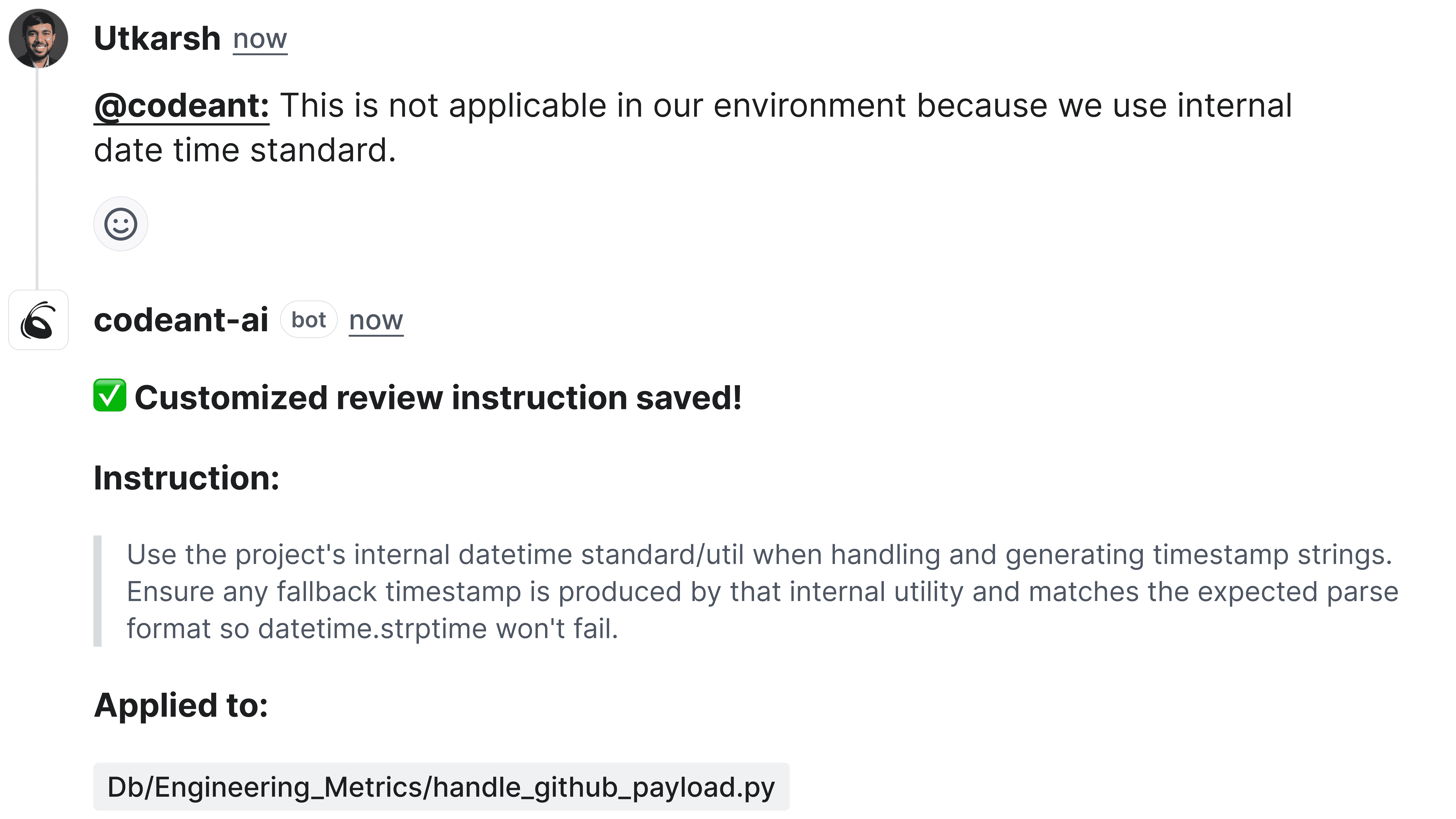
PR interface showing a customized review instruction being saved, including project-specific timestamp formatting guidance and the file path it applies to.

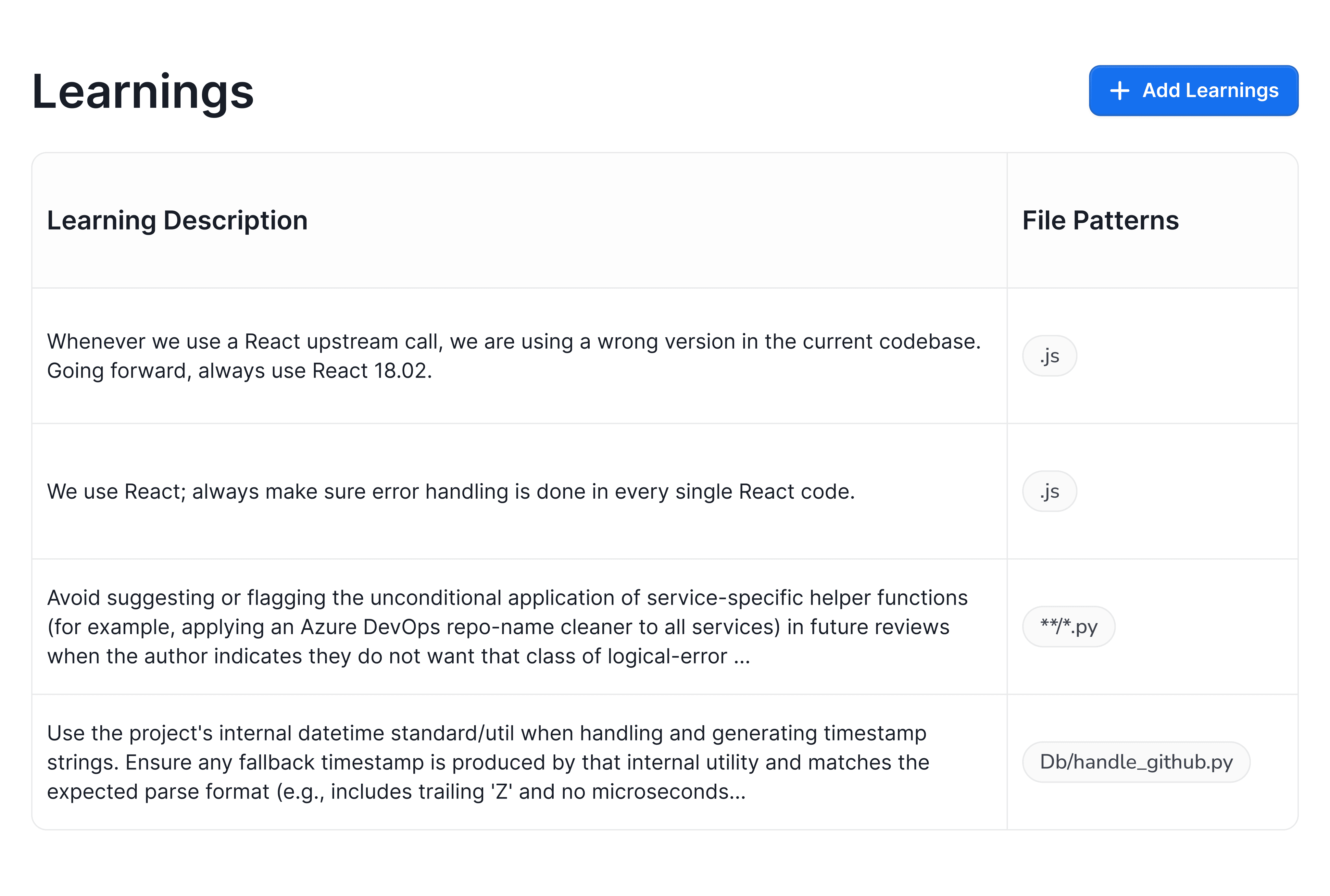
Manage Learnings

Edit or delete any learning created on a repository.

Admins have full control to update and manage learnings.
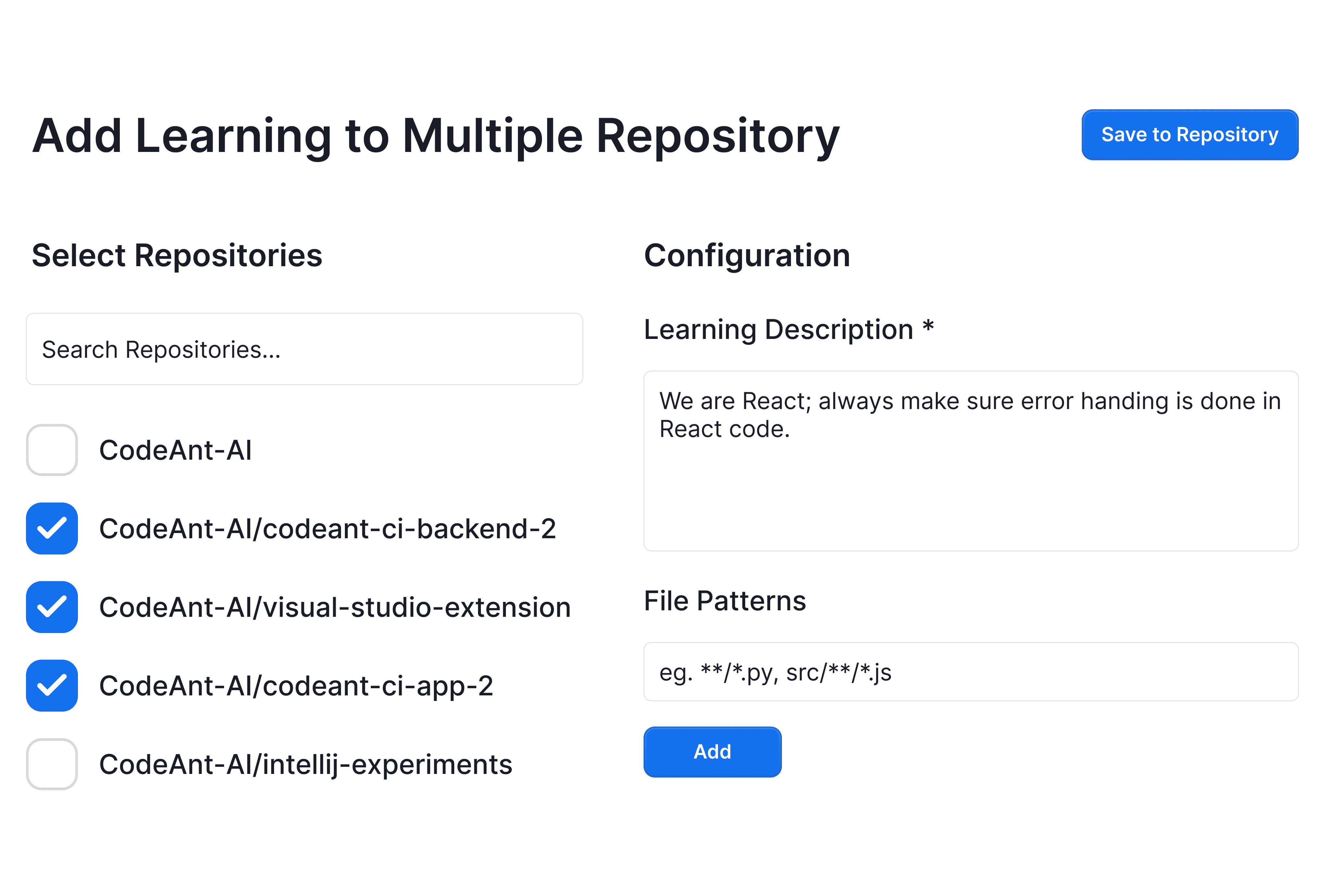
CodeAnt AI provides option to configureAI learning across multiple repositories, including repo selection, learning description, and file pattern setup.”

Learning Across Repositories

Apply a single learning rule to multiple repositories instantly.

Target specific files, folders, or patterns for precise control.
CodeAnt AI allows users to create, edit, and save custom AI learning rules for specific repositories, files, or folders.

Why Best Teams Love CodeAnt AI
NASDAQ:CVLT ($8 Billion Market Cap)

How CodeAnt’s Code Health Platform Powers Commvault’s 800+ Developers

Enterprise-grade security

HIPAA Compliant - CodeAnt AI
SOC2 Type II Compliant - CodeAnt AI

No code storage

Zero data retention

1M+ PRs/month

Handles effortlessly

200M+

Lines of Code Scanned
Git Integrations
Bitbucket Integration - CodeAnt AI
Gitlab Integration - CodeAnt AI
Azure Devops Integration - CodeAnt AI
Github Integration - CodeAnt AI
NASDAQ:CVLT ($8 Billion Market Cap)

How CodeAnt’s Code Health Platform Powers Commvault’s 800+ Developers

Enterprise-grade security

HIPAA Compliant - CodeAnt AI
SOC2 Type II Compliant - CodeAnt AI

No code storage

Zero data retention

1M+ PRs/month

Handles effortlessly

200M+

Lines of Code Scanned
Git Integrations
Bitbucket Integration - CodeAnt AI
Gitlab Integration - CodeAnt AI
Azure Devops Integration - CodeAnt AI
Github Integration - CodeAnt AI
NASDAQ:CVLT ($8 Billion Market Cap)

How CodeAnt’s Code Health Platform Powers Commvault’s 800+ Developers

Enterprise-grade security

HIPAA Compliant - CodeAnt AI
SOC2 Type II Compliant - CodeAnt AI

No code storage

Zero data retention

1M+ PRs/month

Handles effortlessly

200M+

Lines of Code Scanned
Git Integrations
Bitbucket Integration - CodeAnt AI
Gitlab Integration - CodeAnt AI
Azure Devops Integration - CodeAnt AI
Github Integration - CodeAnt AI

Turn Pull Request Reviews Into Insights

Turn Pull Request Reviews Into Insights

Turn Pull Request Reviews Into Insights

FAQs

How granular can custom rules get?

How granular can custom rules get?

How granular can custom rules get?

How does rule evolution work?

How does rule evolution work?

How does rule evolution work?

How are rules enforced in CI/CD?

How are rules enforced in CI/CD?

How are rules enforced in CI/CD?

Does defining many custom rules hurt performance?

Does defining many custom rules hurt performance?

Does defining many custom rules hurt performance?

Is there support for compliance frameworks via custom rules?

Is there support for compliance frameworks via custom rules?
Is there support for compliance frameworks via custom rules?