Code Quality
Top 7 SonarQube Alternatives for Static Code Analysis in 2026

Sonali Sood

Founding GTM, CodeAnt AI
SonarQube has been the default choice for static code analysis for years, but “default” doesn’t mean “best fit.” Teams outgrow it. Infrastructure overhead piles up. Security gaps appear. And suddenly you’re managing three tools instead of one.
The alternatives have caught up, and in some cases, pulled ahead. AI-powered code reviews, unified security scanning, and SaaS delivery now come standard. This guide breaks down 7 SonarQube alternatives worth evaluating in 2026, with direct comparisons to help you find the right match for your team’s priorities.
What is SonarQube?
SonarQube is an open-source platform for continuous code quality inspection. It scans source code without executing it, a process called static analysis, to find bugs, security vulnerabilities, and code smells across 30+ programming languages.
Most teams run SonarQube as a self-hosted server connected to their CI/CD pipelines. When developers push code, SonarQube analyzes it and flags issues through quality gates that can block merges if standards aren’t met. The platform offers a free Community Edition, though enterprise features like branch analysis require paid tiers.
Why Teams Look for SonarQube Alternatives?
The best SonarQube alternatives typically offer real-time feedback, AI-powered automation, and deeper security scanning integrated directly into developer workflows. Which tool fits best depends on whether your priority is code quality, security testing, CI/CD integration, or developer experience.
So why are teams actively searching for something different? Here are the common pain points.
Self-Hosting Complexity and Infrastructure Overhead
Running SonarQube means managing servers, handling updates, and scaling infrastructure as your codebase grows. For cloud-native teams, this overhead feels increasingly outdated.
Database maintenance, memory tuning, and high availability all take time away from shipping features. Many SaaS alternatives eliminate this burden entirely.
Limited AI-Powered Code Review Capabilities
SonarQube relies on rule-based static analysis. It checks code against predefined patterns but doesn’t understand context the way modern AI tools do.
You won’t get intelligent suggestions, auto-fixes, or PR summaries. The feedback tells you what’s wrong without explaining how to fix it.
Security Gaps in SAST and Secrets Detection
While SonarQube includes Static Application Security Testing (SAST), which scans source code for vulnerabilities, its coverage is narrower than dedicated security tools. Secrets detection and dependency scanning require additional configuration or separate tools.
Teams handling sensitive data often end up bolting on CodeAnt AI, Snyk, Gitleaks, or other scanners, adding complexity and context-switching.
High Costs at Enterprise Scale
SonarQube’s enterprise licensing can become expensive quickly. Pricing based on lines of code creates unpredictable costs as your codebase expands.
For organizations with 100+ developers, the math often favors alternatives with per-user or flat-rate pricing models.
Fragmented Tooling Across Security and Quality
Here’s a common scenario: SonarQube for quality, Snyk for dependencies, a separate SAST tool for security, and yet another dashboard for metrics. Each tool has its own interface, alert system, and learning curve.
Unified platforms reduce this friction by combining security, quality, and review capabilities in one place.
Key Criteria for Evaluating SonarQube Competitors
Before diving into specific tools, it helps to establish what matters most. Use the following criteria to match alternatives to your team’s actual priorities.
Static Analysis Depth and Language Coverage
Modern codebases are polyglot, Java backend, TypeScript frontend, Python scripts, Terraform infrastructure. Your static analysis tool has to keep up.
Key considerations:
Language breadth: 25+ languages with deep rule coverage
Custom rules: Ability to encode your team’s specific patterns
Incremental analysis: Fast scans on changed files, not full repo sweeps
Security Scanning and SAST Capabilities
SAST examines source code for vulnerabilities before runtime. Strong security scanning goes beyond basic checks.
What to evaluate:
OWASP Top 10 coverage: Protection against common web vulnerabilities
Secrets detection: Catching API keys, passwords, and tokens in code
Compliance reporting: SOC 2, ISO 27001, HIPAA alignment
AI-Assisted Code Review and Auto-Fix
This is where modern tools pull ahead of SonarQube. AI-powered analysis understands context, suggests fixes, and learns from your codebase.
The best tools summarize PRs, explain why something is problematic, and offer one-click remediation, not just flags.
CI/CD and DevOps Integration
Seamless workflow embedding matters more than feature lists. If developers have to leave their IDE or PR interface, adoption suffers. Check for native integrations with GitHub, GitLab, Bitbucket, Azure DevOps, and your CI pipelines.
Pricing and Scalability for Large Teams
Pricing models vary widely. Per-user pricing is predictable and scales with team size. Per-repo works for smaller organizations. Per-line-of-code can become expensive as codebases grow.
For teams with 100+ developers, predictability often matters more than the lowest starting price.
Top 7 SonarQube Alternatives for Static Code Analysis
Now let’s look at the tools worth considering. Each has distinct strengths, and the right choice depends on your priorities.
CodeAnt AI
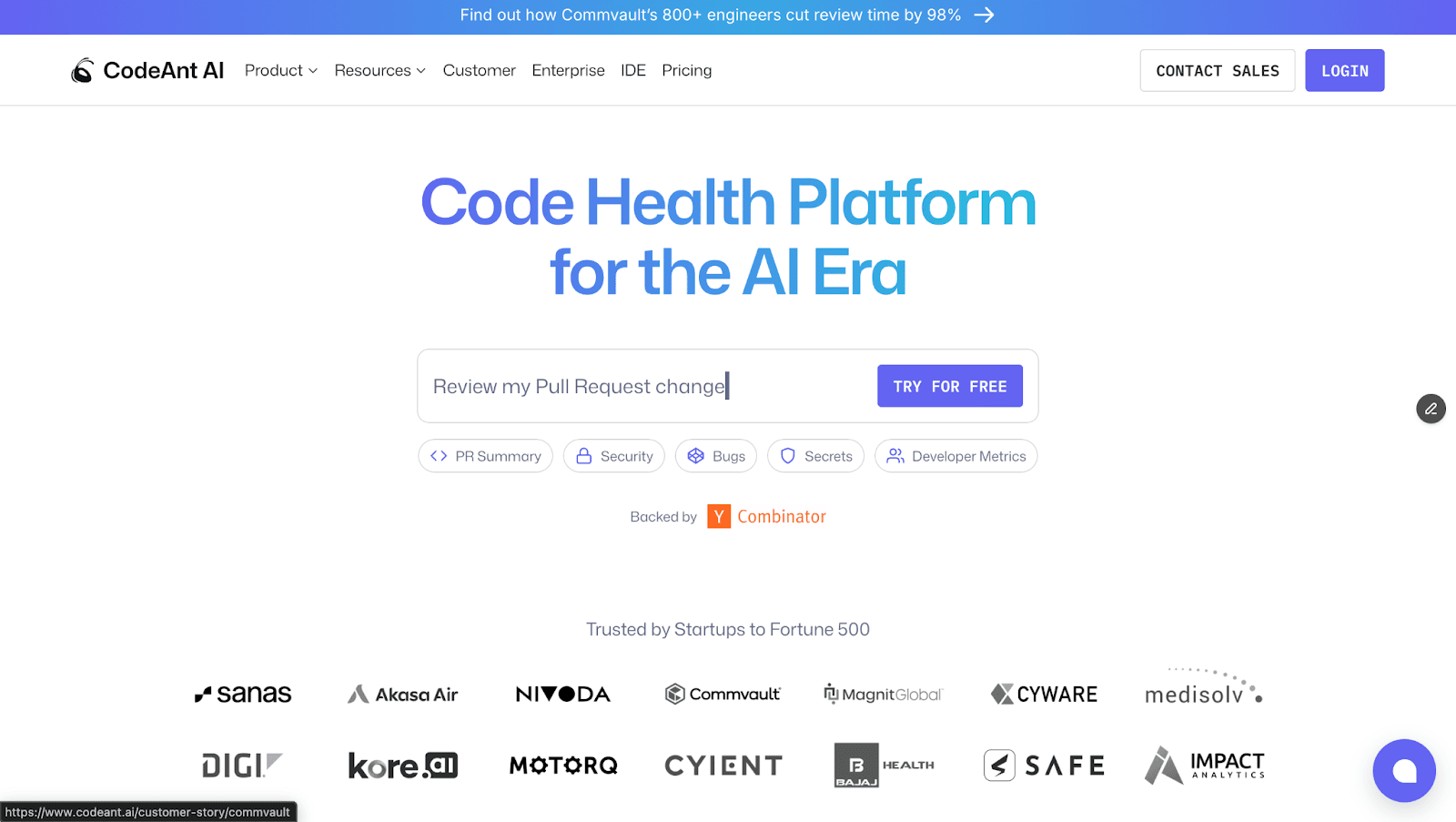
CodeAnt AI brings code review, security scanning, and quality metrics into a single platform. It automatically reviews pull requests, summarizes changes, and suggests fixes while enforcing your organization’s specific coding standards.
What sets it apart is the unified approach. Instead of juggling separate tools for review, security, and quality, you get one platform that understands your codebase and tracks maintainability, complexity, duplication, and DORA metrics over time.
Features:
AI-powered line-by-line code reviews with auto-fix suggestions
SAST, secrets detection, and vulnerability scanning
Organization-specific learning that adapts to your conventions
30+ language support including Java, Python, JavaScript, Go, and Terraform
Native integrations with GitHub, GitLab, Bitbucket, and Azure DevOps
Self-hosting available for teams with data residency requirements
Best for: Teams wanting a single platform for code quality, security, and AI-assisted reviews.
Limitations: Newer entrant compared to established players; some advanced enterprise features still maturing.
Pricing: 14-day free trial, no credit card required. Plans start at $10/user/month.
👉 Try CodeAnt AI free for 14 days
Snyk Code
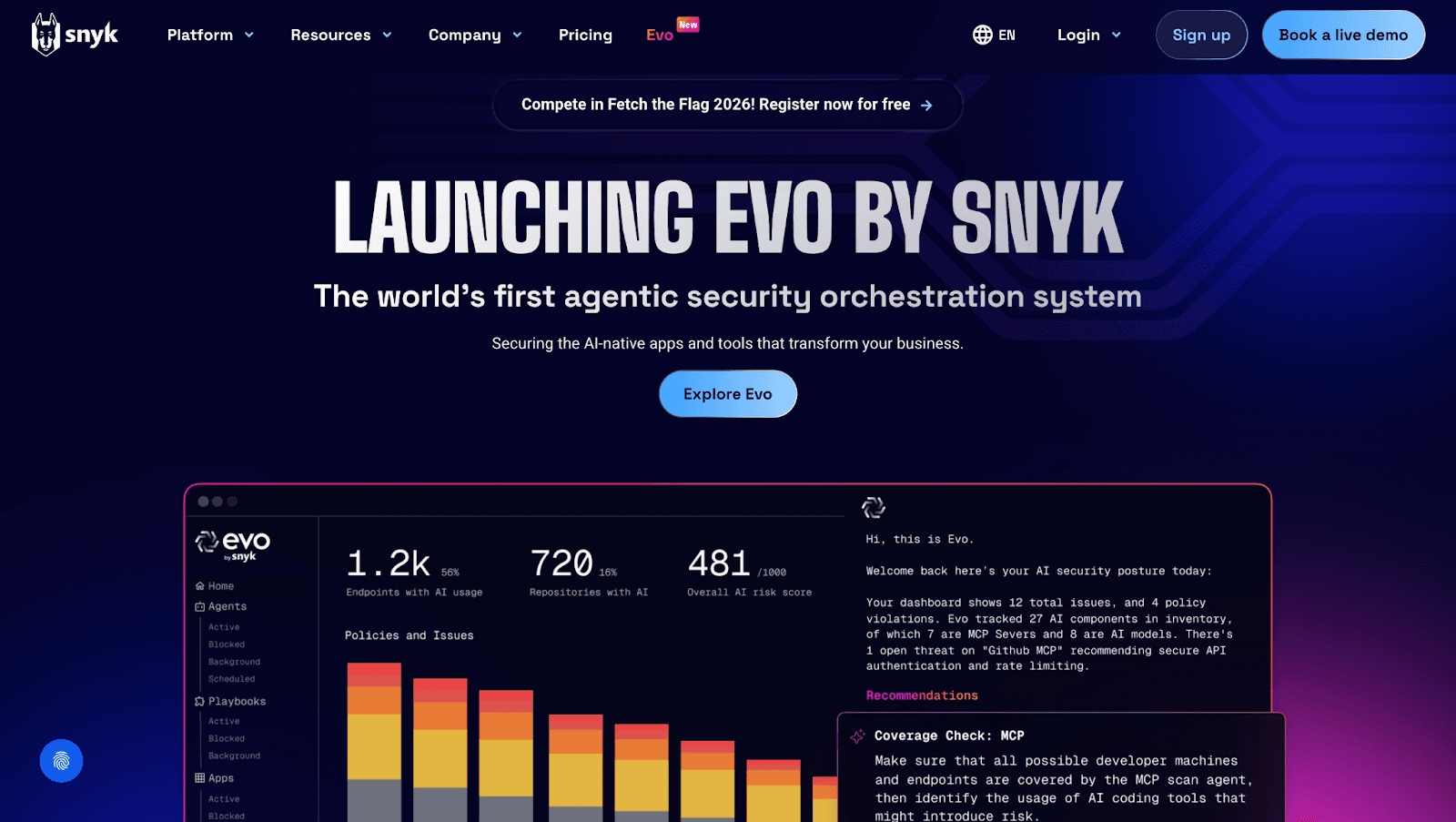
Snyk Code focuses on developer-first security scanning. It excels at finding vulnerabilities in your code and open-source dependencies, with strong IDE integration that catches issues before commit.
Features:
Real-time vulnerability detection in IDE and PR
Dependency scanning (SCA) with remediation guidance
Container and infrastructure-as-code security
Developer-friendly explanations of security issues
Best for: Security-conscious teams prioritizing vulnerability detection over code quality metrics.
Limitations: Less focus on code quality, maintainability, and technical debt. Can generate noise without proper configuration.
Pricing: Free tier available; paid plans based on developers and projects.
Checkout this Synk Alternative.
Checkmarx SAST
Checkmarx offers enterprise-grade static application security testing. It provides deep security scanning with strong compliance focus, ideal for regulated industries.
Features:
Comprehensive SAST with broad language support
Incremental scanning for faster CI/CD integration
Compliance reporting for PCI-DSS, HIPAA, SOC 2
Integration with major DevOps platforms
Best for: Large enterprises with dedicated security teams and strict compliance requirements.
Limitations: Complex configuration requiring security expertise. No code quality metrics, purely security-focused.
Pricing: Custom enterprise pricing.
Checkout this Checkmarx Alternative.
Veracode Static Analysis
Veracode provides cloud-based SAST with strong compliance certifications. It’s particularly popular in regulated industries like finance and healthcare.
Features:
Binary and source code analysis
Policy-based compliance enforcement
Detailed remediation guidance
SaaS delivery with no infrastructure to manage
Best for: Organizations in regulated industries with compliance-first security scanning requirements.
Limitations: Security-only focus with no code quality or maintainability metrics. Scan times can be lengthy for large codebases.
Pricing: Custom pricing based on application portfolio.
Fortify Static Code Analyzer
Fortify (now part of OpenText) is a heavyweight enterprise SAST tool. It offers comprehensive language support and deep analysis for safety-critical systems.
Features:
30+ language support with deep rule sets
On-premise and cloud deployment options
Integration with ALM and DevOps tools
Regulatory compliance reporting
Best for: Large enterprises in aerospace, defense, or financial services with complex compliance requirements.
Limitations: Steep learning curve and complex deployment. Requires dedicated security personnel.
Pricing: Enterprise licensing; contact for quotes.
Coverity

Coverity (by Synopsys) specializes in deep defect detection. It’s particularly strong for embedded systems and safety-critical applications where bugs have serious consequences.
Features:
Advanced static analysis for C, C++, Java, and more
Low false-positive rates through path-sensitive analysis
Integration with issue trackers and CI systems
Compliance with safety standards (ISO 26262, DO-178C)
Best for: Teams building embedded, automotive, or safety-critical software.
Limitations: Expensive and complex to deploy. Less focus on modern cloud-native workflows.
Pricing: Enterprise pricing; typically six-figure annual contracts.
Semgrep
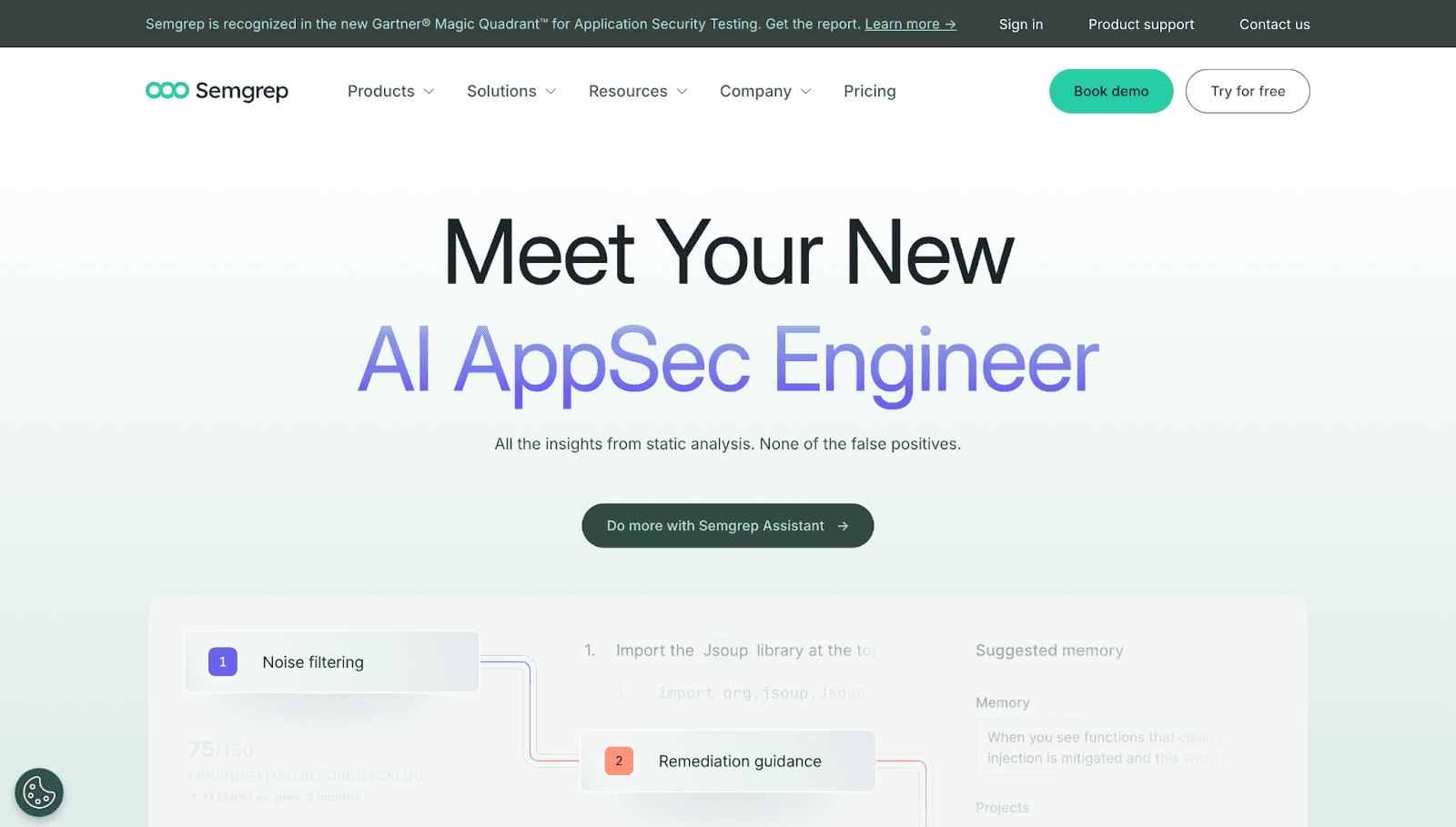
Semgrep takes a different approach, lightweight, open-source, and highly customizable. You write rules in a simple syntax that matches code patterns.
Features:
Fast, incremental scanning
Custom rule creation with intuitive syntax
Open-source core with commercial add-ons
Strong community rule library
Best for: Teams wanting control over their rules and fast, lightweight analysis.
Limitations: Requires more manual configuration for comprehensive coverage. Limited code quality metrics.
Pricing: Free open-source tier; Team and Enterprise plans available.
Tool | Primary Focus | AI Capabilities | Security Scanning | Code Quality Metrics | Pricing Model |
CodeAnt AI | Unified code health | Yes | SAST, secrets, dependencies | Yes | Per-user |
Snyk Code | Security | Limited | Strong SAST + SCA | No | Per-developer |
Checkmarx | Enterprise security | Limited | Comprehensive SAST | No | Enterprise |
Veracode | Compliance security | No | Strong SAST | No | Per-application |
Fortify | Enterprise SAST | No | Comprehensive | No | Enterprise |
Coverity | Defect detection | No | Strong SAST | Limited | Enterprise |
Semgrep | Customizable analysis | No | Good with rules | No | Freemium |
SonarQube Alternatives Compared
Sometimes you want a direct head-to-head. Here’s how the top alternatives stack up against SonarQube.
CodeAnt AI vs SonarQube
CodeAnt AI approaches code quality as a unified code health problem, not a standalone static analysis task. While SonarQube focuses primarily on rule-based static code inspection, CodeAnt AI combines AI-driven code review, security scanning, quality metrics, and developer productivity insights into a single platform. SonarQube flags issues after analysis. CodeAnt AI explains why changes matter, how they impact runtime behavior, and what to fix, directly inside pull requests.
Snyk vs SonarQube
Snyk excels at security, vulnerability detection, dependency scanning, and remediation guidance. SonarQube offers broader code quality metrics but weaker security coverage. Choose Snyk if security is your primary concern.
Checkmarx vs SonarQube
Checkmarx targets enterprise security teams with deep SAST and compliance features. SonarQube is more developer-centric and accessible. Checkmarx suits organizations with dedicated AppSec teams.
Veracode vs SonarQube
Veracode wins on compliance certifications and binary analysis. SonarQube offers better code smell detection and maintainability tracking. Regulated industries often choose Veracode.
Fortify vs SonarQube
Fortify provides heavyweight enterprise SAST for complex, regulated environments. SonarQube is more accessible and developer-friendly. Fortify fits aerospace, defense, and financial services.
Coverity vs SonarQube
Coverity excels at deep defect analysis for embedded and safety-critical systems. SonarQube targets web and cloud applications. Choose Coverity for automotive or medical device software.
Semgrep vs SonarQube
Semgrep offers lightweight, customizable analysis with fast scans. SonarQube provides more comprehensive out-of-box coverage. Teams wanting control over rules prefer Semgrep.
How to Choose the Right SonarQube Alternative for Your Team
With seven solid options, how do you decide? Start with your primary pain point:
If security is your priority
If you want unified code health
If you require enterprise compliance
If you prefer open-source flexibility
Team size matters too. Tools like CodeAnt AI work well for teams without specialized AppSec resources. To learn more about our defensive and offensive security platform, book your 1:1 with our experts today!
FAQs
What is the typical migration path from SonarQube to an alternative tool?
Which SonarQube alternatives support on-premise deployment?
Which SonarQube alternative produces the lowest false-positive rate?
Do any SonarQube alternatives combine code quality and security in one platform?
How do SonarQube alternatives handle monorepo architectures?