

CodeAnt AI and Bishop Fox both use artificial intelligence to find exploitable application risk, but they package the work very differently. CodeAnt AI is an AI-native security platform designed to run quickly, connect findings to source code, and support repeated remediation cycles. Bishop Fox is a managed offensive security provider that combines the Cosmos technology platform, Cosmos AI, and expert penetration testers across applications, networks, cloud, hardware, AI systems, and red-team programs.
This is no longer a simple “AI tool versus traditional consultancy” comparison. Bishop Fox launched AI-powered application penetration testing in 2026 and uses automation inside expert workflows. The real decision is between a developer-native platform optimized for speed and continuous code context and a broad managed offensive-security partner optimized for human oversight, enterprise portfolios, and multiple attack surfaces.
This guide compares CodeAnt AI and Bishop Fox using official information available in July 2026.
CodeAnt AI vs Bishop Fox: the short answer
Choose CodeAnt AI for fast, repeatable web application and API pentesting, source-code context, developer remediation, and testing that can run alongside pull requests and releases.
Choose Bishop Fox for expert-led penetration testing across applications, cloud, networks, hardware, mobile, and AI systems, or when you want continuous threat exposure management and red-team services from one provider.
Choose CodeAnt AI when a 48-hour report and unlimited re-verification are material requirements.
Choose Bishop Fox when named human expertise, manual attack chaining, portfolio strategy, and broader offensive-security coverage justify a managed engagement.
Use both when continuous application testing should be supplemented by independent expert reviews, cloud or hardware assessments, and periodic red-team exercises.
Decision area | CodeAnt AI | Bishop Fox |
|---|---|---|
Primary model | AI-native pentesting and code-security platform | Managed offensive-security services powered by Cosmos |
Application testing | Black-box, white-box, and gray-box AI pentesting | AI-powered and expert-led application penetration testing |
Human involvement | Product-led workflow with security-team review | Human validation or human-driven testing, depending on package |
Code context | Repository, pull request, SAST, SCA, secrets, IaC, and code memory | Scoped secure code review with automation, manual review, and threat modeling options |
Public turnaround | Audit-grade report advertised within 48 hours | Baseline findings in days; traditional engagements commonly take several weeks |
Pricing | Outcome-based pentesting terms are public | Quote-only |
Retesting | Free unlimited rescans advertised | Engagement and package terms vary |
Broader coverage | Strongest around applications and software delivery | Applications, networks, cloud, hardware, mobile, AI/LLM, CTEM, and red teams |
Operating style | Self-serve and repeatable | Fully managed service |
Best fit | Fast-moving engineering organizations | Enterprises seeking a consolidated offensive-security partner |
What is CodeAnt AI?
CodeAnt AI is a code quality and application security platform. Its AI penetration testing offer supports black-box, white-box, and gray-box testing and advertises an audit-grade SOC 2 or ISO 27001 report within 48 hours.
The platform also provides AI code review and code security capabilities such as SAST, SCA, secrets detection, infrastructure-as-code scanning, SBOM generation, and attack-path context. That broader workflow is central to the comparison. CodeAnt can connect a runtime exploit to a repository, help an engineer understand the root cause, and re-run testing after a fix.
Its commercial model for pentesting is outcome-oriented. CodeAnt advertises no engagement fee, payment when it delivers a working proof-of-concept exploit, no payment when nothing exploitable is found, and free unlimited rescans.
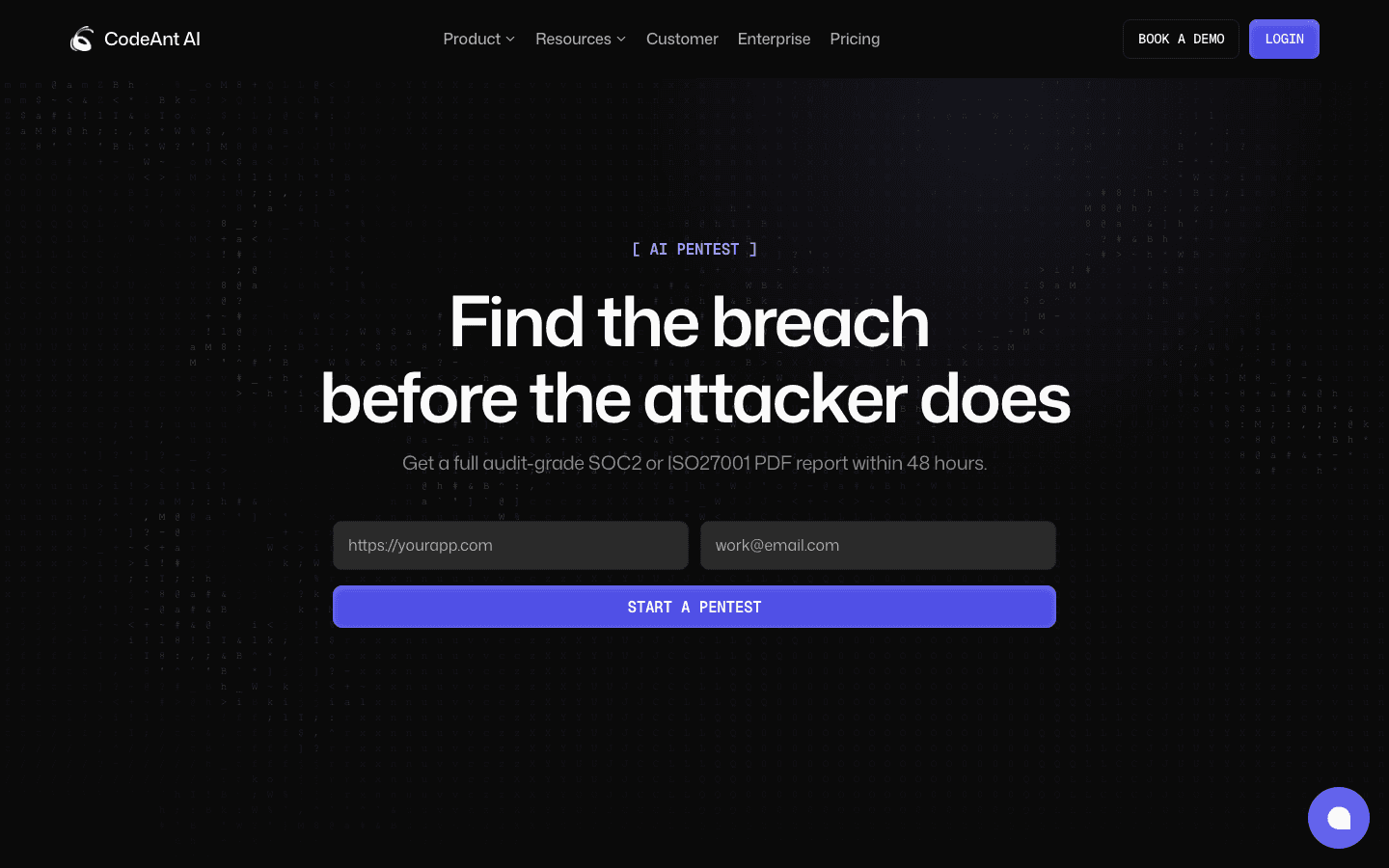
CodeAnt is strongest when the target is a modern web application or API and the buyer wants a repeatable security loop rather than a separately scheduled consulting project.
What is Bishop Fox?
Bishop Fox is an offensive security company founded in 2005. Its company page describes more than 20 years of experience, work with 26 Fortune 100 companies, and a 70 Net Promoter Score. The firm says it has conducted more than 10,000 application security assessments.
Its current portfolio includes:
Application, mobile, secure-code, cloud, hardware, internal-network, and external-network testing
AI and LLM security assessments
Continuous threat exposure management
Attack-surface discovery and testing
Red teaming, social engineering, ransomware readiness, and incident-response tabletop exercises
The Cosmos technology platform and Cosmos AI engine
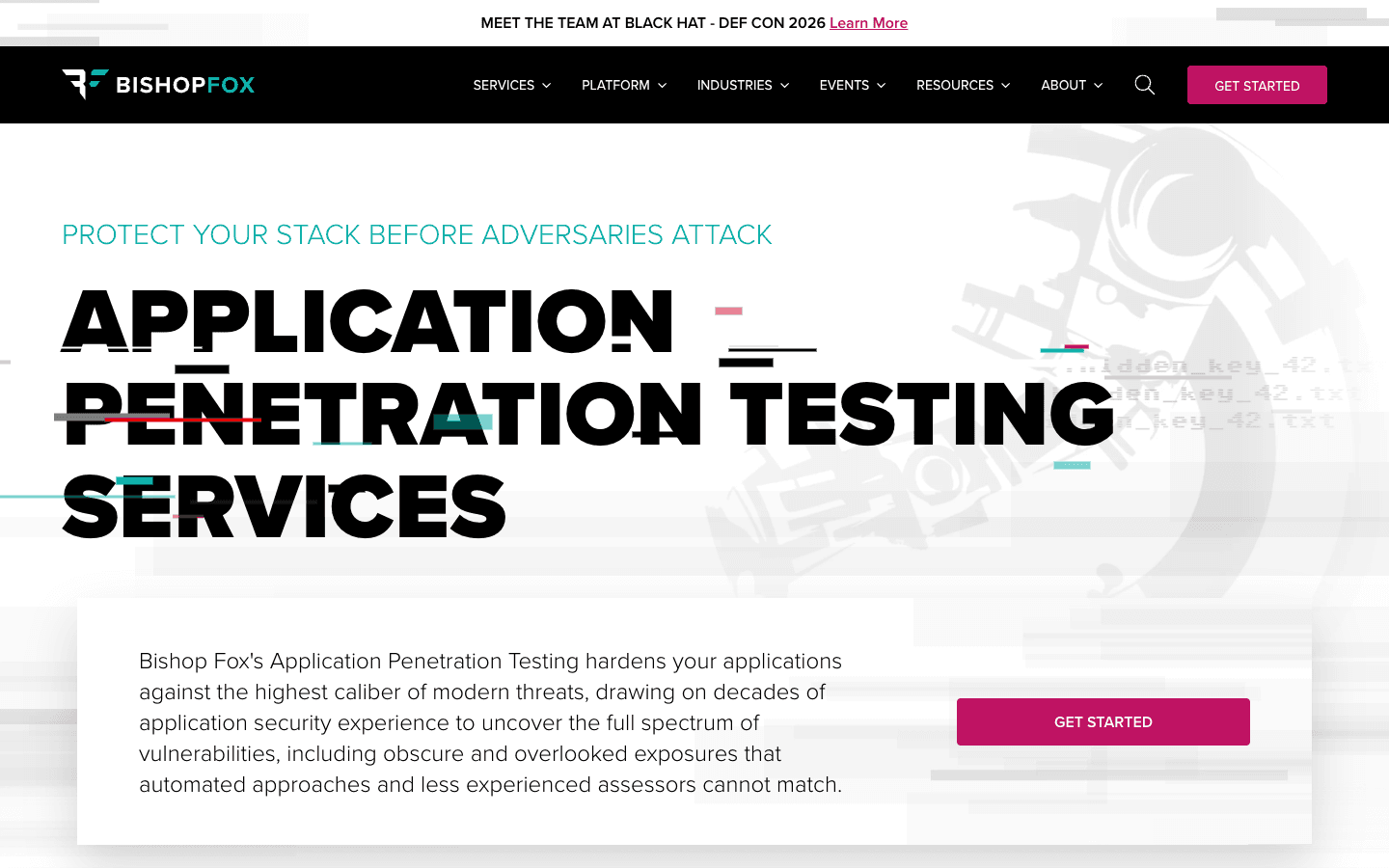
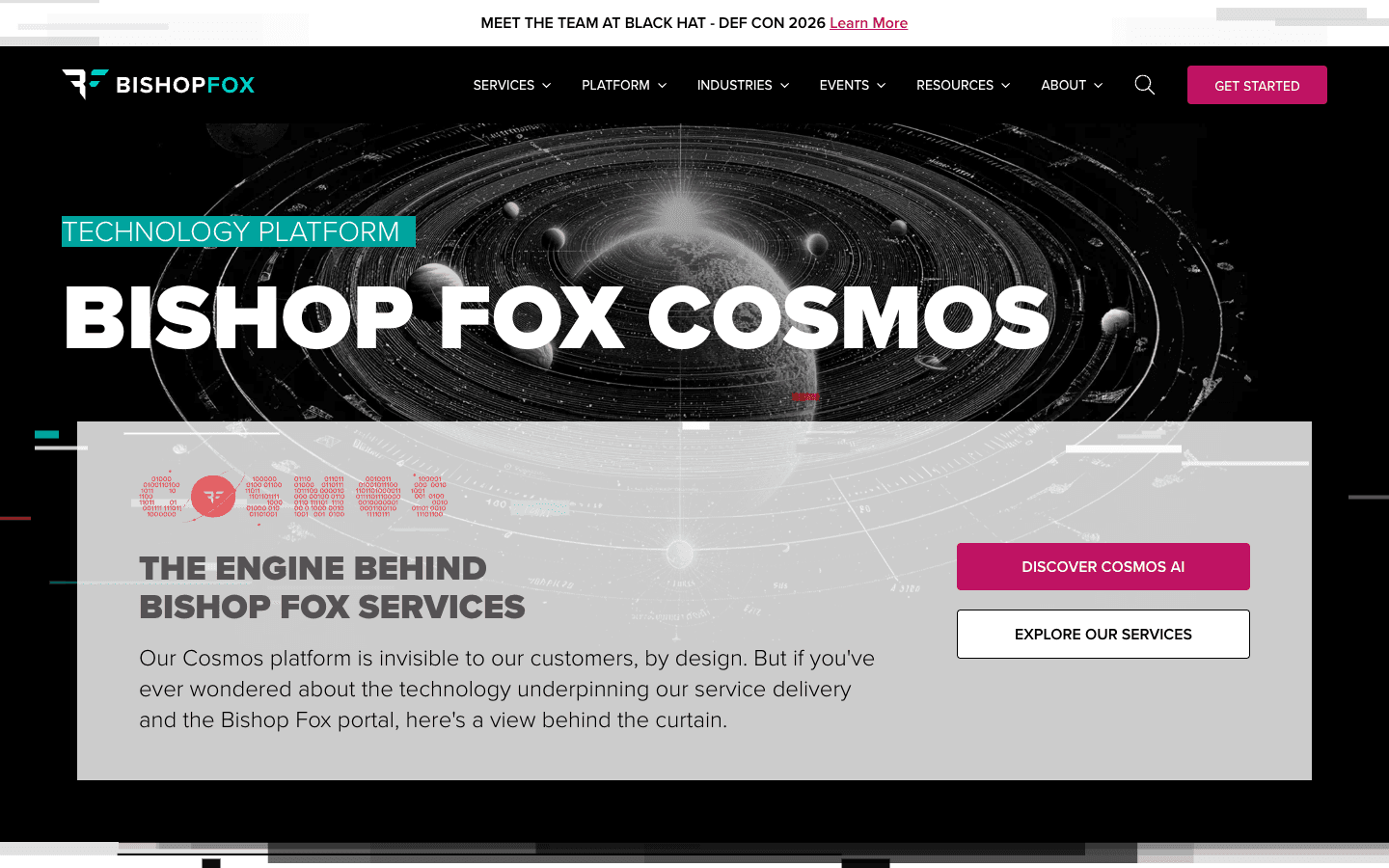
Bishop Fox is not a software license that customers deploy and operate themselves. Its Cosmos page says the platform is operated and managed by Bishop Fox as part of its services. Customers receive verified assets, findings, evidence, workflow integrations, and expert collaboration through the Bishop Fox Portal.
The central difference: developer-native versus managed offensive security
CodeAnt begins with the software-development lifecycle. It can learn from source code, pull requests, repository history, static findings, dependencies, secrets, and application roles. Pentesting becomes another event in a continuous engineering workflow.
Bishop Fox begins with a managed offensive-security program. It combines technology with specialists who scope the work, select tactics, validate results, pursue attack chains, communicate findings, and support remediation.
That difference changes the buyer experience:
CodeAnt reduces the friction between a code change and a security result.
Bishop Fox reduces the burden of building and coordinating a broad offensive-security capability internally.
CodeAnt puts more operational control in the customer’s hands.
Bishop Fox carries more operational responsibility as a service provider.
Neither model is automatically deeper. Code context can reveal implementation weaknesses that an external test misses. A skilled human can recognize a novel business assumption, adapt a test, and chain exposures across systems in ways that a standardized workflow may not prioritize.
How their AI pentesting models compare
Bishop Fox announced the current generation of its AI-powered application penetration testing in February 2026. Cosmos AI is embedded in expert workflows to expand coverage and accelerate discovery.
Bishop Fox publishes three web application testing package levels:
Baseline: AI-powered application discovery, vulnerability identification, and testing, followed by one day of human validation and exploitation.
Standard: AI-accelerated discovery and vulnerability identification plus human-driven penetration testing, exploitation, and attack chaining.
Advanced: Deeper human-driven testing of critical applications, specific features, and targeted risk areas.
CodeAnt’s model is more consistently productized across the workflow. Its agents test the application, use source and development context where available, generate proof-of-concept evidence, and support immediate re-verification.
AI testing question | CodeAnt AI | Bishop Fox |
|---|---|---|
Is AI the primary operating layer? | Yes | AI augments a managed expert service |
Is human validation included? | Security teams review product evidence | Explicit in Bishop Fox packages |
Can the system use source context? | Yes, as part of the continuous platform | Yes, through scoped secure code review or white-box work |
Is testing portfolio-oriented? | Repeatable across connected applications | Yes, especially with Baseline packages and Cosmos |
Who operates the underlying platform? | Customer uses CodeAnt workflows | Bishop Fox operates Cosmos |
Is manual attack chaining available? | Agentic exploit validation | Explicit human-driven capability in Standard and Advanced |
CodeAnt is the better fit when the organization wants an AI testing system it can trigger frequently. Bishop Fox is stronger when security leadership wants AI to increase the reach of a human-led service without giving up managed execution.
Source-code security and developer workflow
CodeAnt connects pentesting with SAST, SCA, secret scanning, IaC scanning, and AI code review. The same platform can reason about a vulnerable route, the implementation behind it, related dependencies, and the pull request that introduces or fixes the problem.
Bishop Fox offers a separate Secure Code Review service with three depths:
Baseline: SAST plus expert validation
Targeted: SAST, expert validation, and manual code review
In-depth: SAST, expert validation, manual code review, and threat modeling
Its methodology includes architecture review, software composition analysis, static scanning, manual review, attack-surface mapping, framework alignment, remediation, and secure-coding guidance.
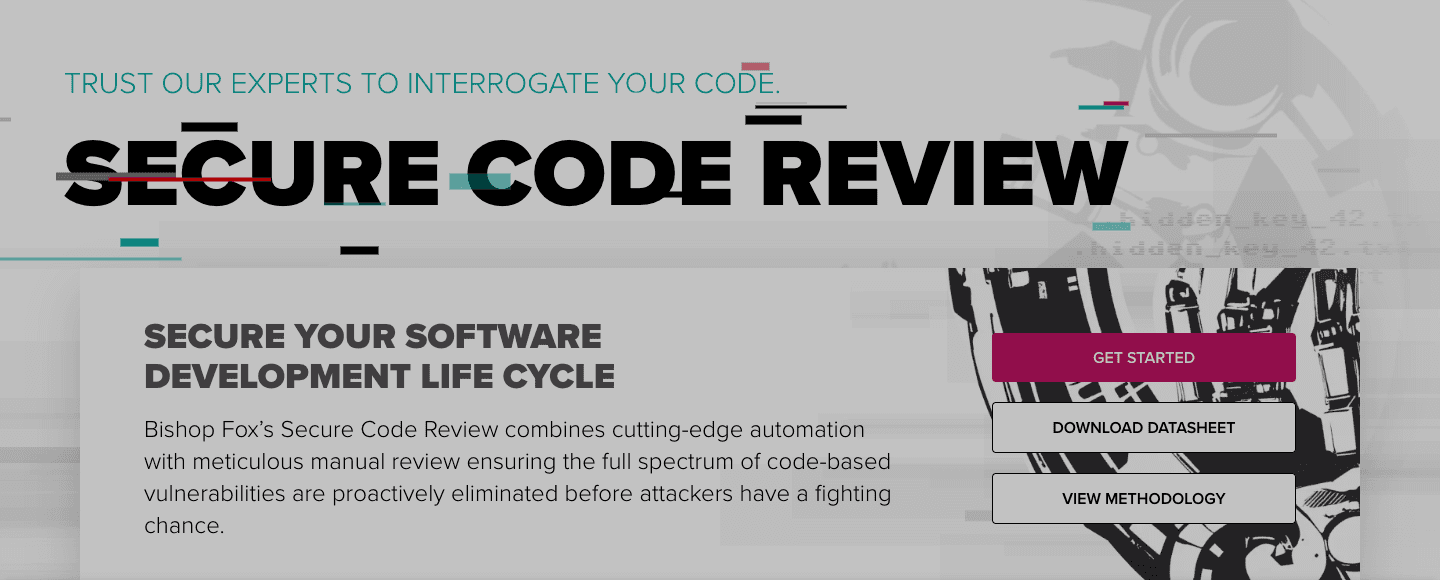
Bishop Fox has strong code-review depth, but it remains a scoped engagement. CodeAnt’s advantage is cadence: code analysis, pull-request review, runtime pentesting, remediation, and re-testing can remain in one continuous system.
Choose Bishop Fox for a high-stakes independent code audit or threat-model-heavy review. Choose CodeAnt when developers need security feedback on every meaningful change.
Application coverage and business-logic testing
Bishop Fox’s application testing covers web applications, thick clients, e-commerce systems, single-page applications, APIs, and diverse programming languages. Its public methodology includes reconnaissance, attack-surface mapping, authentication, authorization, session management, configuration, data validation, encryption, file transfer, and application-logic circumvention.
CodeAnt focuses on black-box, white-box, and gray-box application testing. Source and authenticated role context are useful for:
IDOR and BOLA
Privilege escalation
Tenant-isolation failures
JWT and session mistakes
Injection paths across services
Secrets and unsafe configuration
Business-process abuse
Reachable vulnerable dependencies
Both are credible for web application and API risk. Bishop Fox adds explicit human attack chaining. CodeAnt adds continuous repository and remediation context.
For more background, see black-box versus white-box versus gray-box pentesting and the guide to AI source-code analysis in penetration testing.
Broader offensive-security coverage
Bishop Fox wins decisively on the breadth of its public service catalog.
Target or program | CodeAnt AI | Bishop Fox |
|---|---|---|
Web applications and APIs | Core strength | Core strength |
Secure code review | Continuous product workflow | Expert-led scoped service |
Mobile applications | Confirm exact scope | Dedicated service |
Cloud penetration testing | Code and cloud security context | Objective-based AWS, Azure, GCP, and Kubernetes testing |
External networks | Not the primary product | Dedicated service |
Internal networks | Not the primary product | Dedicated service |
Hardware and embedded systems | Not a core category | Dedicated hardware penetration testing |
AI and LLM systems | Relevant agentic application testing | Dedicated AI/LLM assessment service |
Attack-surface management | Application-focused discovery | Cosmos and CTEM services |
Red teams and social engineering | Not a core product | Dedicated programs |
Incident-response readiness | Not a core product | Ransomware and tabletop services |
If the buying problem crosses applications, identity, cloud, perimeter, devices, and detection teams, Bishop Fox can serve as a consolidated partner. If the problem is specifically “help engineering continuously find and fix application risk,” the larger catalog can add unnecessary cost and process.
Cosmos versus CodeAnt’s platform
Bishop Fox Cosmos continuously discovers external assets, validates reachability and protocols, collects screenshots and service evidence, connects to AWS, GCP, Azure, Cloudflare, and Oracle, and sends verified findings through an expert pipeline.
The Bishop Fox Portal provides:
A living external asset inventory
Confirmed findings and indicators of exposure
Remediation and triage workflows
Jira and ServiceNow integrations
Secure file exchange and collaboration
CodeAnt’s platform is organized around repositories, applications, pull requests, code-security controls, and developer remediation. It is less of an enterprise external-asset operating system and more of a software-risk operating system.
Choose Cosmos when external asset change, cloud sprawl, mergers, and continuous exposure validation are central. Choose CodeAnt when source change, release velocity, and developer action are central.
Speed and scheduling
CodeAnt advertises an audit-grade report within 48 hours. Its repeatable product model reduces the time spent negotiating scope, waiting for an assessor, preparing a separate project, and arranging a retest.
Bishop Fox provides two different speed profiles:
Its AI-powered Baseline package advertises expert findings in days.
Its application testing FAQ says most traditional engagements include one to two weeks of scoping and preparation, one to three weeks of fieldwork, and one to two weeks for reporting and remediation support.
That means a complete expert-led Bishop Fox engagement can require roughly three to seven weeks from preparation through reporting, depending on complexity and scheduling. This is not a weakness if the scope requires concentrated manual depth. It is a real operational difference for fast release cycles.
Ask Bishop Fox which package applies, when the team can start, when critical findings are communicated, and whether retesting fits the release deadline.
Reporting, remediation, and retesting
CodeAnt positions its deliverable for multiple audiences: a concise executive view, audit mapping for SOC 2 and ISO 27001, technical exploit evidence for developers, ticketing, and re-verification.
Bishop Fox provides technical and executive reporting, customer-portal findings, remediation guidance, expert communication, and retesting. Its application methodologies describe likelihood, impact, severity, and on-demand remediation review.
The distinction is repeatability:
CodeAnt advertises free unlimited rescans.
Bishop Fox public materials describe remediation testing but do not establish one universal retest entitlement for every service and package.
Put the number of verification rounds, time window, deliverable, and response SLA into the Bishop Fox statement of work. Use the penetration test retest guide to normalize vendor terms.
CodeAnt AI vs Bishop Fox pricing
Bishop Fox does not publish current list prices for its penetration testing packages, secure code review, Cosmos, CTEM, red teams, or other services. The official application package material names Baseline, Standard, and Advanced tiers but requires a sales conversation.
CodeAnt publishes outcome-based terms for AI pentesting:
No engagement fee
Payment when a working proof-of-concept exploit is delivered
No payment when nothing exploitable is found
A report within 48 hours
Free unlimited rescans
These terms should still be confirmed for the exact target, scope, finding severity, and contract. Bishop Fox’s quote may include reserved expert time, planning, manual testing, reporting, and broader advisory value that outcome pricing does not represent.
Read the complete Bishop Fox pricing guide and how much penetration testing costs before comparing proposals.
Trust, track record, and research
Bishop Fox has the stronger longevity and enterprise-services track record. Its official figures include:
More than 20 years in offensive security
More than 10,000 application security assessments
Work with 26 Fortune 100 companies
A 70 NPS
A portfolio of public tools, research, advisories, and exploit-development work
CodeAnt has a newer, product-led trust story. It publishes security research and CVEs and emphasizes demonstrable proof-of-concept exploits, developer remediation, and audit-ready reporting.
Do not choose on logo counts alone. Ask both vendors to demonstrate the workflow on a representative application with multiple roles, meaningful APIs, and a recent architectural change.
Who should choose CodeAnt AI?
CodeAnt is the stronger fit when:
The primary assets are web applications and APIs.
Releases occur frequently.
Source repositories and CI/CD are available.
Engineers need file-level root-cause context.
SAST, SCA, secrets, IaC, SBOM, and code review should live beside pentesting.
A 48-hour result is more valuable than a multi-week engagement.
The team wants to re-test immediately after every fix.
Procurement prefers an outcome-based entry point.
The best evaluation is a live pilot. Measure authenticated-route coverage, role switching, business-logic depth, proof quality, time to remediate, and re-verification speed.
Who should choose Bishop Fox?
Bishop Fox is the stronger fit when:
The organization wants a managed offensive-security partner.
Scope spans applications, networks, cloud, hardware, mobile, or AI systems.
Named expert validation and manual attack chaining are requirements.
A portfolio needs tiered Baseline, Standard, and Advanced testing.
External asset discovery and CTEM are part of the program.
Red teams, social engineering, ransomware readiness, or tabletop exercises are needed.
Enterprise reporting, portal collaboration, Jira, and ServiceNow matter.
A consulting timeline and quote-based procurement process are acceptable.
Ask to meet the proposed technical lead, understand package boundaries, review a redacted report, and confirm which work is performed by Cosmos AI versus human testers.
Can you use CodeAnt AI and Bishop Fox together?
Yes. A layered program often creates the best coverage:
Run CodeAnt continuously against approved applications and repositories.
Fix and re-verify exploitable application findings.
Use Bishop Fox for annual or milestone expert assessments.
Add Bishop Fox cloud, network, hardware, AI/LLM, CTEM, or red-team services where needed.
Convert Bishop Fox discoveries into CodeAnt rules, tests, quality gates, and secure-coding guidance.
Use continuous testing to prevent point-in-time findings from recurring.
This model lets Bishop Fox researchers focus on the questions that require human judgment instead of repeatedly rediscovering basic weaknesses.
A fair evaluation checklist
Give each provider the same representative application and define success before testing:
Confirmed exploitable findings
Authentication and authorization depth
Business-logic and attack-chain insight
Source and architecture context
Time to first critical notification
Time to final report
Developer effort to reproduce findings
Remediation specificity
Retest speed
Auditor and executive usability
Total internal coordination effort
Total commercial exposure
Do not score raw finding volume. One verified cross-tenant exploit is more valuable than dozens of duplicated low-risk observations.
Final verdict
CodeAnt AI is the better choice for fast, continuous, code-aware application pentesting and developer remediation. Bishop Fox is the better choice for managed, expert-led offensive security across a much broader attack surface.
Bishop Fox’s use of Cosmos AI makes the comparison more nuanced than automation versus humans. Its packages combine AI-powered discovery with human validation and deeper manual testing. CodeAnt still has the advantage in self-service cadence, source-to-fix workflow, 48-hour reporting, and published outcome-based pentest terms.
For a fast-moving SaaS engineering team, start with CodeAnt AI. For an enterprise seeking one partner for application testing, CTEM, cloud, networks, hardware, AI systems, and red teams, shortlist Bishop Fox. Mature programs can use CodeAnt continuously and Bishop Fox selectively for independent assurance and specialist depth.

