

Your CI/CD pipeline runs fast until PRs pile up. SonarQube floods your reviews with false positives. Snyk only catches security issues. You’re juggling three tools, reconciling conflicting findings, and still shipping defects.
What’s the best vendor offering AI code review that integrates with CI/CD and GitHub? The answer depends on whether you need a unified code health platform or another point solution. Most teams patch together separate tools for review, security, and quality, then spend 15+ hours weekly managing integrations. Modern engineering organizations are consolidating to AI-driven platforms that deliver 70% faster reviews and 80% fewer false positives in a single GitHub integration.
This guide evaluates seven leading AI code review vendors for production CI/CD workflows. You’ll learn which platforms unify capabilities that traditionally required multiple vendors, and exactly which solution fits your team’s size, compliance requirements, and infrastructure constraints.
The Real Cost of Tool Sprawl in GitHub CI/CD
Before evaluating vendors, quantify what tool sprawl actually costs. A typical 100-developer team running SonarQube + Snyk + Codacy spends:
8–12 hours/week managing webhooks, API tokens, and version compatibility
15–20 hours/week triaging duplicate findings across platforms
5–8 hours/week reconciling conflicting severity ratings and quality gates
3–5 hours/week coordinating vendor support escalations
Total: 31–45 hours per week, one full-time engineer maintaining the toolchain instead of shipping features.
The real damage is trust erosion. When SonarQube flags 47 issues per PR but only 10 are actionable, developers learn to ignore alerts. Critical security vulnerabilities get buried in noise. Teams disable quality gates to maintain velocity, bypassing the protections they invested in.
The root cause: Rule-based tools apply the same logic to every line of code, regardless of context. They can’t distinguish between a minor style violation in a test helper and a critical authentication flaw. Context-aware AI changes this equation, understanding your architecture, dependencies, and team standards to deliver 80% fewer false positives while catching issues static analyzers miss entirely.
Enterprise Requirements Checklist
Production-ready AI code review must meet these non-negotiables:
GitHub Integration Depth
Native Checks API: Issues appear inline in Files Changed, not external dashboards
GitHub Actions support: Pre-built Actions that trigger on
pull_request,push,schedulewithout custom scriptingWebhook-driven: Real-time analysis triggered by GitHub events, not polling delays
Branch protection compatibility: Status checks that integrate with required reviewers and merge requirements
Policy Enforcement
Baseline vs. new issue gating: Block merges on new issues while tracking existing debt separately
Configurable severity controls: Distinguish blocking issues (critical security) from advisory findings (code smells)
Policy as code: YAML-based rule configuration stored in version control
Custom rule authoring: Support for organization-specific patterns beyond out-of-box detectors
Security Coverage
Risk Category | Required Detection |
Secrets | API keys, tokens in code and history |
Dependencies | CVE scanning across direct and transitive deps |
Misconfigurations | IaC security (Terraform, K8s), cloud exposure |
Code vulnerabilities | OWASP Top 10, injection flaws, auth bypasses |
License compliance | OSS license detection and policy enforcement |
Scale and Architecture
Monorepo support: Handle 100K+ files without timeouts
Incremental scanning: Analyze only changed files and dependencies
Language coverage: Support for your tech stack (30+ languages minimum)
Performance SLAs: Sub-5-minute scans for typical PRs
Enterprise Security
SOC 2 Type II certification: Required for handling source code
SSO and RBAC: SAML/OIDC with granular permissions
Data residency options: On-premises deployment for regulated industries
Encryption standards: TLS 1.3 in transit, AES-256 at rest
AI Code Review Vendors: Feature Comparison
CodeAnt AI, a Defensive and Offensive Security Platform
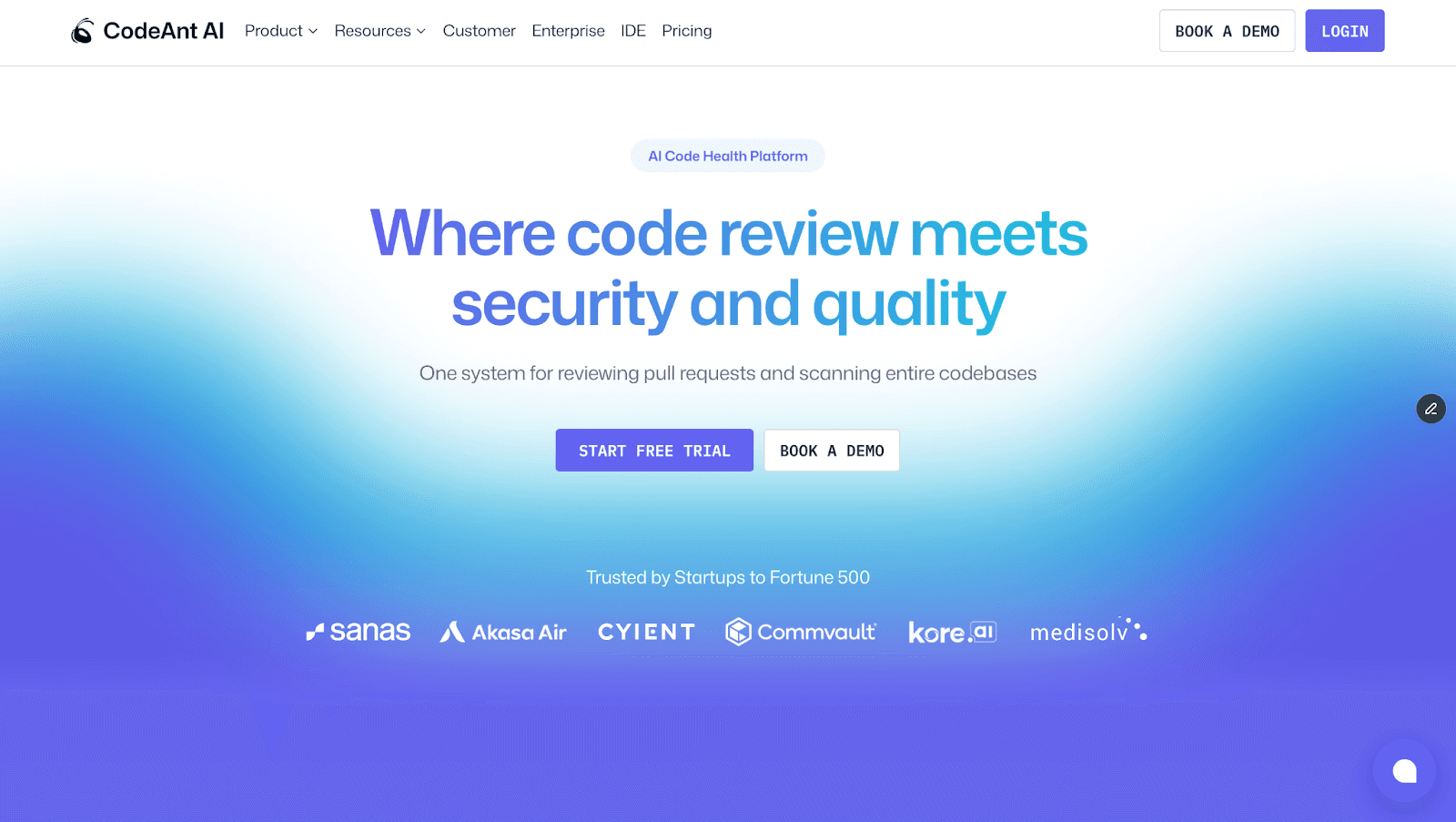
What it delivers: The only platform that unifies AI-powered PR review, continuous security scanning (SAST, secrets, dependencies), code quality enforcement, and DORA metrics in one GitHub integration. Replaces SonarQube, Snyk, and separate analytics tools.
Key strengths:
Context-aware AI review: Understands architecture and dependencies, reducing false positives by 80% vs. SonarQube
Proactive + reactive coverage: Scans existing codebases continuously and reviews every PR
Native GitHub Actions: Webhook-driven quality gates with no custom scripting
Built-in DORA metrics: Track deployment frequency, lead time, change failure rate, MTTR
SOC 2 Type II certified: Enterprise compliance for regulated industries
Ideal for: Teams with 100+ developers consolidating tool sprawl, enforcing security/quality gates in CI/CD, and gaining DORA visibility without managing multiple vendors.
Pricing: $10/user/month transparent pricing
GitHub Copilot: Code Suggestions Without Enforcement
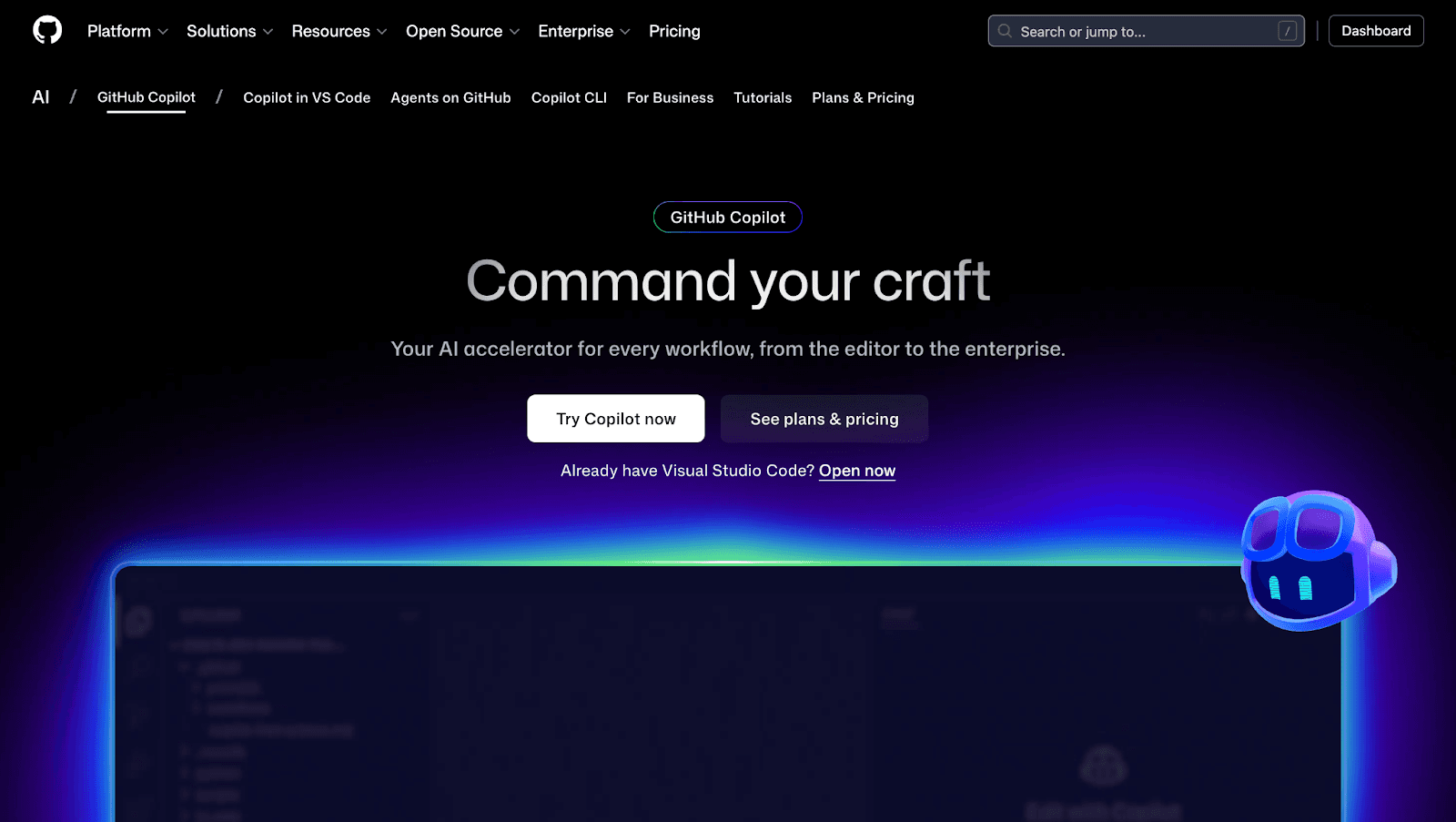
What it delivers: AI-powered code completions and PR descriptions. No quality gates or security scanning.
Strengths: Native GitHub integration, speeds boilerplate code generation, low-friction adoption
Limitations: No CI/CD enforcement, no security scanning, no DORA metrics. Purely an assistance tool.
Ideal for: Teams wanting code suggestions alongside a separate code review platform like CodeAnt AI.
Pricing: $21/user/month (Business) or $39/user/month (Enterprise).
Checkout the best Github Copilot alternative.
SonarQube: Legacy Static Analysis
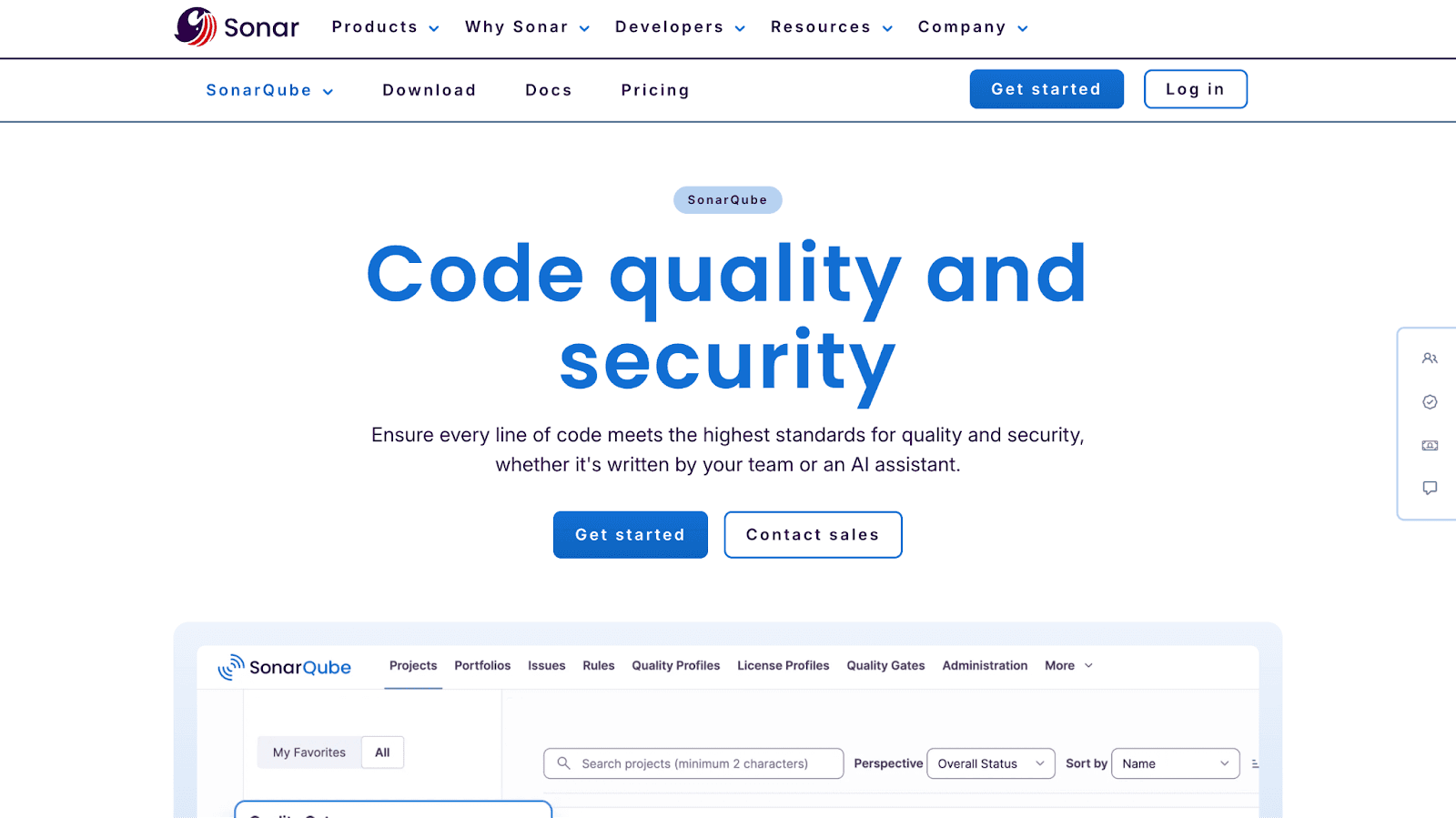
What it delivers: Rule-based static analysis for bugs, vulnerabilities, code smells. Industry standard for 15+ years.
Strengths: Market maturity, 30+ language support, self-hosted option
Limitations:
Rule-based (not AI), generates 80% false positives
No PR-level AI review
Requires separate tools for secrets, dependencies, DORA metrics
High TCO: $150K+/year for Enterprise
Ideal for: Large enterprises with legacy codebases needing broad language support, willing to tolerate high noise.
Pricing: Free (Community), $150/year per 100K LOC (Developer), custom enterprise pricing.
Checkout the best SonarQube alternative.
CodeRabbit: PR-Only AI Review
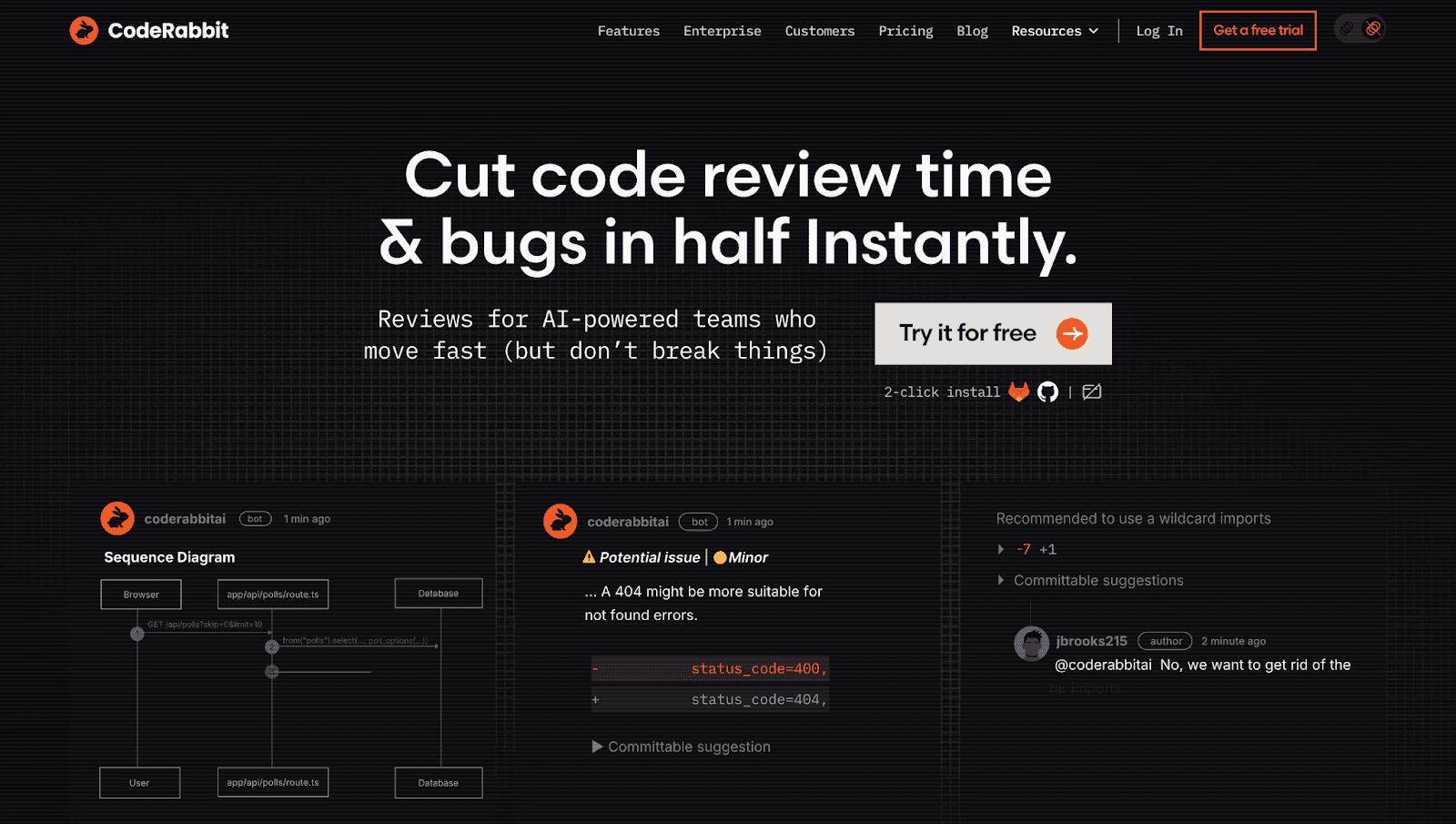
What it delivers: AI-powered PR review with conversational feedback. Focused exclusively on pull requests.
Strengths: Conversational AI review, fast PR turnaround, GitHub-native experience
Limitations: PR-only (no continuous scanning), no security scanning, no DORA metrics or quality gates
Ideal for: Small teams (<50 developers) with separate security tools already in place.
Pricing: $15/user/month (Pro) or custom enterprise pricing.
Checkout the best CodeRabbit alternative.
Snyk Code: Security-First SAST
What it delivers: SAST scanning for security vulnerabilities with AI-powered analysis.
Strengths: Best-in-class vulnerability detection, developer-friendly fixes, broad ecosystem integration
Limitations: Security-only (no code quality enforcement), no DORA metrics, requires multiple Snyk products for full coverage
Ideal for: Security-first teams in regulated industries needing deep vulnerability scanning.
Pricing: Free (limited), $98/month (Team), custom enterprise pricing.
Checkout the best Synk alternative.
AWS CodeGuru: AWS-Locked Intelligence
What it delivers: AI code review and performance profiling for AWS-hosted applications.
Strengths: AWS-native integration, performance profiling, pay-per-use pricing
Limitations: AWS ecosystem lock-in, limited language support (Java, Python, JavaScript only), no DORA metrics
Ideal for: AWS-native teams building serverless applications.
Pricing: $0.50–$0.75 per 100 lines analyzed
Codacy: Quality-Focused Static Analysis
What it delivers: Code quality platform with automated reviews, technical debt tracking, CI/CD gates.
Strengths: Quality-focused metrics, GitHub integration, team collaboration features
Limitations: Rule-based (not AI), no security scanning, no DORA metrics
Ideal for: Teams wanting automated quality enforcement with separate security tools.
Pricing: $18/user/month
Vendor Comparison Matrix
Capability | CodeAnt AI | Copilot | SonarQube | CodeRabbit | Snyk | CodeGuru | Codacy |
AI PR review | ✅ Context-aware | ✅ Suggestions | ❌ Rule-based | ✅ Context-aware | ❌ | ⚠️ Limited | ❌ |
Continuous scanning | ✅ | ❌ | ✅ | ❌ | ✅ | ✅ | ✅ |
Security (SAST/secrets/deps) | ✅ | ❌ | ⚠️ Add-on | ❌ | ✅ | ⚠️ | ❌ |
Code quality enforcement | ✅ | ❌ | ✅ | ⚠️ | ❌ | ⚠️ | ✅ |
DORA metrics | ✅ | ❌ | ❌ | ❌ | ❌ | ❌ | ❌ |
GitHub Actions native | ✅ | ✅ | ✅ | ✅ | ✅ | ⚠️ | ✅ |
SOC 2 compliance | ✅ Type II | ✅ | ✅ | ⚠️ | ✅ | ✅ | ✅ |
Key insight: CodeAnt AI is a defensive and offensive security platform delivering AI review, security, quality, and DORA metrics in one integration. Competitors force you to choose between point solutions or legacy tools with high false positive rates.
Integrating AI Code Review into GitHub Actions
Step 1: Install and Baseline
Install the CodeAnt AI GitHub App at app.codeant.ai. The platform immediately scans your codebase to establish a baseline, cataloging existing issues separately from new problems introduced in PRs.
Why baselines matter: You don’t want to block merges on legacy debt that’s been in main for years. CodeAnt AI’s baseline separation prevents “legacy debt paralysis” while enforcing quality on new code.
Step 2: Add GitHub Actions Workflow
Integrate CodeAnt AI into your CI/CD pipeline using GitHub Actions:
Configuration: Set fail-on-critical: false initially to run in comment-only mode. This lets teams calibrate policies and build trust before enabling blocking gates.
Performance: Analysis completes in under 2 minutes for typical PRs via webhook-driven, incremental scanning. CodeAnt AI analyzes only changed files and dependencies—not the entire codebase.
Step 3: Configure Quality Gates
Define which issues block merges:
Repository-specific policies: High-risk services (payments, auth) get strict gates. Internal tools get relaxed rules. Monorepos support directory-level policies.
Step 4: Enable Branch Protection
Add CodeAnt AI as a required status check in Settings → Branches → Branch protection rules:
Require “CodeAnt AI Code Health Check” to pass before merging
Require branches to be up to date
Include administrators in enforcement
Continuous monitoring: Unlike PR-only tools (CodeRabbit), CodeAnt AI scans all branches continuously. If a new CVE affects a dependency in main, you get immediate alerts, even without an open PR.
Step 5: Multi-Repo Rollout Strategy
Phase 1 (Weeks 1–2): Pilot 2–3 high-velocity services in comment-only mode
Phase 2 (Weeks 3–4): Expand to 10–15 core services, enable blocking gates for critical security issues
Phase 3 (Weeks 5–8): Org-wide deployment with full blocking gates
Managing monorepos: Use .codeant.yml at repo root for directory-level policies:
policies:
Decision Framework
Choose CodeAnt AI if:
You have 100+ developers consolidating SonarQube + Snyk + analytics into one platform
You need AI review and continuous security and DORA metrics visibility
You’re tired of false positive noise from rule-based tools
You want transparent pricing and fast ROI
Choose GitHub Copilot if:
You want code suggestions to speed development
You already have separate review, security, and quality tools
You accept it’s assistance, not enforcement
Choose SonarQube if:
You have legacy codebases (COBOL, PL/SQL) newer tools don’t support
You need on-premises in air-gapped environments
You tolerate high false positive rates
Choose CodeRabbit if:
You only need PR review with existing security/quality tools
You have a small team (<50 developers)
You accept reactive-only coverage (no continuous scanning)
Choose Snyk Code if:
Security is primary concern with separate quality tools
You’re in regulated industries with strict compliance
You already use other Snyk products
Real-World Impact: Akasa Air Case Study
Akasa Air adopted CodeAnt AI as a defensive and offensive security platform across its GitHub ecosystem, securing and maintaining quality across 1M+ lines of mission-critical aviation code.
Measured Outcomes
Metric | Outcome |
Lines of code scanned | 1M+ LOC |
Security issues identified | 900+ issues flagged |
Quality issues detected | 100K+ issues surfaced |
IaC risks identified | 150+ misconfigurations fixed early |
Critical/high dependency CVEs | 20+ surfaced with fixes |
Secrets exposure | 20+ secrets detected and blocked |
Visibility | Org-wide risk funnels across all repos |
What Changed After CodeAnt AI
Unified security and quality coverage: Akasa Air moved from fragmented, inconsistent scanning to a single always-on Code Health layer covering SAST, IaC, SCA, secrets, and quality checks across every GitHub repository.
Earlier risk detection: Security vulnerabilities, infrastructure misconfigurations, dependency risks, and secrets were identified before issues propagated downstream, reducing late-stage discovery and manual intervention.
Consistent quality enforcement: Code quality checks that were previously manual and uneven became automated and continuous, surfacing dead code, duplication, anti-patterns, and documentation gaps at scale.
Centralized visibility for leadership: Risk funnels and dashboards provided engineering and leadership teams with a clear, organization-wide view of security and quality hot-spots, replacing repo-by-repo blind spots.
Why This Worked
Always-on coverage: CodeAnt AI continuously scanned the full codebase, not just individual pull requests
Broad code health scope: Security, infrastructure, dependencies, secrets, and quality enforced together
GitHub-native integration: No workflow disruption for developers
Enterprise readiness: Suitable for aviation-grade compliance and large-scale platform engineering
Result
Akasa Air now uses CodeAnt AI as its system of record for Code Health, supporting secure scaling of its engineering organization and enabling enterprise expansion initiatives, including the Air India deal cycle.
To stay accurate, this case study does not assert:
Specific PR review time reductions
False positive percentage reductions
Tool replacement counts (e.g., “replaced SonarQube + Snyk”)
DORA metric deltas (change failure rate, deployment frequency)
Those claims require separate measurement or attribution and are not stated in the original Akasa Air source.
Making the Right Choice
The best AI code review vendor eliminates tool sprawl while delivering measurable PR velocity and defect reduction. Your platform should natively integrate with GitHub and CI/CD, enforce quality gates with minimal false positives, cover both PR reviews and continuous scanning, and meet enterprise compliance requirements.
Validate Impact with a Proof-of-Concept
Before committing, measure what matters:
Deploy baseline-first gating on a pilot repo for 1–2 weeks
Track PR cycle time, false positive rate, defect escape rate vs. current tools
Count integration complexity: tools, webhooks, manual reconciliation steps you can eliminate
Measure DORA metrics: deployment frequency, lead time, change failure rate, MTTR
If you’re managing 100+ developers and need unified code health, automated PR reviews, continuous security scanning, and real-time DORA metrics in one GitHub integration, CodeAnt AI replaces 3-4 point solutions with context-aware AI analysis.
Start your 14-day free trial to measure impact on PR velocity and defect rates. No credit card required.

