AI Code Review
How to Do a Good Code Review in Bitbucket

Sonali Sood

Founding GTM, CodeAnt AI
Your team uses Bitbucket, has configured branch permissions and default reviewers, and PRs are getting reviewed, but they still pile up, reviews feel inconsistent, and critical issues slip into production. The problem isn't Bitbucket's features; it's that manual-only reviews don't scale past 20-30 engineers. Reviewers burn out on repetitive checks, cross-timezone PRs sit idle for 12+ hours, and quality varies by who's reviewing.
This guide shows you how to build a code review process that catches security vulnerabilities and complexity issues automatically, provides instant feedback regardless of timezone, and enforces your standards consistently, without adding manual work. You'll learn the step-by-step Bitbucket workflow, when to add AI-powered pre-review, and how teams are cutting review time by 80% while improving code quality.
What Defines a Good Bitbucket Code Review
Effective code reviews deliver fast, consistent, actionable feedback that measurably improves code quality. In practice, this means three things working together:
1. Thoroughness Without Bottlenecks
Reviews must catch security vulnerabilities, logic errors, and maintainability issues before merge, but thoroughness can't kill velocity. The challenge: manual reviews excel at architectural feedback but struggle with repetitive checks (style violations, security patterns, complexity analysis) at scale.
2. Consistency Across Team and Time
Every PR should receive the same scrutiny regardless of who reviews it or when. Reality: junior reviewers miss issues seniors catch, and the same reviewer applies different standards when tired or rushed.
3. Actionable, Prioritized Feedback
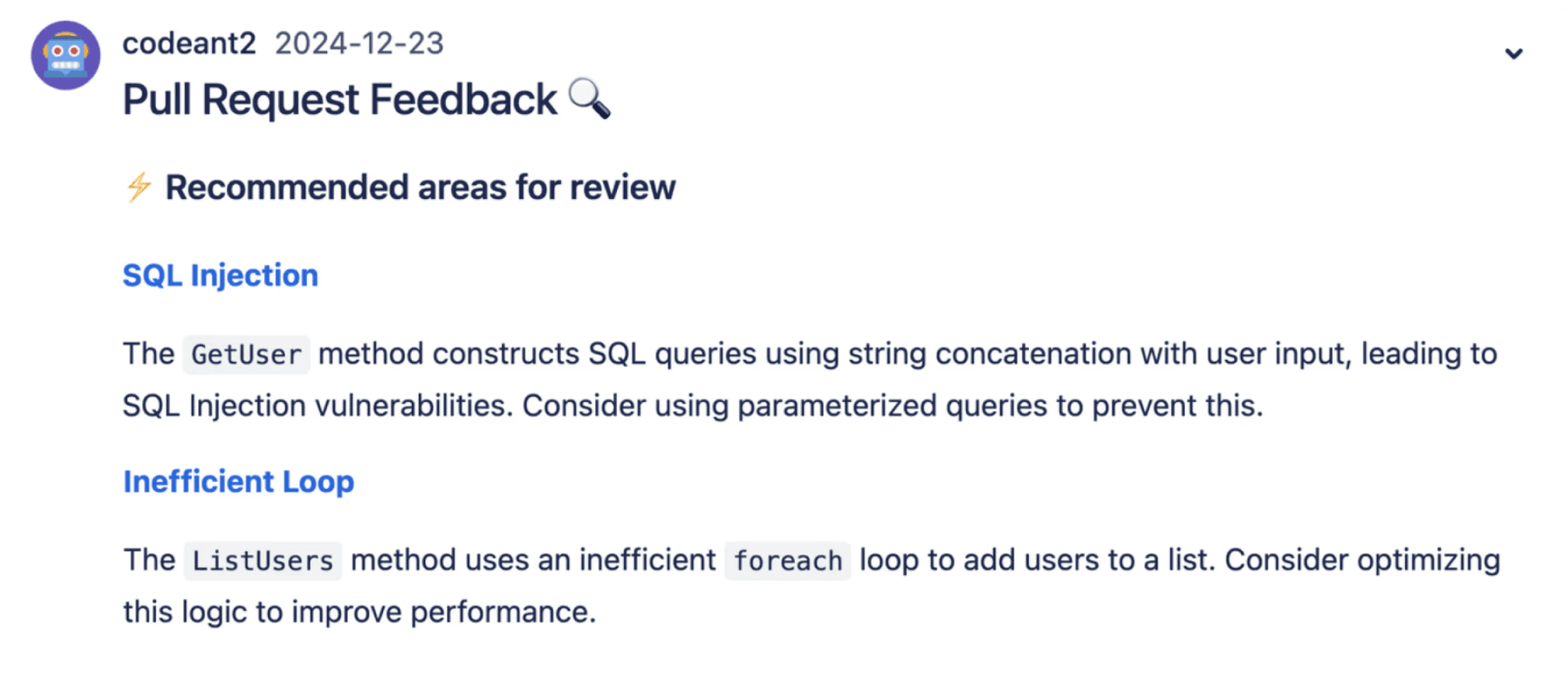
Comments should be specific, reproducible, and ranked by severity, not a flat list mixing nitpicks with critical security issues. Reviewers need to know what blocks merge, what's a suggestion, and what's noise.
Where Manual Reviews Hit Limits
Even well-intentioned teams hit predictable bottlenecks:
Bottleneck | Impact | Root Cause |
Review Queue Buildup | PRs wait 8–24 hours for feedback | Limited reviewer availability across timezones |
Inconsistent Quality | Critical issues slip through while nitpicks dominate | Reviewer experience varies; no standards enforcement |
Nitpick Fatigue | Reviewers burn out on style comments | Manual checking of formatting and simple patterns |
Context Switching Cost | 15–30 minutes per PR just to understand changes | Bitbucket shows diffs, not full codebase context |
These aren't process failures, they're inherent limitations of manual-only workflows at scale.
Key Metrics for Review Quality
Before diving into workflow specifics, define success criteria:
Velocity:
Cycle time: PR open to merge (target: <24 hours for standard changes)
First response time: How quickly PRs get initial feedback (target: <2 hours)
Review iterations: Back-and-forth cycles (target: <3)
Quality:
Defect escape rate: Bugs in production that should've been caught (target: <5%)
Security detection: Vulnerabilities caught before merge (target: 100% of common patterns)
Team Health:
Reviewer workload: Are reviews evenly spread? (target: <30% variance)
Nitpick ratio: Style comments vs. substantive feedback (target: <20% nitpicks)
Setting Up Bitbucket for Effective Reviews
Configure Branch Permissions and Merge Checks
Proper branch protection prevents low-quality code from reaching production:
Core platform repositories (customer-facing services, shared libraries):
Restrict merges to tech leads and senior engineers
Required approvals: Minimum 2, with 1 from designated code owner
Enable: All builds must pass, all tasks resolved, no open conflicts
Internal tooling:
Allow all team members to merge
Required approvals: Minimum 1
Disable self-approval to prevent rubber-stamping
Configure in Bitbucket: Repository settings → Branch permissions → Add branch permission for main, master, or release/* patterns.
Essential merge checks:
Required before merge:
✓ All builds pass
✓ Minimum approvals met
✓ All tasks resolved
✓ No merge conflicts
✓ Default reviewers approved
Use PR Templates to Reduce Cognitive Load
Create .bitbucket/pull_request_template.md:
## What changed?
Brief description and why it was needed.
## Related Ticket
Fixes #1234 (link to issue)
## How to test
1. Check out branch
2. Run `npm run test:integration`
3. Verify endpoint returns 200
Configure default reviewers by path:
Repository Settings → Default reviewers
Add rules:
src/api/**→ API team,src/frontend/**→ Frontend team
Integrate CI Status Checks as Mandatory Gates
Essential CI checks to require:
Unit and integration tests with coverage thresholds (e.g., ≥80%)
Linting and formatting (ESLint, Prettier)
Security scanning (Snyk, Trivy, or CodeAnt for vulnerabilities and secrets)
Build verification in staging environments
Dependency audits for outdated or vulnerable packages
Example Bitbucket Pipeline:
The Step-by-Step Review Process
Phase 0: Author Preparation (Before Submitting)
Keep PRs focused: Target 200–400 lines per PR. Break large work into sequential PRs.
Write clear context:
What changed and why
Link to ticket/issue
How to verify the change
Migration or deployment notes
Self-review first: Walk through your own diff. Catch obvious issues before requesting review.
Phase 1: AI Pre-Review (0-2 Minutes)
Modern workflows insert automated analysis before human review. When integrated, AI tools like CodeAnt automatically:
Generate PR summary with full codebase context—how changes interact with existing patterns
Scan for security issues: hardcoded secrets, SQL injection, authentication bypasses
Check complexity and maintainability: cyclomatic complexity, duplication, missing error handling
Validate test coverage: identify untested branches
What reviewers see:
🔴 CRITICAL: SQL injection in PaymentService.findByTransactionId()
Line 47: User input concatenated into query
Fix: Use parameterized queries
🟡 MEDIUM: Missing error handling for payment gateway timeout
Line 112: NetworkException not caught
🟢 LOW: Inconsistent naming convention
Line 203: snake_case instead of camelCase
Auto-fix available
Time saved: From 20-30 minutes of manual scanning to 2 minutes of triaging ranked findings.
Phase 2: Human Review (10-15 Minutes)
With AI handling repetitive checks, focus on what requires judgment:
The Seven-Point Review Rubric
1. Intent and Requirements Alignment
Does the PR solve the stated problem?
Check for scope creep or unrelated changes
2. Correctness and Edge Cases
Trace happy path, then failure modes: null inputs, empty collections, timeouts
Look for off-by-one errors, missing validation
3. API and Contract Changes
Identify breaking changes to interfaces or data contracts
Verify backward compatibility
4. Security and Auth/Authorization
Missing permission checks before data access
SQL injection, XSS, or SSRF vulnerabilities
Exposed credentials or overly permissive policies
5. Performance and Failure Modes
N+1 queries, missing indexes, unbounded loops
Resource leaks: unclosed connections, unfreed memory
Graceful error handling and recovery
6. Data Migrations and Schema Changes
Verify migrations are idempotent and reversible
Check for data loss risks
7. Test Coverage and Quality
Unit tests for new logic, integration tests for workflows
Tests that verify behavior, not just coverage metrics
Edge cases and error conditions tested
Reading Diffs Effectively
Start with the file tree: Understand scope, localized or scattered?
Read tests first: Tests reveal intent better than implementation.
Look for asymmetry: If a function is added but never called, something's wrong.
Flag complex conditionals: Nested ifs and deeply nested loops hide bugs.
Phase 3: Feedback and Iteration (5-10 Minutes)
Structure feedback by priority:
Must fix before merge:
Fix SQL injection (line 47)
Add timeout error handling (line 112)
Add test coverage for failure scenarios
Should fix (strong recommendation):
Consider async processing for long-running transactions
Extract shared transaction logic to avoid duplication
Nice to have (non-blocking):
Rename method to match camelCase convention
Add inline documentation for edge cases
Write actionable comments:
❌ Vague: "This function is too complex."
✅ Actionable: "This function has cyclomatic complexity of 15. Extract validation logic (lines 45-67) into validateUserInput() to improve testability."
Phase 4: Re-Review and Approval (2-5 Minutes)
The author pushes updates. Verify:
Critical findings resolved
Suggested tests added
Quality gates pass
Approve with clear criteria:
✅ Approved! Nice work addressing security issues and adding test coverage.
Let's discuss async processing in our next architecture review.
Total review time: ~20 minutes for a 500-line PR, compared to 60-90 minutes purely manual.
Scaling Reviews Across Distributed Teams
Solving Cross-Timezone Delays
The async-first PR description framework:
Context block: ticket link, business problem, why this approach
Change summary: what changed at component level
Test plan: explicit verification steps
Deployment notes: migrations, feature flags, config changes
Reduce idle time:
AI review provides 24/7 feedback regardless of reviewer timezones
Developers fix issues before end-of-day, unblocking next timezone
Quality Gates enforce standards automatically
Pattern: Author submits PR → AI reviews instantly → Author addresses findings before logging off → Next timezone reviewer focuses on architecture, not bugs.
Maintaining Consistent Quality
Structural solutions:
Code ownership (CODEOWNERS): Require expert approval for critical paths
Rotating reviewer assignments: Pair juniors with seniors on rotation
Review debt tracking: Tag PRs with light review for follow-up audits
AI enforcement:
Modern AI tools learn your organization's patterns and enforce baseline standards automatically:
Every PR gets expert-level security, complexity, and style analysis
No PR merges with critical issues, regardless of reviewer experience
Human reviewers focus on the 20% requiring judgment: API design, business logic, architecture
Handling High PR Volume
Process optimizations:
Size limits: Enforce 400-line maximum via merge checks
Review capacity planning: Track workload, rebalance when reviewers hit 12+ PRs
Async-first culture: Don't expect immediate responses; use inline threads for discussions
AI leverage:
AI handles 80% of repetitive pattern matching, catching secrets, identifying unused code, flagging complexity. This cuts per-PR review time by 70-80%, letting teams handle 3-4x volume without increasing headcount.
Measuring and Improving Your Process
What to Measure
Flow metrics:
Time-to-first-review: Gap between PR creation and first comment (target: <4 hours)
Time-to-merge: PR open to merge (track by size: <24h for sub-100 lines)
Review iterations: Rounds of feedback before approval (target: <3)
Quality metrics:
Escaped defects: Production bugs that should've been caught (track by severity)
Security findings per PR: Vulnerabilities detected and resolved pre-merge
Test coverage trends: Are new features adequately tested?
Reviewer health:
Load distribution: Are 20% of reviewers handling 60%+ of PRs?
Comment resolution time: How long authors take to address feedback
Approval ratio: PRs approved without changes (80%+ suggests rubber-stamping; <40% suggests overly strict standards)
Using Dashboards for Continuous Improvement
Track trends to identify bottlenecks:
If review cycle time increases 30% in a quarter, drill into which repos are slowest
If the same security vulnerability appears in 15% of PRs, that's a systemic training gap
If certain reviewers are overloaded, rebalance assignments
Data-driven improvements:
High false positive rate on a rule? Adjust threshold or context
Critical issues passing review? Tighten Quality Gates
Repeated complexity violations in one service? Trigger refactor initiative
When to Add AI-Assisted Review
Bitbucket Native Is Sufficient When:
Team under 20 developers
Low PR volume (<10-15 PRs/day)
Non-regulated industry without strict compliance
Simple codebase with minimal dependencies
AI-Assisted Review Becomes Essential When:
Scenario | Pain Point | AI Solution |
100+ developers | Inconsistent quality across reviewers | Baseline standards enforced on every PR |
50+ PRs/day | Reviewer burnout, rubber-stamping | 80% time reduction, handles repetitive checks |
Distributed teams | Cross-timezone delays block merges | 24/7 feedback, developers iterate without waiting |
Compliance/security requirements | Manual checks miss vulnerabilities | Continuous scanning with SAST, secrets detection |
Complex codebases | Reviewers lack context for side effects | Full codebase analysis catches ripple effects |
Pragmatic Adoption Path
Week 1: Connect AI tool (e.g., CodeAnt) to Bitbucket; enable on one repo; let AI pre-review all PRs
Week 2-3: Configure Quality Gates to block critical issues; integrate with merge checks
Week 4+: Enable dashboards to track metrics; expand to additional teams
Expected ROI for 100-developer team:
Manual: 30 min/PR × 50 PRs/day = 25 hours/day
With AI: 6 min/PR × 50 PRs/day = 5 hours/day
Savings: 100 hours/week = $150K–$200K annually
Plus: 3x more security issues caught, faster cycle times, consistent quality.
Conclusion: Ship Better Code, Faster
A good Bitbucket code review is a repeatable system, not a heroic effort. The workflow: authors prepare focused PRs with context; AI pre-review catches security, complexity, and style issues instantly; humans focus on design, correctness, and business logic; iteration happens through inline tasks; merge checks enforce quality before code ships.
Your implementation roadmap:
Week 1: Configure merge checks, deploy PR templates, measure baseline cycle time
Week 2: Add AI pre-review on one high-traffic repo; let it handle repetitive checks
Week 3-4: Compare metrics (cycle time, defect rate, workload); expand to additional teams based on results
Success metrics to track:
Cycle time: 40-60% reduction
Time-to-first-review: <2 hours (vs. 8-12 hours)
Defect escape rate: 50%+ fewer issues reaching production
Security findings: 3-5x more caught pre-merge
Reviewer time savings: 70%+
Ready to transform your Bitbucket workflow?Start your 14-day free trial with CodeAnt AI on a single repo, no credit card required. Most teams see measurable improvements within the first week.
FAQs
How many approvals should I require on a PR?
How do I avoid nitpicking and keep reviews focused?
What's a realistic review SLA?
Who should review my code?
How do I enforce standards without slowing down my team?