

That $0.10 per million token model looks like a steal, until your monthly invoice arrives at 10x what you budgeted. The paradox is real: cheaper per-token rates often hide dramatically higher total costs because budget models consume far more tokens to complete the same work.
The culprits range from verbose outputs and retry loops to bloated conversation histories and redundant API calls. This guide breaks down exactly where those hidden costs come from, how to calculate your true LLM spend, and practical strategies to cut expenses without sacrificing output quality.
Why Cheaper Per Token Pricing Misleads Engineering Teams
Low per-token rates often hide higher overall costs because cheaper models consume far more tokens to complete the same task. A model advertising $0.10 per million tokens looks attractive on paper. But if that model generates verbose outputs, requires longer prompts, and fails more often than a premium alternative, the savings disappear fast.
Here's the core problem: cheaper models typically produce longer, less precise responses. They also require more detailed prompts with explicit instructions to achieve acceptable quality. When a budget model consumes 10x more tokens due to inefficiency, the math flips against you.
Consider a practical example. A premium model at $3 per million tokens might complete a task in 500 tokens. A budget model at $0.30 per million tokens might require 5,000 tokens for the same result, and still produce lower quality output. The "cheaper" option actually costs more while delivering less.
Hidden Cost Drivers That Inflate LLM Bills
Beyond the per-token price, several factors multiply your actual token consumption in ways that aren't obvious until you're deep into production.
Context Window Overhead
The context window represents the total text (input plus output) that a model processes in one request. Every API call includes system instructions, few-shot examples, and conversation history before the model even starts generating a response.
A typical enterprise prompt might include 2,000 tokens of context before asking a simple question. That overhead repeats on every single call. Cheaper models with smaller context windows force you to split tasks across multiple requests, and each one pays that overhead again.
Retry and Failure Rates
Less capable models fail more often. They produce incorrect outputs, hallucinate facts, or return unusable responses that require re-prompting. Each retry doubles or triples your token spend for a single successful completion.
If a cheaper model has a 30% failure rate compared to 5% for a premium model, you're effectively paying for 1.3x the calls before accounting for the developer time spent identifying and handling failures.
Prompt Verbosity Requirements
Cheaper models often require longer, more explicit prompts to produce acceptable results. Where a capable model understands "summarize this document," a budget model might require detailed instructions about length, format, tone, and what to include or exclude.
This extra instruction overhead adds input tokens to every request. Over thousands of daily calls, those extra tokens compound into significant costs.
Multi-Turn Conversation Bloat
In conversational applications, dialogue history accumulates with each turn. The entire conversation context gets passed with every new message, expanding the token count exponentially.
Cheaper models that produce verbose responses accelerate this bloat. A model that uses 200 tokens where 50 would suffice creates conversation histories that grow 4x faster. You pay for that history on every subsequent turn.
Output Quality and Rework Costs
Poor quality outputs create a hidden cost that doesn't appear on your LLM invoice: developer time spent fixing, re-prompting, or manually correcting responses.
When AI-assisted code review produces inconsistent or incorrect suggestions, engineers waste time evaluating and discarding bad recommendations. Consolidated AI platforms like CodeAnt AI address this by improving consistency across code review, security scanning, and quality analysis, which reduces the rework loop.
How Token Consumption Explodes in Production Workloads
Real-world production scenarios multiply token consumption in ways that proof-of-concept testing rarely reveals.
Agentic Workflows and Compound Calls
Agentic workflows are autonomous AI systems that make multiple sequential LLM calls to complete complex tasks. A single user request might trigger a planning step, several execution steps, a verification step, and a summarization step.
Each step in the agent's process multiplies token usage. If your agent makes 15 LLM calls to handle one user query, your per-query cost is 15x what you estimated from single-call testing. Cheaper models that require more reasoning steps compound this problem further.
RAG Pipeline Token Multiplication
Retrieval-Augmented Generation (RAG) enhances LLM responses by injecting relevant documents retrieved from a knowledge base. Those retrieved documents get added to the prompt as context.
A typical RAG query might retrieve 3-5 document chunks totaling 2,000-4,000 tokens, added to every single query. This context injection happens regardless of the model's per-token price, making efficient retrieval and chunking strategies critical for cost control.
Logging and Audit Overhead
Many applications require logging full prompts and responses for compliance, debugging, or analytics. This creates storage and processing costs beyond direct token fees. Verbose models generate larger logs, increasing storage costs and making debugging more time-consuming.
How to Calculate True LLM Total Cost of Ownership
Understanding real costs requires a Total Cost of Ownership (TCO) framework that captures all direct and indirect expenses. A proper TCO analysis often reveals that models with cheaper per-token rates actually cost more when all factors are included.
Cost Component | What to Measure |
Token costs | Input + output tokens × price per token |
Retry overhead | Failed requests × average tokens per retry |
Infrastructure | Latency, throughput, API gateway fees |
Developer time | Hours spent fixing poor outputs |
Opportunity cost | Delayed features due to model unreliability |
Track these metrics for at least two weeks of production traffic before making model decisions. Proof-of-concept testing almost never captures the full cost picture.
How to Choose the Right Model for Each Task
Not every task requires the most expensive model, or the cheapest. The key is matching model capability to task complexity.
Matching Model Capability to Task Complexity
Simple tasks like text classification, entity extraction, or basic formatting work well with smaller, cheaper models. Complex tasks requiring deep reasoning (code generation, nuanced analysis, multi-step problem solving) benefit from more capable models. The cost of retries and poor outputs on complex tasks typically exceeds the savings from cheaper per-token rates.
When Smaller Models Outperform
Lighter models genuinely provide better value in specific scenarios:
High-volume, low-complexity tasks: Classification, tagging, simple extraction
Predictable output formats: Structured data generation, template filling
Easily verifiable results: Tasks where automated testing can catch failures quickly
For these use cases, a smaller model's speed and cost advantages outweigh capability limitations.
Multi-Model Routing Architectures
Model routing uses an intermediary layer, often called an AI gateway, to direct queries to the most appropriate model based on task requirements. A routing architecture might send simple queries to a budget model while routing complex requests to a premium model. This approach optimizes cost and performance simultaneously, using expensive models only when necessary.
Proven Strategies to Cut LLM Costs Without Sacrificing Quality
Several tactics help engineering teams reduce LLM expenses while maintaining output quality.
Implement Prompt Caching for Repeated Content
Prompt caching stores and reuses responses for identical or similar prompts. System prompts, common instructions, and frequently asked questions are prime candidates for caching. Many providers now offer native prompt caching that reduces costs for repeated prefixes.
Prune and Summarize Conversation History
Instead of passing entire conversation histories with each turn, compress or summarize prior context. A 10-turn conversation might be summarized into 200 tokens rather than passed as 2,000 tokens of raw history. This technique significantly reduces input tokens in multi-turn applications while preserving the context the model actually uses.
Use Tools and Code Execution to Reduce Context
Offload computational or deterministic tasks to external tools like calculators, code interpreters, database queries, or API calls. This prevents the model from performing verbose reasoning chains in its response. A model asked to calculate compound interest might generate 500 tokens of step-by-step math. A tool call returns the answer in 10 tokens.
Consolidate AI Tools to Eliminate Redundant Calls
Using multiple disconnected AI tools for related tasks creates redundant LLM calls. Each tool might independently analyze the same code, duplicating token consumption. Unified platforms like CodeAnt AI consolidate code review, security scanning, and quality analysis into single efficient workflows. One comprehensive analysis replaces multiple overlapping tool calls.
👉 Try CodeAnt AI to consolidate your AI-powered code health workflows.
Batch Requests to Maximize Throughput
Where possible, group multiple independent queries into single API calls. Batching reduces per-request network overhead and can lower overall latency costs. This approach works well for asynchronous processing where immediate responses aren't required.
Balancing Cost, Quality, and Latency in Production
Optimizing LLM usage means navigating tradeoffs between cost, quality, and latency. Focusing purely on one metric often degrades the others.
Cost vs. Quality: Cheaper models typically produce lower-quality outputs, increasing human review and rework
Cost vs. Latency: Batching saves money but increases perceived response time for individual users
Quality vs. Latency: The most capable models often have longer inference times, impacting real-time user experience
Establish clear quality thresholds before aggressively optimizing for cost. A 20% cost reduction that doubles your error rate rarely makes business sense.
What Metrics to Track for LLM Cost Efficiency
Effective cost management requires monitoring specific KPIs beyond simple token counts.
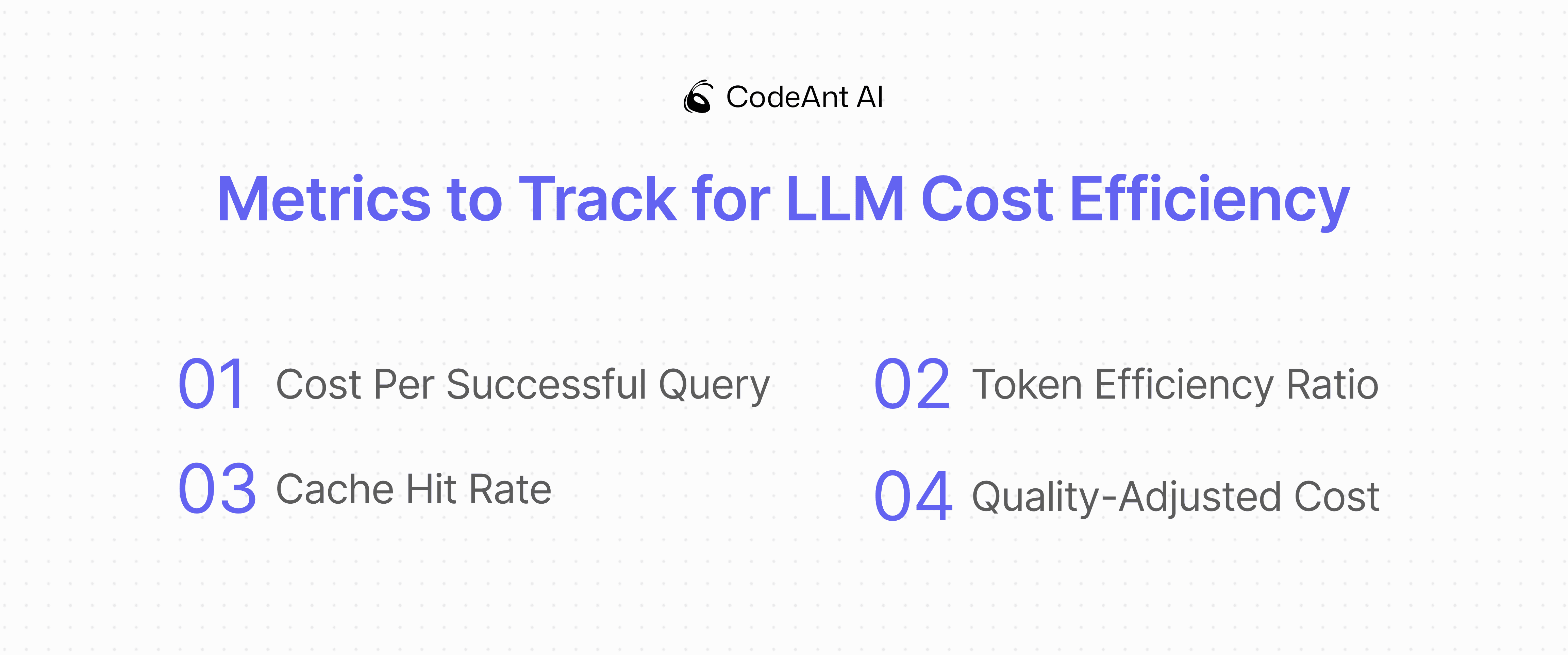
Cost Per Successful Query
Calculate total spend divided by queries that produced valid, acceptable outputs. This metric inherently accounts for retry costs and gives a truer picture of task-completion expense. A model with 95% success rate at $0.02 per query beats a model with 70% success rate at $0.01 per query.
Token Efficiency Ratio
Measure useful output tokens divided by total tokens consumed (input plus output). This ratio penalizes verbosity and inefficiency, showing how much value you extract per token spent.
Cache Hit Rate
Track the percentage of requests served from cache rather than requiring new model calls. Higher cache hit rates directly indicate improved cost efficiency.
Quality-Adjusted Cost
Calculate cost per output weighted by a quantitative quality score. This advanced metric enables fair comparison between models with different capability and price levels.
Building Sustainable AI Economics for Your Engineering Team
Managing LLM costs effectively requires a strategic approach that goes beyond chasing the lowest per-token price.
Start with a Total Cost of Ownership analysis before selecting any model. Include retry rates, developer time, and infrastructure costs, not just token fees. Then implement model routing to match tasks with appropriate models. Simple tasks go to budget models; complex tasks go to capable models.
Consolidate AI tooling to eliminate redundant calls. Platforms like CodeAnt AI unify code health analysis into single efficient workflows, reducing the overhead of running multiple disconnected tools. Finally, move beyond tracking simple token costs. Monitor cost-per-successful-query and quality-adjusted cost to understand your true AI economics.
Ready to optimize your AI-powered development workflow? Book your 1:1 with our experts today!

