

In 2026, application security isn’t starved for data, it’s overwhelmed by it. Developers are flooded with CVEs. Security teams are buried in dashboards. And everyone’s asking the same question: “Which vulnerabilities actually matter right now?”
That’s the problem the Exploit Prediction Scoring System (EPSS) was built to solve, and it’s why CodeAnt now integrates EPSS scores, trends, and fix guidance across both SAST and SCA workflows.
This post breaks down:
What EPSS is and why it matters
Where traditional scoring like CVSS falls short
How CodeAnt AI applies EPSS to help teams fix what’s likely to be exploited
Why this shift matters for dev-first security and risk-aware engineering
What Is EPSS?
EPSS is a scoring system that predicts the probability a vulnerability will be exploited in the wild in the next 30 days. It’s developed by FIRST.org and powered by live threat data: malware activity, exploit toolkits, scanning trends, and more.
Each vulnerability is assigned a score between 0 and 100, not based on hypothetical severity, but on how often attackers are actually using it.
Key difference from CVSS:
CVSS | EPSS |
Measures theoretical impact | Measures real-world likelihood |
Static score, rarely updated | Dynamic, data-driven, updated frequently |
Treats all environments equally | Informed by threat telemetry and exploit behavior |
In short: CVSS tells you how bad a vuln could be. EPSS tells you how likely it is to hurt you now.
Why CVSS Alone Isn’t Enough
For years, security tools have leaned heavily on CVSS to rank risk. But this has led to real-world bottlenecks:
Alert fatigue: Critical CVSS scores flood dashboards, even if most are never exploited.
Misallocated effort: Teams fix what’s loud, not what’s urgent.
Slowed engineering: Developers chase down findings with zero exploit value.
According to CISA, only 4% of known CVEs are actively exploited, yet they cause the vast majority of breaches. That’s the signal EPSS surfaces.
Why EPSS Matters for Developers and Engineering Teams
EPSS flips the conversation from severity-first to likelihood-first. For fast-moving product teams, this changes everything:
Backlogs shrink: because you filter by real-world risk.
Review decisions get faster: because triage is data-backed.
DevSecOps alignment improves: because you can justify what gets fixed, delayed, or blocked.
But the real unlock comes when this scoring becomes part of the developer workflow, not another dashboard. That’s where CodeAnt AI comes in.
How CodeAnt AI Integrates EPSS into Developer Workflows
Where exploit intelligence meets day-to-day engineering
One of the hardest parts of DevSecOps isn’t detection, it’s decision-making. You might know there’s a vulnerability, but you’re still left asking: “Is this likely to be exploited? Does it impact this repo? Should I fix it now or defer it?”
CodeAnt.ai’s integration of EPSS closes that gap. It brings predictive exploitability into the same surface where devs triage findings, review PRs, and make fix-or-merge decisions, no switching tabs, no buried reports.
Let’s break that down across the two most common surfaces: SAST and SCA.
EPSS for SAST
Signal, not noise, right inside the pull request
When a static finding is flagged (e.g. insecure input validation, hardcoded secrets, unsafe concurrency), CodeAnt doesn’t just show you the rule that was violated. It shows you:
1. EPSS Score
A real-time probability (0.0 to 1.0) that this specific class of issue will be exploited in the next 30 days, based on live telemetry from malware, scanning activity, and attacker behavior patterns.
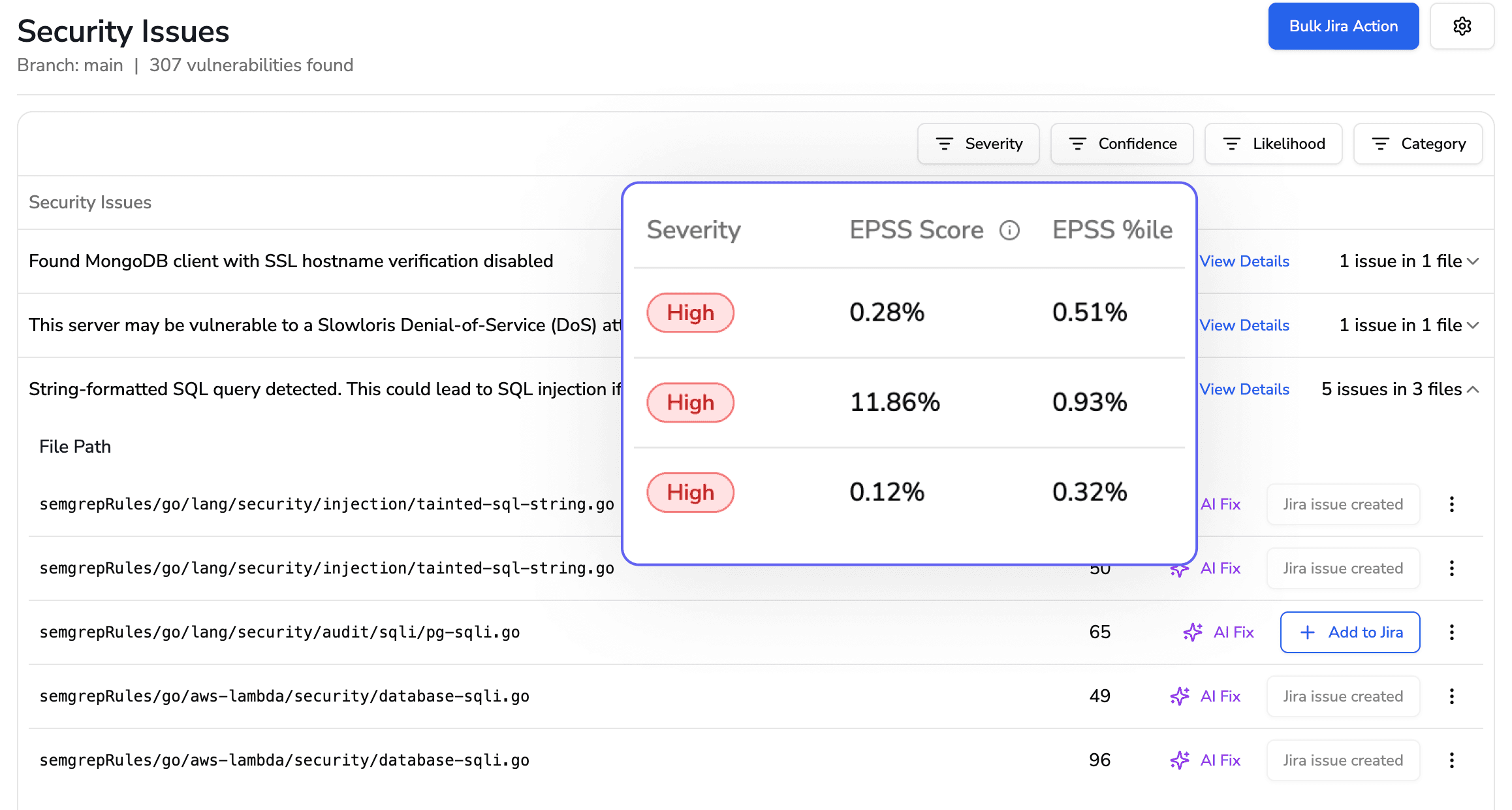
2. Percentile Ranking
Contextualizes the score globally, e.g., “this finding is riskier than 94% of known vulnerabilities today.”
3. 30-Day Trend Chart
See if exploit activity is accelerating. A vuln trending upward may warrant urgent review, even if it doesn’t have a “critical” label.
4. Inline AI Fix Suggestions
Secure code snippets and patterns, contextualized to your language and repo structure, are suggested when EPSS scores cross risk thresholds. These aren’t just generic autofixes; they’re pattern-aware and review-ready.
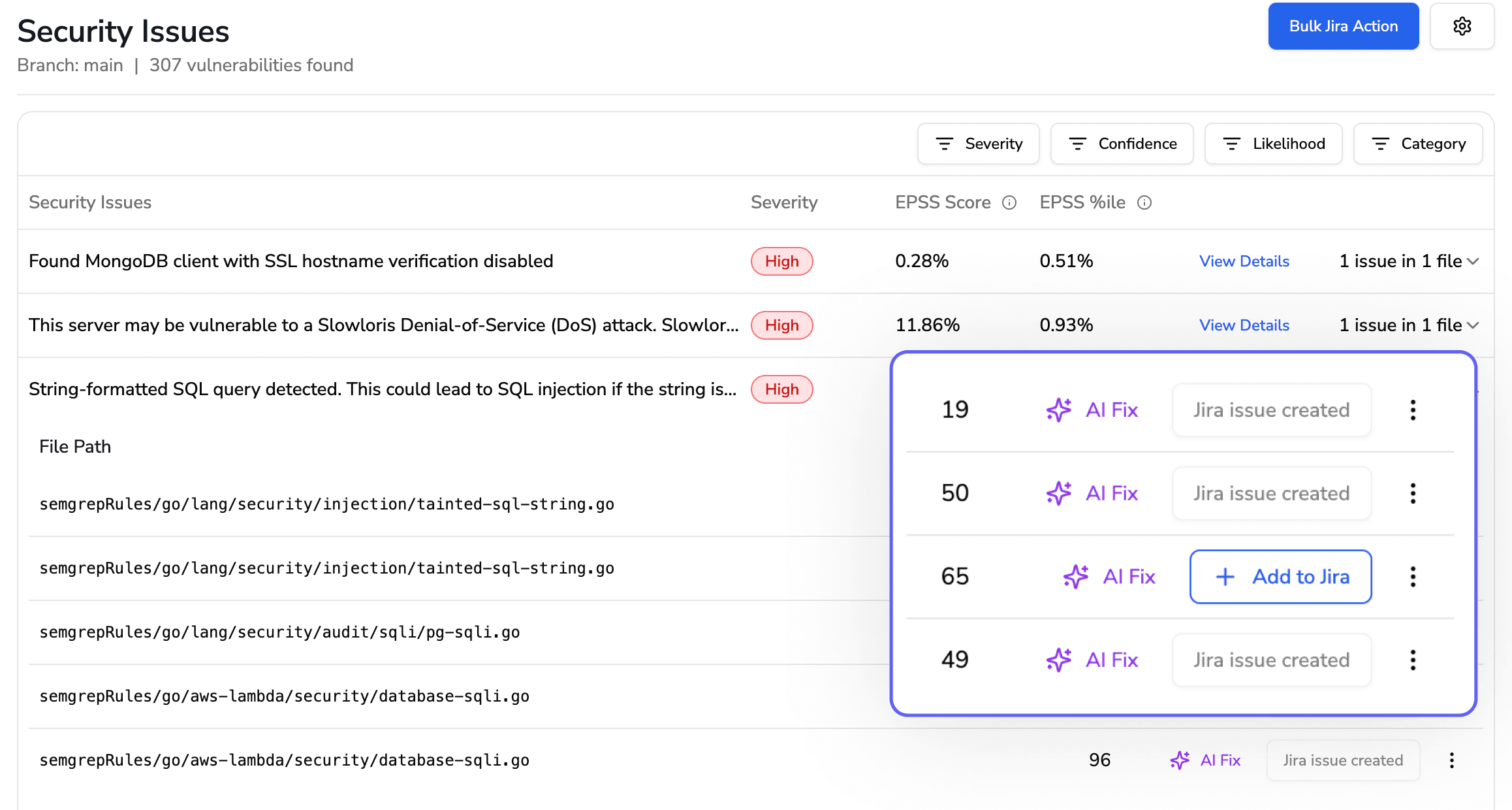
These insights are surfaced directly:
In the PR view (so the reviewer knows what’s urgent)
In developer dashboards (so security debt isn’t hidden)
Via CLI, if reviewing locally
Example: A PR introduces a regex injection vulnerability. CodeAnt.ai flags it with EPSS 0.79, 88th percentile, and a sharp upward trend. Instead of leaving it buried under five other “medium” alerts, it surfaces as a priority, with a one-click AI fix inline. No debate, no delay.
EPSS for SCA
Smarter dependency decisions with real-world exploit signals
For open-source libraries, traditional scanners stop at "this version has a CVE." CodeAnt adds context that actually matters to engineers:
1. EPSS per Package Version
Not just at the vulnerability level, we calculate EPSS based on the specific version of the package in your repo. Because not every CVE matters in every version.
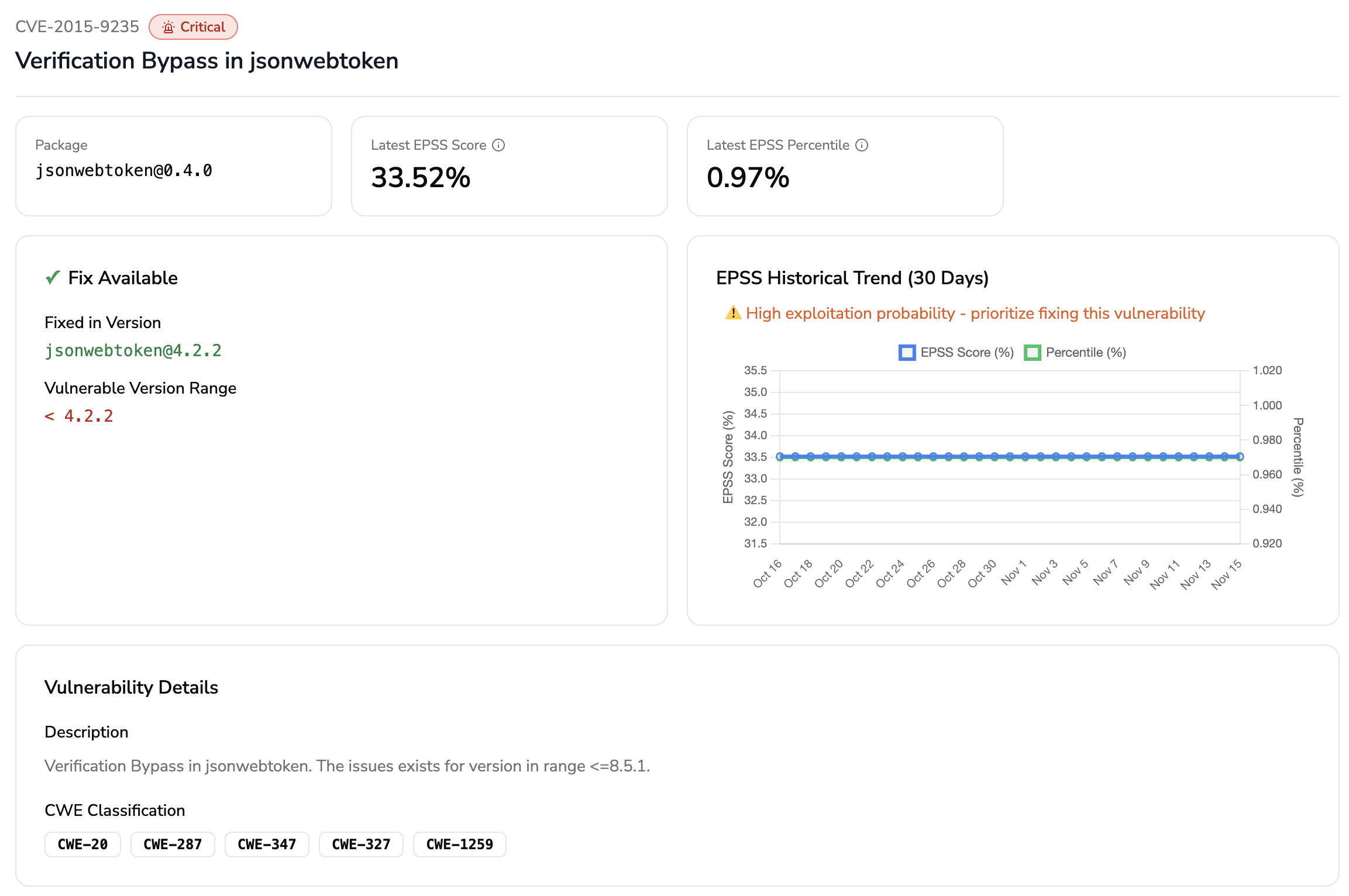
2. Fix Availability with Risk Context
CodeAnt.ai shows safe upgrade paths for vulnerable packages, highlighting which fixes are non-breaking, so your team can reduce risk without grinding delivery to a halt.
3. Exploit Surge Indicators
Dynamic graphs show when a package is trending in attacker activity. This often predicts what will show up on public threat feeds days later, giving your team a lead time advantage.
Example: A logging library in your project has CVSS 5.4, typically low urgency. But CodeAnt AI shows EPSS 0.83 for your exact version, with a trend line that’s sharply up since last week. Fixes are available one minor version up. You prioritize the patch, block the PR, and stay ahead of an exploit campaign that makes headlines two days later.
Why This Matters
With EPSS built into your CodeAnt AIworkflow:
Developers get fewer, higher-quality signals
Engineering managers get clear risk justification
Security teams get exploit-aware triage without extra overhead
This isn’t about adding another column to your vuln report. It’s about building smarter defaults, so you’re not just scanning code, you’re prioritizing what attackers actually care about.
Risk-Aware Quality Gates: From Insights to Actions
All the EPSS intelligence in the world doesn’t help if it doesn’t affect delivery. That’s why CodeAnt lets you enforce EPSS-aware policies in your pipelines.
You can:
Block or flag PRs if vulnerabilities exceed a set EPSS threshold (e.g. )
Apply different rules for SAST vs SCA
Auto-create Jira tickets or route findings based on risk profiles
This means engineering and security stay in sync, without needing a separate meeting to negotiate every PR exception.
Why EPSS in CodeAnt AI Is Different Other Tools
Most platforms still treat CVSS as the primary risk lens. Some offer priority scoring, but:
Their models are static or generic
They rarely integrate EPSS into both SAST and SCA
They focus more on flagging than fixing
CodeAnt AI takes a different approach:
EPSS is updated continuously and tied to your actual code and dependencies
Fix suggestions adapt to your codebase and ecosystem
Exploit trends are visible per finding, not just at report level
Developers see all this where they work, in the PR, in the CLI, in CI/CD
In short: we don’t just surface EPSS, we apply it.
Final Takeaway: Fix What’s Likely to Be Exploited First
Security teams can’t fix everything. Developers shouldn’t have to guess what’s urgent. And CVSS can’t carry the weight of risk alone. EPSS is the missing layer of prioritization, and CodeAnt AI makes it usable.
By integrating EPSS into every part of the secure coding workflow, we help teams:
Cut false positives and dead-end findings
Respond to real-world risk as it changes
Fix faster, and smarter
Want to see how EPSS can reduce security noise and speed up your fixes? [Get a demo of CodeAnt’s EPSS-powered workflow].

