

CodeAnt AI and HackerOne both find and fix security vulnerabilities, from opposite ends of the software lifecycle.
CodeAnt AI reviews code in pull requests and CI/CD, then reuses that same code context to run agentic AI penetration testing against your applications and APIs.
HackerOne runs the H1 Platform, a researcher-anchored security program spanning bug bounty, pentesting, AI red teaming, and code review.
What CodeAnt AI solves here: one code-aware layer reviews every pull request for vulnerabilities, then reuses what it learned about your auth flows, APIs, and data models to drive an automated pentest. Findings land in the PR with file and line references, not in a separate dashboard.
The two models split on delivery. CodeAnt AI is AI-automated and self-serve, running continuously inside your dev workflow.
HackerOne is anchored in a large researcher community with human-in-the-loop validation, delivered through enterprise engagements. Most mature SaaS teams eventually run both.
So the first question is which problem to solve first. Preventing and validating code-informed issues before they reach production, or expanding external researcher coverage across a deployed attack surface.
How Do CodeAnt AI and HackerOne Differ?
Both platforms now review code and run agentic pentests. They diverge on where the intelligence comes from and how a finding reaches a developer.
CodeAnt AI’s Unified Code Intelligence
CodeAnt AI runs on a single code-intelligence layer that powers both defensive review and offensive testing. Reviewing pull requests, it builds an understanding of your application, authentication flows, API endpoints, data models, and authorization boundaries.
That understanding then drives the pentest. When its agents start reconnaissance, they arrive pre-informed by the same code analysis that runs on every review:
Black box agents know which subdomains exist from CI/CD configs, which JavaScript bundles carry hardcoded secrets, and which cloud assets to enumerate.
White box agents trace data flows from HTTP entry points to dangerous sinks using the same AST analysis that catches injection during code review.
Gray box agents test role boundaries because they have already mapped authentication middleware and session handling from source.
CodeAnt AI runs across GitHub, GitLab, Bitbucket, and Azure DevOps, and deploys 500+ exploit agents that chain findings rather than checking them in isolation. The reconnaissance is code-informed, so the pentest attacks from outside with inside knowledge of your architecture.
HackerOne’s H1 Platform And Researcher Community
In June 2026, HackerOne consolidated its products under the H1 Platform, positioned around continuous threat exposure management. An AI orchestrator called Hai runs across discovery, validation, prioritization, and remediation.
The platform spans H1 Bounty, H1 Agentic Pentest, H1 Continuous Testing, H1 AI Red Teaming, H1 Validation, and H1 Code. Its foundation is one of the largest security-researcher communities in the industry, paired with human-in-the-loop expert validation.
Researchers test deployed systems and attack surface from the outside. That surfaces creative attack paths, particularly business logic flaws, that automated tooling can miss.
H1 Code extends this into the pipeline. It detects vulnerabilities in commits and pull requests using SAST and SCA with reasoning models, escalates complex issues for human review, and delivers into GitHub, GitLab, Bitbucket, and Azure DevOps.
The older idea that HackerOne only tests deployed systems no longer holds. The distinction now is delivery. CodeAnt AI centralizes review and pentest in one automated, self-serve product, while HackerOne’s depth is anchored in human researchers and enterprise engagements.
How Each Approaches Exploit Chains And Remediation
CodeAnt AI constructs multi-step chains by reasoning about application architecture. An open signup pool grants a default role, the default role reaches an admin route that skips an authorization check, and the chain becomes an account-takeover path.

External-only testing would catch the exposed admin route but might miss the full path back to the signup pool. HackerOne researchers excel at creative, human-driven chains, especially business logic flaws that need domain understanding, and H1 Code adds source-based review on top.
On remediation, CodeAnt AI provides file and line references, root cause, and a suggested diff, such as removing a route from an auth-middleware exclusion list and adding an ownership check. A researcher report describes the observable symptom, and your engineers trace it to the root cause unless the program also runs H1 Code against the source.
Dimension | CodeAnt AI | HackerOne |
|---|---|---|
Testing context | Black, white, and gray box with code awareness | Black box researcher testing, plus H1 Code for source review |
Exploit chain depth | Multi-step chains reasoned from internal architecture | Creative, human-driven chains from external behavior |
Validation | Automated exploitability check before a finding is raised | Human triage validates researcher submissions |
Remediation guidance | File and line references, root cause, suggested diff | Researcher narrative and reproduction steps |
How Would Each Platform Catch an Authentication Bypass?
Both platforms would flag the bypass. Only the code-aware path also pins down why it exists and every endpoint it exposes.
Consider a healthcare SaaS with role-based access control and a React admin panel at /admin/dashboard. Here is how each model would likely approach it, as an illustrative walkthrough rather than a specific customer engagement.
The Code-Informed Path
White box analysis identifies that static files are served before the auth middleware runs, which is not visible from outside.
Black box validation then confirms the admin index loads without auth, extracts internal API endpoints from JavaScript, and finds an open signup pool that allows self-registration.
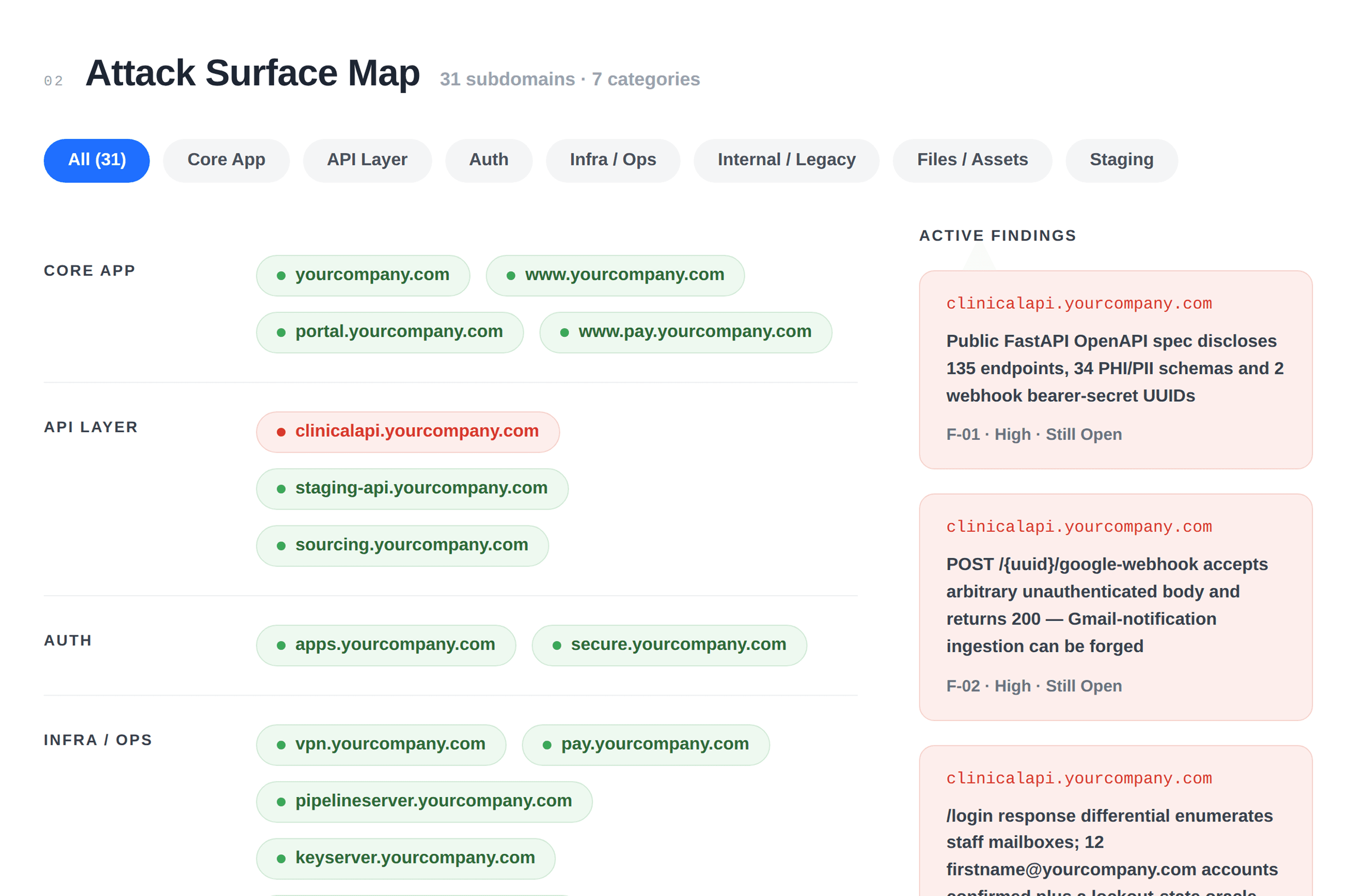
The gray box step chains open signup to a default role to an unprotected admin route, which could expose a large volume of patient records. Root cause traces to a middleware config line, and the report includes the exact code diff.
The External Path
A researcher enumerates subdomains, finds the admin panel, and reports unauthenticated access as broken access control. The symptom is flagged clearly and reproducibly.
Because the tester works from outside, pinning the exact root cause and enumerating every affected endpoint is left to your engineers. If the program also runs H1 Code against the source, some of that code context comes back into scope.
Where Do Findings Land in Your Workflow?
Day to day, what varies is where a finding shows up and how many hands it passes through before a developer sees it.
CodeAnt AI Native Workflow Integration
CodeAnt AI puts security where developers already work.
IDE and CLI: security feedback in the editor as developers write code.
CI/CD gates: block insecure code from merging.
Inline PR comments: findings in GitHub, GitLab, and Bitbucket with file and line references.
Fix suggestions: ready-to-apply patches for common patterns.
Offensive testing: black, white, and gray box pentests with working proof-of-concept exploits and unlimited automated retests after a fix deploys.
Developers never leave their workflow, so there is no context-switch to an external dashboard.
HackerOne Dashboard-First Workflow
HackerOne’s researcher findings arrive through the program and route out to engineering.
Researchers test and submit through the HackerOne dashboard.
Triage validates a submission before it reaches your security team.
The security team assigns work to product or engineering owners.
Integrations with Jira, GitHub Issues, Slack, and ServiceNow move findings into existing tools.
This model adds review and validation steps: researcher to triage, triage to security, security to engineering, and back for retest. H1 Code findings can land closer to the PR, while bounty and pentest findings follow the researcher path.
How Does Each Platform Affect Mean Time to Remediation?
The handoffs shape mean time to remediation. The illustrative timeline below shows an inline PR flow against a researcher-submission flow, and the numbers vary by program and severity.
Metric | CodeAnt AI | HackerOne |
|---|---|---|
Time to developer awareness | Immediate PR comment | Hours to days through triage and routing |
Context provided | File and line refs, root cause, diff, PoC | Researcher narrative and reproduction steps |
Developer action | Apply the fix in the same PR | Open the dashboard, locate the code, open a new PR |
Remediation validation | Automatic retest, included | Retest coordinated through the program |
Typical high-severity MTTR | Around 1 to 3 days | Around 1 to 3 weeks |
How Much Do CodeAnt AI and HackerOne Cost?
Pricing is the most visible divergence between the two models. One is published and per seat, the other sales-led and usage-driven.
CodeAnt AI Pricing
CodeAnt AI publishes its pricing on the pricing page.
Free trial: 14 days, 100 PR reviews, all premium features, unlimited seats, no credit card.
Premium: $24 per user per month, with unlimited PR reviews, dashboards, integrations, and SOC 2 and HIPAA compliance reports.
Enterprise: custom, adding SSO, audit logs, and on-prem deployment.
Free for open source, with startup discounts available.
HackerOne Pricing
HackerOne does not publish pricing. Engagements are sales-led, and bug bounty programs are funded by a customer-defined bounty pool on top of any platform subscription.
Total cost therefore combines a subscription, variable bounty payouts, and the internal time to run the program. That last part, triage, researcher communication, and remediation tracking, is budget even though it never appears on an invoice.
Dimension | CodeAnt AI | HackerOne |
|---|---|---|
Pricing model | Published, per seat ($24 per user per month) | Sales-led, not public |
How to start | 14-day free trial, 100 PR reviews | Contact sales |
What drives cost | Number of seats | Subscription, bounty payouts, and program management time |
Budget predictability | Fixed per seat | Varies with submissions and payouts |
What Compliance Evidence Do CodeAnt AI and HackerOne Provide?
Both platforms can support an audit. They produce different kinds of evidence, so the right fit depends on what your auditors ask for.
Evidence area | CodeAnt AI | HackerOne |
|---|---|---|
Pentest evidence | Audit-ready report per pentest, with exploit PoC, remediation, and retest verification | Program dashboards, finding reports, and researcher activity records |
Retest proof | Automated retest confirms the original exploit no longer works | Retest coordinated through the program |
Control mapping | Maps findings to SOC 2 TSC and ISO 27001 controls | Typically compiled from findings and tickets |
Timeline documentation | Discovery, remediation, and validation dates tracked per finding | Activity timelines live in dashboards, compiled as needed |
Best fit | Teams needing SOC 2, ISO 27001, HIPAA, or PCI-DSS evidence tied to the SDLC | Teams proving ongoing external validation and researcher engagement |
CodeAnt AI is optimized for audit-ready deliverables tied to the code and the fix. HackerOne is strong at demonstrating continuous external validation through researcher engagement and finding history.
Should You Choose CodeAnt AI or HackerOne?
Your choice depends on where you want security to live and how you want it delivered. CodeAnt AI leads for teams that want prevention inside the pipeline, and HackerOne leads for teams that want crowdsourced human depth against a deployed product.
Choose CodeAnt AI If
You want prevention inside the pipeline, with findings inline in pull requests and file-level references.
You need code-aware pentesting and unlimited automated retests tied to the SDLC.
You want transparent, per-seat pricing and a free trial to start.
You need recurring, audit-ready SOC 2, ISO 27001, or HIPAA evidence without manual compilation.
Your risky findings involve APIs, IDOR, BOLA, auth bypass, or business logic that benefits from code context.
Archetype: high-growth SaaS with 30 to 100 developers preparing for SOC 2, with limited security headcount.
Choose HackerOne If
A public bug bounty program is a strategic signal of security maturity.
Your auditors or customers specifically ask for crowdsourced researcher validation.
You have the bandwidth to run a program, including triage, researcher communication, and bounty decisions.
Your attack surface is broad across many apps and APIs, and you value creative human testing.
You want adversarial testing of AI systems through AI red teaming.
Archetype: public-facing enterprise with a broad attack surface and a mature security team.
Use Both If
You want shift-left prevention and continuous external validation together.
Compliance calls for both automated pentest evidence and bug bounty activity records.
You can manage two vendor relationships and a layered control model.
Archetype: mature AppSec org with a dedicated security team serving enterprise customers.
How Do You Roll Out Each Platform in the First 30 Days?
A short rollout keeps either platform from becoming shelfware. The plan below assumes you start CodeAnt AI in the pipeline and stand up a HackerOne program in parallel.
Week | CodeAnt AI rollout | HackerOne setup | Common risk to avoid |
|---|---|---|---|
Week 1 | Connect 2 to 3 repositories, including a legacy monolith, an active microservice, and IaC. Run a baseline scan and review with security and engineering leads. | Define precise in-scope assets, draft safe-harbor language, and decide program visibility. | Weak scope creates noisy findings and unclear ownership. |
Week 2 | Enable PR gates for critical and high findings only. Configure org-specific rules and notifications. | Set bounty ranges per severity, define a severity rubric, and configure duplicate handling. | Blocking every severity from day one creates developer friction. |
Week 3 | Define the attack surface for the first black and gray box pentest. Provide API docs, test credentials, and environment access. | Assign a triage owner, wire up Jira or GitHub, and set internal SLAs for triage and remediation. | No triage owner means submissions sit unresolved. |
Week 4 | Establish the automated retest workflow, download the compliance evidence package, and track MTTR for high and critical findings. | Route validated findings to engineering with reproduction steps and set up a retest feedback loop. | Retesting must be operationalized early, or teams cannot prove closure. |
Where This Leaves You
CodeAnt AI vs HackerOne is not about AI pentesting beating bug bounty, or the reverse. They solve different problems, and after HackerOne’s H1 Platform launch they increasingly overlap.
HackerOne is valuable when you need external validation, public bug bounty credibility, and human researchers across a broad deployed attack surface. It suits mature teams that can manage triage, researcher communication, and bounty decisions.
CodeAnt AI is stronger when security needs to move closer to engineering. The same intelligence that flags risky code in a pull request also guides code-aware reconnaissance and exploit validation, so defensive and offensive testing share one context.
For high-growth SaaS teams preparing for SOC 2 with limited security headcount, CodeAnt AI gives a direct path from vulnerable code to confirmed exploit to remediation evidence. Start with a free CodeAnt AI pentest and PR review, then layer in a bug bounty program when your external attack surface and program maturity call for it.

