

Here is a scenario that plays out in engineering organizations constantly. The code review tool flags a potential SQL injection in a pull request. The developer looks at it, decides the input is validated two layers up, marks it as a false positive, and merges. The code ships.
Three months later, the annual penetration test runs. The external tester probes the endpoint from the outside. The input validation two layers up is indeed present, but the tester, operating without source code access, cannot trace whether there’s a secondary code path that bypasses it. The endpoint gets marked clean. The report comes back green.
Six months after that, a real adversary finds the secondary code path through careful reconnaissance. The SQL injection is real. It has been real for nine months. Neither the defensive tool nor the offensive test found it because each one had a structural blind spot the other would have closed.
This is not an edge case. It is the structural consequence of running defensive security and offensive security as separate programs with separate tools, separate vendors, and separate schedules, a model that describes how the overwhelming majority of SaaS companies operate today.
What Defensive Security Actually Does, and Where it Stops
Defensive security is everything that prevents vulnerabilities from shipping in the first place. At its best, it starts at the first line of code a developer writes and runs continuously through every stage of the development lifecycle.
At the IDE level, real-time analysis catches insecure patterns as they are written: parameterized query violations, path construction from user-controlled input, authentication token handling in API calls, insecure random number generation in security-sensitive contexts. The cost of catching these here is minutes. The cost of the same issue in a production breach is measured in months and millions.
At the code review level, analyzing every pull request against the full codebase context, the analysis goes deeper. A new endpoint that follows the correct pattern in isolation but routes around the authentication middleware when evaluated in the context of the complete routing configuration is a finding that requires full-codebase context to surface. Reviewing only the changed lines misses it. Reviewing the changed lines against the complete architecture catches it.
At the CI/CD level, pipeline security gates enforce that code meeting defined security thresholds cannot merge without explicit override, creating an audit trail of every security decision made across the development process, and the record that feeds compliance documentation.
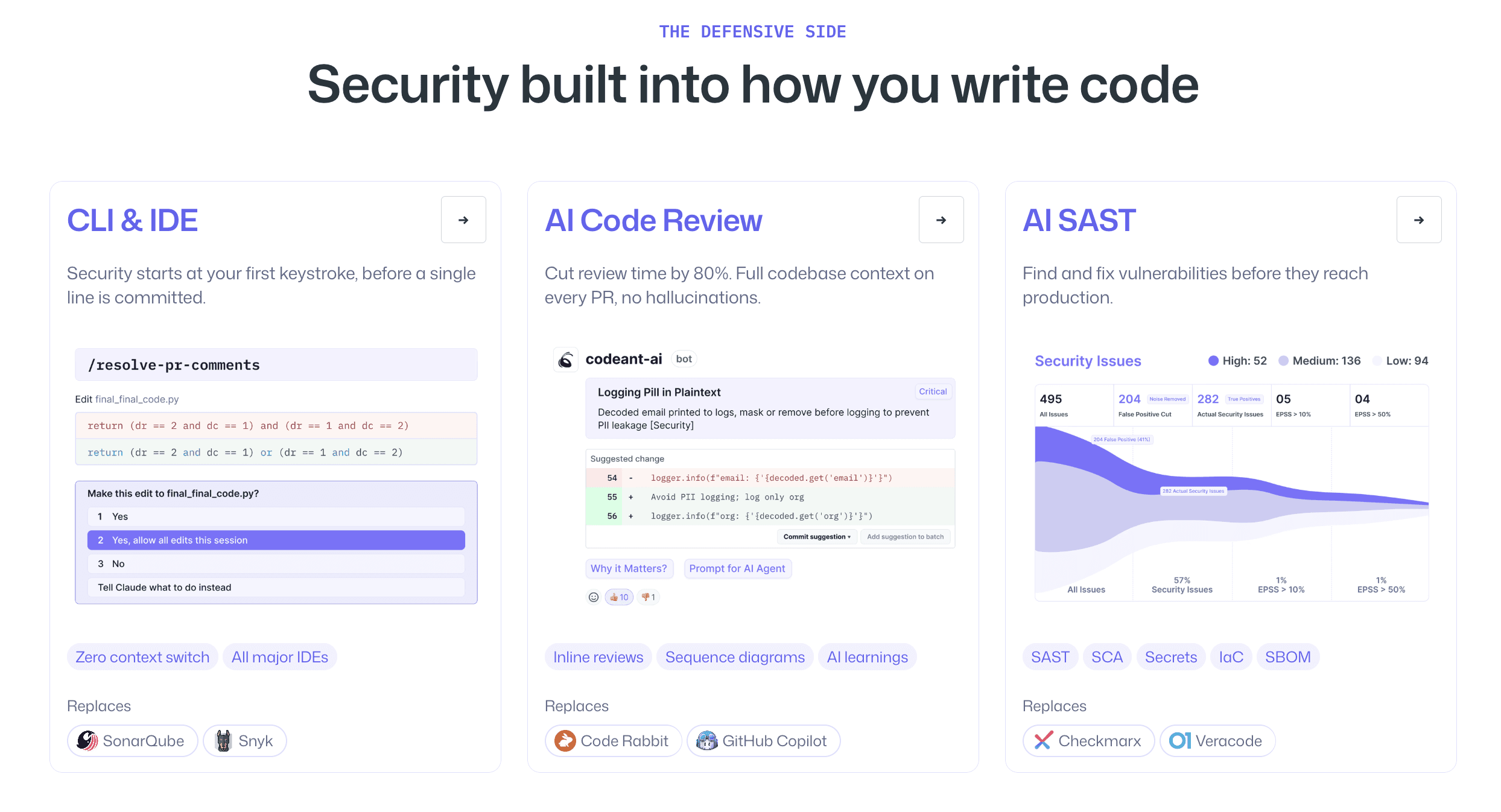
This is the defensive posture. It is genuinely valuable. The average cost to remediate a vulnerability found at the design or code review phase is roughly 10x less than remediating the same vulnerability found in testing, and roughly 100x less than remediating it after a breach.
But defensive security has a hard ceiling on what it can find. It catches what it is trained to recognize in code. It cannot confirm whether a flagged pattern is actually exploitable in the production environment as it currently exists, with the specific middleware configuration, the specific cloud infrastructure, the specific runtime state. It cannot find the vulnerability in a library your code depends on that shipped with a clean PR review. It cannot tell you that your staging environment has a Jenkins dashboard accessible from the public internet with default credentials. It cannot see your company from the outside.
For that, you need the other half.
Defensive vs Offensive Security: At a Glance
Aspect | Defensive security | Offensive security |
|---|---|---|
Core question | Are we writing and shipping secure code? | Can someone exploit our systems right now? |
When it runs | Before and during development | After deployment, against production |
Starting point | Developer’s IDE, pull request, CI/CD pipeline | External attack surface, authenticated user flows |
What it finds | Insecure code patterns, dependency vulnerabilities, secrets in config | Exploitable vulnerabilities, exploit chains, business logic flaws |
What it confirms | That a pattern looks risky in code | That a vulnerability is actually exploitable in production |
What it cannot do | Confirm exploitability in the live environment | Prevent new vulnerabilities from shipping between tests |
Output | Flagged findings, PR comments, pipeline gates | Working proof-of-exploit, CVSS scores, remediation diffs |
Compliance value | Audit trail of security decisions per commit | Evidence of exploitable vulnerability remediation for SOC 2 CC7.1 |
Biggest blind spot | Misses what is visible only from outside | Misses what is invisible to external probing |
Who it protects against | Mistakes made during development | Adversaries approaching from outside or inside with credentials |
What Offensive Security Actually Does, and Where it Stops
Offensive security is what tests whether your defenses hold from the perspective of an adversary, someone approaching your systems with no inside access, no goodwill, and no knowledge of what you think is secure.
A genuine offensive security engagement starts with adversarial reconnaissance. Not “let’s test the endpoints we know about,” but mapping your entire external exposure from scratch, the way a sophisticated adversary would before attempting any exploitation.
That means DNS enumeration across every subdomain pattern that might resolve:
dev,staging,jenkins,grafana,internal,old-api,admin,kibana,elastic,uat, and hundreds more. It means querying Certificate Transparency logs, every TLS certificate ever issued for any subdomain of your domain is publicly logged, including certificates for subdomains that were decommissioned from DNS but still have a server running.It means full port scanning across every discovered host.
It means cloud asset enumeration: S3 buckets, Azure Blob containers, GCP storage, exposed container registries, CI/CD dashboards.
It means JavaScript bundle analysis, downloading every JS file your application serves and extracting what it knows about your internal architecture. A typical SaaS application ships 5–15 MB of compiled JavaScript to every visitor.
Inside that code is a map of every API endpoint the frontend calls, every internal service it references, and, consistently, secrets that were never meant to be accessible:
hardcoded Stripe live keys
AWS access credentials
JWT secrets
internal API hostnames
These are not hypothetical. They are among the highest-yield findings in every black box engagement.
On the white box track, offensive security reads your source code the way an adversary who had obtained repository access would.
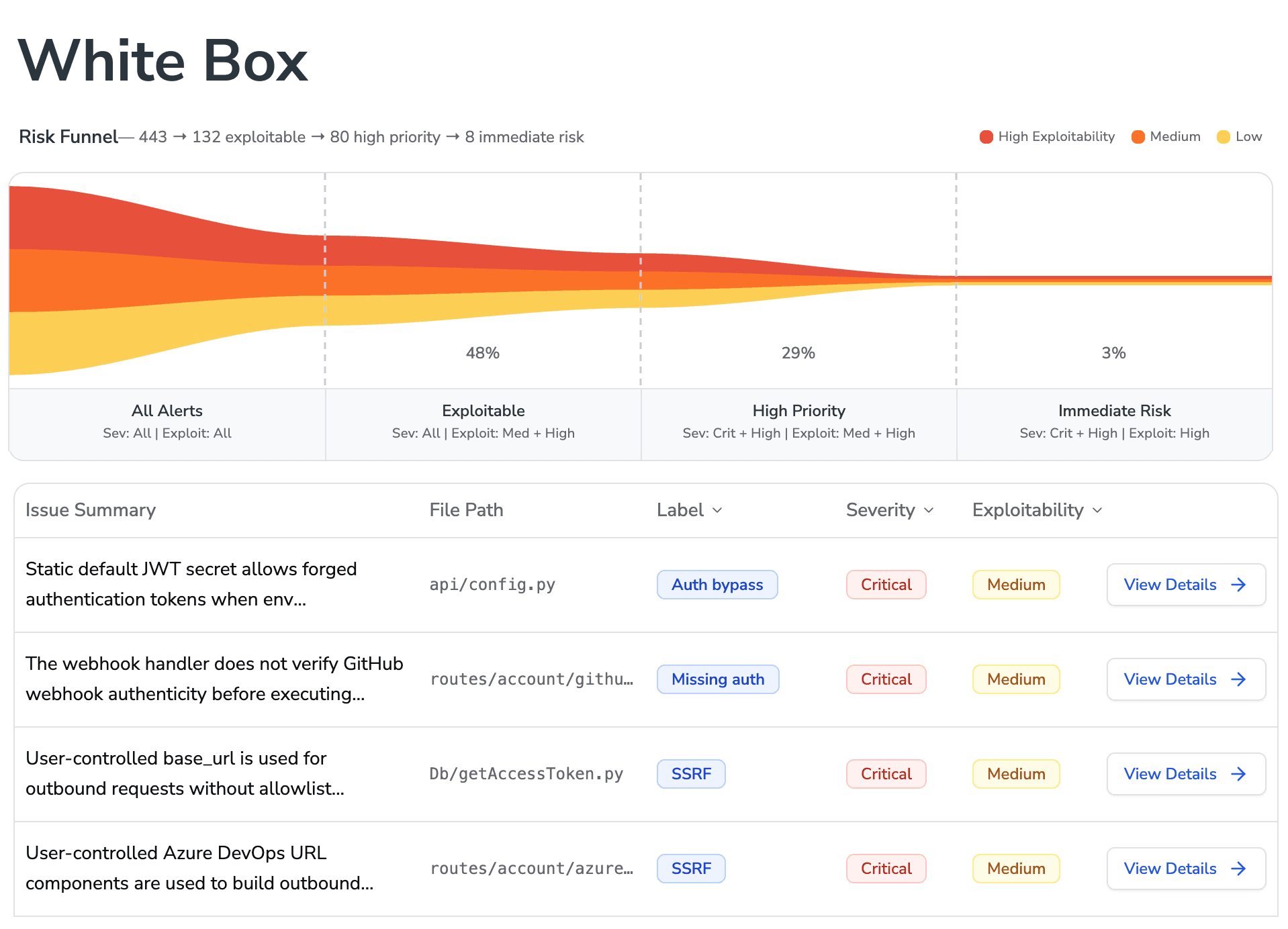
Every authentication configuration end-to-end:
Spring Security filter chains
Express.js middleware ordering
Django permission classes
Rails
before_actiondeclarations
The middleware ordering vulnerability, where admin routes are registered before authentication middleware applies globally and are therefore publicly accessible despite appearing protected, is invisible to every external testing approach and is found immediately by reading the routing configuration.
On the gray box track, offensive security tests what your own legitimate users can do beyond their intended permissions.
Not an external stranger, a customer, employee, or contractor who already has valid credentials and is systematically exploring what they can access.
Every admin endpoint tested with standard user credentials.
Every identifier-accepting endpoint tested for IDOR.
Every critical workflow tested for step-bypass attacks.
Every JWT tested for claim manipulation.
This is the most dangerous threat model for most SaaS applications, and it is the one that requires authenticated testing to assess.
Where offensive security stops: it tests what exists in the production environment at the time of the engagement. It does not prevent the next vulnerability from shipping. An annual penetration test conducted in January is testing an application that will have received hundreds of commits by December. Those commits are untested until the next engagement.
The Structural Problem With Running Them Separately
When defensive and offensive security operate as separate programs, different vendors, different tools, different schedules, two structural blind spots emerge.
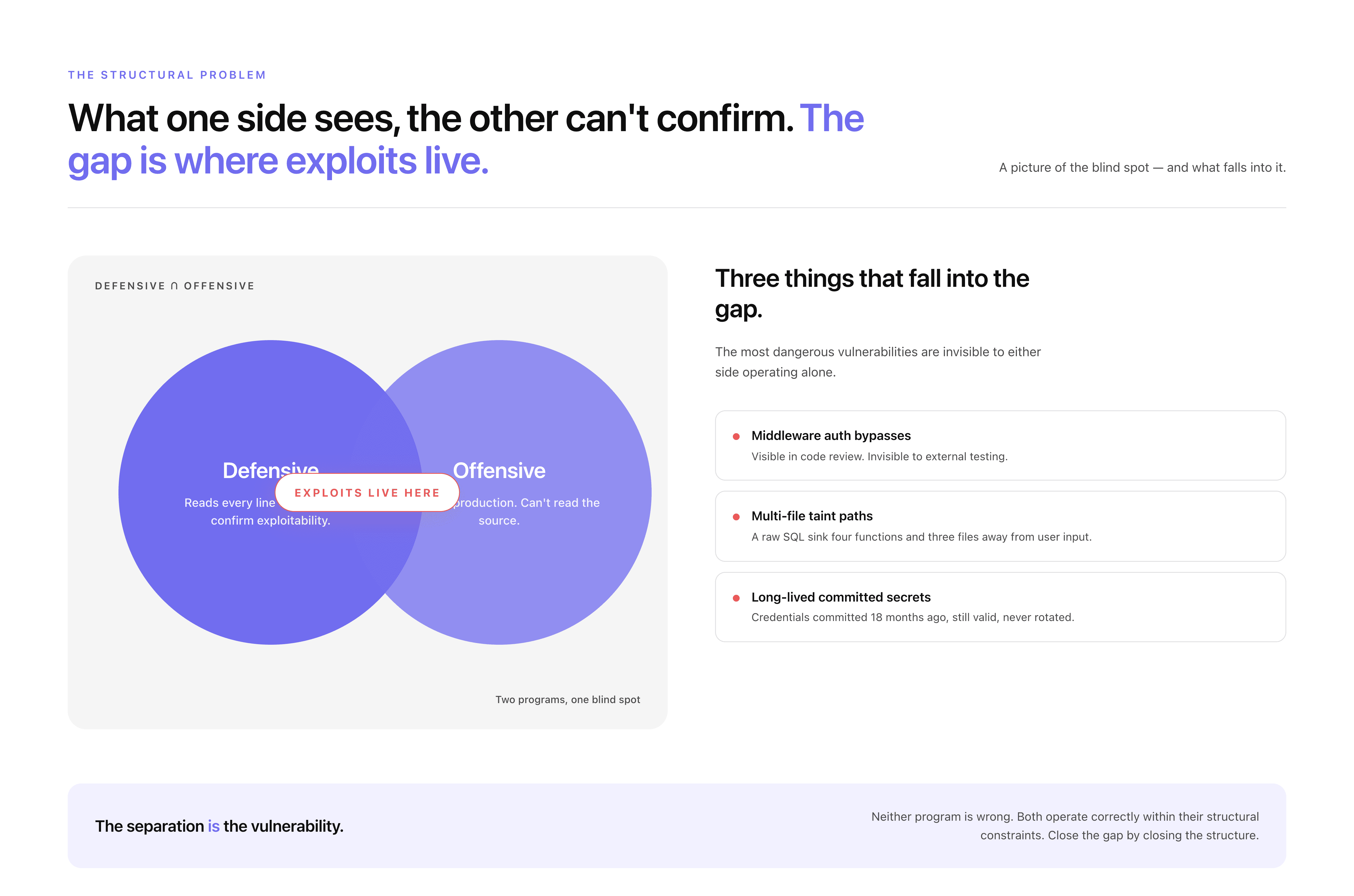
The offensive engagement cannot see what the defensive analysis knows. A penetration test conducted without source code context cannot find the middleware authentication bypass that routes admin traffic around the security filter chain. It cannot trace whether user input in an API endpoint reaches a raw SQL query through a four-function call chain spanning three files. It cannot find the credential committed to Git history eighteen months ago that was never rotated. These vulnerabilities exist, are exploitable, and are invisible to any external-only testing approach. The defensive analysis has already seen them, but the offensive engagement does not have that knowledge.
The defensive analysis cannot confirm what the offensive engagement validates. A code review that flags a potential path traversal in a file operation cannot tell you whether that path is actually reachable from an authenticated endpoint in production, whether the input reaches it unsanitized through the full middleware chain, and whether the exploitation produces meaningful data access given the file system permissions. The offensive engagement can confirm all of that, but if it runs annually from a different vendor with no access to the code review findings, those findings are never cross-validated.
The result is a gap between the two programs where the most dangerous vulnerabilities live. The defensive tool missed it as a false positive. The offensive test missed it because it lacked code context. Neither program is wrong, they are both operating correctly within their structural constraints. The constraint is the separation itself.
What Changes When One Platform Does Both
When the platform conducting code review in your CI/CD pipeline is the same platform conducting the penetration test, the intelligence transfers in both directions.
The defensive analysis has spent eighteen months reading your authentication middleware, tracing your data flows, and flagging your insecure API call patterns.
When the offensive engagement begins, that code intelligence is already available. The platform knows which authentication patterns are in use, which endpoints have insecure data flows based on the defensive review, and which configurations have known weaknesses. It tests from the outside with inside knowledge, the most accurate simulation of how a sophisticated adversary with persistent access actually operates.
This is not simply running two tools from the same vendor. It is a fundamentally different engagement architecture. The five-phase offensive methodology, external reconnaissance, source code intelligence, JavaScript bundle analysis, active exploitation, and gray box authenticated testing, is informed by the same code comprehension that the defensive review uses to flag insecure patterns in pull requests. An adversary who has read your codebase does not probe randomly. They probe precisely.
The offensive findings feed back into the defensive analysis.
When an exploit chain is confirmed because a particular authentication pattern was bypassable in a specific context, that pattern gets flagged more aggressively in future pull requests. When a CORS misconfiguration is exploited to read API responses cross-origin, the defensive review adds that configuration pattern to its check list. The offensive engagement makes the defensive analysis smarter. The defensive analysis makes the offensive engagement deeper.
The result is what a genuine defensive and offensive security program looks like: not a code review tool and a pentest vendor that bill you separately, but a single platform that understands your codebase from the inside and attacks your perimeter from the outside, closing the gap that every siloed approach leaves open.
Are you Missing Half Your Security Coverage?
Most teams running a security program believe they are covered. These seven signals indicate the defensive and offensive programs are running independently, and the gap between them is open.
Your code review tool and your penetration testing firm are different vendors with no data sharing between them
Your annual or semi-annual pentest report does not reference findings from your code review or SAST tool
Vulnerabilities found in penetration tests are not fed back into your defensive detection rules
Your penetration testing firm does not have access to your source code, every engagement is black box only
You cannot answer what percentage of your code review findings have been confirmed exploitable versus theoretical
Your retest is conducted by the same firm weeks after remediation with no continuous verification between tests
You have never tested whether a vulnerability your code review flagged as a false positive is actually exploitable in production
If three or more of these are true, you are running two half-programs instead of one complete security posture. The gap between them is not theoretical, it is the exact space where the middleware authentication bypass ships through code review and survives the annual pentest because it produces a normal HTTP response to external probes.
A unified defensive and offensive platform closes each item on this list structurally, not through process discipline, but because both programs share the same code intelligence, the same finding history, and the same production environment context.
What This Means for Teams That Have Been Doing One or the Other
If your current security program is primarily defensive:
… you likely have a clear picture of vulnerability patterns in your codebase and an incomplete picture of what those patterns mean for an adversary approaching from outside. You do not know which of your flagged findings are actually exploitable in the production environment, whether your cloud infrastructure has exposure your code review never touches, or what your external attack surface looks like to someone with no inside knowledge.
If your current security program is primarily offensive, annual or semi-annual penetration tests, you likely have periodic confirmation that your external surface was clean at the time of testing, and no continuous visibility into what changes between tests. You do not know whether the authentication vulnerability that shipped three sprints ago has been sitting in production waiting to be found. You also do not have the continuous compliance documentation that SOC 2 Type II requires across the full observation period.
The teams that run both, continuously, on a unified platform, answer a different question than either program answers alone. Not “is our code secure?” and not “is our perimeter secure?” but “is our system secure right now, from the perspective of every adversary that would care to test it?”
That question is the one your enterprise customers are asking in their security reviews. It is the one your SOC 2 auditor is asking when they pull up CC7.1. It is the one that determines whether your security program produces a clean audit opinion or a qualified one.
Conclusion: Fix the Gap Between Defensive and Offensive Security Today!
Defensive security and offensive security both work. The problem is running them separately.
One helps you catch issues while writing code. The other tests whether those issues can actually be exploited. When they operate in isolation, critical vulnerabilities slip through because each one lacks the context the other already has.
If your current setup relies only on code review tools or only on periodic penetration testing, you are not seeing your full risk surface.
To fix this, you need a system that connects how your code is written to how it is attacked.
CodeAnt does exactly that. It combines code-level analysis with real penetration testing, validates vulnerabilities with proof of exploit, and feeds those learnings back into your development workflow.
If you want to stop guessing and start seeing real risk, it is time to move beyond siloed tools and evaluate a unified approach.
👉 Start by testing your system the way an attacker actually would.

