

What is a defensive and offensive security platform? A defensive and offensive security platform combines code-level protection (AI code review, SAST, secrets scanning) with active attack simulation (penetration testing across black box, white box, and grey box methodologies) in one system. CodeAnt AI is the only platform where both layers share the same code intelligence, meaning the penetration test is informed by what the code review already learned about your codebase.
The Real Reason Your Penetration Test Keeps Missing What Matters
Every engineering team running a security program in 2026 is managing two separate problems that nobody has forced into one conversation.
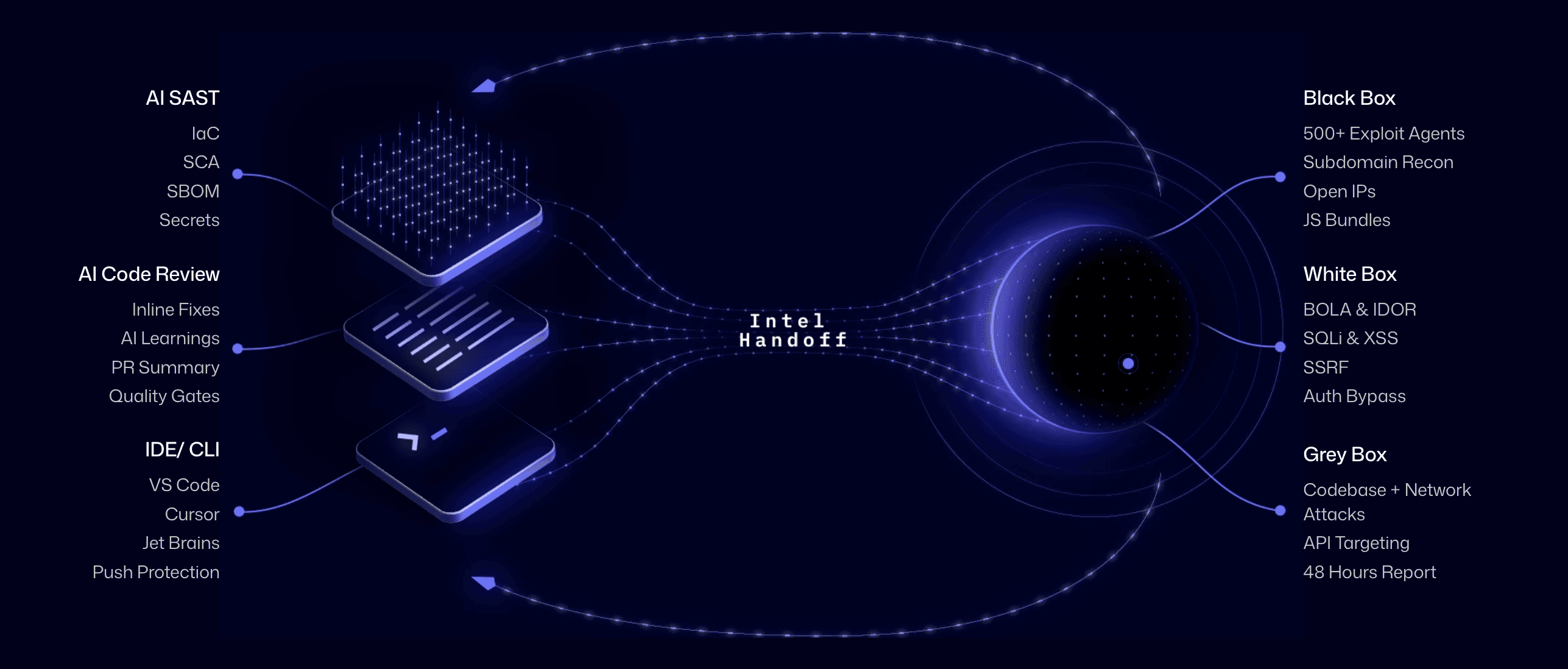
On one side: static analysis tools, code review, secrets scanning, dependency audits. Tools that live in your IDE, your CI pipeline, your pull request workflow. They catch what they can. They flag issues before code ships. They are, by definition, defensive.
On the other side: penetration testing. An annual engagement, sometimes biannual if you are ahead of the curve. An external firm maps your attack surface, runs tests for two to four weeks, and delivers a report. By the time you act on it, parts of the codebase it assessed have already changed.
These two programs do not talk to each other. The SAST tool does not know what the pentest found. The penetration tester does not know what the code review flagged three sprints ago. The gap between them, the weeks and months of continuous deployment between one pentest and the next, is exactly where breaches happen.
This is not a resourcing problem. It is an architectural one. And the architecture is what CodeAnt AI has rebuilt.
Why Every AI Penetration Testing Platform Gets Defensive and Offensive Security Wrong
The phrase gets used loosely. Before anything else, it is worth being precise.
Defensive security is the discipline of hardening systems from within. It includes reviewing code for insecure patterns before deployment, scanning infrastructure configuration for misconfigurations, detecting exposed secrets in repositories, auditing third-party dependencies for known CVEs. The goal is to reduce the attack surface before an adversary ever touches it.
Offensive security is the discipline of testing systems the way an adversary would. It includes penetration testing, red teaming, attack surface mapping, and exploit chain construction. The goal is to validate whether the defenses you believe are in place actually hold against a motivated attacker.
The conventional model treats these as sequential: defend first, test later. The problem is that “later” in a continuous deployment environment can mean months of new code, new endpoints, new dependencies, all untested offensively. The attacker does not wait for your pentest window. They are looking at your production surface continuously.
A unified platform closes that gap. Not by doing both things adequately. By doing both things on the same intelligence layer, so that what the defensive analysis learns informs what the offensive test attacks.
The Three Depths of AI Penetration Testing
Understanding how CodeAnt’s offensive layer works requires understanding what distinguishes each penetration testing methodology, and why running all three on a shared code intelligence layer produces fundamentally different results than running them separately.
Black Box Penetration Testing: The External Attacker’s View
In black box testing, the attacker has zero prior knowledge of the target. No credentials, no source code, no architecture documentation. This is the most realistic simulation of an opportunistic external adversary.
What CodeAnt’s black box scan covers:
Subdomain enumeration and reconnaissance, mapping every publicly visible asset, including forgotten staging environments, legacy subdomains, and misconfigured DNS records
Open port and service fingerprinting, identifying exposed services and the software versions running on them, cross-referenced against known CVE databases
JavaScript bundle analysis, extracting internal API endpoint references, hardcoded credentials, and environment variable leakage from client-side bundles
Public repository scanning, identifying secrets committed to version history, even if subsequently deleted
Attack surface mapping, building a complete picture of what is externally reachable before any active testing begins
This phase answers the question most organizations genuinely cannot answer on their own: what can a stranger with a search engine and a port scanner learn about your infrastructure before they’ve touched anything?
White Box Penetration Testing: 500+ Exploit Agents, Chained Attacks
White box testing operates with full knowledge of the application. In a traditional engagement, this means source code access, architecture diagrams, and internal documentation. In CodeAnt’s model, it means the same code intelligence already built by the defensive analysis layer.
The 500+ exploit agents do not run isolated vulnerability checks. They construct and validate attack chains, sequences of findings that individually appear low severity but combine into critical exploit paths. This distinction matters because real breaches rarely hinge on a single critical vulnerability. They hinge on chains.
Vulnerability classes actively tested:
BOLA (Broken Object Level Authorization) and IDOR, the most common class of API vulnerability in 2026, responsible for a disproportionate share of data breach incidents
SQL injection and command injection, including second-order injection and stored injection patterns that escape automated scanners
Cross-site scripting (XSS), DOM-based, reflected, and stored variants
SSRF (Server-Side Request Forgery), including cloud metadata endpoint exploitation
Authentication bypass, covering JWT algorithm confusion, session fixation, and insecure token validation patterns
Business logic flaws, price manipulation, privilege escalation paths, workflow bypass
The 500+ agent architecture is designed to find what a motivated human attacker would find, not just what appears in a CVE database.
Grey Box Penetration Testing: The Architectural Advantage
Grey box testing is where CodeAnt’s unified architecture creates a capability that no external-only penetration testing platform can replicate.
In a conventional grey box engagement, the tester has partial knowledge: typically credentials and some documentation. What they do not have is deep understanding of how the application was actually written. They do not know which authentication patterns the development team favored and historically got wrong. They do not know which third-party dependencies carry known weaknesses in the specific versions deployed. They do not know the internal API endpoint structure that the external scan cannot fully reveal.
CodeAnt’s grey box test inherits all of that from the defensive analysis. The codebase intelligence built through months of AI code review and SAST scanning becomes the attack briefing. The test is not generic. It is targeted at the specific patterns, endpoints, and dependency configurations already identified as risk areas.
Grey box capabilities in CodeAnt’s platform:
Code-aware attack construction, attacks tailored to known weak patterns in the specific codebase
API targeting based on internal endpoint maps, not just what is externally visible, but the full endpoint surface the defensive layer already catalogued
Dependency-informed exploitation, targeting specific CVEs in the exact dependency versions confirmed by SCA scanning
48-hour report delivery, with full evidence, remediation guidance, and compliance mapping
Why Codebase Context Changes What the Pentesting Finds
In January 2026, CodeAnt’s security research team discovered CVE-2026-29000, a CVSS 10 authentication bypass in pac4j-jwt. The vulnerability existed because the library trusted the algorithm declared in the JWT header, meaning any attacker with only the public key could forge admin sessions. Blast radius: every application using pac4j-jwt for authentication.
This finding was not surfaced by an external black box scan. It required understanding how JWT authentication was implemented in the specific codebase, the kind of understanding that only comes from code-level analysis. The finding was subsequently covered by GBHackers, CyberPress, VulnCheck, Tenable, and NVD.
Two additional CVEs followed:
CVE-2026-28292 (CVSS 9.8): Remote code execution in simple-git
CVE-2026-31988 (CVSS 5.3): Denial of service in yauzl
These were not found by running known-vulnerability scanners. They were found by the same methodology the platform uses in production: code intelligence combined with active exploit validation.
In production environments, the same approach has secured:
3.2 million PHI records at a US healthcare provider, exposed through an unauthenticated API that passed conventional security review
6 million passenger records at a major airline, exposed via a BOLA attack chain requiring codebase context to construct
500,000 client files at a UK law firm, accessible without authentication, missed by prior penetration testing engagements
The Defensive Layer: Security Built Into the Development Workflow
The offensive capability only makes sense in the context of what the defensive layer builds first.
Here is how CodeAnt embeds security across the full development lifecycle.
IDE and CLI: Security at the First Keystroke
Security that starts in the IDE is security that costs the least to fix. CodeAnt’s IDE extension and CLI tool catch vulnerabilities before the first commit, not as a friction layer, but as a zero-context-switch integration into existing workflows.
Supported environments: VS Code, Cursor, JetBrains. Push protection prevents secrets from being committed in the first place, which is a materially different intervention than detecting them after the fact.
AI Code Review: Full Codebase Context on Every PR
The most common failure mode in automated code review is reviewing the diff in isolation. A vulnerability that spans three files and two functions does not appear dangerous when you look at only the lines that changed. CodeAnt’s code reviewer runs on every pull request with full codebase context, every dependency, every call graph, every prior finding.
Results: inline fix suggestions aligned to repository context, sequence diagram generation for complex authentication and data flows, AI learnings that improve accuracy over time as the system learns the specific codebase’s patterns.
Up to 80% reduction in review time. No hallucinated findings that waste developer time chasing non-issues.
AI SAST: Real Threat Prioritization, Not Alert Noise
CodeAnt’s SAST layer covers five surfaces in a single scan:
Application code (SAST), injection flaws, authentication weaknesses, insecure deserialization, cryptographic failures, SSRF, security misconfigurations
Infrastructure as Code (IaC), Terraform, CloudFormation, Kubernetes manifests scanned for misconfigurations before they reach production
Software Composition Analysis (SCA), third-party dependency vulnerabilities cross-referenced against CVE databases and EPSS scores
Secrets detection, API keys, tokens, credentials in code, config files, and environment variables
SBOM generation, a complete software bill of materials for compliance and supply chain visibility
Every finding is ranked by EPSS score, real-world exploit probability, not just theoretical CVSS severity. The difference matters. A CVSS 7 finding with a 0.02% EPSS score is a different priority than a CVSS 6 finding with a 12% EPSS score. Prioritizing by severity alone produces the wrong remediation order.
Typical result: 282 confirmed security threats out of 495 total issues, with 204 false positives eliminated before they reach developer queues.
Who This AI Pentesting Platform Is Built For
SaaS engineering teams on continuous deployment cycles who need security embedded in the development workflow, not a quarterly audit that is stale by the time it arrives.
Security teams pursuing SOC 2 Type II, HIPAA, PCI DSS, or GDPR compliance who need penetration test reports formatted for auditor review from the start. CodeAnt’s reports map findings directly to compliance framework controls.
Engineering managers replacing a fragmented security stack like CodeRabbit for code review, Snyk for dependency scanning, SonarQube for static analysis, plus a separate annual pentest vendor. One platform replaces all of it, with the added advantage that every layer shares the same codebase intelligence.
CTOs and CISOs evaluating security posture who want a defensible answer to “what would an attacker find?” without the $10,000–$80,000 upfront engagement fee that traditional firms charge before finding anything.
The AI Pentesting Pricing Model That Changes the Incentive
Traditional penetration testing firms charge upfront regardless of findings. The commercial model incentivizes generating reports, not finding real exploitable vulnerabilities.
CodeAnt’s pricing model inverts this:
Free black box scan, one URL, report in 24 hours, no credit card required
Low and medium findings always free, full visibility into your exposure without a payment gate
High and critical findings unlock on payment, you pay when we deliver a working proof-of-concept exploit, not before
Unlimited re-scans after remediation, at no additional cost, because verifying the fix is not optional
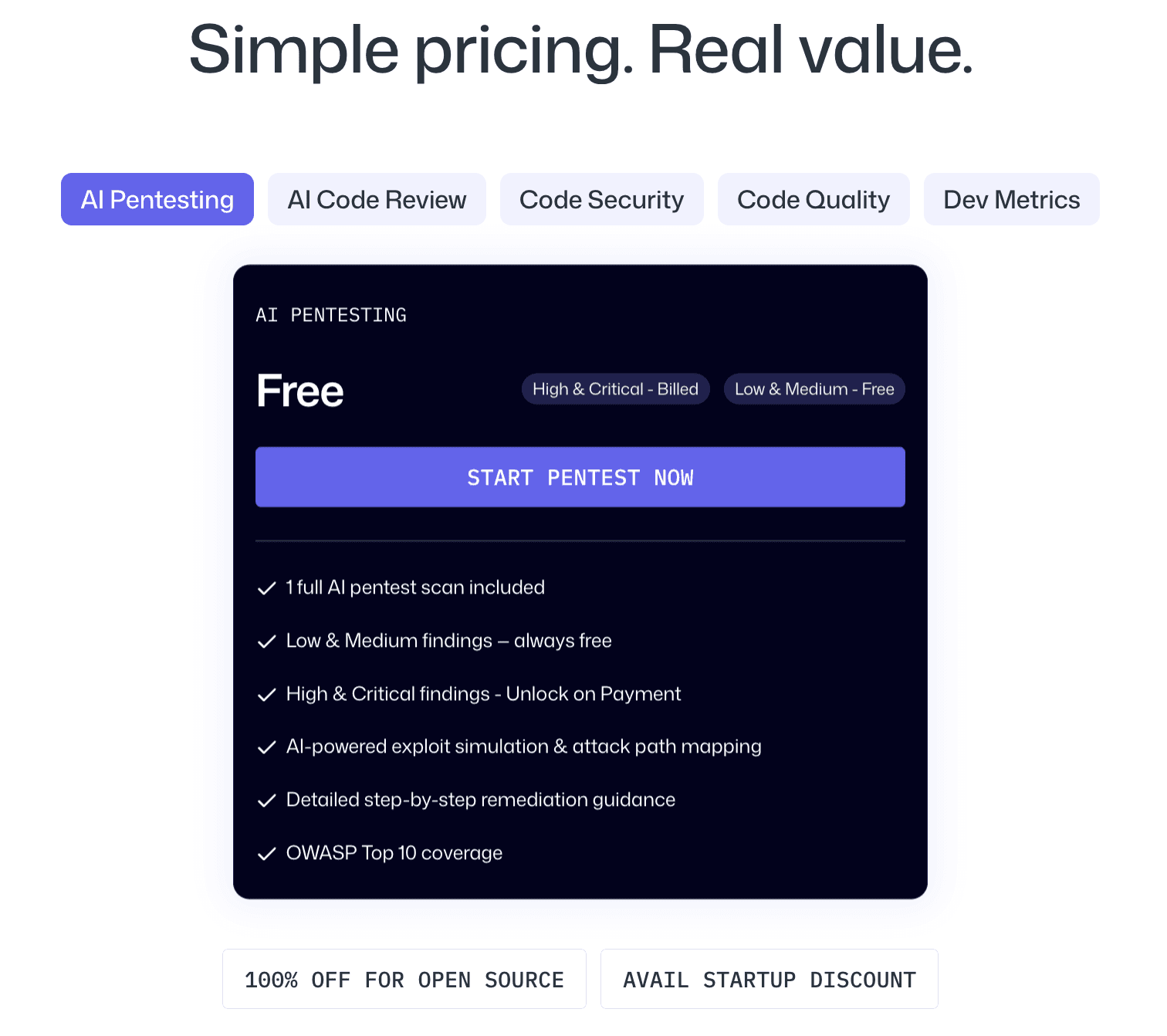
The alignment is different: CodeAnt is paid to find real, exploitable vulnerabilities. The model only works if the platform actually finds them.
Start Your Free Penetration Test Today!!
One URL. Black box scan. Report in 24 hours. No credit card. No sales call. Low and medium findings are always free. High and critical findings unlock when we deliver a working proof-of-concept exploit.
Run Free Pentest with us today!!
For the full defensive and offensive platform, AI code review, SAST, and pentesting in one, the 14-day free trial is live at app.codeant.ai. No credit card required.

