AI Code Review
7 Disadvantages of Bitbucket That Slow Teams at Scale

Sonali Sood

Founding GTM, CodeAnt AI
Bitbucket served your team well at 20 developers shipping weekly. But at 100+ engineers deploying daily, PRs sit for three days awaiting review. Senior engineers spend more time commenting on code than writing it. Security scans only run when someone remembers to create a PR. And you're paying for Bitbucket plus SonarQube, Snyk, Jenkins, and separate analytics, none of which talk to each other.
These aren't configuration problems you can fix with better workflows. Architectural limitations of platforms built before AI-powered development, continuous security posture, and unified code health became non-negotiable for teams at scale.
This article breaks down seven critical limitations that manifest as measurable friction in daily workflows. More importantly, you'll see how modern AI-native platforms eliminate these constraints entirely, replacing tool sprawl with unified code intelligence that actually scales.
The Core Problem: Version Control vs. Code Health Platform
Bitbucket was architected when "Git hosting + pull requests" defined the category. Today's engineering teams need platforms that understand code semantically, enforce security continuously, surface quality metrics proactively, and eliminate tool sprawl.
You'll feel Bitbucket's constraints most acutely when:
Team size crosses 50+ developers and PR review becomes a bottleneck, not a checkpoint
Security compliance becomes mandatory (SOC 2, HIPAA, PCI-DSS) and PR-only scanning leaves gaps auditors flag
Technical debt compounds and you lack visibility into what's degrading or where to invest refactoring effort
Tool costs balloon as you layer multiple solutions on top of basic Git hosting
Velocity targets increase and manual review cycles stretch to 3+ days, blocking deployments
7 Critical Disadvantages of Bitbucket That Slow Development Teams
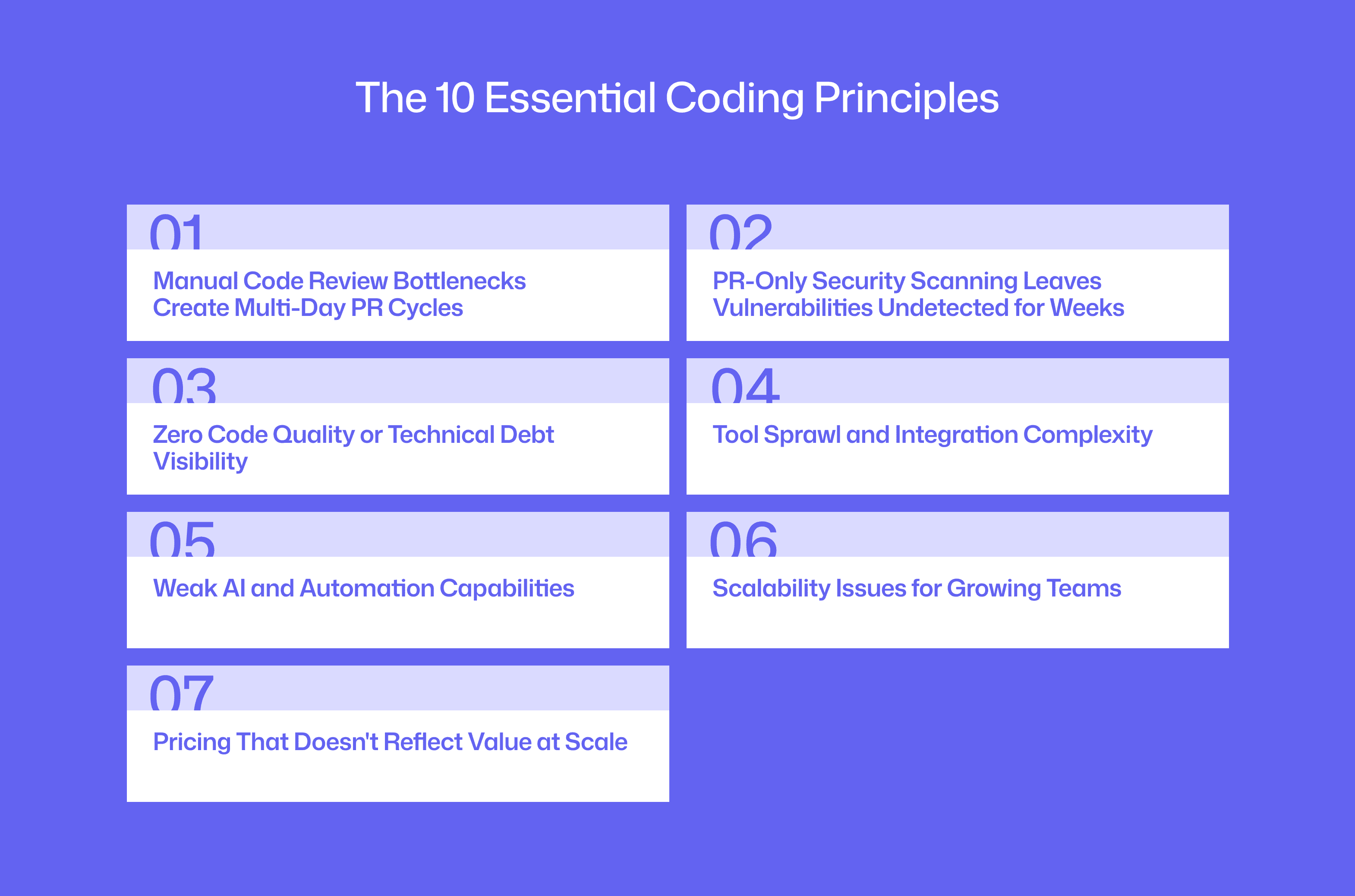
1. Manual Code Review Bottlenecks Create Multi-Day PR Cycles
The Problem:
Bitbucket's PR workflow is entirely manual. A developer opens a PR, tags reviewers, and waits. For teams above 50 developers, this creates compounding bottlenecks: senior engineers spend 60% of their time reviewing instead of building, and average PR cycle time stretches to 3.2 days.
What's Missing:
No intelligent prioritization (which PRs are critical vs. routine?)
No automated feedback on common issues (style violations, complexity spikes, test coverage gaps)
No context-aware analysis that understands your codebase's architecture
No AI-powered summarization to help reviewers quickly understand changes
Measurable Impact:
Teams >50 developers report 3.2-day average PR cycle times
Senior engineers spend 60% of their time reviewing, not building
Context switching between writing and reviewing reduces individual productivity by 23%
The AI-Powered Alternative:
Platforms like CodeAnt AI review every PR instantly with context-aware AI that understands your codebase's patterns, flags critical issues with actionable fixes, and reduces manual review effort by 80%. Senior engineers focus on architectural decisions, not syntax checks.
2. PR-Only Security Scanning Leaves Vulnerabilities Undetected for Weeks
The Problem:
Bitbucket has no native security scanning. Teams integrate third-party tools that scan code only when a PR is created. Vulnerabilities introduced in feature branches sit undetected until someone decides to merge, often weeks later.
Real-World Scenario:
A developer introduces a SQL injection vulnerability in a feature branch on Monday. The branch isn't PR'd until Friday. The vulnerability sits undetected for four days. If it reaches production before detection, you're looking at an incident, not a code review comment.
What's Missing:
No continuous scanning across all repos, branches, and commits
No proactive detection before PR creation
No context-aware analysis that understands data flow and business logic
No unified view of security posture across your entire codebase
Security Model | Bitbucket + Snyk | CodeAnt AI |
Scan Trigger | PR creation only | Every commit, continuously |
Coverage | PR branches only | All repos, branches, commits |
Detection Type | Pattern matching | Context-aware, data flow analysis |
Fix Workflow | Manual remediation | AI-suggested fixes, one-click apply |
Mean Time to Detect | 3-7 days | <5 minutes |
3. Zero Code Quality or Technical Debt Visibility
The Problem:
Bitbucket shows you code changes. It doesn't show you code health. There are no metrics on complexity, duplication, maintainability trends, or technical debt accumulation. Engineering leaders operate blind: Which modules are degrading? Where should we invest refactoring effort?
What's Missing:
No complexity tracking (cyclomatic, cognitive)
No duplication detection across repos
No maintainability scoring or trends
No DORA metrics (deployment frequency, lead time, change failure rate)
No test coverage visibility or enforcement
The Modern Alternative:
CodeAnt AI provides a 360° code health dashboard: complexity heatmaps, duplication detection, maintainability trends, DORA metrics, test coverage, and contribution insights. Engineering leaders make data-driven decisions on hiring, team allocation, and refactoring priorities.
Example Insight:
"Your authentication module's complexity increased 40% this quarter and has 23% code duplication. Recommend allocating one sprint to refactoring before adding new features."
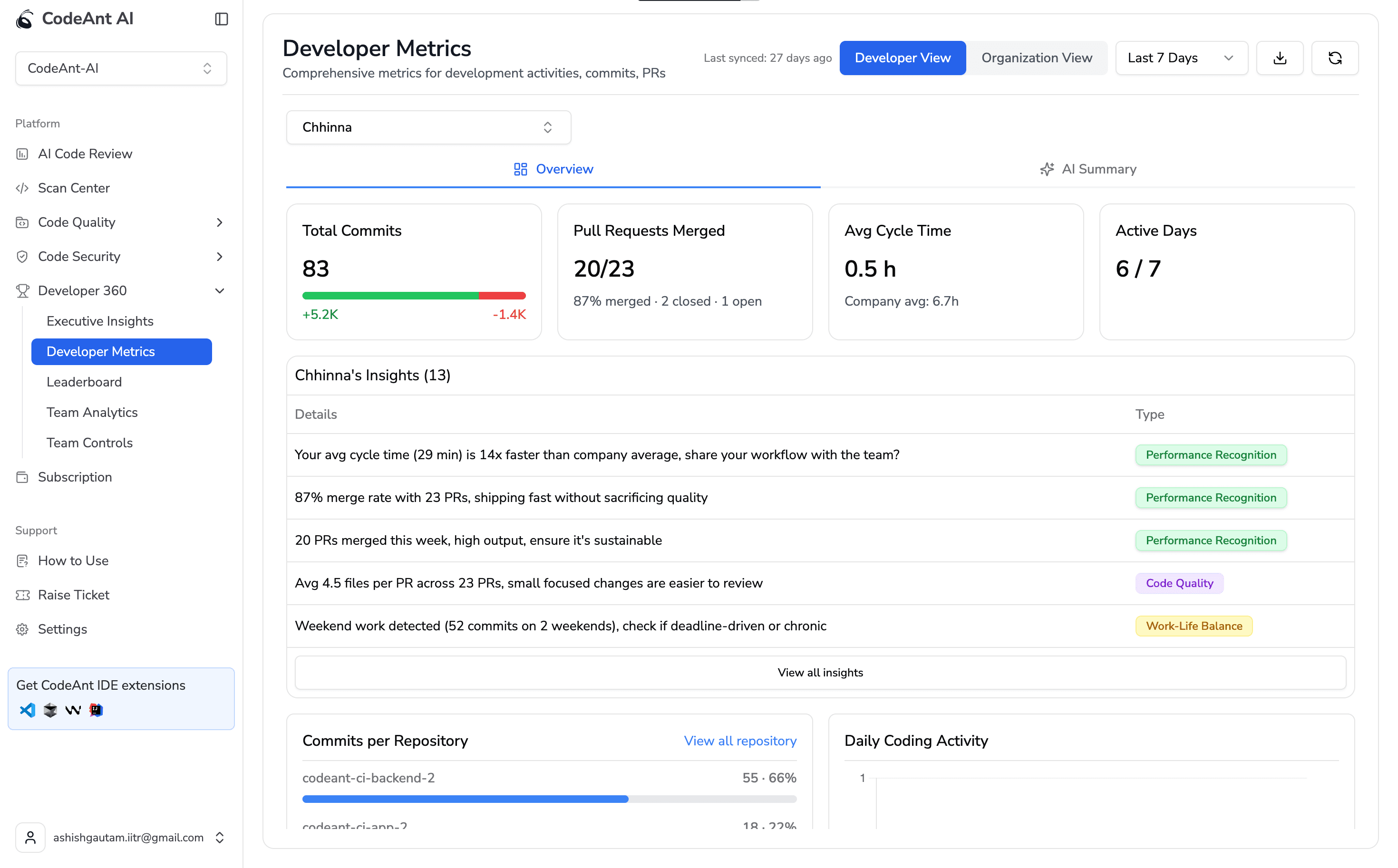
4. Tool Sprawl and Integration Complexity
The Problem:
Bitbucket is just version control. To build a complete code health workflow, teams layer on multiple tools, each requiring separate configuration, maintenance, and user management.
Typical Stack:
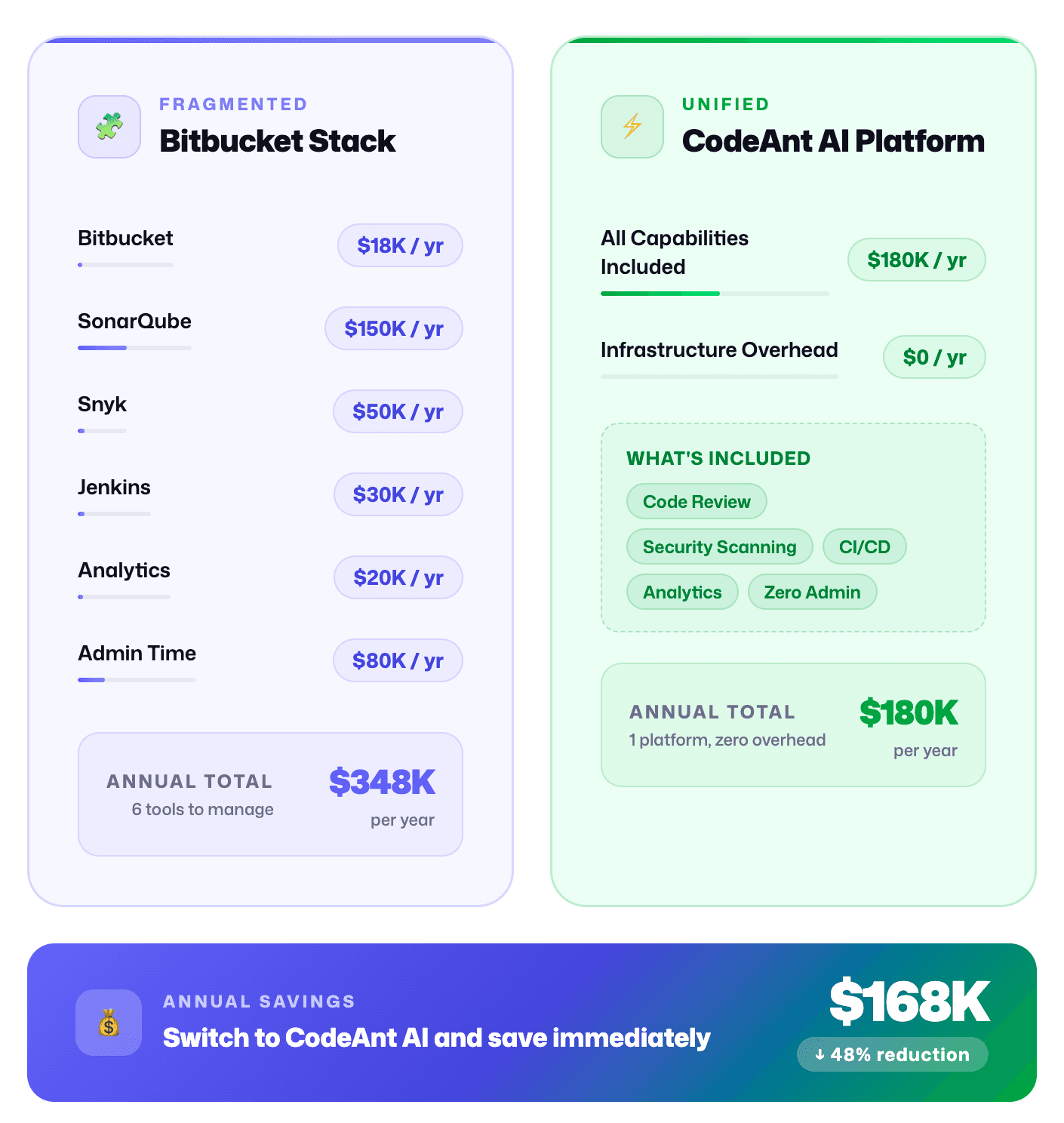
SonarQube for quality metrics ($150K+/year for enterprise)
Snyk for security scanning ($50K+/year)
Jenkins or CircleCI for CI/CD orchestration ($30K+/year)
Separate analytics tools for DORA metrics ($20K+/year)
Hidden Costs:
Direct spend: $275K+/year in tool subscriptions
Maintenance overhead: Each tool requires configuration, updates, troubleshooting
Context switching: Developers jump between 5+ interfaces to understand code health
No unified view: Security findings in Snyk, quality issues in SonarQube, metrics scattered, no single source of truth
5. Weak AI and Automation Capabilities
The Problem:
Bitbucket treats code as text. It has no semantic understanding of your codebase's architecture, patterns, or business logic. This means:
No AI-powered PR summarization (reviewers read every line manually)
No intelligent fix suggestions (developers Google solutions)
No codebase understanding for new developers (onboarding takes weeks)
No learning from your team's standards and architectural patterns
Developer Experience Impact:
A new developer joins your team. With Bitbucket, they spend 4-6 weeks reading documentation and making mistakes before contributing meaningfully. With an AI-native platform, they get context-aware guidance from day one: "This module handles authentication. Here's the established pattern. Your change violates our standard, here's the fix."
The Modern Alternative:
CodeAnt AI understands your codebase semantically. It learns your team's architectural patterns, coding standards, and business logic. New developers contribute meaningful code in week 1, not week 6.
6. Scalability Issues for Growing Teams
The Problem:
As teams grow beyond 100 developers and codebases expand to millions of lines, Bitbucket shows strain:
Self-Hosted:
Performance degrades with large repos (>10GB)
High user concurrency slows UI responsiveness
Complex CI/CD workflows require infrastructure investment
Cloud:
Build minute caps force teams to optimize for billing, not quality
Load times increase as codebase grows
Limited customization for enterprise workflows
Growth Tax:
Teams scaling from 50 to 150 developers often need to hire a dedicated Bitbucket admin, invest in infrastructure upgrades, or migrate to enterprise tiers, all while still lacking the code health capabilities modern teams need.
The Modern Alternative:
CodeAnt AI is built for teams of 100+ developers from day one. It handles enterprise-scale repos without performance degradation, scales automatically with team growth, and requires zero infrastructure overhead.
7. Pricing That Doesn't Reflect Value at Scale
The Problem:
Bitbucket's per-user pricing seems reasonable until you calculate total cost of ownership:
Bitbucket Cloud Standard: $3/user/month = $3,600/year for 100 users
But you still need: SonarQube ($150K), Snyk ($50K), CI/CD ($30K), analytics ($20K)
Plus: Admin time ($80K), integration maintenance, context switching overhead
Total Cost: $333,600/year for basic Git hosting + fragmented code health tools
Value Equation:
You're paying for version control but still buying 4+ additional tools to get code review automation, security scanning, quality metrics, and analytics. Bitbucket's pricing reflects its narrow scope, not the complete platform modern teams need.
The Modern Alternative:
CodeAnt AI delivers more capabilities (AI review, continuous security, quality metrics, unified analytics) at lower total cost. For 100 developers: $180K/year for the complete platform vs. $333K+ for Bitbucket + integrations, a 46% cost reduction.
When Bitbucket's Limitations Justify Migration
Not every team needs to migrate immediately, but specific trigger points indicate when Bitbucket's disadvantages outweigh its benefits.
Migrate when you experience:
Review bottlenecks: PR cycle times >2 days, senior engineers spending >50% time reviewing
Security gaps: Audit findings, compliance requirements, or incidents from missed vulnerabilities
Velocity pressure: Deployment frequency targets that manual workflows can't support
Tool sprawl costs: Total spend on Bitbucket + integrations exceeding $200K/year for 100 developers
Quality degradation: Rising bug rates, technical debt compounding, no visibility into code health trends
Expected Outcomes:
Teams migrating to CodeAnt AI typically see:
80% reduction in manual review effort
<1 day PR cycle times (from 3.2 days average)
40% tool cost reduction
Zero security incidents from missed vulnerabilities
Measurable code quality improvement within 6 months
The Bottom Line: Bitbucket's Disadvantages Are Architectural, Not Fixable
The disadvantages outlined above aren't bugs Atlassian can patch, they're fundamental constraints of platforms built before AI-assisted development, continuous security posture, and unified code health became table stakes.
Bitbucket excels at what it was designed for: basic Git hosting for teams invested in the Atlassian ecosystem. But modern engineering organizations need more—and Bitbucket's architecture can't deliver it without the tool sprawl, cost, and complexity that create new problems.
The evolutionary step forward: AI-native platforms like CodeAnt AI that treat code health as a continuous, end-to-end concern. One platform that understands your code, enforces security and quality automatically, and gives engineering leaders the visibility they need to make data-driven decisions.
Run a 2-Week Baseline Assessment
Before making any platform decision, quantify your current state with hard data:
PR Cycle Time Audit:
Track time from PR creation to merge across 50+ pull requests
Calculate senior engineer hours spent on manual review per week
Benchmark against elite performers (DORA: <1 day cycle time)
Security Posture Baseline:
Audit when vulnerabilities are detected: branch creation, PR time, post-merge?
Review incident history: how many security issues reached production?
Measure time from vulnerability detection to remediation
Toolchain Inventory:
List every tool in your code workflow
Calculate total annual cost: subscriptions + maintenance + admin overhead
Count tools that could be consolidated into a unified platform
With baseline metrics in hand, you can evaluate whether Bitbucket's architectural constraints are blocking your team's ability to ship faster, safer, and smarter.
Book a 1:1 with our team to walk through your baseline assessment and see how CodeAnt AI delivers measurable improvements in your specific workflow, AI-powered code review, continuous security scanning, unified code health visibility, and platform consolidation that eliminates tool sprawl.
FAQs
Is Bitbucket bad for large teams?
Can Bitbucket be secure with integrations?
How do we reduce PR cycle time without sacrificing quality?
What's the lowest-risk migration approach from Bitbucket?
Can we keep our Atlassian tools (Jira, Confluence) if we migrate?