

Bishop Fox is a strong offensive-security provider for enterprises that want expert-led penetration testing, Cosmos external attack-surface management, continuous threat exposure management, secure code review, hardware testing, AI assessments, and red-team services from one partner.
It is not the right fit for every program. Engineering teams may need faster, code-aware testing and immediate retests. Security leaders may prefer a pentesting-as-a-service platform, a vetted researcher community, an automated exposure-validation product, deeper cryptography expertise, or global consulting delivery. Quote-only pricing and multi-week professional-service timelines can also motivate a search for Bishop Fox alternatives.
This guide compares ten leading alternatives using official product information available in July 2026. The goal is not to declare one universal winner. It is to match each provider’s operating model to the security outcome you need.
The best Bishop Fox alternatives in 2026
CodeAnt AI — best for AI-native, code-aware application pentesting
NetSPI — best for enterprise PTaaS and a broad proactive-security platform
Synack — best for a vetted global researcher community
Cobalt — best for fast, collaborative pentesting as a service
Praetorian — best for elite adversary simulation and continuous validation
Trail of Bits — best for deep software, cryptography, blockchain, and systems assurance
IOActive — best for hardware, embedded, transportation, and full-stack product security
BreachLock — best for a unified ASM, autonomous validation, and PTaaS workflow
Pentera — best for customer-operated automated exposure validation
NCC Group — best for global delivery, assurance, and regulated environments
Bishop Fox alternatives compared
Provider | Primary model | Best for | Main tradeoff |
|---|---|---|---|
CodeAnt AI | AI-native application and code-security platform | Continuous web/API pentesting tied to source and remediation | Narrower services catalog |
NetSPI | Expert-led, AI-accelerated PTaaS platform | Large enterprise pentesting programs across many technologies | Quote-based enterprise procurement |
Synack | Platform plus vetted researcher community and AI testing | Continuous diverse talent and government-grade platform controls | Community model requires comfort with distributed researchers |
Cobalt | Collaborative PTaaS with a tester community | Fast test launches and developer collaboration | Less bespoke research depth than a specialist consultancy |
Praetorian | Expert offensive security plus Chariot | Advanced attack paths, red teams, and continuous validation | Premium, expert-led model |
Trail of Bits | Research-led software assurance | Critical software, cryptography, blockchain, and code audits | Not a general-purpose PTaaS replacement |
IOActive | Full-stack product and enterprise security consultancy | Hardware, embedded, silicon, wireless, and safety-critical systems | Traditional scoped engagement |
BreachLock | Unified ASM, AEV, and CREST-certified PTaaS | One workflow for discovery, autonomous validation, and certified reports | Broad platform requires careful package comparison |
Pentera | Automated security-validation platform | Continuous internal, external, cloud, identity, and control validation | Does not replace an independent human application audit |
NCC Group | Global technical assurance and consulting | Multinational and regulated organizations | Less product-led than modern PTaaS platforms |
Why consider a Bishop Fox alternative?
Bishop Fox combines breadth, technical credibility, and managed execution. Its current AI-powered application packages also make it more scalable than a purely traditional consultancy. Still, another provider may be better when:
You need application results inside 48 hours.
Every pull request should receive code-security feedback.
You want published commercial terms.
A self-service PTaaS portal is more important than a managed relationship.
You prefer a diverse vetted researcher community.
Your main goal is automated internal and cloud attack-path validation.
You need specialist cryptography, blockchain, or formal-methods expertise.
Global delivery and regional regulatory coverage are decisive.
You want to operate the platform directly rather than have Bishop Fox operate Cosmos.
Your security program needs one narrow assessment rather than a broad offensive-security partner.
Before replacing Bishop Fox, decide whether the requirement is a penetration test, continuous threat exposure management, attack-surface management, secure code review, adversary simulation, or automated security validation. These categories overlap, but they are not interchangeable.
1. CodeAnt AI: best for code-aware AI penetration testing
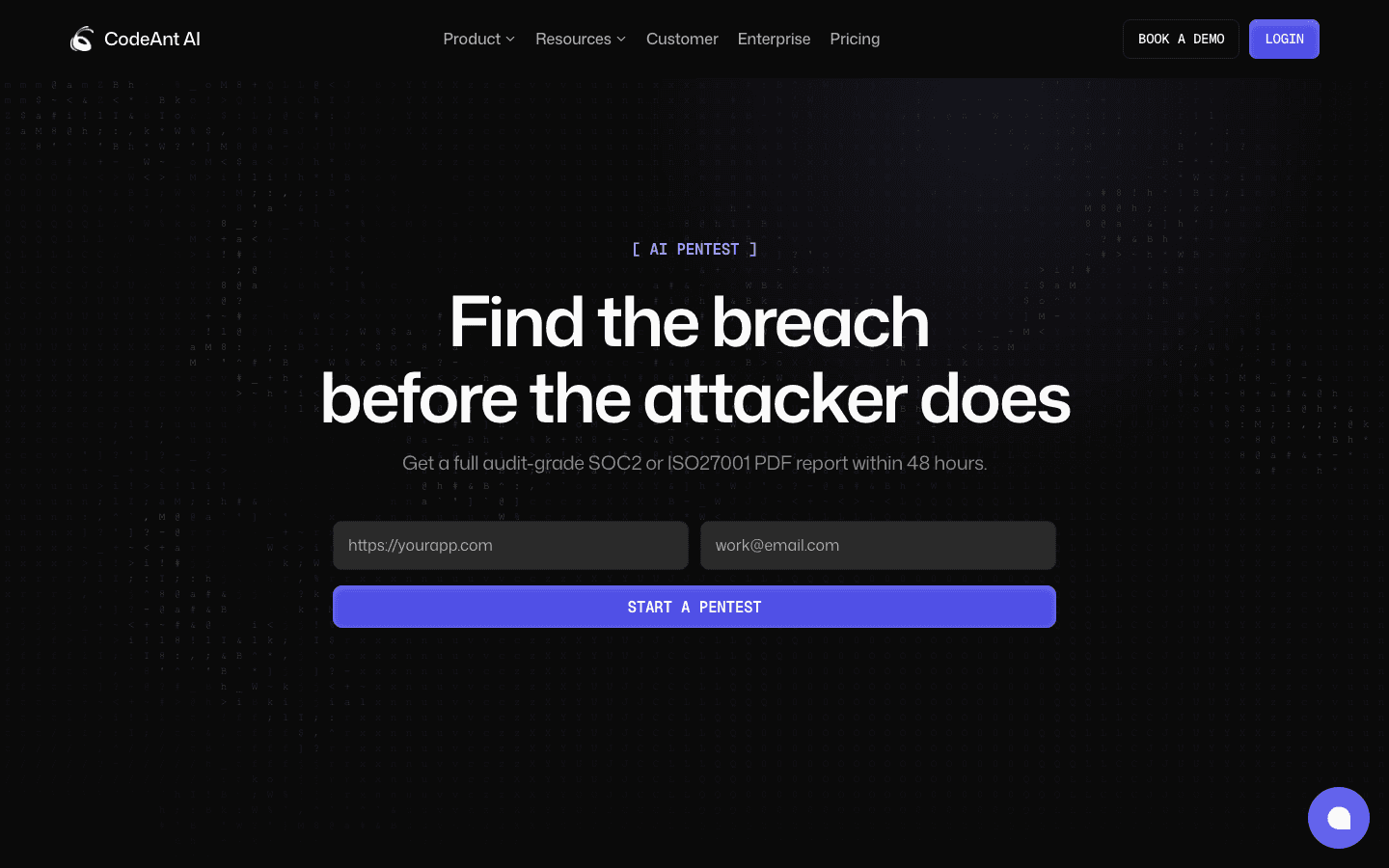
CodeAnt AI is the strongest Bishop Fox alternative for fast-moving software teams that want application pentesting connected directly to source code and developer remediation.
Its AI pentesting supports black-box, white-box, and gray-box approaches. CodeAnt advertises an audit-grade report within 48 hours, no engagement fee, payment when it produces a working proof-of-concept exploit, no payment when nothing exploitable is found, and free unlimited rescans.
The wider platform includes:
SAST
Software composition analysis
Secret scanning
Infrastructure-as-code scanning
SBOM generation
AI code review
Repository and pull-request context
Code memory and attack-path reasoning
Why choose CodeAnt AI over Bishop Fox?
Choose CodeAnt when security needs to operate at engineering speed. A confirmed runtime weakness can be connected to implementation context, routed to developers, fixed, and reverified without scheduling another consulting phase.
It is especially suitable for SaaS companies with frequent releases, multiple authenticated roles, APIs, and an appetite for continuous testing.
Where Bishop Fox is stronger
Bishop Fox has dedicated services for mobile, cloud, networks, hardware, AI systems, CTEM, red teams, social engineering, and readiness exercises. CodeAnt is most differentiated around applications, code, and software delivery.
The complete CodeAnt AI vs Bishop Fox comparison explains the decision in depth.
2. NetSPI: best enterprise PTaaS alternative
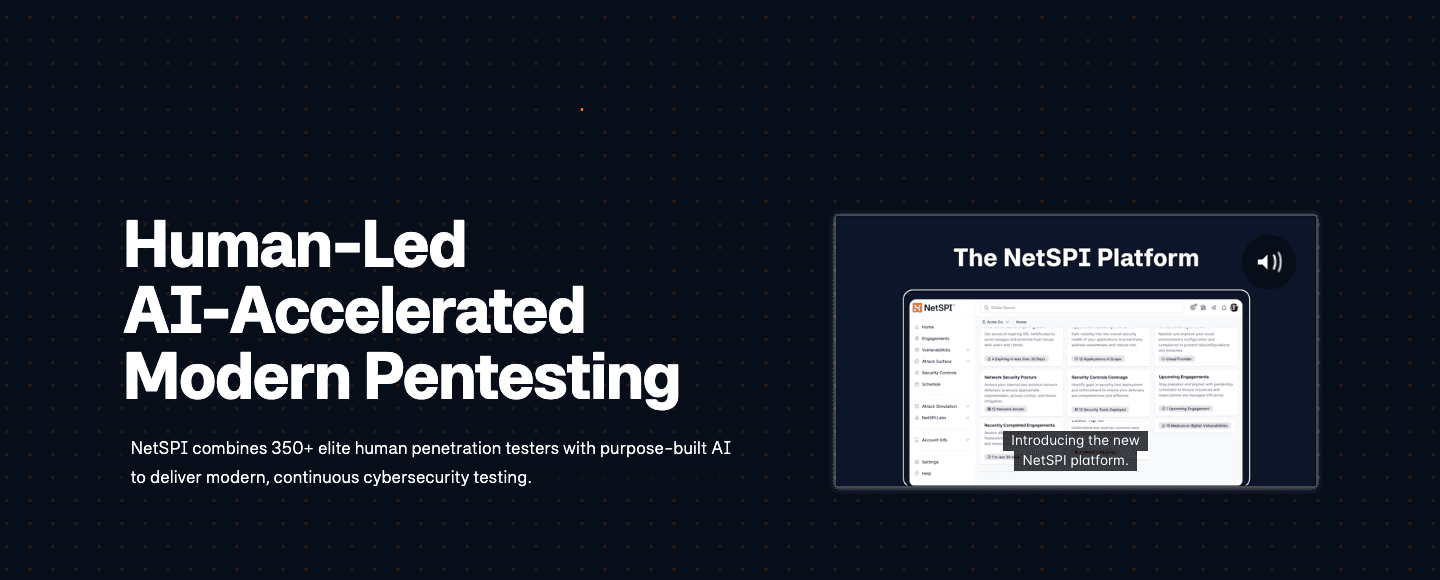
NetSPI combines in-house penetration testers, an AI-accelerated platform, continuous testing, attack-surface visibility, and program management.
Its official PTaaS catalog covers web applications, APIs, mobile and thick clients, internal and external networks, cloud, hardware, mainframes, AI and ML, and other specialized targets. NetSPI says it has more than 350 in-house pentesters and over 50 pentesting services.
Key capabilities include:
Program and findings management
Real-time collaboration
Remediation testing
Trend dashboards
External asset discovery
Continuous pentesting
AI-assisted attack-surface mapping
Open API and workflow integrations
Attack simulation and detection validation
Why choose NetSPI over Bishop Fox?
NetSPI is attractive when a large enterprise wants PTaaS as an operating platform rather than a sequence of standalone assessments. Its service breadth is close to Bishop Fox, while its public positioning emphasizes customer control, continuous pentesting, and platform telemetry.
It is also a credible shortlist option for unusual technologies such as mainframes or broad enterprise portfolios.
Where Bishop Fox is stronger
Bishop Fox may be preferable when the buyer values its particular research culture, Cosmos-managed model, hardware expertise, or a highly bespoke offensive-security relationship. Both providers use expert-led and AI-augmented testing, so the decision should be based on the proposed team, scope, platform workflow, and total program cost.
Run the same pilot through both and measure exploit quality, speed, reporting, and remediation effort.
3. Synack: best vetted researcher-community alternative
Synack combines a security-testing platform with the Synack Red Team, a vetted community of more than 1,500 researchers. It now also offers Sara agentic AI pentesting.
Synack supports:
Web, mobile, API, host, cloud, and AI application testing
Point-in-time and continuous programs
Attack-surface discovery and analytics
Self-service test launches
Researcher traffic visibility and stop controls
Internal vulnerability triage
Patch verification
Executive and technical reporting
Synack14, Synack90, and Synack365 testing windows
FedRAMP Moderate platform controls
Why choose Synack over Bishop Fox?
Synack is strongest when the buyer wants diverse, on-demand talent rather than a smaller assigned consulting team. Incentivized researchers can bring varied techniques and domain expertise to a target over a longer testing window.
The platform also gives customers visibility into testing traffic and coverage. Synack handles researcher payouts and presents verified results rather than requiring the customer to run a public bug bounty.
Where Bishop Fox is stronger
Bishop Fox offers a conventional managed relationship with specialist services across hardware, secure code review, CTEM, and adversary simulation. Some organizations may prefer a named, stable team over a community model.
Compare CodeAnt AI vs Synack, Synack features, and Synack pricing before shortlisting.
4. Cobalt: best for fast, collaborative PTaaS
Cobalt is a pentesting-as-a-service platform backed by the Cobalt Core community of security experts. It emphasizes quick scheduling, real-time findings, direct collaboration, integrations, and reusable pentesting credits.
Cobalt’s current platform supports:
Web, API, mobile, desktop, network, cloud, and AI/LLM tests
Human-led and autonomous pentest options
Launches in as little as 24 hours
Live findings during the engagement
Platform and Slack collaboration
Jira, GitHub, API, and other integrations
Custom reports and attestations
Free retesting for defined six- or twelve-month periods
Comprehensive and Agile Pentesting scopes
Why choose Cobalt over Bishop Fox?
Cobalt is designed to reduce procurement and scheduling friction. It is a good fit for application-security teams that run many repeatable tests and want findings to flow into developer workflows before the final PDF arrives.
Its Agile Pentesting option is relevant for a new release, a microservice, a delta test, or a targeted vulnerability class.
Where Bishop Fox is stronger
Bishop Fox offers deeper breadth in areas such as continuous threat exposure management, hardware, research-led specialist work, and managed enterprise offensive-security programs. Cobalt’s community and credit model are more standardized.
Read CodeAnt AI vs Cobalt, Cobalt features, and Cobalt pricing.
5. Praetorian: best for elite adversary simulation
Praetorian provides expert-led penetration testing across applications, networks, cloud, AI, IoT, and other attack surfaces. Its Chariot platform supports continuous security, attack-surface management, vulnerability management, breach and attack simulation, and continuous penetration testing.
Praetorian’s advanced offensive services include:
Application, mobile, API, and microservice testing
Internal and external network testing
Cloud and IoT assessment
Red, purple, and assumed-breach exercises
Attack-path mapping
Social engineering
Continuous adversarial validation through Chariot
Expert verification and retesting
Why choose Praetorian over Bishop Fox?
Praetorian is a strong alternative for goal-oriented adversary simulation and technically demanding attack paths. Its public positioning emphasizes advanced operators, bespoke tooling, attack chaining, and using offensive work to strengthen detection and response.
Chariot is also relevant when the organization wants a continuous managed validation platform rather than only point-in-time consulting.
Where Bishop Fox is stronger
Bishop Fox’s Cosmos platform provides a distinct external asset and CTEM operating model, while its public application packages make AI-assisted portfolio tiering easy to understand. Compare the actual team, testing objectives, continuous-service boundaries, and portal workflows.
Neither provider publishes simple list pricing, so a controlled pilot and itemized proposal are essential.
6. Trail of Bits: best for critical software and cryptography
Trail of Bits is a research-led security engineering firm known for deeply technical software assessments. It combines manual review, static and dynamic analysis, threat modeling, architecture work, and custom security engineering.
Its application-security services include:
Design assessments
Data-centric threat modeling
Cloud and infrastructure assessment
Comprehensive code assessment
Manual and automated analysis
Security engineering and custom tooling
Public assessment reports
The company also has deep practices in cryptography, blockchain, AI and ML, systems software, and formal or advanced testing techniques.
Why choose Trail of Bits over Bishop Fox?
Choose Trail of Bits when the central question is whether complex or high-value software is designed and implemented securely—not merely whether a deployed web surface contains common vulnerabilities.
It is particularly relevant for cryptographic protocols, blockchain systems, developer infrastructure, open-source foundations, security-sensitive libraries, and projects that benefit from custom analysis tooling.
Where Bishop Fox is stronger
Trail of Bits is not a direct replacement for a broad enterprise PTaaS, CTEM, external attack-surface, or red-team program. Bishop Fox is easier to consolidate across application, network, cloud, hardware, and organizational readiness services.
Use Trail of Bits for specialist depth and Bishop Fox for broader offensive-security program coverage.
7. IOActive: best for hardware and full-stack product security
IOActive is a research-led security consultancy with decades of experience across software, hardware, embedded devices, wireless technologies, cloud, infrastructure, and operational environments.
Its public penetration-testing coverage includes:
Mobile applications
Infrastructure
Wireless systems
Cloud environments
Embedded devices
Web services
Full-stack product security
Secure development lifecycle consulting
Red and purple teams
Adversarial emulation
Why choose IOActive over Bishop Fox?
IOActive is a strong alternative when risk crosses physical products, silicon, firmware, wireless protocols, cloud backends, mobile applications, supply chains, and safety-critical operations.
The provider is particularly relevant to transportation, industrial, automotive, aerospace, medical, and connected-device companies that need a research-oriented view of the entire product stack.
Where Bishop Fox is stronger
Bishop Fox offers a more explicit managed Cosmos and CTEM platform story, including continuous external discovery and workflow integrations. IOActive’s model is closer to a scoped specialist consultancy.
For a hardware test, compare exact laboratories, device experience, destructive-testing rules, firmware skills, radio capabilities, and the named researchers—not only the corporate service list.
8. BreachLock: best unified ASM, AEV, and PTaaS alternative
BreachLock combines attack-surface management, adversarial exposure validation, and CREST-certified penetration testing as a service in one platform.
Its current product model includes:
Continuous external asset discovery
Agentic AI-powered autonomous pentesting
Multi-step exploit and attack-path validation
Certified human-led PTaaS
Web, API, cloud, network, IoT, and LLM testing
In-house certified pentesters
Audit-ready reports for common frameworks
Launches advertised in 24 to 48 hours
Unlimited retesting
A unified asset, finding, and remediation data model
Why choose BreachLock over Bishop Fox?
BreachLock is attractive when a buyer wants one operational workflow from discovery to autonomous validation, certified manual testing, remediation, and revalidation. Its launch and retesting terms are more explicit than Bishop Fox’s public materials.
The combination of ASM, AEV, and PTaaS is also useful for teams that want both continuous machine-driven validation and formal human assessment.
Where Bishop Fox is stronger
Bishop Fox has a longer specialist offensive-security identity and public depth across secure code review, hardware, red teams, and research. Its Cosmos-managed model may suit organizations that want the provider to carry more operational responsibility.
Read CodeAnt AI vs BreachLock, BreachLock features, and BreachLock pricing.
9. Pentera: best automated exposure-validation alternative
Pentera is an automated security-validation platform. It runs adversarial testing across internal networks, external assets, cloud, identity, and security controls, then prioritizes proven attack paths and revalidates remediation.
Core products include:
Pentera Core for internal attack paths, lateral movement, and privilege escalation
Pentera Surface for external assets, applications, and exposed identities
Pentera Cloud for cloud-native identity and resource compromise
Pentera Resolve for remediation routing, validation, and proof
Pentera Peer for natural-language interaction and analysis
The platform is designed to run repeatedly under customer-controlled guardrails in production environments.
Why choose Pentera over Bishop Fox?
Pentera is the better fit when the primary goal is automated, customer-operated exposure validation at enterprise scale. Teams can run tests after changes without reserving consultant time and can measure whether internal, external, or cloud attack paths remain exploitable.
It is especially relevant for CTEM validation, ransomware readiness, identity risk, and control effectiveness.
Where Bishop Fox is stronger
Pentera is not the same as an independent human application assessment. Bishop Fox offers expert business-logic testing, secure code review, hardware work, AI assessments, and bespoke adversary simulation.
Many mature programs use an automated validation platform continuously and independent human specialists periodically. Compare Pentera vs CodeAnt AI, Pentera features, and Pentera pricing.
10. NCC Group: best global assurance alternative
NCC Group is a global cyber-security and assurance provider with in-house consultants, international delivery, technical research, and services for regulated environments.
Its penetration-testing portfolio includes:
Application and mobile testing
Source review and secure development lifecycle work
Internal and external network testing
Cloud security assessment
AI and ML testing
Cryptographic implementation review
Red, purple, and black team exercises
Technical due diligence
Continuous penetration testing
Portal and vulnerability-management integration
Why choose NCC Group over Bishop Fox?
NCC Group is attractive to multinational organizations that need regional delivery, standardized assurance, compliance alignment, and a broad catalog beyond a single offensive-security program.
Its global footprint can simplify vendor consolidation across business units and jurisdictions. It is also relevant for buyers that need adjacent risk, resilience, assurance, or due-diligence services.
Where Bishop Fox is stronger
Bishop Fox has a sharper offensive-security focus and a clearer Cosmos technology story. NCC Group’s breadth can feel more like a large consultancy, so the quality of the assigned team and scope requires close attention.
Ask both providers to identify the actual practitioners, quality-assurance process, start date, retesting allowance, and regional data-handling model.
Which Bishop Fox competitor should you choose?
Use the underlying problem to narrow the list.
Requirement | Best starting shortlist |
|---|---|
Continuous web and API testing tied to code | CodeAnt AI |
Enterprise PTaaS across many technologies | NetSPI, Cobalt, BreachLock |
Diverse vetted security researchers | Synack |
Elite red teams and attack paths | Praetorian, Bishop Fox |
Cryptography, blockchain, or critical code | Trail of Bits |
Hardware, embedded, wireless, or product stack | IOActive, Bishop Fox |
Automated internal, cloud, and identity validation | Pentera |
Unified ASM, autonomous validation, and certified PTaaS | BreachLock |
Global regulated delivery | NCC Group |
Managed external attack-surface and CTEM program | Bishop Fox, NetSPI, Praetorian |
Do not invite all ten vendors to the same request for proposal. Select three whose operating model matches the requirement, then run a pilot.
How to evaluate Bishop Fox alternatives
1. Define the target and objective
“Penetration test our platform” is not a useful scope. Provide applications, APIs, roles, repositories, cloud accounts, network ranges, devices, business workflows, and prohibited actions.
Define whether success means compliance evidence, exploit discovery, source assurance, detection validation, asset visibility, or continuous risk reduction.
2. Separate breadth from depth
A provider can touch 1,000 assets without deeply understanding one critical workflow. Another can spend weeks on one trust boundary. Decide which outcome matters and buy the corresponding depth.
3. Normalize human involvement
Ask which work is automated, AI-assisted, expert-validated, community-tested, or manually led. Obtain the number of human test days and role of the technical lead.
4. Test the workflow
Run one representative application through the platform. Measure:
Time to begin
Time to first critical notification
Authenticated coverage
Business-logic depth
Confirmed exploit quality
Duplicate and false-positive rate
Developer time to reproduce
Remediation specificity
Retest speed
Audit and executive usability
5. Compare the full price
Include setup, targets, expert days, platform fees, overages, integrations, workshops, retests, travel, and renewal. Read the Bishop Fox pricing guide and the general guide to penetration testing cost.
6. Verify the team and evidence
Review a redacted report. Meet the proposed technical lead. Ask for relevant target experience. Do not infer engagement quality from a famous research team that will not participate in your work.
7. Put retesting in writing
Confirm the number of retest rounds, request window, turnaround, updated deliverable, and treatment of partial fixes. “Remediation support” can mean very different things.
A practical three-vendor shortlist
For a modern SaaS company:
CodeAnt AI for continuous code-aware application testing
Cobalt or BreachLock for PTaaS
Bishop Fox for managed expert depth
For a large enterprise:
NetSPI for broad PTaaS
Bishop Fox for Cosmos and specialist offensive security
Synack for researcher diversity
For continuous exposure validation:
Pentera for customer-operated automation
BreachLock for unified ASM, AEV, and PTaaS
Bishop Fox or Praetorian for managed expert validation
For critical software or connected products:
Trail of Bits for code, cryptography, and systems
IOActive for hardware and product stacks
Bishop Fox for broad independent offensive testing
Can you use Bishop Fox with an alternative?
Yes. These tools and services can be complementary.
A mature program might:
Run CodeAnt AI on every approved application and codebase.
Use Pentera to validate internal, external, cloud, and identity attack paths.
Commission Bishop Fox for an annual expert application review, hardware assessment, or red team.
Use a specialist such as Trail of Bits for a cryptographic or blockchain component.
The goal is not maximum vendor count. Each layer should cover a distinct risk and produce evidence that flows into one remediation process.
Final verdict
CodeAnt AI is the best Bishop Fox alternative for continuous, code-aware application pentesting. NetSPI is the closest broad enterprise PTaaS alternative. Synack is strongest when researcher diversity matters, while Cobalt offers a fast collaborative developer workflow. Praetorian is compelling for advanced adversary simulation; Trail of Bits and IOActive stand out for specialist software and hardware depth. BreachLock unifies ASM, autonomous validation, and certified PTaaS. Pentera leads when customer-operated automated exposure validation is the priority, and NCC Group offers global assurance reach.
Bishop Fox remains a strong choice for organizations that want Cosmos, managed CTEM, expert-led testing, hardware work, AI assessments, and red teams from one offensive-security partner. The right alternative depends on whether your real requirement is speed, code context, platform control, specialist expertise, diverse talent, global delivery, or continuous validation.
Create a representative pilot, score confirmed evidence rather than finding volume, and select the provider that shortens the path from exposure to verified remediation.

