

BreachLock is not one pentesting feature wrapped in a dashboard. It is an offensive-security and automated security validation platform with three main engines: Attack Surface Management discovers what is exposed, Adversarial Exposure Validation proves what is exploitable, and Penetration Testing as a Service brings in certified human testers for deeper or compliance-driven work.
Around those engines sit vulnerability scanning, attack-path visualization, dark-web monitoring, reports, ticketing integrations, retesting, remediation support, and red-team services.
TL;DR
BreachLock ASM is an attack surface management platform for continuous asset discovery, exposure monitoring, and prioritization.
BreachLock AEV provides adversarial exposure validation through autonomous web and network penetration testing.
BreachLock PTaaS adds certified human pentesters, compliance-ready reporting, remediation support, and manual retesting.
BreachLock RTaaS adds external, internal, hybrid, and purple-team exercises.
The main trade-off is breadth: application-only teams may not use enough of the platform to justify the larger program.
This guide explains what every major BreachLock feature does in 2026, where it is genuinely strong, and where another penetration testing platform fits better.
BreachLock Features at a Glance
Feature area | What BreachLock provides | Best use |
|---|---|---|
Attack Surface Management | Continuous asset discovery, shadow IT, dark-web credentials, attack-path mapping, and scanning | Finding unknown external and internal exposure |
Adversarial Exposure Validation | Agentic autonomous web and network attacks with kill-chain evidence | Continuous proof of exploitability |
PTaaS | Certified in-house human pentesters in the same platform | Complex, high-stakes, or compliance-led tests |
Vulnerability scanning | Authenticated and unauthenticated application, API, and network scans | Continuous baseline coverage |
Reporting | Technical, executive, and compliance-ready reports | Engineering, audit, board, and customer evidence |
Retesting | Unlimited autonomous or automated retests; one manual PTaaS re-test | Validating fixes without waiting for another annual cycle |
Integrations | Jira, ServiceNow, Azure DevOps, and GitHub workflows | Moving findings into remediation queues |
RTaaS | External, internal, hybrid, and purple-team exercises | Testing people, process, detection, and response |
What Is the BreachLock Unified Platform?
The BreachLock Unified Platform stores ASM, AEV, and PTaaS findings under one data model.
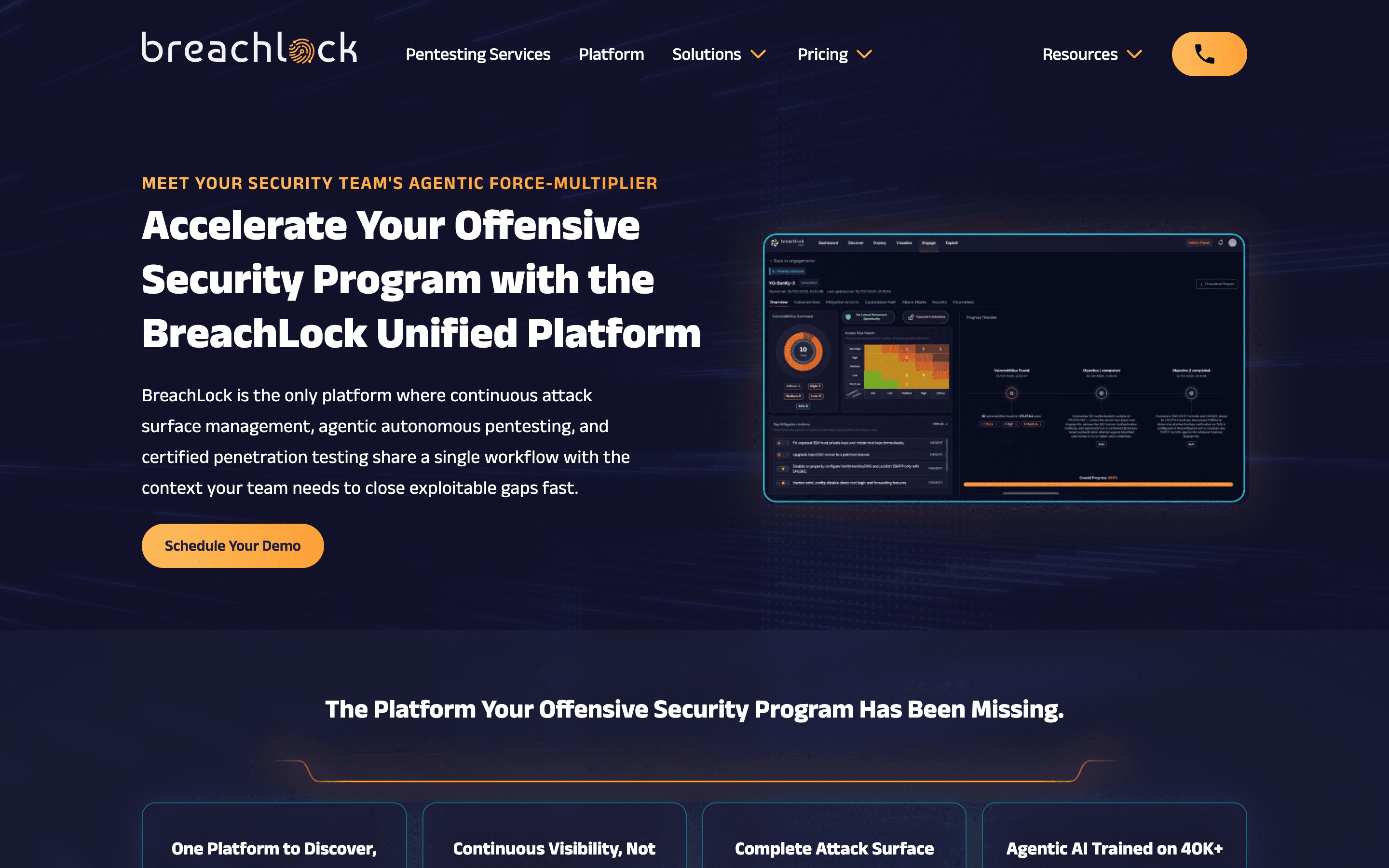
That sounds administrative, but it changes the testing workflow. Traditional programs often have one vendor discovering assets, another scanning them, a consultancy running the annual pentest, and a ticketing system tracking remediation. The same asset and vulnerability can acquire different names and severities in every tool.
BreachLock tries to keep the chain intact:
ASM discovers a domain, IP, service, credential exposure, or shadow asset.
The platform prioritizes the exposure using risk and business context.
AEV executes multi-step attacks to validate reachability and exploitability.
PTaaS adds a certified tester when complexity or compliance demands it.
The finding moves into a developer or service-management workflow.
Retesting validates the fix and closes the evidence loop.
The dashboard therefore operates as an offensive-security system of record. Teams can see assets, tests, attack paths, vulnerabilities, remediation status, and reports without reconciling exports from several vendors.
This is the platform’s strongest strategic feature. Each individual module has competitors. Fewer competitors connect continuous discovery, autonomous validation, and human testing this tightly.
How Does BreachLock Attack Surface Management Work?
BreachLock ASM starts with a seed domain and expands outward through DNS, MX, CNAME, certificate, IP, hosting, protocol, and technology data.
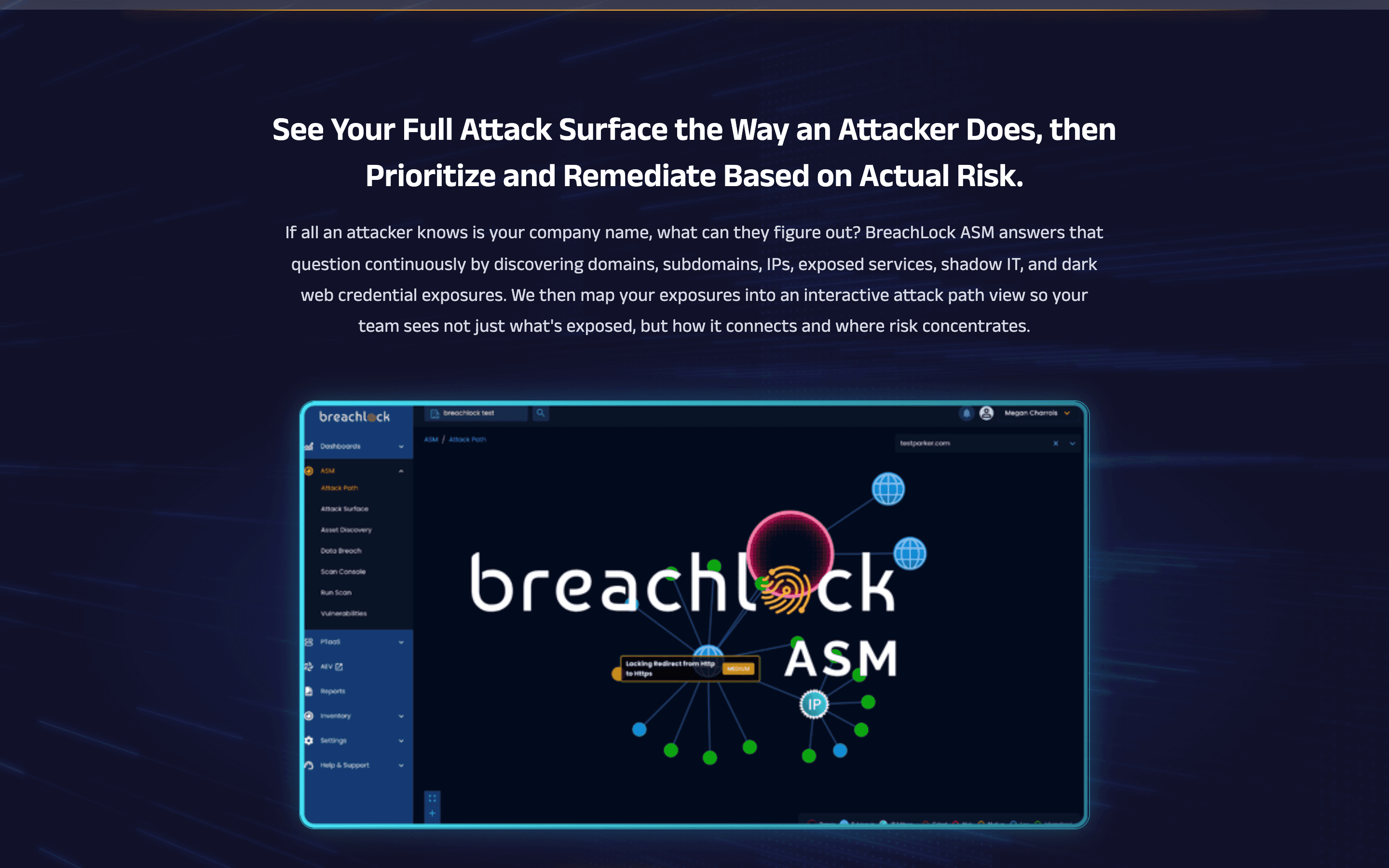
It continuously discovers:
domains and subdomains
public IP addresses
exposed ports and services
web applications and APIs
cloud services
remote access services
third-party and supply-chain infrastructure
source-code repositories
shadow IT
dark-web credential exposures
New assets can be discovered on a daily, weekly, or custom schedule, or added manually. BreachLock categorizes them by criticality, sensitivity, and business relevance.
The useful detail is what appears on each asset. The platform can show a landing-page screenshot, hosting IP, open ports, protocols, technology stack, and TLS or cipher information. That gives the security team a reconnaissance profile close to what an attacker would assemble.
Interactive attack-path mapping
ASM maps how seed domains, subdomains, servers, services, and vulnerabilities connect. A flat inventory answers “what do we own?” An attack-path view answers “how could one exposed object lead to another?”
The visualization also provides a natural escalation point. A suspicious route can move into AEV for autonomous exploitation or PTaaS for a certified human test.
Dark-web credential monitoring
BreachLock correlates the organization with threat-intelligence feeds and public breach data. A result can identify the affected user, whether the credential is a hash or plain text, and the breach source.
This feature matters because a valid credential can turn a medium exposure into an authenticated attack path. It belongs beside asset discovery rather than in a disconnected brand-monitoring portal.
Internal and external scope
BreachLock positions ASM across both internal and external assets.
External coverage includes websites, APIs, cloud, DNS, remote access, source repositories, third-party infrastructure, and leaked credentials. Internal coverage extends to workstations, servers, databases, network devices, identity systems, internal apps and APIs, mobile devices, IoT, and shadow IT. For an application-focused view of external testing, see our external penetration-testing methodology.
The breadth is a differentiator from external-only EASM tools. Buyers should still confirm which internal discovery capabilities and deployment requirements are included in their specific contract.
What Vulnerability Scanning Does BreachLock Include?
BreachLock ASM includes subscription-based unlimited scanning across discovered assets.
Supported scan types include:
authenticated and unauthenticated application scans
network vulnerability scans
API scans
non-invasive production profiles
more invasive staging or development profiles with additional fuzzing and form interaction
Each finding includes severity, context, evidence, affected assets, and remediation guidance. Prioritization combines OSINT, CVSS, known breach data, likelihood of exploitation, and business relevance instead of relying on CVSS alone.
This is still vulnerability scanning, not proof that every finding is exploitable. The escalation into AEV is what separates discovery from validation. Our vulnerability assessment versus penetration testing guide explains the evidence gap.
BreachLock has also described DAST, SAST, and API fuzzing in its application-security material. Buyers should distinguish general platform and service capabilities from the exact engines licensed in the ASM, AEV, or PTaaS proposal. A product page mentioning SAST does not automatically mean source analysis is included in every package, and SAST and DAST answer different questions.
What Is BreachLock Adversarial Exposure Validation?
BreachLock AEV is the autonomous offensive engine.
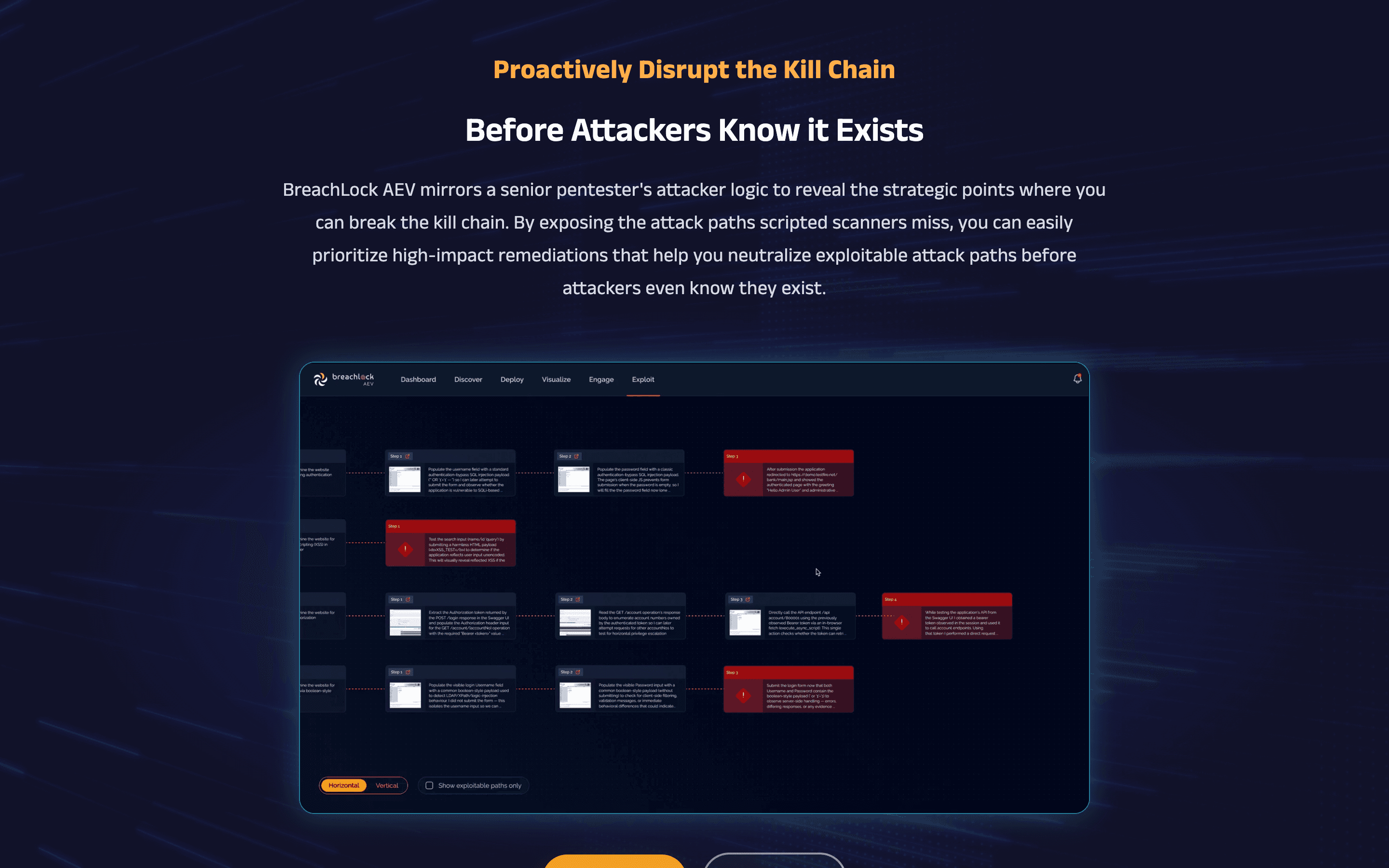
It uses agentic AI to move beyond signatures and isolated findings. The system plans and executes multi-step attacks from reconnaissance through exploitation, pivoting, and lateral movement. BreachLock says the AI is trained on intelligence from more than 40,000 real-world pentesting engagements rather than only lab exercises or CVE databases. For category context, see how automated penetration testing works.
Core AEV features include:
web and network autonomous pentesting
multi-step exploit chains
business-logic testing
lateral movement and pivoting
threat-intelligence-led tactics
proof-of-concept screenshots
full kill-chain context
attack-path mapping
real-time execution visibility
unlimited testing on contracted assets
Approval gates and kill switch
Autonomous exploitation in production needs control. BreachLock lets an operator approve or deny lateral movement and exploitation before the system continues. A kill switch can stop the engagement.
This feature is more important than an agent-count claim. It creates a boundary between machine-speed exploration and actions that may affect sensitive systems. Teams should still document those boundaries in a pentest authorization letter.
Agentless deployment
AEV can be deployed with a single command using a Linux machine, OVA file, or Docker. BreachLock describes the deployment as agentless and does not require dedicated hardware.
The operational questions to ask are:
which network segments the deployment can reach
which credentials or privileges it requires
how production safety is enforced
what traffic it generates
how findings and test data are stored
Unlimited testing within contracted scope
AEV is subscription-based and priced by the number of IPs or URLs covered. Within that scope, teams can run tests as often as required.
That makes AEV useful after firewall changes, deployments, identity updates, and remediation. “Unlimited” applies to contracted assets, so scope mechanics remain part of the commercial evaluation.
What Does BreachLock PTaaS Include?
BreachLock PTaaS is the human-led layer.
The service covers web applications, APIs, networks, cloud, mobile apps, thick clients, IoT, and DevOps environments through black, gray, and white box methods.
Every official PTaaS engagement includes:
a 100% in-house certified pentesting team
CREST-certified audit-ready reporting
one free comprehensive manual re-test
unlimited online remediation support
access to the Unified Platform
findings that appear in real time during the engagement
direct communication with the assigned pentester
BreachLock lists certifications including OSCP, OSCE, CREST, CISSP, CEH, GSNA, eJPT, eMAPT, and specialized mobile security credentials.
Scoping and launch
BreachLock says a test can be scoped, scheduled, and started in 24 to 48 hours. The engagement itself may take a few days to a couple of weeks depending on scope and technology.
That is faster than a traditional consulting queue, but it is still a human project. Access preparation, account creation, target documentation, and tester scheduling affect the clock.
Real-time collaboration
Findings populate in the platform as testers work. A critical issue can be escalated immediately, and the customer can ask the assigned tester for context before the final report.
This avoids the worst part of a conventional pentest: discovering a critical issue only when a static PDF arrives at the end.
Manual re-test
PTaaS includes one comprehensive manual re-test. BreachLock’s platform and AEV pages also use “unlimited retesting” language, but the entitlements are different:
automated or autonomous retests can be unlimited within the licensed scope
certified human tester time is limited by the PTaaS agreement
The distinction belongs in the contract. Our penetration-test retest guide explains what evidence a valid closure should include, while the PTaaS SLA guide covers windows, support, and escalation terms.
What Reporting and Compliance Features Does BreachLock Offer?
BreachLock can generate several report views from the same finding set:
detailed technical reports for security and engineering
executive summaries for leaders and boards
compliance-ready reports for auditors and customers
reports across several assets or selected individual assets
multiple file formats
PTaaS reports are mapped to SOC 2, PCI DSS, ISO 27001, HIPAA, GDPR, and other frameworks. The platform also describes NIST-aligned use cases. Our compliance pentesting guide maps the major frameworks to testing evidence.
The report is not the only artifact. Each vulnerability can include evidence, a proof of concept, severity, business impact, affected assets, and remediation guidance. AEV adds kill-chain and attack-path context.
This layered reporting is valuable because an auditor and an engineer do not need the same document. The auditor needs coverage, control mapping, and closure. The engineer needs reproduction and a fix. The board needs current business risk.
Which Integrations Does BreachLock Support?
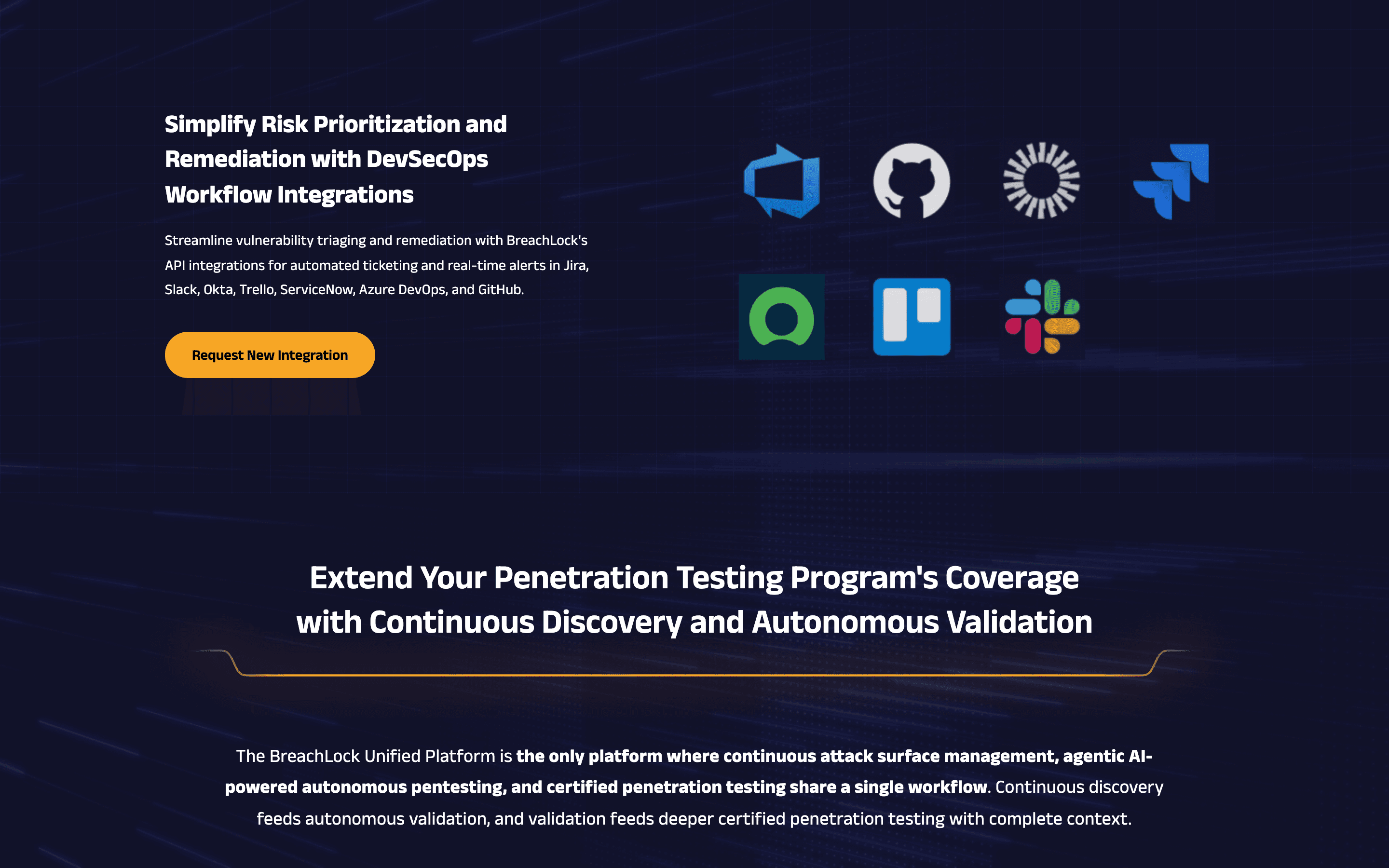
BreachLock ASM can push findings into:
Jira
ServiceNow
Azure DevOps
GitHub
The platform also describes built-in ticketing and DevSecOps integration, while older continuous-validation packaging lists SSO and customized reports at the highest tier.
The integration model is remediation-oriented. A finding moves from the security platform into a work queue, is fixed, and returns for validation.
What is less central is continuous code intelligence before the test. BreachLock can test applications and offer source-based services, but its public workflow begins with assets and exposures rather than pull-request code review and repository memory.
That distinction matters for engineering teams. A Jira ticket is a handoff. A security engine commenting on the pull request where the vulnerable logic was introduced is an earlier control point. Code-quality gates can stop the issue before merge, and continuous code-security scanning keeps that control inside CI/CD.
What Red-Team Features Does BreachLock Offer?
BreachLock Red Team as a Service broadens the scope beyond a defined penetration test.
External red teaming
External exercises can cover:
network infrastructure
web application exploitation
social engineering
wireless networks
supply chains
IoT and industrial-control systems
cloud environments
Internal or assumed-breach testing
Internal exercises can cover:
on-network lateral movement
credential theft and abuse
privilege escalation
insider-threat simulation
data exfiltration
application compromise
detection and response
Hybrid and purple teaming
Hybrid scenarios can cross IT and OT, adapt tactics based on defensive response, and combine red-team, pentest, and blue-team work. Purple-team services include incident-response drills, detection workshops, SIEM evaluation, shadow-IT exercises, social engineering, and secure-development reviews.
This is a major BreachLock advantage over application-only AI pentesting platforms. Red teaming tests technology, people, process, detection, and response. It is not a larger vulnerability scan. The legal scope also differs, as our red-team authorization guide explains.
How Does BreachLock Prioritize and Remediate Findings?
BreachLock combines several signals:
CVSS severity
OSINT
known breach data
exploitability
reachability
attack-path context
asset criticality
business impact
ASM identifies and scores exposure. AEV proves whether an attack path works. PTaaS adds human context. That progression reduces the risk of treating every scanner alert as equally urgent.
Findings include evidence and remediation guidance, can move into a ticketing system, and can be retested from the platform. The ideal workflow is:
Discover the asset.
Validate the exploit.
Assign the fix.
Re-test the exact path.
Generate closure evidence.
The strength is prioritization through proof. The limitation is developer depth. A finding may tell a developer what is exploitable and how to remediate it without providing the same repository-level trace or code change that a code-native platform can produce through source-code analysis, steps of reproduction, or an IDE fix.
What Are BreachLock’s Main Limitations?
BreachLock’s breadth creates trade-offs.
Current pricing is not transparent
PTaaS and AEV require a sales conversation. The $2,500 and $5,000 figures still visible on G2 were last updated in October 2024. Our BreachLock pricing guide separates those historical floors from the current model.
There is no published self-serve free tier
Security teams cannot start a real test from a public free plan. They must request a demo or quote.
The suite can be larger than the problem
A software company that needs one application tested may not need ASM, network AEV, RTaaS, dark-web monitoring, and a certified pentester bench.
Code-to-PR remediation is not the core workflow
BreachLock integrates with developer ticketing systems and offers application testing, but it is not organized around continuous AI code review, repository memory, source-level root cause, and pull-request fixes. Nor does it position SCA, secret scanning, IaC scanning, and SBOM generation as one native developer workflow.
User experience deserves a trial
BreachLock holds a strong 4.6 out of 5 score on G2. Reviewers praise support and reporting, while some mention false positives, a slow interface, expensive pricing, and limited report customization. Test the administration and remediation flow during procurement, not just the final report.
How Do BreachLock Features Compare to CodeAnt AI?
The CodeAnt AI vs BreachLock comparison covers the full decision. The short version is that each platform owns a different context layer.
Capability | BreachLock | CodeAnt AI |
|---|---|---|
Continuous attack-surface discovery | Strong ASM with shadow IT and dark-web credentials | External application reconnaissance, not a full enterprise ASM replacement |
Autonomous web pentesting | Yes through AEV | Yes across black, white, and gray box modes |
Autonomous network pentesting | A core AEV strength | Not the primary use case |
Certified human PTaaS | Yes, in-house team | Not the central product |
Source-code and Git-history context | Available in white-box services, not the platform foundation | Core platform context |
SAST, secrets, SCA, and code review | Not the organizing workflow | Native defensive layer |
Pull-request remediation | Ticketing integrations | Native code-review and developer workflow |
Red teaming and social engineering | Broad RTaaS offering | Not a direct replacement |
Free entry | No published free tier | Free one-URL black-box scan |
BreachLock is better for broad enterprise exposure. CodeAnt is better when the decisive attack path lives in application logic and the decisive fix lives in a repository.
Who Should Use BreachLock?
BreachLock fits teams that need several of these capabilities together:
internal and external attack-surface management
web and network autonomous validation
lateral movement and kill-chain evidence
certified human penetration testing
compliance-mapped reports
continuous retesting
red-team and purple-team exercises
central remediation across security and IT
It is particularly well suited to enterprises that are consolidating several offensive-security vendors.
A product-security or SaaS team with a narrow application scope should compare the cost and workflow against a code-aware option. Start with the CodeAnt AI free pentest, inspect the proof and root cause, then decide whether broader network and human-led coverage justifies BreachLock. The best BreachLock alternatives guide maps the closest options by target type.
The Bottom Line on BreachLock Features
BreachLock’s defining feature is not AEV, ASM, or PTaaS alone. It is the connection between them.
ASM discovers an asset. AEV proves how it can be exploited. PTaaS adds certified human depth. The platform routes the finding into remediation and retains the evidence through retesting and reporting.
That is a strong model for an enterprise offensive-security program.
It is less differentiated inside the software-development loop. When source code, Git history, PR context, and developer fixes determine depth, CodeAnt AI has the more direct architecture.
Choose the context layer that matches your highest-risk assets, then verify the product on a real scope rather than a feature checklist. Use the BreachLock pricing analysis to normalize scope, or the CodeAnt AI vs BreachLock comparison for the final product decision.

