

SaaS security teams now have a choice that did not exist a few years ago: use a unified security platform that combines defensive code review with offensive pentesting, or use a specialized PTaaS vendor built around human-led, crowdsourced testing.
That choice matters because CodeAnt AI and Cobalt are not the same type of platform.
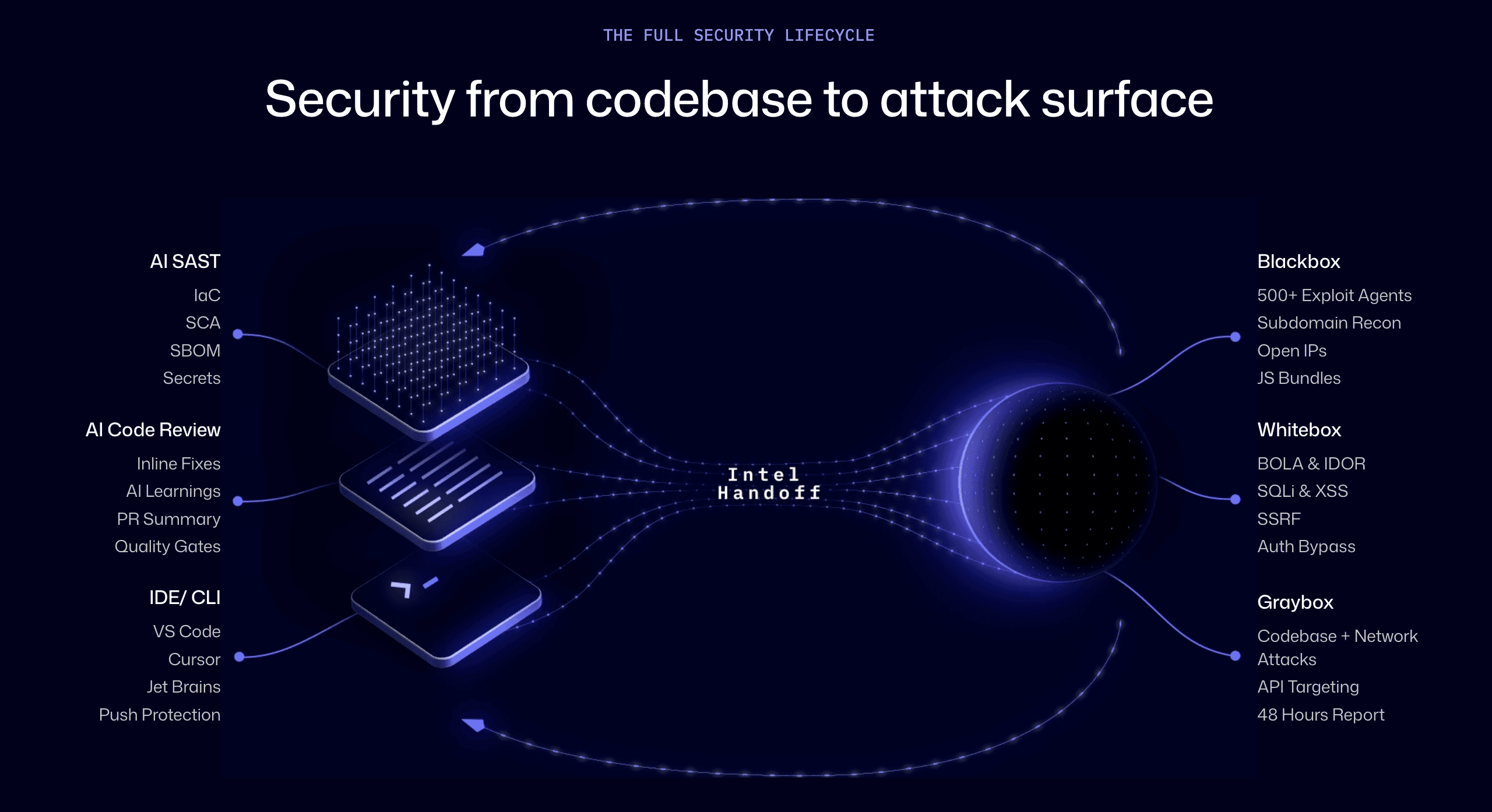
CodeAnt AI is a defensive and offensive security platform. It reviews code inside developer workflows and CI/CD pipelines, then uses that same codebase intelligence to guide offensive pentesting from the outside. This makes it a stronger fit for teams that want code-aware AI penetration testing, gray box testing, automated retesting, and compliance evidence tied directly to the SDLC.
Cobalt is a mature human-led PTaaS platform, positioned by the company as “Human-Led, AI-Powered Continuous Offensive Security” as of July 2026. It gives teams access to a vetted network of pentesters, established engagement workflows, and external validation through manual security testing. This makes it a strong fit for teams that want crowdsourced testing depth, human creativity, and a standalone PTaaS program.
The right choice depends on your testing model, not abstract vendor claims.
CodeAnt AI fits fast-moving SaaS teams that need continuous code-informed pentesting, SOC 2 evidence, exploit validation, and retesting after every meaningful fix.
Cobalt fits teams that prefer human-led PTaaS, manual tester diversity, and a mature crowdsourced pentesting workflow.
This comparison breaks down CodeAnt AI vs Cobalt across pricing models, testing depth, compliance deliverables, retesting, CI/CD fit, and total cost of ownership so security teams can choose the PTaaS model that matches their workflow.
What Is The Main Difference Between CodeAnt AI And Cobalt?
You’re evaluating two fundamentally different approaches:
CodeAnt AI’s unified model
The same platform that reviews your pull requests for security issues also conducts adversarial reconnaissance against production. Months of defensive code review context, understanding your API endpoints, authentication flows, middleware configurations, feeds directly into offensive testing. It’s code-informed pentesting: testing your application with inside knowledge of how it’s built.
Cobalt’s specialized model
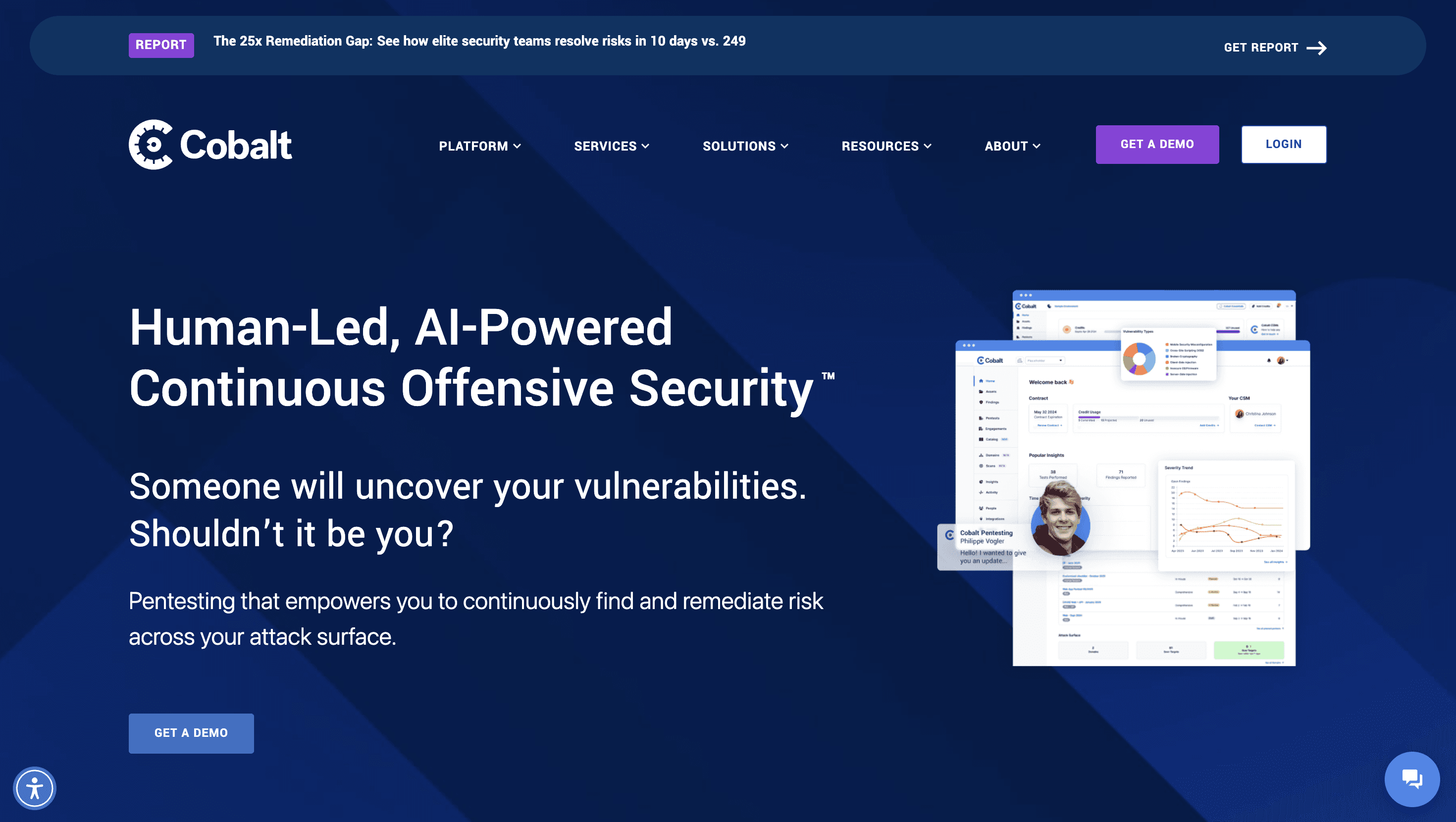
A proven PTaaS platform deploying 400+ human pentesters (OSCP, OSWE, CREST certified, per Cobalt) against your external attack surface. Testing starts from the outside, simulating real adversaries with no prior code knowledge. You get tester diversity, business logic validation, and flexible engagement models without coupling pentesting to your defensive tooling.
Key Architectural Differences Between CodeAnt AI And Cobalt PTaaS
Architectural Area | CodeAnt AI | Cobalt PTaaS |
|---|---|---|
Testing Methodology | Grey box by default. CodeAnt uses JS bundle analysis, data flow tracing, middleware awareness, API context, and codebase intelligence to inform exploit attempts. | Black box starting point. Cobalt begins with external reconnaissance, then uses human judgment and optional source code access depending on engagement scope. |
Core Testing Model | Unified defensive and offensive security platform. It reviews code and uses the same intelligence layer to guide offensive testing. | Human-led PTaaS platform. It relies on vetted pentesters, manual testing depth, and mature crowdsourced testing workflows. |
Retesting Model | Unlimited automated retests included. Fix validation can happen in hours without additional retest cost. | Unlimited on-demand retesting included throughout the contract term (per Cobalt’s pricing page, as of July 2026). Retests are performed by the pentester who filed the finding, and retest requests end 10 days before contract end. |
Integration Approach | Unified platform from IDE through production. Findings appear where developers already review code, security issues, and CI/CD feedback. | Best-of-breed integrations. Cobalt connects with 50+ ticketing and reporting tools such as Jira, Slack, GitHub, and ServiceNow (per Cobalt’s integrations page, as of July 2026). |
Developer Workflow Fit | Strong for teams that want security feedback inside PRs, CI/CD, and remediation workflows. | Strong for teams that want pentest findings routed into existing ticketing and collaboration tools. |
Best Fit | Fast-moving SaaS teams that need code-aware AI pentesting, continuous retesting, exploit validation, and SDLC-aligned evidence. | Teams that want mature human-led PTaaS, tester diversity, external validation, and a standalone pentesting program. |
CodeAnt AI Vs Cobalt: 5 Questions To Choose The Right PTaaS
Decision Question | CodeAnt AI Fit | Cobalt PTaaS Fit | Decision Point |
|---|---|---|---|
Do you need code-aware testing or is external-only sufficient? | Code-aware testing. CodeAnt AI discovers vulnerabilities that require understanding application internals, including misconfigured internal APIs, client-side logic flaws, authentication bypass chains, source-level authorization gaps, and risks visible only through code context. CodeAnt AI reports 100+ day-zero vulnerabilities found in open-source dependencies, including CVE-2026-28292 at CVSS 9.8 per NVD (codeant.ai/pentest, as of July 2026), showing what code-informed reconnaissance can uncover. | External-only testing. Cobalt catches vulnerabilities discoverable from the outside, simulating real adversaries who do not have code access. It is strong for external black-box testing and business logic flaws that benefit from human judgment. | If your threat model includes adversaries with partial code knowledge, such as ex-employees, leaked repositories, or supply chain compromise, code-aware testing models that reality better. |
Do you need human business logic validation or is agentic depth enough? | Agentic exploit depth. CodeAnt uses 500+ autonomous agents to chain vulnerabilities systematically, such as BOLA → IDOR → privilege escalation → data exfiltration. This is strong for technical vulnerability depth, comprehensive exploit coverage, API abuse, authentication flaws, and large attack surfaces. | Human-led diversity. Cobalt’s 400+ pentesters bring creative thinking, business context understanding, and manual judgment that AI agents do not fully replicate yet. This is strong for authorization edge cases, multi-step workflow abuse, and domain-specific attack vectors. | Complex business workflows requiring contextual judgment favor human-led PTaaS. Deep technical exploitation across large attack surfaces favors agentic AI penetration testing. |
How often do you ship, and what does retesting cost? | Daily or weekly releases. CodeAnt includes unlimited retesting by default. When a vulnerability is fixed, teams can trigger a retest, validate the patch, and close the issue without additional retesting cost. This fits continuous deployment and CI/CD security workflows. | Monthly or quarterly releases. Cobalt includes unlimited on-demand retesting throughout the contract term (per cobalt.io/pricing, as of July 2026). Each retest is performed by the pentester who filed the finding, so turnaround depends on human scheduling within the contract window. | Both platforms include unlimited retests. Continuous deployment environments benefit from automated in-pipeline validation, while less frequent releases can absorb human retest turnaround. |
What compliance evidence granularity do auditors require? | Highly regulated environments. CodeAnt delivers an 8-document compliance evidence package, including retest reports, timeline documentation, TSC control mapping such as CC6.1, CC6.6, and CC7.1, regulatory exposure analysis, and remediation verification. This supports SOC 2 Type 2, HIPAA, PCI-DSS, and ISO 27001 audit preparation. | Standard compliance needs. Cobalt provides a pentest report plus attestation letter, which is sufficient for many SOC 2 Type 1, ISO 27001, and standard customer security review requirements. | If auditors demand detailed control mapping, exploit PoC evidence, retest timelines, and remediation history, granular evidence packages can save audit preparation time. |
What cost model fits your risk tolerance? | Performance-based pricing. CodeAnt uses a pay-for-results model where the AI pentest scan is free, Low and Medium findings are always free, and teams pay only for High or Critical findings with working PoC exploits (per codeant.ai/pricing, as of July 2026). Unlimited retesting is included. Total cost depends on vulnerabilities found, which can be less predictable but more directly tied to validated exploitability. | Credit-based subscription. Cobalt uses a fixed annual subscription model where credits are allocated across different test types and 1 credit equals 8 hours of testing. Cobalt does not publish dollar pricing (per cobalt.io/pricing, as of July 2026), so budgeting starts from a quote, with costs fixed once the credit package is set. | Budget predictability favors subscription-based PTaaS. Pay-for-results accountability favors performance-based AI penetration testing. |
CodeAnt AI Vs Cobalt: Testing Methodology And Findings
Vulnerability Class Comparison
Vulnerability Type | CodeAnt AI | Cobalt | Why |
|---|---|---|---|
BOLA/IDOR | High detection | Moderate | Code analysis reveals object ownership models; systematic enumeration tests authorization across all resources |
Auth Bypass | High detection | Moderate | Middleware configuration awareness shows which routes lack auth guards; JS bundle analysis exposes client-side checks |
SQL Injection (second-order) | High detection | Lower | Data flow tracing follows stored input through database writes to later query construction |
Business Logic Flaws | Lower detection | High | Human testers excel at understanding workflow intent and identifying logic gaps (refund abuse, coupon stacking) |
Race Conditions | Lower detection | High | Requires timing-based exploitation and transaction boundary understanding—human judgment outperforms automation |
GraphQL Issues | High detection | Moderate | Schema extraction from bundles enables systematic introspection bypass and batching attacks |
Real Finding Examples
Code-informed discovery (CodeAnt): US healthcare provider, where an unauthenticated API was found exposing patient records. CodeAnt AI reports 3.2M PHI records secured from that engagement, alongside 6M passenger PII records secured at a major airline through a BOLA attack chain and 500K+ client records secured at a UK law firm (production findings published on codeant.ai/pentest, as of July 2026).
Human-led discovery (Cobalt): Fintech application, tester noticed “transfer funds” workflow allowed negative amounts in API request despite UI preventing it. Manipulating amount parameter to
-$1000credited sender’s account instead of debiting, business logic flaw requiring understanding intended behavior to recognize the violation.
Pricing Models & 3-Year TCO
CodeAnt AI: Performance-Based Pricing
Model: Pay only for confirmed exploitable high/critical findings with working PoC. The AI pentest scan is free and low/medium findings are free (per codeant.ai/pricing, as of July 2026). Unlimited retesting included.
CodeAnt AI publishes its engagement economics on its pentest page, compared against traditional pentest firms (as of July 2026):
Engagement Item | Traditional Pentest Firm | CodeAnt AI |
|---|---|---|
Engagement fee | $10K to $80K upfront | $0 |
You pay when | The testers show up | A working PoC exploit ships |
You pay nothing when | Never, the invoice arrives regardless | Nothing exploitable is found |
Time to report | 2 to 4 weeks | 48 hours |
Rescan after a fix | Around three weeks | Free and unlimited |
Costs decline as fixes accumulate and exploitable surface area shrinks. Published platform pricing as of July 2026 is $24 per user per month billed annually ($30 monthly) for AI Code Review, $200 per 10 users per month each for Code Security and Code Quality, and $20 per user per month for Dev Metrics (codeant.ai/pricing). Published platform pricing as of July 2026 is $24 per user per month billed annually ($30 monthly) for AI Code Review, $200 per 10 users per month each for Code Security and Code Quality, and $20 per user per month for Dev Metrics (codeant.ai/pricing).
Cobalt: Credit-Based Subscription
Model: Annual credit allocation applied across web, mobile, API, network, cloud tests. Unlimited on-demand retesting included throughout the contract term.
Cobalt does not publish dollar pricing. What its pricing page does publish, as of July 2026:
Credit Mechanic | What Cobalt Publishes |
|---|---|
What a credit buys | 8 hours of offensive security testing, delivered through AI-powered automation and human expertise |
How credits are sold | Annual packages, with mid-year top-ups available |
Standard tier | Pentest launch in 3 business days, 6-month credit rollover |
Premium tier | Launch in 2 business days, 12-month credit rollover |
Enterprise tier | Launch in 1 business day, 12-month rollover, quarterly strategic planning |
Retesting | Unlimited on-demand retesting throughout the contract term |
Fixed annual costs regardless of finding volume.
Retesting & the Remediation Loop
How Retesting Works in Practice
CodeAnt’s unlimited model:
Day 0: Findings delivered
Day 1: Engineer fixes SQLi → Commits PR → Auto-retest in 8 minutes → Confirmed fixed
Day 2: Engineer fixes auth bypass → Commits PR → Auto-retest in 12 minutes → Confirmed fixed
Day 3: All findings remediated and verified → Audit evidence ready
Cobalt’s engagement model (per docs.cobalt.io, as of July 2026):
Day 0: Findings delivered
Day 1-5: Engineering remediates 12 findings
Day 6: Request retest, wait for tester assignment
Day 8: Retest begins (tester available)
Day 10: Results confirm 10/12 fixed, 2 incomplete
Day 11-13: Re-remediate remaining findings
Day 14: Request second retest cycle…
Impact on Release Velocity
Scenario | Human-Performed Retest (Cobalt) | Automated Retest (CodeAnt AI) |
|---|---|---|
Hotfix deployment | Mark finding ready and wait on the pentester’s turnaround | Retest in pipeline (minutes) |
Sprint-end release | Coordinate retest timing with tester availability | Continuous verification |
Post-incident remediation | Expedited retest request through the platform | Immediate validation |
For teams deploying multiple times per day, retesting that waits on a human cycle becomes a release bottleneck. Unlimited automated retesting removes the trade-off between shipping fast and validating security fixes.
CodeAnt AI Vs Cobalt For Compliance Evidence: What Auditors Actually Need
Compliance Evidence Area | CodeAnt AI | Cobalt PTaaS | When It Matters |
|---|---|---|---|
Primary Pentest Report | Primary pentest report with CVSS scoring, exploit PoCs, technical findings, business impact, and remediation guidance. | Comprehensive pentest report with findings, severity, methodology, and remediation steps. | Required for SOC 2, ISO 27001, PCI-DSS, HIPAA, and enterprise customer security reviews. |
Exploit Proof | Includes working exploit PoCs and attack chain documentation to show confirmed exploitability, not just theoretical risk. | Includes validated findings from human-led pentesting, with evidence depending on engagement scope and tester output. | Important when auditors or customers ask whether vulnerabilities were actually exploitable. |
Control Mapping | Includes control mapping to TSC control IDs such as CC6.1, CC6.6, and CC7.1. | Compliance-focused formatting is available for SOC 2 and ISO 27001 needs, but custom TSC-level mapping may require follow-up. | Critical for SOC 2 Type 2 audits where auditors want control-level evidence. |
Retest Timeline | Retest timeline showing fix validation dates, remediation status, and before/after verification. | Unlimited on-demand retests are included during the contract term, with turnaround per finding depending on the retesting pentester. | Useful when auditors ask when the issue was fixed and how the fix was verified. |
Regulatory Exposure Analysis | Includes regulatory penalty exposure analysis for frameworks such as HIPAA and PCI-DSS. | Standard reporting may support compliance review, but detailed regulatory exposure analysis may require additional coordination. | Important for healthcare, fintech, payment, and regulated SaaS teams. |
Attack Chain Documentation | Documents attack chains with business impact, such as auth bypass → privilege escalation → data access. | Human testers document findings and impact, especially when manual business logic testing is in scope. | Valuable when technical findings need to be translated into business risk. |
Compliance Attestation | Includes a compliance attestation letter as part of the 8-document evidence package. | Provides an attestation letter certifying test scope and methodology. | Helpful for customers, auditors, procurement teams, and security questionnaires. |
Executive Summary | Executive summary maps technical findings to business risk for leadership and audit stakeholders. | Executive summaries are typically included in mature PTaaS reporting workflows. | Useful for CISOs, founders, boards, and non-technical stakeholders. |
Remediation Verification | Remediation verification report includes before/after evidence and retest confirmation. | Retest validation is available on demand within the contract term, human-performed per finding. | Important when audit teams require proof that fixes were validated, not just marked complete. |
Best Compliance Fit | Best fit for SOC 2 Type 2, ISO 27001, HIPAA, and PCI-DSS audits that require granular control mapping, exploit proof, retest evidence, and detailed remediation history. | Best fit for standard SOC 2 Type 2, ISO 27001, and PCI-related audits where a pentest report plus attestation letter is sufficient. | Choose based on how much evidence detail your auditor expects. |
Potential Follow-Up Work | Lower follow-up burden when granular documentation is required because the 8-document package is included. | Custom control mapping may require 1 to 2 weeks of additional coordination if auditors request specific TSC-level documentation. | Matters when audit deadlines are tight. |
Auditor Confidence | CodeAnt AI is itself SOC 2 Type II audited and HIPAA compliant, and was named a Gartner Cool Vendor in 2026 (per codeant.ai/pentest). | Cobalt is SOC 2 Type II audited annually, ISO 27001 certified, and CREST accredited, per its own announcements. | Useful for compliance-heavy teams comparing AI pentesting vs human-led PTaaS evidence. |
When to Choose Each PTaaS Platform
Choose CodeAnt AI When:
You want unified defensive and offensive security on the same code intelligence layer
You need unlimited retesting without additional cost or engagement scheduling
You value performance-based accountability, pay only for exploitable findings
Your compliance evidence needs are granular, SOC 2 TSC control mapping, penalty exposure analysis
You deploy continuously and need security validation at deployment velocity
Choose Cobalt When:
You need human tester diversity for business logic validation and creative exploitation
You prefer predictable subscription budgets over variable performance-based costs
You want proven vendor maturity, 10+ year track record, enterprise customer base
You need pentesting as standalone service without coupling to code review tools
You value rapid engagement launch, 24-hour turnaround from scope to active testing
Run Both When:
Budget-permitting, combine Cobalt’s human-led business logic validation with CodeAnt’s code-informed continuous testing for complementary coverage.
CodeAnt AI Vs Cobalt Pilot Checklist: How To Evaluate PTaaS Before Buying
Evaluation Area | What To Test | Success Metric | Why It Matters |
|---|---|---|---|
Scope Definition | Test 2 to 3 production apps, including one customer-facing app, one internal app, and one API-heavy application. | Coverage across web apps, APIs, authentication flows, and internal workflows. | A good PTaaS pilot should test real SaaS risk, not only a small demo environment. |
Testing Model | Run a black box baseline first, then run a grey box retest with source or code context where possible. | Clear difference between external-only testing and code-aware AI pentesting. | This helps compare Cobalt’s human-led PTaaS model with CodeAnt AI’s code-aware defensive and offensive testing model. |
Pilot Timeline | Allow 4 to 6 weeks for the initial test, remediation, and retest cycle. | Full cycle completed from kickoff to report to fix validation. | A PTaaS pilot is incomplete if it only measures first findings and ignores retesting speed. |
Time-To-Retest | Measure how many hours pass from fix deployment to validation complete. | Lower time-to-retest means faster remediation closure. | This is critical for continuous pentesting, CI/CD security testing, SOC 2 evidence, and release velocity. |
Critical Finding Rate | Track CVSS 9.0+ exploitable issues per application. | Number of confirmed high or critical findings with working exploit PoCs. | This measures exploit validation quality, not just scanner output or theoretical vulnerabilities. |
Audit Evidence Completeness | Check whether the deliverables satisfy your compliance framework, such as SOC 2, ISO 27001, HIPAA, or PCI-DSS. | Evidence package includes scope, methodology, exploit proof, control mapping, retest reports, and remediation verification. | Compliance-heavy teams should evaluate whether the PTaaS report reduces auditor follow-up work. |
Developer Friction | Survey engineering teams on workflow integration, finding clarity, and remediation effort. | Developers can understand, reproduce, and fix findings without excessive back-and-forth. | A strong PTaaS platform should improve security without slowing engineering teams. |
Commercial Validation | Calculate 12-month TCO using pilot finding counts and expected retest volume. | Realistic annual cost estimate based on your application risk and release frequency. | This helps compare performance-based AI pentesting pricing with credit-based PTaaS subscriptions. |
Retest Volume Estimate | Estimate annual retest volume based on deployment frequency and expected vulnerability fixes. | Predicted number of retests per month or quarter. | Unlimited retesting matters more for teams shipping daily or weekly. |
Auditor Time Saved | Quantify how much internal audit preparation time is saved through evidence packages. | Hours saved on control mapping, remediation proof, and report preparation. | This shows whether compliance evidence is a true platform benefit or still requires manual internal work. |
Conclusion: Choose The PTaaS Model That Matches Your SDLC
CodeAnt AI vs Cobalt is not a simple “which vendor is better” comparison. It is a choice between two different PTaaS models.
Cobalt is a strong fit when your team wants mature human-led pentesting, tester diversity, external validation, and a standalone PTaaS workflow. It works especially well when business logic review, manual creativity, and predictable subscription planning matter more than deep CI/CD integration.
CodeAnt AI is stronger when pentesting needs to move at the speed of software delivery. Its advantage is the connection between defensive code review and offensive validation. The same intelligence that understands your codebase can guide gray box testing, validate exploit chains, retest fixes, and produce detailed audit evidence.
For SaaS teams deploying weekly or daily, the real bottleneck is often not finding vulnerabilities. It is proving what is exploitable, fixing it fast, retesting without delay, and giving auditors or customers evidence they can trust.
If your security program needs human-led validation, shortlist Cobalt. If your SaaS team needs code-aware AI pentesting, continuous retesting, and compliance-ready evidence tied to your SDLC, evaluate CodeAnt AI as the better fit for deployment-speed security.

