Veracode and CodeAnt AI represent two generations of application security tooling. Veracode is an established enterprise platform, over 15 years in the market, with a signature binary analysis capability that scans compiled code without requiring source access.
CodeAnt AI is an AI-native platform built for how modern teams actually work code security scanning unified into a single PR-native workflow that covers every stage from pre-commit hooks through the SecOps dashboard.
This page compares both tools across the same six-dimension evaluation framework used in our full SAST tools comparison. The comparison is written for AppSec leads and CISOs evaluating whether to modernize their SAST tooling, people who need compliance depth but also need developers to actually fix what the scanner finds.
CodeAnt AI vs Veracode: Quick Summary
Dimension | Veracode | CodeAnt AI |
Primary Strength | Enterprise compliance + binary analysis | Unified AI code review + quality + security |
AI Tier | AI-Assisted | AI-Native |
Detection Engine | Binary analysis (compiled code) + pattern matching | AI as primary detection engine (source-level) |
Steps of Reproduction | ✗ | ✓ (every finding) |
Auto-Fix | Veracode Fix (AI-assisted remediation suggestions) | AI-generated one-click fixes in PR |
Security Coverage | SAST + SCA + DAST | SAST + SCA + Secrets + IaC + SBOMs |
Binary Analysis | ✓ genuine differentiator (scans without source) | ✗ (source-level analysis only) |
AI Code Security Review | ✗ | ✓ (AI code security review with inline comments) |
DAST | ✓ | ✗ |
Code Quality | ✗ | ✓ (complexity, duplication, dead code) |
Workflow Integration | Upload → Scan → Portal results | CLI → IDE → PR → CI/CD → SecOps |
IDE Support | VS Code, IntelliJ (Veracode Greenlight — limited real-time) | VS Code, JetBrains, Visual Studio, Cursor, Windsurf |
Pre-Commit / CLI | CLI for binary upload (no pre-commit secret blocking) | ✓ (blocks secrets, credentials, SAST/SCA issues before commit) |
SecOps Dashboard | ✓ Veracode Analytics (mature, compliance-focused) | ✓ (vulnerability trends, OWASP/CWE/CVE, team risk, Jira/Azure Boards) |
SCM Support | GitHub, GitLab, Bitbucket, Azure DevOps | GitHub, GitLab, Azure DevOps, or Bitbucket |
Deployment | Cloud-primary (FedRAMP Authorized) | Customer DC (air-gapped), Customer Cloud, CodeAnt Cloud |
Compliance | FedRAMP, SOC 2, PCI DSS, HIPAA | SOC 2 Type II, HIPAA, zero data retention |
Pricing Model | Custom enterprise contracts (Contact Sales) | Per user ($20/user/month Code Security) |
Languages | 100+ languages and frameworks | 30+ languages, 85+ frameworks |
Comparison verified against Veracode documentation and CodeAnt AI documentation as of February 2026. Features change, verify with both vendors before purchasing.
Where Veracode Excels
Veracode has been a fixture in enterprise application security for over 15 years. Any honest comparison starts with what Veracode does well, and in compliance-driven enterprise environments, Veracode does several things very well.
Mature Platform with Decades of Vulnerability Data
Veracode has scanned billions of lines of code across thousands of enterprise customers. This history means a deeply refined vulnerability database, well-calibrated severity scoring, and detection tuned by decades of real-world scan data. Veracode claims a false positive rate below 1.1%, and while independent verification is difficult, the claim reflects a scanning engine that has been refined over 15+ years of enterprise feedback.
Veracode’s binary analysis capability is genuinely unique. The platform can scan compiled binaries, JARs, WARs, DLLs, executables, without requiring access to source code. This matters for enterprises that use third-party commercial software, legacy applications where source may be unavailable, or vendor-supplied components that arrive as compiled packages. No source access required means Veracode can assess the security of code that most SAST tools cannot analyze at all.
Language support is also exceptionally broad: Veracode covers 100+ languages and frameworks, including legacy enterprise languages that many newer tools do not support.
Broad AST Suite (SAST, DAST, SCA)
Veracode offers SAST, DAST (dynamic application security testing), and SCA in a single platform. The DAST capability provides runtime security testing, probing running applications for vulnerabilities that static analysis cannot detect (authentication flaws, session management issues, runtime configuration problems). For security programs that need both static and dynamic testing under one vendor, Veracode provides this without requiring a separate DAST tool.
DAST is a capability that CodeAnt AI does not offer. Teams that need runtime security testing alongside static analysis should weigh this gap accordingly.
FedRAMP and Government Compliance
Veracode holds FedRAMP Authorization, a genuine, battle-tested compliance certification for government and defense procurement. FedRAMP authorization requires rigorous security assessment, continuous monitoring, and third-party audit validation. For government agencies, defense contractors, and any organization that operates under FedRAMP requirements, Veracode’s authorization is not just a checkbox, it is a procurement prerequisite that eliminates Veracode from the “needs evaluation” category and places it in the “already approved” category.
Beyond FedRAMP, Veracode holds SOC 2, PCI DSS, and HIPAA certifications with compliance reporting that has been refined through years of government and regulated-industry audits. For a broader perspective on how SAST tools handle compliance requirements, see our SAST compliance frameworks guide.
Where CodeAnt AI Goes Further
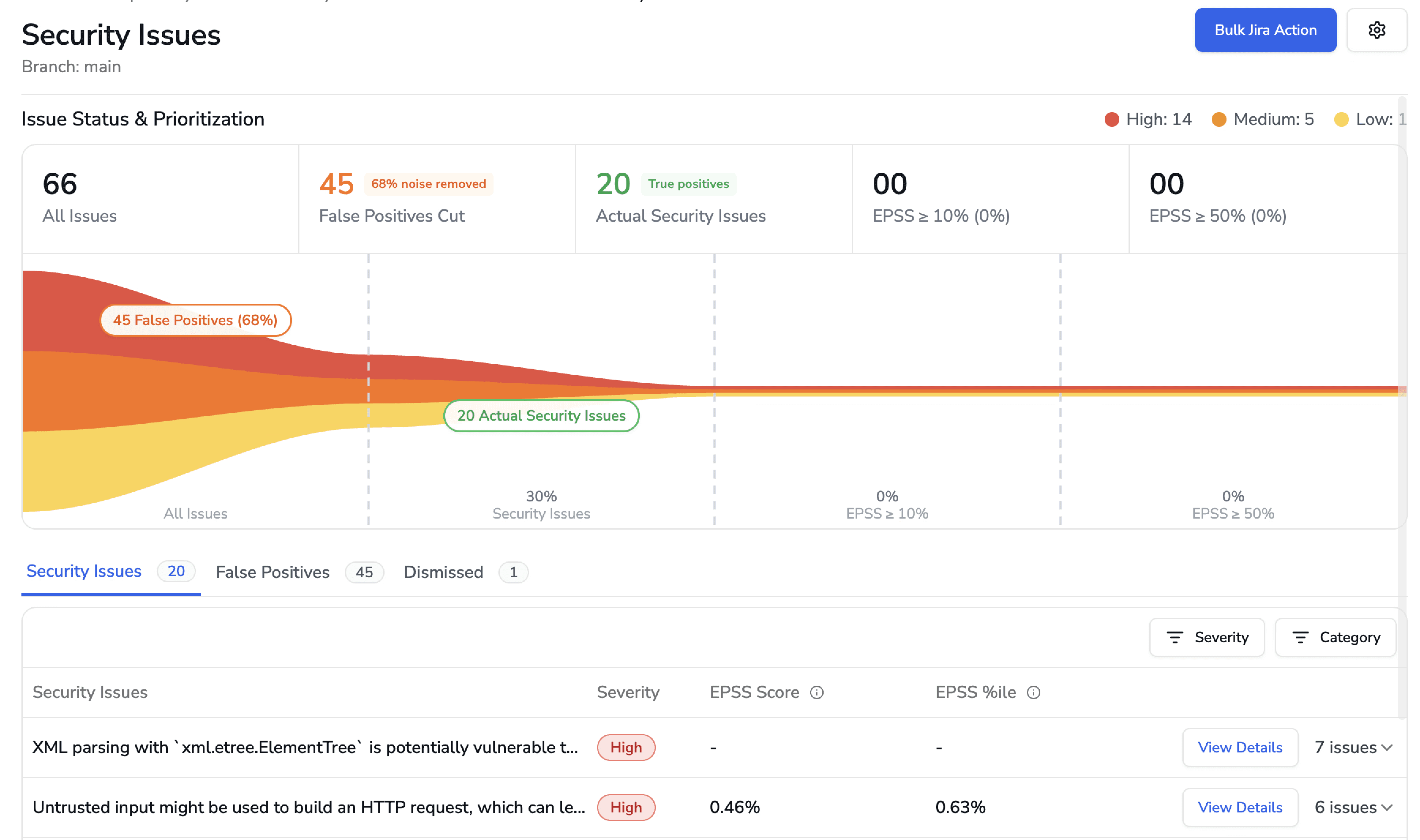
CodeAnt AI addresses several areas where enterprise teams encounter friction with Veracode, particularly around scanning speed, developer workflow, evidence-based findings, and pricing predictability.
AI-Native vs. Compiled-Binary Analysis
CodeAnt AI performs source-level analysis using an AI-native detection engine. The scanner reasons about code semantics, data flows, function reachability, input validation patterns, directly from source code, without requiring compilation or binary upload. Results appear in seconds as inline PR comments, not hours later in a portal.
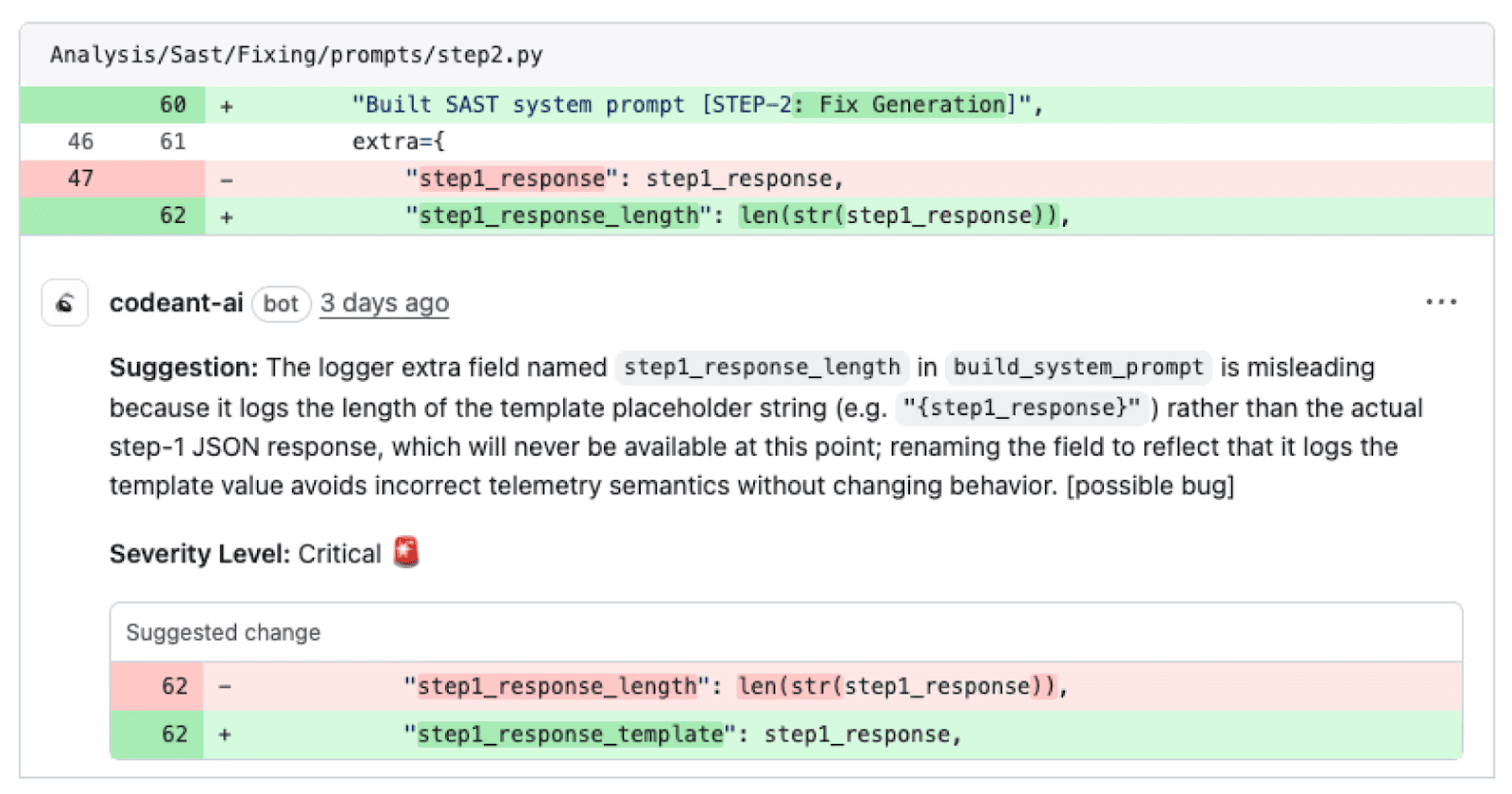
The tradeoff is real. Veracode’s binary analysis catches issues that depend on compilation behavior and can scan code without source access.
CodeAnt AI’s source-level AI analysis is faster, integrates into the PR workflow, and catches novel patterns through AI reasoning. Teams that need binary analysis (third-party code, legacy systems) benefit from Veracode’s approach. Teams that need fast, developer-facing feedback on code they are actively writing benefit from CodeAnt AI’s approach.
PR-Native Workflow (Not Upload-and-Wait)
Veracode’s scanning model follows a pattern that was designed before pull-request-based development became the industry standard.
The typical Veracode workflow:
developer commits code → CI pipeline packages the application → binary is uploaded to Veracode → Veracode scans the binary → results appear in the Veracode portal → developer navigates to the portal to review findings → developer returns to their code to implement fixes.
CodeAnt AI delivers findings directly in the pull request. The developer opens a PR, CodeAnt AI scans it in seconds, and findings appear as inline comments with Steps of Reproduction and one-click fix suggestions.
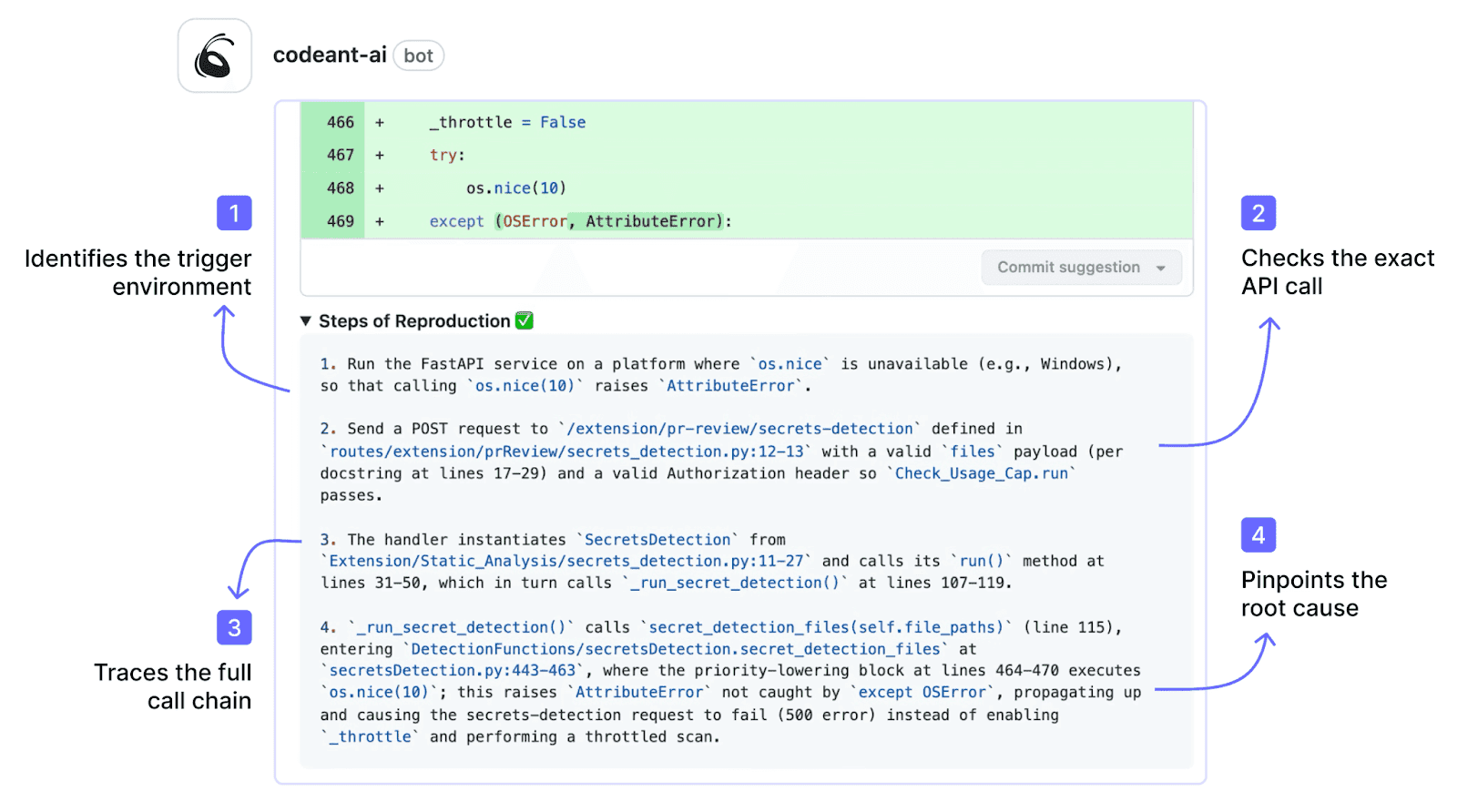
The developer reviews, applies fixes, and merges, all within the PR. No upload step, no waiting for binary analysis to complete, no context-switching to a separate portal.
This is the difference between a security tool designed around the CI pipeline (Veracode) and a security tool designed around the pull request (CodeAnt AI). Both deliver findings, but the path from finding to fix is fundamentally different.
Steps of Reproduction for Faster Remediation
CodeAnt AI generates Steps of Reproduction for every finding: the exact entry point, the complete taint flow, the vulnerable sink, and a concrete exploitation scenario.
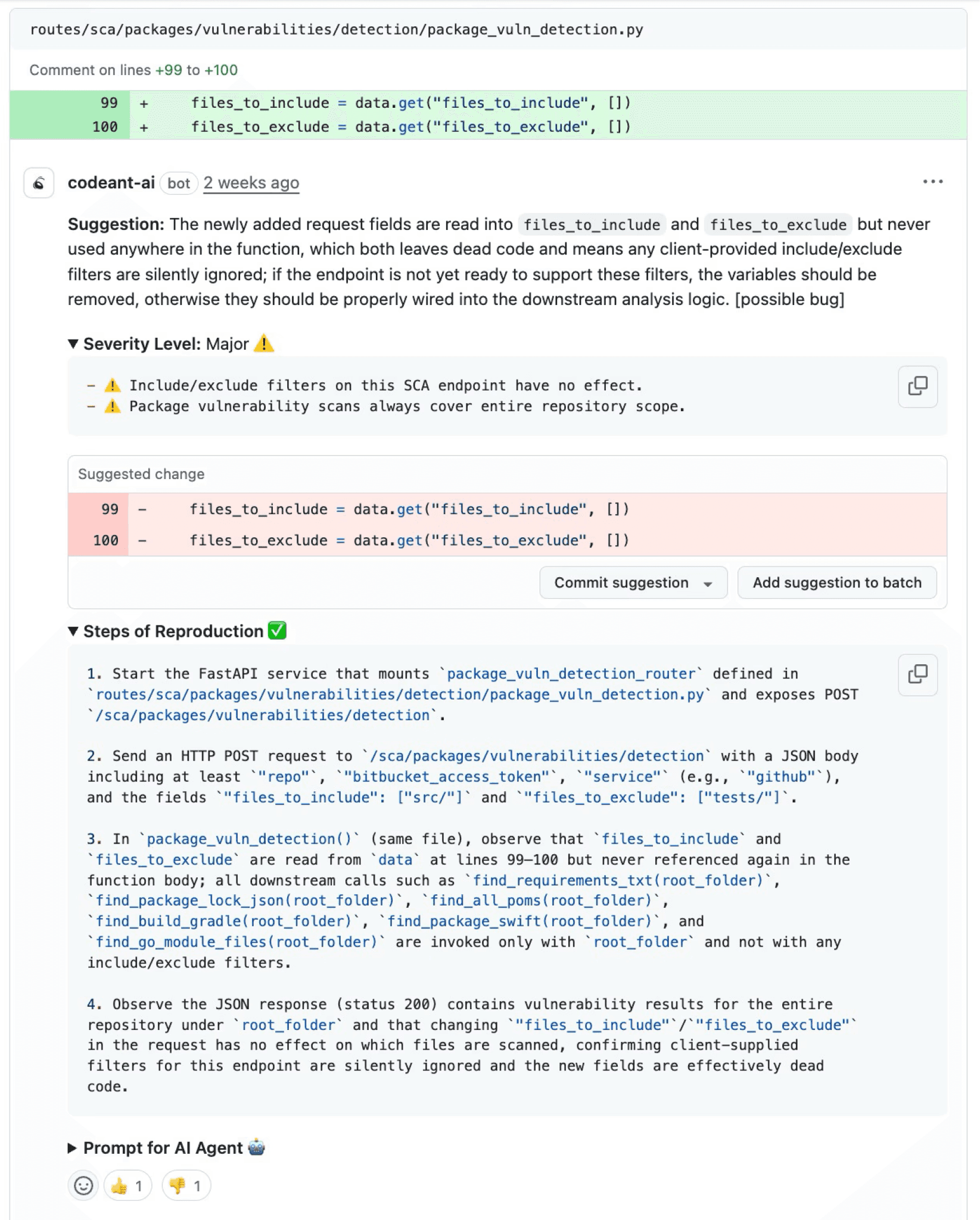
Fixes are one-click committable suggestions directly in the PR. The developer does not leave the PR to review findings, does not navigate to a portal, and does not manually write fixes for issues the tool already understands. For a deeper analysis of how evidence quality affects remediation velocity, see how both tools handle false positives.
Pricing Simplicity
Veracode follows a custom enterprise pricing model: Contact Sales for a quote. Pricing depends on scan volume, module selection (SAST, DAST, SCA), number of applications, and contract terms. This is standard for enterprise security vendors but makes pre-engagement budgeting difficult.
CodeAnt AI publishes pricing: $20/user/month for Code Security.
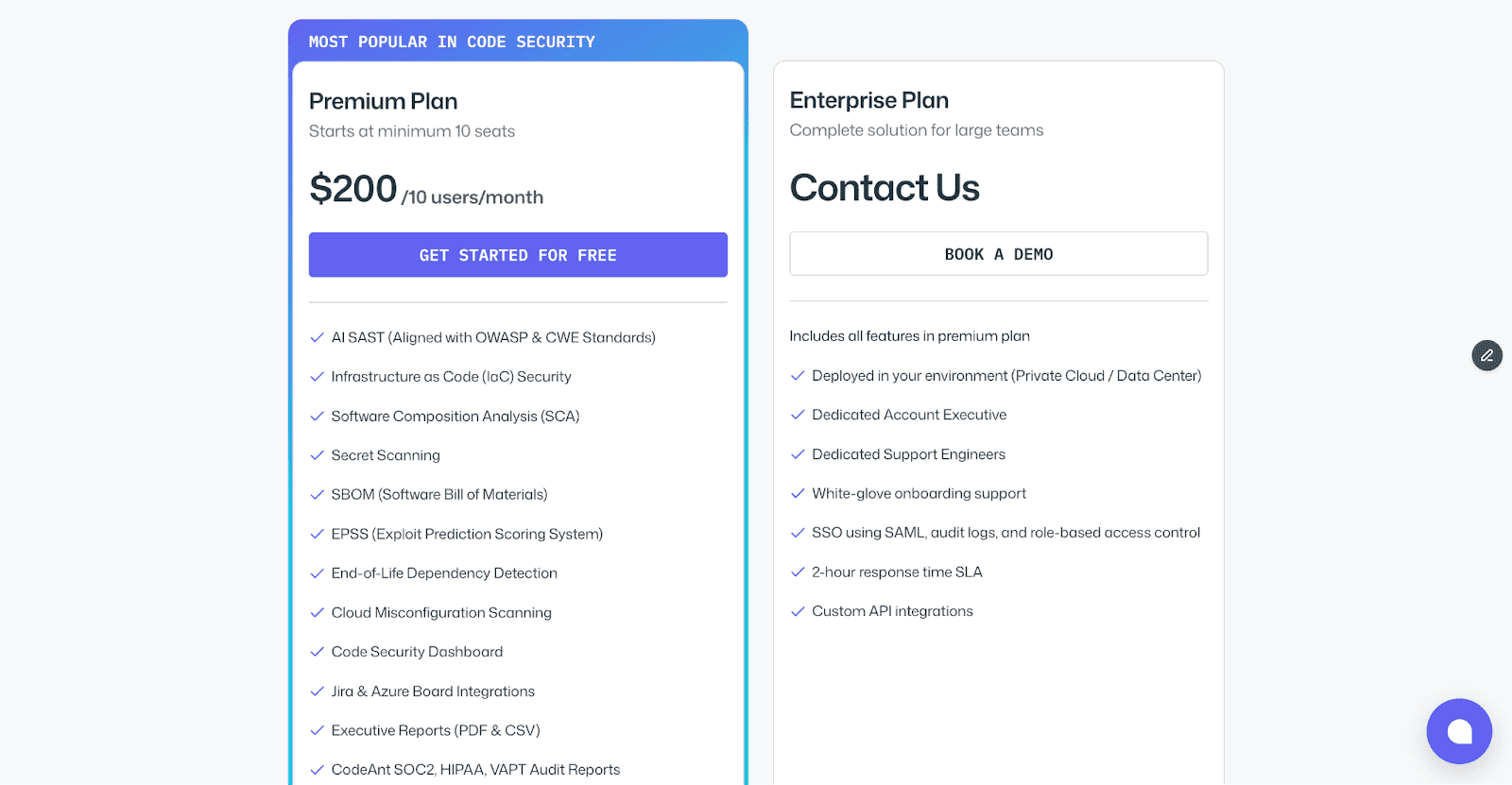
No per-application charges, no per-scan fees, no module-based pricing. Every feature, SAST,SCA,secrets detection,IaC scanning, andSBOM, AI code review, code quality, SecOps dashboard, Jira/Azure Boards integration, is included. For a detailed enterprise pricing comparison, see the SAST pricing guide.
Feature-by-Feature Comparison
Feature | Veracode | CodeAnt AI |
Detection Accuracy | ||
SAST (first-party code) | ✓ (binary analysis + pattern matching, 100+ languages) | ✓ (AI-native with semantic analysis, 30+ languages) |
Binary analysis (compiled code) | ✓ scans without source access | ✗ (source-level only) |
SCA (open-source dependencies) | ✓ | ✓ (with EPSS scoring) |
DAST (runtime testing) | ✓ | ✗ |
Secrets detection | ✓ | ✓ |
IaC scanning | Partial | ✓ (AWS, GCP, Azure) |
SBOM generation | ✓ | ✓ |
Steps of Reproduction | ✗ | ✓ (every finding) |
Published false positive rate | <1.1% (Veracode-claimed) | Not published (AI-native + Steps of Reproduction for validation) |
AI Capabilities | ||
AI tier | AI-Assisted | AI-Native (Tier 3) |
AI code security review | ✗ | ✓ (line-by-line PR review) |
AI auto-fix | ✓ (Veracode Fix AI-assisted suggestions) | ✓ (one-click committable fixes in PR) |
AI triage / false positive reduction | ✓ (priority scoring + data flow analysis) | ✓ (AI-native detection + reachability analysis) |
PR summaries | ✗ | ✓ |
Batch auto-fix | ✗ | ✓ (resolve hundreds of findings at once) |
Developer Experience | ||
Primary interface | Veracode portal (web UI) | PR-native (inline comments) |
Scan model | Upload binary → wait → portal results | Real-time source scanning → PR inline results |
CLI scanning | ✓ (for binary upload to Veracode cloud) | ✓ |
Pre-commit hooks (secret/credential/SAST blocking) | ✗ | ✓ (blocks before commit) |
IDE integration | ✓ (Veracode Greenlight VS Code, IntelliJ; limited real-time depth) | ✓ (VS Code, JetBrains, Visual Studio, Cursor, Windsurf) |
AI prompt generation for IDE fixes | ✗ | ✓ (generates prompts for Claude Code/Cursor) |
Inline PR comments | Partial (pipeline scan results can post to PR) | ✓ (findings + Steps of Reproduction + fix suggestions) |
One-click fix application | ✗ (Veracode Fix suggests; developer implements) | ✓ (committable suggestions in existing PR) |
Integrations | ||
GitHub | ✓ | ✓ |
GitLab | ✓ | ✓ |
Bitbucket | ✓ | ✓ |
Azure DevOps | ✓ | ✓ |
CI/CD pipelines | ✓ (Jenkins, GitHub Actions, GitLab CI, Azure DevOps, CircleCI) | ✓ (GitHub Actions, Jenkins, GitLab CI, Bitbucket Pipelines, Azure DevOps Pipelines) |
Jira integration | ✓ | ✓ (native) |
Pricing | ||
Free tier | ✗ | 14-day free trial |
Pricing model | Custom enterprise contracts (Contact Sales) | Per user |
Starter price | Contact Sales | $20/user/month (Code Security) |
Enterprise price | Custom (typically $$$ tier) | Custom |
Enterprise Readiness | ||
Deployment options | Cloud-primary (FedRAMP Authorized) | Customer DC (air-gapped), Customer Cloud (AWS/GCP/Azure), CodeAnt Cloud |
FedRAMP | ✓ Authorized | ✗ |
SOC 2 | ✓ | ✓ (Type II) |
PCI DSS | ✓ | ✓ (mapping) |
HIPAA | ✓ | ✓ |
Zero data retention | ✗ | ✓ (across all deployment models) |
SecOps dashboard | ✓ Veracode Analytics (mature, compliance-focused) | ✓ (vulnerability trends, fix rates, team risk, OWASP/CWE/CVE mapping) |
Ticketing integration | ✓ (Jira, ServiceNow) | ✓ (Jira, Azure Boards native) |
Audit-ready reporting | ✓ (comprehensive FedRAMP, SOC 2, PCI DSS, HIPAA) | ✓ (PDF/CSV exports for SOC 2, ISO 27001) |
Attribution / risk distribution | ✓ | ✓ (repo-level and developer-level risk) |
Code quality analysis | ✗ | ✓ (code smells, duplication, dead code, complexity) |
Developer productivity metrics | ✗ | ✓ (DORA metrics, PR cycle time, SLA tracking) |
Workflow Comparison: Source-Level PR Scanning vs. Binary Upload
The most visible day-to-day difference between Veracode and CodeAnt AI is how scanning fits into the developer workflow.
Veracode was designed for build-based security scanning.
The typical flow:
Code is committed
CI compiles and packages the application
The binary is uploaded to Veracode’s cloud
Veracode scans the compiled artifact (minutes to hours depending on size and queue)
Results appear in the Veracode portal
Developers navigate to the portal to review findings
Developers return to their IDE to implement fixes
This model has real strengths. Binary analysis can detect issues tied to compilation behavior, linking, and runtime framework behavior. It can also scan third-party binaries where source code is unavailable.
CodeAnt AI was designed for pull-request-centric development.
The workflow is shorter:
Developer opens a PR
CodeAnt AI scans source code in seconds
Findings appear inline in the PR
Each finding includes Steps of Reproduction and one-click fixes
Developer applies fixes and merges
The feedback loop is immediate, in-context, and integrated into the PR.
The tradeoff is clear:
Veracode’s advantage: binary analysis, compiled artifact scanning, and third-party code coverage.
CodeAnt AI’s advantage: real-time, source-level feedback before code merges.
If your priority is scanning compiled artifacts and vendor binaries, Veracode’s model is essential.
If your priority is catching vulnerabilities before they reach the main branch, source-level PR scanning provides a faster and more developer-friendly feedback loop.
End-to-End Workflow Comparison (CLI → IDE → PR → CI/CD → SecOps)
Beyond the scanning model itself, the two tools cover different stages of the developer workflow.
Workflow Stage | Veracode | CodeAnt AI |
CLI + Pre-Commit | CLI exists for binary upload ( | ✓ CLI blocks secrets, credentials, API keys, tokens, and high-risk SAST/SCA issues before |
IDE | ✓ Veracode Greenlight provides IDE-level scanning for VS Code and IntelliJ. Scans local code against Veracode’s rules. Useful for early feedback, though the depth and real-time responsiveness are more limited than the full platform scan. | ✓ VS Code, JetBrains (IntelliJ, PyCharm, WebStorm), Visual Studio, Cursor, Windsurf. In-context scanning with guided remediation. AI prompt generation triggers Claude Code or Cursor to auto-fix vulnerabilities. |
Pull Request | Partial. Pipeline Scan (a lightweight SAST scan) can post results to PRs, but the full-depth scan (Policy Scan) requires binary upload with results in the portal. Developers get either a lightweight PR scan or full results in a separate portal, not both in the PR. No AI code review. No one-click fixes. | ✓ AI code review + security analysis on every PR. Full-depth findings with Steps of Reproduction appear as inline comments. One-click AI-generated fixes committed directly in the PR. PR summaries. Developer never leave the PR. |
CI/CD | ✓ Broad CI/CD integration (Jenkins, GitHub Actions, GitLab CI, Azure DevOps, CircleCI). Binary upload and Policy Scan triggered by pipeline. Configurable policy thresholds (severity-based, compliance-based). Mature in enterprise pipelines. | ✓ GitHub Actions, Jenkins, GitLab CI, Bitbucket Pipelines, Azure DevOps Pipelines. Configurable policy gates by severity, CWE category, OWASP classification, and custom rules. |
SecOps / Compliance | ✓ Veracode Analytics provides a mature compliance dashboard with FedRAMP, SOC 2, PCI DSS, and HIPAA reporting. Vulnerability trends, remediation SLAs, and application risk scoring. Jira and ServiceNow integration. Compliance reporting is one of Veracode’s strongest dimensions. | ✓ Unified SecOps dashboard: vulnerability trends, TP/FP rates, fix rates, EPSS scoring, OWASP/CWE/CVE mapping, team/repo risk distribution. Native Jira and Azure Boards. Audit-ready PDF/CSV for SOC 2, ISO 27001. Attribution reporting. |
Where Veracode falls short is in the developer-facing stages. The pre-commit layer does not exist, there is no mechanism to block secrets or vulnerable code before it enters Git. The IDE integration (Greenlight) provides some early feedback but is more limited than the full platform scan. And the PR experience is split: the lightweight Pipeline Scan can post to PRs, but the full-depth Policy Scan lives in the portal. Developers who want the richest findings must leave their PR and navigate to Veracode’s dashboard.
CodeAnt AI’s strength is the inverse. The pre-commit layer blocks the most dangerous issues before they enter Git. The IDE integration supports modern environments including Cursor and Windsurf, with AI-prompted auto-fixes. The PR experience delivers full-depth findings with Steps of Reproduction and one-click fixes, no portal required. Where CodeAnt AI’s SecOps layer is strong (vulnerability trends, attribution, Jira/Azure Boards), it does not match Veracode’s depth in government-specific compliance reporting (FedRAMP, continuous monitoring, agency-specific templates).
Deployment and Data Residency
For enterprises with strict data residency or regulatory requirements, deployment architecture is a critical procurement factor.
Veracode is a cloud-primary platform. Compiled binaries are uploaded to Veracode’s cloud infrastructure for scanning. The platform holds FedRAMP Authorization, an independently audited certification required for many federal and defense contracts. For organizations operating under FedRAMP mandates, this is not optional, it is a procurement prerequisite. This remains one of Veracode’s strongest competitive advantages.
However, Veracode does not offer a fully self-hosted or air-gapped deployment. All scanning occurs within Veracode’s cloud environment. For teams that cannot send code — even compiled binaries, to a third-party cloud, this creates a limitation regardless of compliance certifications.
CodeAnt AI provides three deployment options:
Customer Data Center (Air-Gapped): Fully deployed within on-prem infrastructure, including zero external connectivity. No code, metadata, or telemetry leaves the environment. The complete platform, CLI, IDE integration, PR workflow, CI/CD gates, and SecOps dashboard, runs locally.
Customer Cloud (AWS, GCP, Azure): Deployed inside the customer’s VPC, with full control over infrastructure and network boundaries.
CodeAnt Cloud: Hosted by CodeAnt. SOC 2 Type II certified and HIPAA compliant. Fastest to deploy.
Across all models, CodeAnt AI offers zero data retention, code is analyzed in memory and not persisted to disk.
In practical terms:
If FedRAMP Authorization is mandatory, Veracode is the safer procurement path.
If self-hosted or air-gapped deployment is required, CodeAnt AI offers flexibility Veracode does not.
Pricing Comparison
Dimension | Veracode | CodeAnt AI |
Pricing model | Custom enterprise contracts (Contact Sales) | Per user |
Public pricing | ✗ (Contact Sales required) | ✓ ($20/user/month) |
Free option | ✗ | 14-day free trial |
50-dev estimated annual cost | $50K–$200K+/yr (varies by module, application count, scan volume) | $12,000/yr (Code Security) |
Typical contract | Annual or multi-year; minimum commitments common | Monthly or annual; no minimums |
Includes SAST | ✓ | ✓ |
Includes AI code security review | ✗ | ✓ |
Includes SCA | ✓ | ✓ |
Includes DAST | ✓ (additional module) | ✗ |
Includes binary analysis | ✓ | ✗ |
Includes code quality | ✗ | ✓ |
Includes SecOps Dashboard | ✓ (Veracode Analytics) | ✓ |
Pricing page | veracode.com/products (Contact Sales) |
Veracode pricing is custom and not publicly listed. Cost estimates based on Vendr data and industry reports. Actual pricing varies significantly based on application count, module selection, scan volume, and negotiation. CodeAnt AI pricing from codeant.ai/pricing.
The pricing gap between Veracode and CodeAnt AI is significant. For a 50-developer team, CodeAnt AI’s annual cost is approximately $12,000/year. Veracode, depending on modules and application count, typically runs $50,000–$200,000+/year. Veracode’s price includes capabilities CodeAnt AI does not offer (DAST, binary analysis), but even accounting for that, the per-developer economics are substantially different.
The pricing model also differs in how it scales. Veracode pricing often depends on the number of applications scanned and the scan volume, adding new applications or increasing scan frequency can increase costs. CodeAnt AI pricing scales with users only, scan as many repositories as you have, as often as you want, with no per-application or per-scan charges.
For teams that need Veracode’s DAST and binary analysis capabilities, the Veracode investment may be justified. For teams whose primary need is SAST, SCA, and developer-facing security tooling, the cost difference is substantial enough to merit serious evaluation.
Final Verdict: Veracode vs CodeAnt AI for SAST in 2026
Veracode is built for compliance-heavy enterprise environments. CodeAnt AI is built for modern pull-request-driven development.
If your organization requires FedRAMP Authorization, binary analysis of compiled artifacts, DAST under one vendor, and mature compliance reporting refined through government audits, Veracode remains one of the strongest enterprise SAST platforms available.
If your challenge is developer adoption, slow remediation cycles, context-switching to portals, and high security tooling costs, CodeAnt AI offers a fundamentally different approach. Real-time source scanning. Inline PR findings. Evidence-backed Steps of Reproduction. One-click fixes. Transparent pricing.
The decision is not about feature count. It is about where your bottleneck exists.
If your bottleneck is compliance documentation, Veracode may be the right investment. If your bottleneck is developer friction and time-to-fix, CodeAnt AI may unlock more value.
Run both on the same repository. Compare scan speed. Compare remediation flow. Compare developer experience.
See results in your pull request, not in a portal. Start a 14-day CodeAnt AI trial
Veracode and CodeAnt AI represent two generations of application security tooling. Veracode is an established enterprise platform, over 15 years in the market, with a signature binary analysis capability that scans compiled code without requiring source access.
CodeAnt AI is an AI-native platform built for how modern teams actually work code security scanning unified into a single PR-native workflow that covers every stage from pre-commit hooks through the SecOps dashboard.
This page compares both tools across the same six-dimension evaluation framework used in our full SAST tools comparison. The comparison is written for AppSec leads and CISOs evaluating whether to modernize their SAST tooling, people who need compliance depth but also need developers to actually fix what the scanner finds.
CodeAnt AI vs Veracode: Quick Summary

Dimension | Veracode | CodeAnt AI |
Primary Strength | Enterprise compliance + binary analysis | Unified AI code review + quality + security |
AI Tier | AI-Assisted | AI-Native |
Detection Engine | Binary analysis (compiled code) + pattern matching | AI as primary detection engine (source-level) |
Steps of Reproduction | ✗ | ✓ (every finding) |
Auto-Fix | Veracode Fix (AI-assisted remediation suggestions) | AI-generated one-click fixes in PR |
Security Coverage | SAST + SCA + DAST | SAST + SCA + Secrets + IaC + SBOMs |
Binary Analysis | ✓ genuine differentiator (scans without source) | ✗ (source-level analysis only) |
AI Code Security Review | ✗ | ✓ (AI code security review with inline comments) |
DAST | ✓ | ✗ |
Code Quality | ✗ | ✓ (complexity, duplication, dead code) |
Workflow Integration | Upload → Scan → Portal results | CLI → IDE → PR → CI/CD → SecOps |
IDE Support | VS Code, IntelliJ (Veracode Greenlight — limited real-time) | VS Code, JetBrains, Visual Studio, Cursor, Windsurf |
Pre-Commit / CLI | CLI for binary upload (no pre-commit secret blocking) | ✓ (blocks secrets, credentials, SAST/SCA issues before commit) |
SecOps Dashboard | ✓ Veracode Analytics (mature, compliance-focused) | ✓ (vulnerability trends, OWASP/CWE/CVE, team risk, Jira/Azure Boards) |
SCM Support | GitHub, GitLab, Bitbucket, Azure DevOps | GitHub, GitLab, Azure DevOps, or Bitbucket |
Deployment | Cloud-primary (FedRAMP Authorized) | Customer DC (air-gapped), Customer Cloud, CodeAnt Cloud |
Compliance | FedRAMP, SOC 2, PCI DSS, HIPAA | SOC 2 Type II, HIPAA, zero data retention |
Pricing Model | Custom enterprise contracts (Contact Sales) | Per user ($20/user/month Code Security) |
Languages | 100+ languages and frameworks | 30+ languages, 85+ frameworks |
Comparison verified against Veracode documentation and CodeAnt AI documentation as of February 2026. Features change, verify with both vendors before purchasing.
Where Veracode Excels
Veracode has been a fixture in enterprise application security for over 15 years. Any honest comparison starts with what Veracode does well, and in compliance-driven enterprise environments, Veracode does several things very well.
Mature Platform with Decades of Vulnerability Data
Veracode has scanned billions of lines of code across thousands of enterprise customers. This history means a deeply refined vulnerability database, well-calibrated severity scoring, and detection tuned by decades of real-world scan data. Veracode claims a false positive rate below 1.1%, and while independent verification is difficult, the claim reflects a scanning engine that has been refined over 15+ years of enterprise feedback.
Veracode’s binary analysis capability is genuinely unique. The platform can scan compiled binaries, JARs, WARs, DLLs, executables, without requiring access to source code. This matters for enterprises that use third-party commercial software, legacy applications where source may be unavailable, or vendor-supplied components that arrive as compiled packages. No source access required means Veracode can assess the security of code that most SAST tools cannot analyze at all.
Language support is also exceptionally broad: Veracode covers 100+ languages and frameworks, including legacy enterprise languages that many newer tools do not support.
Broad AST Suite (SAST, DAST, SCA)
Veracode offers SAST, DAST (dynamic application security testing), and SCA in a single platform. The DAST capability provides runtime security testing, probing running applications for vulnerabilities that static analysis cannot detect (authentication flaws, session management issues, runtime configuration problems). For security programs that need both static and dynamic testing under one vendor, Veracode provides this without requiring a separate DAST tool.
DAST is a capability that CodeAnt AI does not offer. Teams that need runtime security testing alongside static analysis should weigh this gap accordingly.
FedRAMP and Government Compliance
Veracode holds FedRAMP Authorization, a genuine, battle-tested compliance certification for government and defense procurement. FedRAMP authorization requires rigorous security assessment, continuous monitoring, and third-party audit validation. For government agencies, defense contractors, and any organization that operates under FedRAMP requirements, Veracode’s authorization is not just a checkbox, it is a procurement prerequisite that eliminates Veracode from the “needs evaluation” category and places it in the “already approved” category.
Beyond FedRAMP, Veracode holds SOC 2, PCI DSS, and HIPAA certifications with compliance reporting that has been refined through years of government and regulated-industry audits. For a broader perspective on how SAST tools handle compliance requirements, see our SAST compliance frameworks guide.
Where CodeAnt AI Goes Further

CodeAnt AI addresses several areas where enterprise teams encounter friction with Veracode, particularly around scanning speed, developer workflow, evidence-based findings, and pricing predictability.
AI-Native vs. Compiled-Binary Analysis
CodeAnt AI performs source-level analysis using an AI-native detection engine. The scanner reasons about code semantics, data flows, function reachability, input validation patterns, directly from source code, without requiring compilation or binary upload. Results appear in seconds as inline PR comments, not hours later in a portal.
The tradeoff is real. Veracode’s binary analysis catches issues that depend on compilation behavior and can scan code without source access.
CodeAnt AI’s source-level AI analysis is faster, integrates into the PR workflow, and catches novel patterns through AI reasoning. Teams that need binary analysis (third-party code, legacy systems) benefit from Veracode’s approach. Teams that need fast, developer-facing feedback on code they are actively writing benefit from CodeAnt AI’s approach.
PR-Native Workflow (Not Upload-and-Wait)
Veracode’s scanning model follows a pattern that was designed before pull-request-based development became the industry standard.
The typical Veracode workflow:
developer commits code → CI pipeline packages the application → binary is uploaded to Veracode → Veracode scans the binary → results appear in the Veracode portal → developer navigates to the portal to review findings → developer returns to their code to implement fixes.
CodeAnt AI delivers findings directly in the pull request. The developer opens a PR, CodeAnt AI scans it in seconds, and findings appear as inline comments with Steps of Reproduction and one-click fix suggestions.

The developer reviews, applies fixes, and merges, all within the PR. No upload step, no waiting for binary analysis to complete, no context-switching to a separate portal.
This is the difference between a security tool designed around the CI pipeline (Veracode) and a security tool designed around the pull request (CodeAnt AI). Both deliver findings, but the path from finding to fix is fundamentally different.
Steps of Reproduction for Faster Remediation
CodeAnt AI generates Steps of Reproduction for every finding: the exact entry point, the complete taint flow, the vulnerable sink, and a concrete exploitation scenario.

Fixes are one-click committable suggestions directly in the PR. The developer does not leave the PR to review findings, does not navigate to a portal, and does not manually write fixes for issues the tool already understands. For a deeper analysis of how evidence quality affects remediation velocity, see how both tools handle false positives.
Pricing Simplicity
Veracode follows a custom enterprise pricing model: Contact Sales for a quote. Pricing depends on scan volume, module selection (SAST, DAST, SCA), number of applications, and contract terms. This is standard for enterprise security vendors but makes pre-engagement budgeting difficult.
CodeAnt AI publishes pricing: $20/user/month for Code Security.

No per-application charges, no per-scan fees, no module-based pricing. Every feature, SAST,SCA,secrets detection,IaC scanning, andSBOM, AI code review, code quality, SecOps dashboard, Jira/Azure Boards integration, is included. For a detailed enterprise pricing comparison, see the SAST pricing guide.
Feature-by-Feature Comparison
Feature | Veracode | CodeAnt AI |
Detection Accuracy | ||
SAST (first-party code) | ✓ (binary analysis + pattern matching, 100+ languages) | ✓ (AI-native with semantic analysis, 30+ languages) |
Binary analysis (compiled code) | ✓ scans without source access | ✗ (source-level only) |
SCA (open-source dependencies) | ✓ | ✓ (with EPSS scoring) |
DAST (runtime testing) | ✓ | ✗ |
Secrets detection | ✓ | ✓ |
IaC scanning | Partial | ✓ (AWS, GCP, Azure) |
SBOM generation | ✓ | ✓ |
Steps of Reproduction | ✗ | ✓ (every finding) |
Published false positive rate | <1.1% (Veracode-claimed) | Not published (AI-native + Steps of Reproduction for validation) |
AI Capabilities | ||
AI tier | AI-Assisted | AI-Native (Tier 3) |
AI code security review | ✗ | ✓ (line-by-line PR review) |
AI auto-fix | ✓ (Veracode Fix AI-assisted suggestions) | ✓ (one-click committable fixes in PR) |
AI triage / false positive reduction | ✓ (priority scoring + data flow analysis) | ✓ (AI-native detection + reachability analysis) |
PR summaries | ✗ | ✓ |
Batch auto-fix | ✗ | ✓ (resolve hundreds of findings at once) |
Developer Experience | ||
Primary interface | Veracode portal (web UI) | PR-native (inline comments) |
Scan model | Upload binary → wait → portal results | Real-time source scanning → PR inline results |
CLI scanning | ✓ (for binary upload to Veracode cloud) | ✓ |
Pre-commit hooks (secret/credential/SAST blocking) | ✗ | ✓ (blocks before commit) |
IDE integration | ✓ (Veracode Greenlight VS Code, IntelliJ; limited real-time depth) | ✓ (VS Code, JetBrains, Visual Studio, Cursor, Windsurf) |
AI prompt generation for IDE fixes | ✗ | ✓ (generates prompts for Claude Code/Cursor) |
Inline PR comments | Partial (pipeline scan results can post to PR) | ✓ (findings + Steps of Reproduction + fix suggestions) |
One-click fix application | ✗ (Veracode Fix suggests; developer implements) | ✓ (committable suggestions in existing PR) |
Integrations | ||
GitHub | ✓ | ✓ |
GitLab | ✓ | ✓ |
Bitbucket | ✓ | ✓ |
Azure DevOps | ✓ | ✓ |
CI/CD pipelines | ✓ (Jenkins, GitHub Actions, GitLab CI, Azure DevOps, CircleCI) | ✓ (GitHub Actions, Jenkins, GitLab CI, Bitbucket Pipelines, Azure DevOps Pipelines) |
Jira integration | ✓ | ✓ (native) |
Pricing | ||
Free tier | ✗ | 14-day free trial |
Pricing model | Custom enterprise contracts (Contact Sales) | Per user |
Starter price | Contact Sales | $20/user/month (Code Security) |
Enterprise price | Custom (typically $$$ tier) | Custom |
Enterprise Readiness | ||
Deployment options | Cloud-primary (FedRAMP Authorized) | Customer DC (air-gapped), Customer Cloud (AWS/GCP/Azure), CodeAnt Cloud |
FedRAMP | ✓ Authorized | ✗ |
SOC 2 | ✓ | ✓ (Type II) |
PCI DSS | ✓ | ✓ (mapping) |
HIPAA | ✓ | ✓ |
Zero data retention | ✗ | ✓ (across all deployment models) |
SecOps dashboard | ✓ Veracode Analytics (mature, compliance-focused) | ✓ (vulnerability trends, fix rates, team risk, OWASP/CWE/CVE mapping) |
Ticketing integration | ✓ (Jira, ServiceNow) | ✓ (Jira, Azure Boards native) |
Audit-ready reporting | ✓ (comprehensive FedRAMP, SOC 2, PCI DSS, HIPAA) | ✓ (PDF/CSV exports for SOC 2, ISO 27001) |
Attribution / risk distribution | ✓ | ✓ (repo-level and developer-level risk) |
Code quality analysis | ✗ | ✓ (code smells, duplication, dead code, complexity) |
Developer productivity metrics | ✗ | ✓ (DORA metrics, PR cycle time, SLA tracking) |
Workflow Comparison: Source-Level PR Scanning vs. Binary Upload
The most visible day-to-day difference between Veracode and CodeAnt AI is how scanning fits into the developer workflow.
Veracode was designed for build-based security scanning.
The typical flow:
Code is committed
CI compiles and packages the application
The binary is uploaded to Veracode’s cloud
Veracode scans the compiled artifact (minutes to hours depending on size and queue)
Results appear in the Veracode portal
Developers navigate to the portal to review findings
Developers return to their IDE to implement fixes
This model has real strengths. Binary analysis can detect issues tied to compilation behavior, linking, and runtime framework behavior. It can also scan third-party binaries where source code is unavailable.
CodeAnt AI was designed for pull-request-centric development.
The workflow is shorter:
Developer opens a PR
CodeAnt AI scans source code in seconds
Findings appear inline in the PR
Each finding includes Steps of Reproduction and one-click fixes
Developer applies fixes and merges
The feedback loop is immediate, in-context, and integrated into the PR.
The tradeoff is clear:
Veracode’s advantage: binary analysis, compiled artifact scanning, and third-party code coverage.
CodeAnt AI’s advantage: real-time, source-level feedback before code merges.
If your priority is scanning compiled artifacts and vendor binaries, Veracode’s model is essential.
If your priority is catching vulnerabilities before they reach the main branch, source-level PR scanning provides a faster and more developer-friendly feedback loop.
End-to-End Workflow Comparison (CLI → IDE → PR → CI/CD → SecOps)
Beyond the scanning model itself, the two tools cover different stages of the developer workflow.
Workflow Stage | Veracode | CodeAnt AI |
CLI + Pre-Commit | CLI exists for binary upload ( | ✓ CLI blocks secrets, credentials, API keys, tokens, and high-risk SAST/SCA issues before |
IDE | ✓ Veracode Greenlight provides IDE-level scanning for VS Code and IntelliJ. Scans local code against Veracode’s rules. Useful for early feedback, though the depth and real-time responsiveness are more limited than the full platform scan. | ✓ VS Code, JetBrains (IntelliJ, PyCharm, WebStorm), Visual Studio, Cursor, Windsurf. In-context scanning with guided remediation. AI prompt generation triggers Claude Code or Cursor to auto-fix vulnerabilities. |
Pull Request | Partial. Pipeline Scan (a lightweight SAST scan) can post results to PRs, but the full-depth scan (Policy Scan) requires binary upload with results in the portal. Developers get either a lightweight PR scan or full results in a separate portal, not both in the PR. No AI code review. No one-click fixes. | ✓ AI code review + security analysis on every PR. Full-depth findings with Steps of Reproduction appear as inline comments. One-click AI-generated fixes committed directly in the PR. PR summaries. Developer never leave the PR. |
CI/CD | ✓ Broad CI/CD integration (Jenkins, GitHub Actions, GitLab CI, Azure DevOps, CircleCI). Binary upload and Policy Scan triggered by pipeline. Configurable policy thresholds (severity-based, compliance-based). Mature in enterprise pipelines. | ✓ GitHub Actions, Jenkins, GitLab CI, Bitbucket Pipelines, Azure DevOps Pipelines. Configurable policy gates by severity, CWE category, OWASP classification, and custom rules. |
SecOps / Compliance | ✓ Veracode Analytics provides a mature compliance dashboard with FedRAMP, SOC 2, PCI DSS, and HIPAA reporting. Vulnerability trends, remediation SLAs, and application risk scoring. Jira and ServiceNow integration. Compliance reporting is one of Veracode’s strongest dimensions. | ✓ Unified SecOps dashboard: vulnerability trends, TP/FP rates, fix rates, EPSS scoring, OWASP/CWE/CVE mapping, team/repo risk distribution. Native Jira and Azure Boards. Audit-ready PDF/CSV for SOC 2, ISO 27001. Attribution reporting. |
Where Veracode falls short is in the developer-facing stages. The pre-commit layer does not exist, there is no mechanism to block secrets or vulnerable code before it enters Git. The IDE integration (Greenlight) provides some early feedback but is more limited than the full platform scan. And the PR experience is split: the lightweight Pipeline Scan can post to PRs, but the full-depth Policy Scan lives in the portal. Developers who want the richest findings must leave their PR and navigate to Veracode’s dashboard.
CodeAnt AI’s strength is the inverse. The pre-commit layer blocks the most dangerous issues before they enter Git. The IDE integration supports modern environments including Cursor and Windsurf, with AI-prompted auto-fixes. The PR experience delivers full-depth findings with Steps of Reproduction and one-click fixes, no portal required. Where CodeAnt AI’s SecOps layer is strong (vulnerability trends, attribution, Jira/Azure Boards), it does not match Veracode’s depth in government-specific compliance reporting (FedRAMP, continuous monitoring, agency-specific templates).
Deployment and Data Residency
For enterprises with strict data residency or regulatory requirements, deployment architecture is a critical procurement factor.
Veracode is a cloud-primary platform. Compiled binaries are uploaded to Veracode’s cloud infrastructure for scanning. The platform holds FedRAMP Authorization, an independently audited certification required for many federal and defense contracts. For organizations operating under FedRAMP mandates, this is not optional, it is a procurement prerequisite. This remains one of Veracode’s strongest competitive advantages.
However, Veracode does not offer a fully self-hosted or air-gapped deployment. All scanning occurs within Veracode’s cloud environment. For teams that cannot send code — even compiled binaries, to a third-party cloud, this creates a limitation regardless of compliance certifications.
CodeAnt AI provides three deployment options:
Customer Data Center (Air-Gapped): Fully deployed within on-prem infrastructure, including zero external connectivity. No code, metadata, or telemetry leaves the environment. The complete platform, CLI, IDE integration, PR workflow, CI/CD gates, and SecOps dashboard, runs locally.
Customer Cloud (AWS, GCP, Azure): Deployed inside the customer’s VPC, with full control over infrastructure and network boundaries.
CodeAnt Cloud: Hosted by CodeAnt. SOC 2 Type II certified and HIPAA compliant. Fastest to deploy.
Across all models, CodeAnt AI offers zero data retention, code is analyzed in memory and not persisted to disk.
In practical terms:
If FedRAMP Authorization is mandatory, Veracode is the safer procurement path.
If self-hosted or air-gapped deployment is required, CodeAnt AI offers flexibility Veracode does not.
Pricing Comparison
Dimension | Veracode | CodeAnt AI |
Pricing model | Custom enterprise contracts (Contact Sales) | Per user |
Public pricing | ✗ (Contact Sales required) | ✓ ($20/user/month) |
Free option | ✗ | 14-day free trial |
50-dev estimated annual cost | $50K–$200K+/yr (varies by module, application count, scan volume) | $12,000/yr (Code Security) |
Typical contract | Annual or multi-year; minimum commitments common | Monthly or annual; no minimums |
Includes SAST | ✓ | ✓ |
Includes AI code security review | ✗ | ✓ |
Includes SCA | ✓ | ✓ |
Includes DAST | ✓ (additional module) | ✗ |
Includes binary analysis | ✓ | ✗ |
Includes code quality | ✗ | ✓ |
Includes SecOps Dashboard | ✓ (Veracode Analytics) | ✓ |
Pricing page | veracode.com/products (Contact Sales) |
Veracode pricing is custom and not publicly listed. Cost estimates based on Vendr data and industry reports. Actual pricing varies significantly based on application count, module selection, scan volume, and negotiation. CodeAnt AI pricing from codeant.ai/pricing.
The pricing gap between Veracode and CodeAnt AI is significant. For a 50-developer team, CodeAnt AI’s annual cost is approximately $12,000/year. Veracode, depending on modules and application count, typically runs $50,000–$200,000+/year. Veracode’s price includes capabilities CodeAnt AI does not offer (DAST, binary analysis), but even accounting for that, the per-developer economics are substantially different.
The pricing model also differs in how it scales. Veracode pricing often depends on the number of applications scanned and the scan volume, adding new applications or increasing scan frequency can increase costs. CodeAnt AI pricing scales with users only, scan as many repositories as you have, as often as you want, with no per-application or per-scan charges.
For teams that need Veracode’s DAST and binary analysis capabilities, the Veracode investment may be justified. For teams whose primary need is SAST, SCA, and developer-facing security tooling, the cost difference is substantial enough to merit serious evaluation.
Final Verdict: Veracode vs CodeAnt AI for SAST in 2026
Veracode is built for compliance-heavy enterprise environments. CodeAnt AI is built for modern pull-request-driven development.
If your organization requires FedRAMP Authorization, binary analysis of compiled artifacts, DAST under one vendor, and mature compliance reporting refined through government audits, Veracode remains one of the strongest enterprise SAST platforms available.
If your challenge is developer adoption, slow remediation cycles, context-switching to portals, and high security tooling costs, CodeAnt AI offers a fundamentally different approach. Real-time source scanning. Inline PR findings. Evidence-backed Steps of Reproduction. One-click fixes. Transparent pricing.
The decision is not about feature count. It is about where your bottleneck exists.
If your bottleneck is compliance documentation, Veracode may be the right investment. If your bottleneck is developer friction and time-to-fix, CodeAnt AI may unlock more value.
Run both on the same repository. Compare scan speed. Compare remediation flow. Compare developer experience.
See results in your pull request, not in a portal. Start a 14-day CodeAnt AI trial
FAQs
What is the main difference between Veracode and CodeAnt AI for SAST?
Is Veracode better for government and FedRAMP environments?
Does CodeAnt AI support binary analysis like Veracode?
Which SAST tool provides faster developer feedback?
How do Veracode and CodeAnt AI pricing models compare?
Table of Contents
Start Your 14-Day Free Trial
AI code reviews, security, and quality trusted by modern engineering teams. No credit card required!
Share blog:


