Code Security

Mar 6, 2026

The Anatomy of a CVSS 10 Vulnerability

Amartya | CodeAnt AI Code Review Platform
Sonali Sood

Founding GTM, CodeAnt AI

When a vulnerability receives a CVSS score of 10.0, it represents the maximum severity classification under the Common Vulnerability Scoring System.

This rating is reserved for vulnerabilities that satisfy the most dangerous set of conditions simultaneously:

  • network exploitable

  • no authentication required

  • no user interaction required

  • complete compromise of confidentiality, integrity, and availability

In practice, vulnerabilities meeting these criteria are rare.

But when they appear, they tend to reshape how the security community thinks about software architecture.

Some of the most consequential examples include:

  • Apache Struts OGNL injection (CVE-2017-5638)

  • Log4Shell (CVE-2021-44228)

  • identity token delegation flaws in cloud identity systems

  • authentication bypasses in token validation frameworks

Each vulnerability demonstrates a deeper architectural issue: a system trusting unverified input at a critical boundary.

Recently, another vulnerability joined this category:

CVE-2026-29000 - a JWT authentication bypass discovered in the pac4j authentication framework.
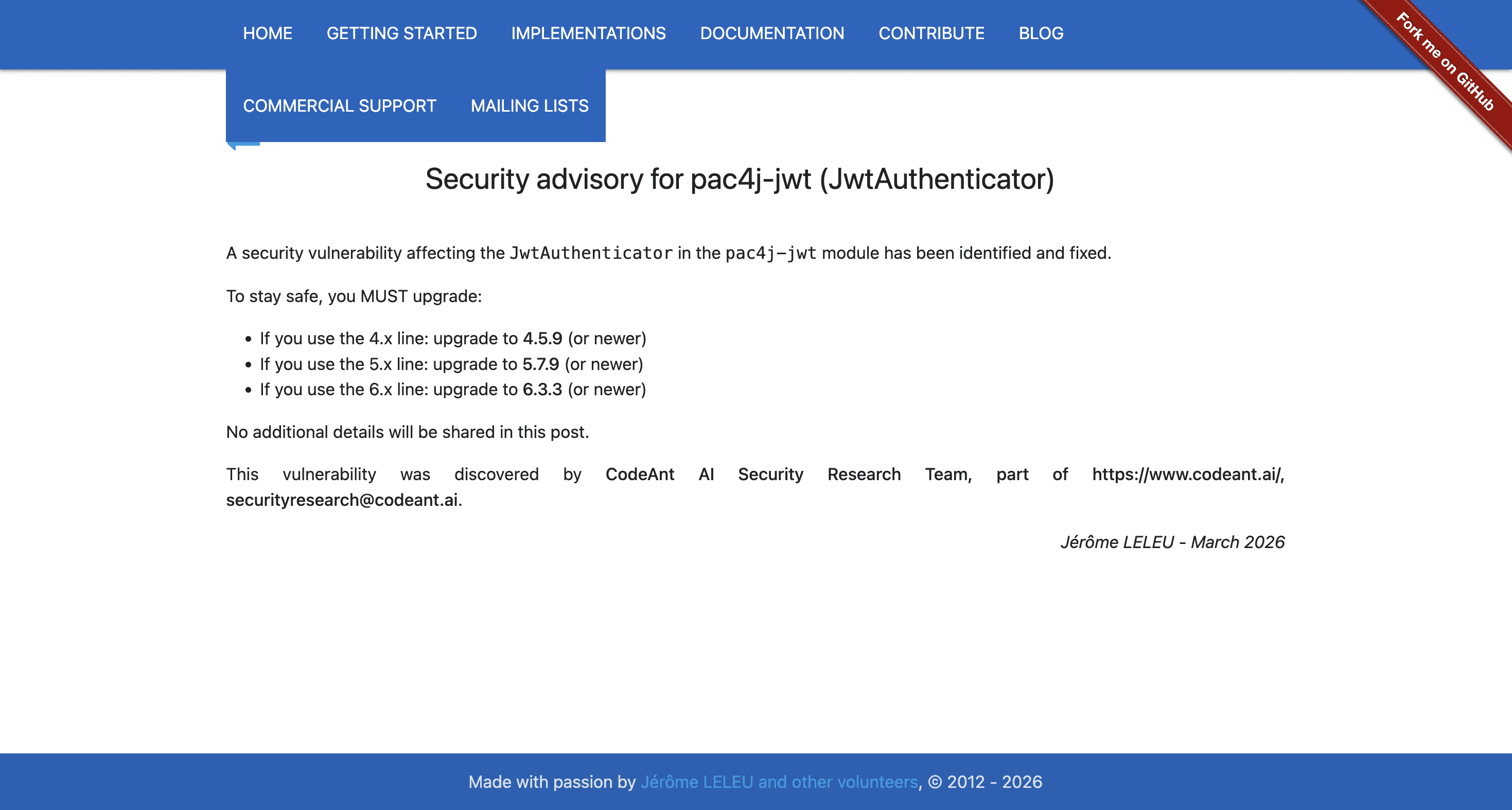
Full technical details are available in the original research disclosure:

https://www.codeant.ai/security-research/pac4j-jwt-authentication-bypass-public-key

To understand why these vulnerabilities are so dangerous, we need to analyze them not individually but structurally.

What CVSS-10 Actually Represents

The CVSS scoring model evaluates vulnerabilities using multiple metrics.

The most important are:


A score of 10.0 typically indicates:

In plain terms:

  • the attacker can exploit the vulnerability remotely

  • the exploit requires little complexity

  • the attacker needs no credentials

  • the victim does not need to perform any action

  • the vulnerability impacts the entire system

When those conditions align, exploitation becomes trivial and impact becomes catastrophic.

Case Study: Apache Struts OGNL Injection

One of the most widely known CVSS-10 vulnerabilities occurred in Apache Struts.

The vulnerability, CVE-2017-5638, allowed attackers to inject malicious expressions into HTTP headers processed by the framework’s multipart request parser.

Details:

https://nvd.nist.gov/vuln/detail/CVE-2017-5638

The vulnerability exploited how Struts evaluated OGNL expressions embedded in error messages.

An attacker could send a crafted request containing something like:

The request would pass through Struts' error handling pipeline.

During processing, the OGNL interpreter evaluated the injected expression.

Which meant user-controlled data became executable code.

This allowed remote command execution on the server.

The exploit chain looked like this:


The vulnerability ultimately enabled the Equifax breach, exposing personal data belonging to over 147 million people.

The architectural flaw was simple:

Case Study: Log4Shell

Another vulnerability that reached maximum severity was Log4Shell.

CVE-2021-44228 affected the widely used Java logging framework Log4j.

Technical details:

https://nvd.nist.gov/vuln/detail/CVE-2021-44228

Log4j supported a feature called lookup substitution, allowing dynamic evaluation of expressions inside log messages.

For example:

But the feature also supported JNDI lookups.

An attacker could submit input containing:

When logged by the application, Log4j would attempt to resolve the lookup.

Under certain configurations this caused the application to load remote Java classes.

Which meant simply logging attacker-controlled input could lead to remote code execution.

The attack path:


Even Minecraft servers were vulnerable because chat messages were logged using Log4j.

The trust boundary failure here was subtle:

Identity Systems: Token Authority Failures

Another category of CVSS-10 vulnerabilities involves identity tokens.

Modern authentication systems frequently rely on signed tokens to represent user identities.

Examples include:

  • OAuth tokens

  • OpenID Connect ID tokens

  • SAML assertions

  • JWT tokens

Because these tokens represent identity, any flaw in token validation can result in complete authentication bypass.

A notable example is the Entra ID actor token vulnerability described by Dirk-Jan Mollema.

https://dirkjanm.io/obtaining-global-admin-in-every-entra-id-tenant-with-actor-tokens/

The vulnerability was later tracked as:

https://msrc.microsoft.com/update-guide/vulnerability/CVE-2025-55241

Actor tokens represent delegated actions performed by one identity on behalf of another.

But the system occasionally treated these tokens as fully authoritative identities.

Which meant attackers could escalate privileges across tenants.

The failure:

CVE-2026-29000: JWT Authentication Bypass

Another example of a trust boundary failure appeared in the pac4j authentication framework.

The vulnerability affects pac4j-jwt, a library used for validating encrypted and signed JSON Web Tokens.

Original research:

https://www.codeant.ai/security-research/pac4j-jwt-authentication-bypass-public-key

The vulnerability occurs in the JwtAuthenticator component responsible for validating tokens.

The intended validation flow is:


But the implementation introduced a subtle control-flow condition.

The code attempted to parse the decrypted payload using:

If the payload contained a signed token, the method returned the parsed object.

If the payload contained an unsigned JWT, the method returned null.

Signature verification occurred only when the parsed token was not null.

Which created the following path:


An attacker could exploit this by embedding an unsigned JWT inside an encrypted wrapper.

Because the encryption layer succeeded, the system trusted the token.

And because signature verification never executed, the claims were accepted.

The attacker could impersonate any user.

Why These Vulnerabilities Are Structurally Similar

Despite targeting different technologies, these vulnerabilities share a common structure.

Vulnerability

Broken Trust Boundary

Apache Struts

input interpreted as executable expression

Log4Shell

logged input interpreted as lookup instruction

Entra actor tokens

delegated identity interpreted as authoritative identity

JWT bypass

encrypted token interpreted as authenticated token

Each system assumed something about its inputs that the specification did not guarantee.

Attackers exploited that assumption.

Why CVSS-10 Vulnerabilities Are Increasing in Identity Systems

Over the past decade, the software industry has shifted from session-based authentication to token-based identity systems.

Modern applications frequently rely on identity artifacts such as:

  • OAuth access tokens

  • OpenID Connect ID tokens

  • SAML assertions

  • JSON Web Tokens (JWTs)

These tokens act as portable identity credentials.

Instead of verifying a user directly, systems trust the claims embedded inside the token.

Which means authentication effectively becomes:

token validation identity verification

This architectural shift creates a new category of high-impact vulnerabilities.

If an attacker can manipulate how a system validates identity tokens, they can often bypass authentication entirely.

Several recent vulnerabilities illustrate this pattern:

Vulnerability

Identity Failure

Entra ID actor tokens

delegated token treated as authoritative identity

JWT algorithm confusion

public key interpreted as HMAC secret

JWT alg:none bugs

unsigned tokens accepted as valid

pac4j JWT flaw

encrypted token interpreted as authenticated token

In each case, the vulnerability does not allow arbitrary code execution.

Instead it allows something more subtle:

identity forgery.

And because identity tokens are used across distributed systems, the impact can cascade across multiple services.

This is why identity validation bugs increasingly receive CVSS-10 classifications.

They allow attackers to impersonate any user without credentials, without user interaction, and often across network boundaries.

In modern cloud architectures, that can mean full control of entire application environments.

The Rise of Composition Vulnerabilities

Modern software relies heavily on layered frameworks and libraries.

As a result, many vulnerabilities today are not caused by a single faulty component.

Instead they arise from interactions between components.

For example:

  • a parser returns unexpected data

  • a validation step assumes a specific format

  • a downstream component trusts the output

Each component behaves correctly.

But the system as a whole becomes vulnerable.

These are known as composition vulnerabilities.

Why This Matters for Security Engineering

The lesson from these CVSS-10 vulnerabilities is not simply that severe bugs exist.

It is that the most catastrophic bugs tend to occur at architectural boundaries:

  • input parsing

  • deserialization

  • authentication

  • identity delegation

  • logging infrastructure

Code operating at these boundaries must be treated as critical infrastructure.

Because if it fails, everything behind it becomes reachable.

When a vulnerability receives a CVSS score of 10.0, it represents the maximum severity classification under the Common Vulnerability Scoring System.

This rating is reserved for vulnerabilities that satisfy the most dangerous set of conditions simultaneously:

  • network exploitable

  • no authentication required

  • no user interaction required

  • complete compromise of confidentiality, integrity, and availability

In practice, vulnerabilities meeting these criteria are rare.

But when they appear, they tend to reshape how the security community thinks about software architecture.

Some of the most consequential examples include:

  • Apache Struts OGNL injection (CVE-2017-5638)

  • Log4Shell (CVE-2021-44228)

  • identity token delegation flaws in cloud identity systems

  • authentication bypasses in token validation frameworks

Each vulnerability demonstrates a deeper architectural issue: a system trusting unverified input at a critical boundary.

Recently, another vulnerability joined this category:

CVE-2026-29000 - a JWT authentication bypass discovered in the pac4j authentication framework.

Full technical details are available in the original research disclosure:

https://www.codeant.ai/security-research/pac4j-jwt-authentication-bypass-public-key

To understand why these vulnerabilities are so dangerous, we need to analyze them not individually but structurally.

What CVSS-10 Actually Represents

The CVSS scoring model evaluates vulnerabilities using multiple metrics.

The most important are:


A score of 10.0 typically indicates:

In plain terms:

  • the attacker can exploit the vulnerability remotely

  • the exploit requires little complexity

  • the attacker needs no credentials

  • the victim does not need to perform any action

  • the vulnerability impacts the entire system

When those conditions align, exploitation becomes trivial and impact becomes catastrophic.

Case Study: Apache Struts OGNL Injection

One of the most widely known CVSS-10 vulnerabilities occurred in Apache Struts.

The vulnerability, CVE-2017-5638, allowed attackers to inject malicious expressions into HTTP headers processed by the framework’s multipart request parser.

Details:

https://nvd.nist.gov/vuln/detail/CVE-2017-5638

The vulnerability exploited how Struts evaluated OGNL expressions embedded in error messages.

An attacker could send a crafted request containing something like:

The request would pass through Struts' error handling pipeline.

During processing, the OGNL interpreter evaluated the injected expression.

Which meant user-controlled data became executable code.

This allowed remote command execution on the server.

The exploit chain looked like this:


The vulnerability ultimately enabled the Equifax breach, exposing personal data belonging to over 147 million people.

The architectural flaw was simple:

Case Study: Log4Shell

Another vulnerability that reached maximum severity was Log4Shell.

CVE-2021-44228 affected the widely used Java logging framework Log4j.

Technical details:

https://nvd.nist.gov/vuln/detail/CVE-2021-44228

Log4j supported a feature called lookup substitution, allowing dynamic evaluation of expressions inside log messages.

For example:

But the feature also supported JNDI lookups.

An attacker could submit input containing:

When logged by the application, Log4j would attempt to resolve the lookup.

Under certain configurations this caused the application to load remote Java classes.

Which meant simply logging attacker-controlled input could lead to remote code execution.

The attack path:


Even Minecraft servers were vulnerable because chat messages were logged using Log4j.

The trust boundary failure here was subtle:

Identity Systems: Token Authority Failures

Another category of CVSS-10 vulnerabilities involves identity tokens.

Modern authentication systems frequently rely on signed tokens to represent user identities.

Examples include:

  • OAuth tokens

  • OpenID Connect ID tokens

  • SAML assertions

  • JWT tokens

Because these tokens represent identity, any flaw in token validation can result in complete authentication bypass.

A notable example is the Entra ID actor token vulnerability described by Dirk-Jan Mollema.

https://dirkjanm.io/obtaining-global-admin-in-every-entra-id-tenant-with-actor-tokens/

The vulnerability was later tracked as:

https://msrc.microsoft.com/update-guide/vulnerability/CVE-2025-55241

Actor tokens represent delegated actions performed by one identity on behalf of another.

But the system occasionally treated these tokens as fully authoritative identities.

Which meant attackers could escalate privileges across tenants.

The failure:

CVE-2026-29000: JWT Authentication Bypass

Another example of a trust boundary failure appeared in the pac4j authentication framework.

The vulnerability affects pac4j-jwt, a library used for validating encrypted and signed JSON Web Tokens.

Original research:

https://www.codeant.ai/security-research/pac4j-jwt-authentication-bypass-public-key

The vulnerability occurs in the JwtAuthenticator component responsible for validating tokens.

The intended validation flow is:


But the implementation introduced a subtle control-flow condition.

The code attempted to parse the decrypted payload using:

If the payload contained a signed token, the method returned the parsed object.

If the payload contained an unsigned JWT, the method returned null.

Signature verification occurred only when the parsed token was not null.

Which created the following path:


An attacker could exploit this by embedding an unsigned JWT inside an encrypted wrapper.

Because the encryption layer succeeded, the system trusted the token.

And because signature verification never executed, the claims were accepted.

The attacker could impersonate any user.

Why These Vulnerabilities Are Structurally Similar

Despite targeting different technologies, these vulnerabilities share a common structure.

Vulnerability

Broken Trust Boundary

Apache Struts

input interpreted as executable expression

Log4Shell

logged input interpreted as lookup instruction

Entra actor tokens

delegated identity interpreted as authoritative identity

JWT bypass

encrypted token interpreted as authenticated token

Each system assumed something about its inputs that the specification did not guarantee.

Attackers exploited that assumption.

Why CVSS-10 Vulnerabilities Are Increasing in Identity Systems

Over the past decade, the software industry has shifted from session-based authentication to token-based identity systems.

Modern applications frequently rely on identity artifacts such as:

  • OAuth access tokens

  • OpenID Connect ID tokens

  • SAML assertions

  • JSON Web Tokens (JWTs)

These tokens act as portable identity credentials.

Instead of verifying a user directly, systems trust the claims embedded inside the token.

Which means authentication effectively becomes:

token validation identity verification

This architectural shift creates a new category of high-impact vulnerabilities.

If an attacker can manipulate how a system validates identity tokens, they can often bypass authentication entirely.

Several recent vulnerabilities illustrate this pattern:

Vulnerability

Identity Failure

Entra ID actor tokens

delegated token treated as authoritative identity

JWT algorithm confusion

public key interpreted as HMAC secret

JWT alg:none bugs

unsigned tokens accepted as valid

pac4j JWT flaw

encrypted token interpreted as authenticated token

In each case, the vulnerability does not allow arbitrary code execution.

Instead it allows something more subtle:

identity forgery.

And because identity tokens are used across distributed systems, the impact can cascade across multiple services.

This is why identity validation bugs increasingly receive CVSS-10 classifications.

They allow attackers to impersonate any user without credentials, without user interaction, and often across network boundaries.

In modern cloud architectures, that can mean full control of entire application environments.

The Rise of Composition Vulnerabilities

Modern software relies heavily on layered frameworks and libraries.

As a result, many vulnerabilities today are not caused by a single faulty component.

Instead they arise from interactions between components.

For example:

  • a parser returns unexpected data

  • a validation step assumes a specific format

  • a downstream component trusts the output

Each component behaves correctly.

But the system as a whole becomes vulnerable.

These are known as composition vulnerabilities.

Why This Matters for Security Engineering

The lesson from these CVSS-10 vulnerabilities is not simply that severe bugs exist.

It is that the most catastrophic bugs tend to occur at architectural boundaries:

  • input parsing

  • deserialization

  • authentication

  • identity delegation

  • logging infrastructure

Code operating at these boundaries must be treated as critical infrastructure.

Because if it fails, everything behind it becomes reachable.

FAQs

What does a CVSS score of 10 mean?

Why are CVSS 10 vulnerabilities rare?

What are examples of CVSS 10 vulnerabilities?

Why do authentication systems often produce critical vulnerabilities?

What are composition vulnerabilities in software security?

Table of Contents

Start Your 14-Day Free Trial

AI code reviews, security, and quality trusted by modern engineering teams. No credit card required!

Share blog: