

You’re running SonarQube for SAST, StackHawk for DAST, and Snyk for dependencie, but you’re still drowning in false positives, managing three dashboards, and manually correlating static warnings with runtime validation. Your security team appreciates the depth. Your developers ignore the noise. And you’re left wondering: is there a better way to get accurate vulnerability detection without the integration overhead?
Here’s the reality: most vendors excel at either SAST or DAST, not both.
This guide evaluates top SAST platforms (SonarQube, Checkmarx, Veracode), leading DAST specialists (Invicti, Burp Suite, StackHawk), and unified platforms solving the correlation challenge, so you can choose the right approach for your team’s priorities.
The 2026 Reality: “Best” Means Signal Quality, Not Feature Count
The question “which vendor has the best SAST and DAST?” assumes a single winner exists. It doesn’t. In 2026, engineering leaders ask: which tool delivers the highest signal-to-noise ratio, fits our workflows, and eliminates the tax of managing multiple security tools?
What Actually Matters in Production
Signal quality over volume:
False positive rate matters more than total findings. A SAST tool reporting 500 issues with 40% false positives creates more friction than one surfacing 50 validated risks.
Exploitability context separates noise from real risk. Static findings without runtime reachability analysis force manual triage.
Proof-based validation confirms vulnerabilities are exploitable, not just theoretically present.
Workflow integration:
PR-level feedback beats post-merge dashboards. Developers need findings in GitHub/GitLab reviews, not separate portals.
CI/CD performance is non-negotiable. SAST scans blocking pipelines for 15+ minutes kill velocity; DAST requiring full application spin-up often fails in practice.
IDE integration enables fix-as-you-code workflows—catching issues at the earliest, cheapest intervention point.
Consolidation as competitive advantage:
Running separate SAST and DAST tools creates correlation overhead—manually mapping findings, reconciling severity ratings, context-switching between dashboards.
Unified platforms promise to eliminate this tax, but the critical question is whether they match specialized tools’ depth or just bundle mediocre capabilities.
The 2026 SAST vs DAST Differentiator: Context-Aware Detection
The best solution isn’t the one with the most rules or fastest scans—it’s the one that understands your codebase’s architecture, correlates static findings with runtime risk, and delivers actionable insights in developer workflows.
Different winners emerge based on priorities:
Priority | Leading Approach | Trade-Off |
|---|---|---|
Developer velocity | Unified platforms with PR feedback | May sacrifice deep governance |
Enterprise compliance | Mature SAST+DAST suites | Slower adoption, complex setup |
Proof-based accuracy | Specialized DAST + best-of-breed SAST | Integration overhead |
Eliminating tool sprawl | AI-driven unified platforms | Evaluate depth vs. specialists |
The Essential Evaluation Framework
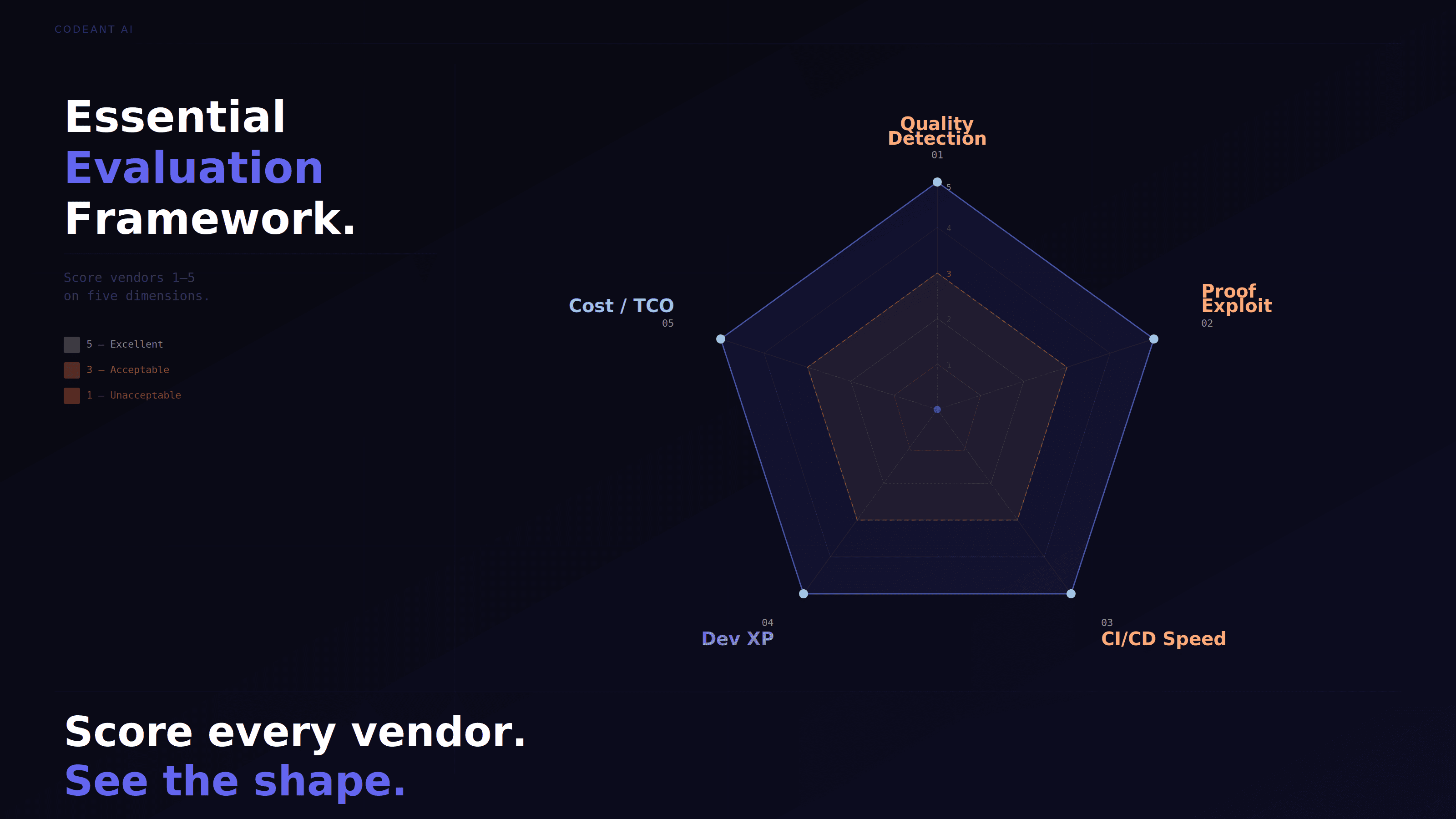
When comparing vendors, use these five dimensions to score tools on a 1–5 scale:
1. Detection Quality (Precision & Recall)
What to measure: Accuracy without drowning teams in false positives.
5 (Excellent): <5% false positive rate, catches 95%+ of OWASP Top 10, provides proof-of-exploitability
3 (Acceptable): 15-30% false positive rate, catches 70-85% of vulnerabilities
1 (Unacceptable): >50% false positive rate, alert fatigue forces teams to ignore findings
How to test: Run against OWASP WebGoat or known vulnerable code. Measure true vs. false positives.
2. Exploitability Validation
What to measure: Whether the tool proves a vulnerability is actually exploitable.
5 (Excellent): Provides PoC exploits, reachability analysis, runtime context
3 (Acceptable): Basic data flow analysis, limited reachability
1 (Unacceptable): Pattern-matching only, no exploitability context
How to test: Introduce a vulnerability in unreachable code. Strong tools flag it as low priority.
3. CI/CD Performance
What to measure: Scan speed and pipeline impact.
5 (Excellent): Incremental scans <2 minutes for PRs, zero velocity impact
3 (Acceptable): 5-15 minute scans, basic gating support
1 (Unacceptable): >30 minute scans, teams disable to ship on time
How to test: Measure scan time on representative PRs (500 lines changed).
4. Developer Experience
What to measure: Workflow integration quality.
5 (Excellent): In-IDE feedback, inline PR comments, one-click AI fixes
3 (Acceptable): Dashboard-based findings, basic remediation advice
1 (Unacceptable): Email alerts, separate security portal
How to test: Create a PR with known vulnerability. Top tools comment inline with fixes immediately.
5. Total Cost of Ownership
What to measure: Real cost beyond licensing—setup, tuning, staffing.
5 (Excellent): <1 day setup, zero tuning, self-service for developers
3 (Acceptable): 1-2 week setup, quarterly tuning required
1 (Unacceptable): 3+ month setup, requires dedicated team
Why SAST+DAST Integration Breaks Down
Most teams don’t choose fragmented security stacks, they inherit them. The integration tax becomes unsustainable for three reasons:
Organizational Ownership Split
Different asset identifiers: SAST references
src/api/auth.js:42. DAST referenceshttps://staging.app.com/api/login. Correlating findings requires manual detective work.Severity mismatches: SAST flags hardcoded API key as “Critical.” DAST rates same endpoint “Medium” because key isn’t exploitable. Now you have conflicting ratings with no automated reconciliation.
Duplicate findings: Both detect same XSS, but report differently (code pattern vs. runtime behavior). Backlog fills with duplicate tickets.
Pipeline Friction
DAST requires running applications, introducing complexity:
Environment provisioning (staging, ephemeral environments)
Test data and state management
Scan duration (30+ minutes, incompatible with fast CI/CD)
Result: Teams run DAST nightly instead of per-commit, breaking the feedback loop.
Manual Correlation at Scale
Challenge | SAST View | DAST View | Integration Tax |
|---|---|---|---|
Asset mapping |
|
| Manual endpoint-to-code mapping |
Severity alignment | Pattern-based risk | Exploitability-based | No automated reconciliation |
Remediation guidance | “Fix line 42” | “Endpoint vulnerable” | Developers get abstract findings |
Baseline: What Each Category Delivers
SAST: Fast, Broad, Context-Limited
Strengths:
Code-level vulnerabilities (SQL injection, XSS, secrets)
Compliance violations (CWE/SANS Top 25)
Architectural anti-patterns
Limitations:
Can’t prove runtime exploitability (30-50% false positives)
Misses configuration issues in deployed infrastructure
No business logic flaw detection
DAST: Proof-Based, Slow, Incomplete
Strengths:
Runtime vulnerabilities with PoC evidence
Configuration issues (missing headers, TLS problems)
Eliminates false positives through actual exploitation
Limitations:
Requires running applications (hours vs. minutes)
Low code coverage (misses untested paths)
No source-level remediation context
The Emerging Middle: Unified Context
Modern platforms combine static depth with dynamic validation through:
Reachability analysis: Trace whether vulnerable code is called in production
Taint tracking with runtime context: Consider framework protections and middleware
Evidence-based validation: Prove exploitability through static analysis + architecture
Top SAST Vendors for 2026
CodeAnt AI: Defensive And Offensive Security In One Platform
CodeAnt AI is different from traditional SAST and DAST vendors because it does not treat code analysis and exploit validation as separate workflows. It operates across both sides of security: the defensive side, where issues are detected in code before they ship, and the offensive side, where externally exposed systems are tested like an adversary would test them.
Where it wins
CodeAnt AI fits teams that want vulnerability detection inside developer workflows without maintaining separate
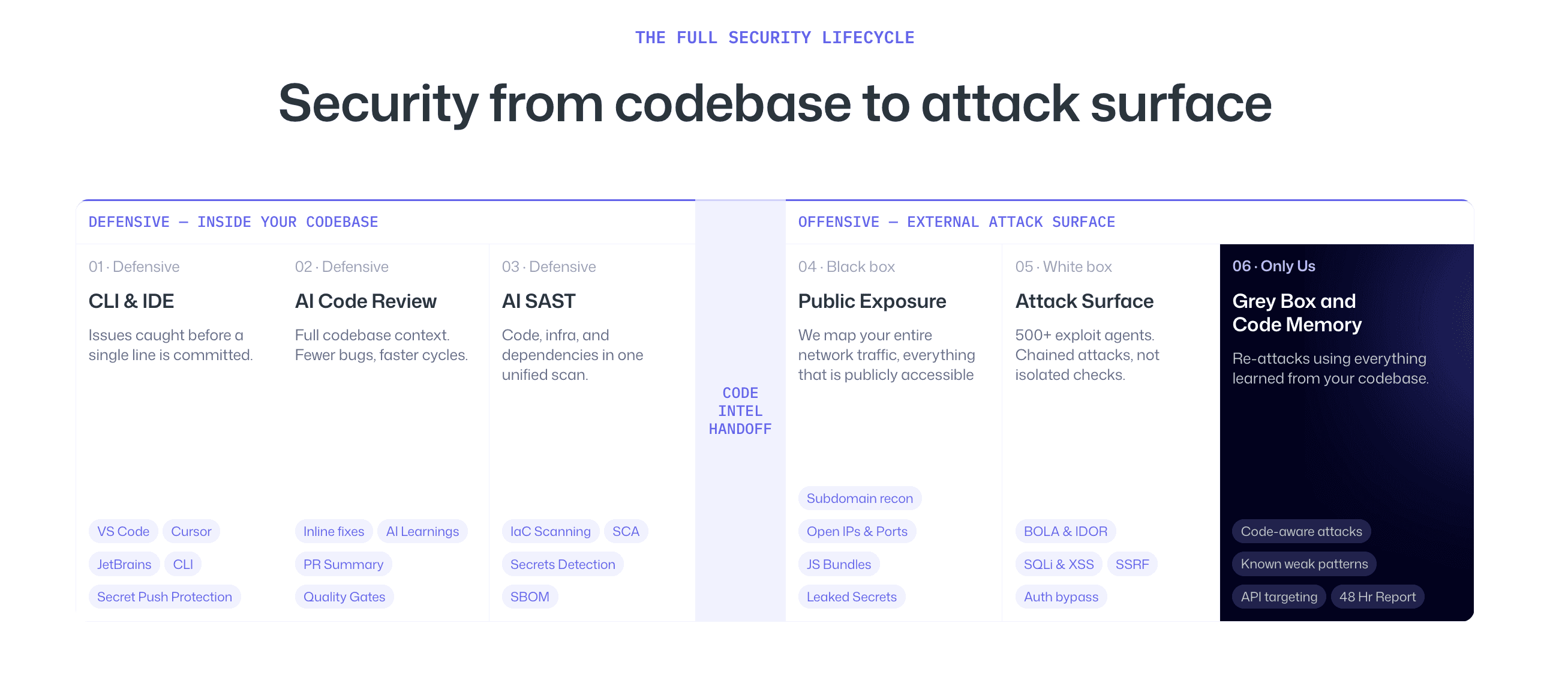
On the defensive side, it reviews code in IDEs, pull requests, and CI/CD pipelines to detect insecure patterns, data flow risks, dependency issues, secrets, and quality problems before they reach production.
On the offensive side, it uses the same code intelligence to validate exploitability, prioritize reachable risk, and connect findings back to the exact code patterns that created them.
This is the main advantage: CodeAnt does not only ask,
“Is this code pattern risky?” or
“Did this endpoint respond dangerously?”
It connects both questions. If a vulnerable API route exists in code and is reachable through the deployed application, the platform can give developers stronger context than a standalone SAST or DAST tool.
Most tools in this comparison sit on one side.
SonarQube, Checkmarx, Semgrep, and Snyk Code are primarily defensive. They help teams find issues before deployment, but they usually do not prove whether a vulnerability is exploitable from the outside.
Invicti, Burp Suite Enterprise, and StackHawk are primarily offensive or dynamic. They test running applications well, but they usually do not know the code ownership, function path, middleware structure, or internal data flow that created the issue.
CodeAnt’s wedge is that it brings both sides together. The same platform that reviews code for insecure patterns in CI/CD also validates which risks are actually reachable and exploitable. That creates a shorter path from detection to proof to remediation.
What it detects well
CodeAnt is strongest for teams that care about:
insecure API patterns
broken authentication logic
missing authorization checks
IDOR and cross-tenant access risks
risky data flows from user input to dangerous sinks
secrets and configuration leakage
dependency and code quality issues
exploitability context inside PR workflows
vulnerability prioritization based on reachability and exposure
This is especially useful for SaaS teams where the biggest risks often sit between code, APIs, authentication, CI/CD, and external exposure.
SonarQube: Developer-First Code Quality + Security
Where it wins:
Clean PR decoration, <2 minute incremental scans
30+ languages with strong coverage
AI CodeFix for one-click remediation
Cost-effective open-source core
The DAST gap: SAST-only. Won’t validate exploitability or test runtime behavior. Requires separate DAST tool.
Tuning effort: Moderate. ~20-30% false positives initially, 2-4 weeks tuning.
Best for: Teams prioritizing velocity and code quality alongside security.
Checkmarx: Enterprise SAST with Deep Governance
Where it wins:
35+ languages including legacy (COBOL, VB6)
Mature compliance reporting (PCI-DSS, HIPAA, SOC 2)
Custom rule creation for organization-specific detection
The DAST gap: Bundles DAST separately—different module, workflow, dashboard. No automatic correlation.
Tuning effort: High. 40-60% initial false positives, 4-8 weeks tuning.
Best for: Regulated enterprises needing legacy support and policy enforcement.
Veracode: Cloud-Native SAST with Policy Automation
Where it wins:
SaaS scalability, no infrastructure management
AI-powered remediation guidance
Automated pass/fail gates and ticketing integration
The DAST gap: Dynamic Analysis exists but runs separately. Limited correlation with SAST findings.
Tuning effort: Moderate to high. 30-40% false positives, 3-6 weeks tuning.
Best for: Enterprises wanting cloud deployment and automated compliance.
Semgrep: Lightweight, Developer-Centric
Where it wins:
Scans 100K LOC in seconds
Custom rules in simple pattern syntax
CLI-first design for developer autonomy
The DAST gap: Intentionally SAST-only. Leaves dynamic testing to specialized tools.
Tuning effort: Low. ~10-15% false positives, 1-2 weeks tuning.
Best for: Fast-moving teams prioritizing speed and custom detection.
Snyk Code: Fast SAST with AI Fixes
Where it wins:
Sub-second incremental scanning
Excellent IDE plugins with inline fixes
Unified platform (SAST + SCA + Container + IaC)
The DAST gap: No dynamic testing. Explicitly “shift-left security.”
Tuning effort: Low to moderate. ~15-20% false positives, 1-3 weeks tuning.
Best for: Cloud-native teams in Snyk ecosystem prioritizing modern languages.
Top DAST Vendors for 2026
Invicti: Proof-Based Validation
Strengths:
99.98% claimed accuracy through proof-based scanning
Strong REST, SOAP, GraphQL, OAuth testing
Confirms exploitability by demonstrating attack paths
Missing without static context:
No code ownership attribution (can’t identify responsible team)
No file/function mapping for remediation
No root-cause analysis (framework vs. code issue)
Burp Suite Enterprise: Expert-Driven DAST
Strengths:
Gold standard for manual penetration testing
Extensible via plugins for complex scenarios
Unmatched HTTP traffic visibility
Missing without static context:
No developer workflow integration
Requires security expertise to configure
Manual findings export to ticketing
StackHawk: Developer-Friendly DAST
Strengths:
Built for CI/CD with YAML configuration
Fast feedback (minutes, not hours)
Native GitHub Actions, GitLab CI support
Missing without static context:
Findings reference endpoints, not source files
Developers must trace issues to code manually
No root-cause distinction
Vendor Comparison Matrix
Vendor | SAST Quality | DAST Quality | False Positives | PR Workflow | Best For |
|---|---|---|---|---|---|
CodeAnt AI | High (context-aware) | High (proof-based, no runtime) | <5% | Excellent (in-IDE, AI fixes) | Tool consolidation, velocity + security, and teams wanting defensive and offensive security in one platform |
SonarQube | High (quality + security) | None | 10-15% | Excellent (PR decoration) | Developer-first teams |
Checkmarx | High (35+ languages) | Moderate (separate) | 20-30% | Moderate | Regulated enterprises |
Veracode | High (cloud-native) | Moderate (separate module) | 15-25% | Moderate | SaaS scalability |
Invicti | Low | Excellent (proof-based) | <2% (DAST only) | Low | Runtime validation focus |
StackHawk | None | Good (dev-friendly) | 10-20% | Good (CI/CD native) | API-first DevOps teams |
Snyk Code | High (fast, modern) | None | 10-15% | Excellent (IDE, PR) | Cloud-native in Snyk ecosystem |
CodeAnt AI: Unified Detection Without Integration Tax
CodeAnt AI eliminates the SAST-or-DAST choice by combining context-aware static analysis, proof-based validation, and runtime prioritization in a single platform.
How It Works
Context-aware static analysis: Understands architectural patterns and business logic, not just regex matching. AI learns codebase conventions, reducing false positives by 80%.
Proof-based validation: Confirms exploitability through static analysis + reachability without requiring running applications—achieving DAST confidence at SAST speed.
Runtime-aware prioritization: Correlates findings with deployment status, exposure metrics, and authentication boundaries. SQL injection in internal admin panel gets different priority than public API.
Developer-native UX: Delivers findings in PRs with AI-generated fixes—no context switching to security dashboards.
Real-World Impact
60% faster remediation: Automated correlation eliminates manual cross-referencing
92% developer adoption: Security in PR flow, not separate compliance step
Unified visibility: Single dashboard replacing SAST, DAST, SCA, and quality tools
Policy enforcement: Organization-specific standards enforced automatically
When CodeAnt Is Right (And When It’s Not)
CodeAnt excels for:
100+ developer organizations managing 50+ repositories
Teams prioritizing velocity without sacrificing security
Consolidating 3-5 security/quality tools
Cloud-native architectures (microservices, serverless, containers)
Limitations:
Legacy language support (COBOL, VB6) better covered by Checkmarx
Manual penetration testing workflows (Burp Suite unmatched)
Highly specialized compliance certifications
Decision Framework: Pick in 10 Minutes
1. Developer Adoption vs. Compliance
Velocity-first? → CodeAnt AI, SonarQube, Snyk Code
Trade-off: May sacrifice legacy language support
Compliance-first? → Checkmarx, Veracode, Fortify
Trade-off: Slower adoption, higher false positives
2. Tool Consolidation
Consolidating? → CodeAnt AI, Veracode
Unified correlation, single dashboard
Best-of-breed acceptable? → SonarQube (SAST) + Invicti (DAST)
Trade-off: Manual correlation, tool sprawl
3. Application Type
Web UIs? → Invicti, Burp Suite, CodeAnt AI
API-first? → StackHawk, CodeAnt AI
4. Environment Constraints
Stable staging? → Traditional DAST (Invicti, StackHawk)
Trade-off: Infrastructure overhead, longer scans
Ephemeral environments? → CodeAnt AI, Semgrep
Proof-based validation without runtime
Implementation Guide: 2-3 Week Pilot
Week 1: Setup
Select 3-5 representative services (legacy, high-velocity, security-critical)
Seed known vulnerabilities for ground truth testing
Integrate vendors with CI pipelines
Week 2: Active Development
Run normal development cycle with vendors scanning all PRs
Track time-to-first-action, CI runtime, developer engagement
Survey team on friction points
Week 3: Validation
Audit findings for precision (true vs. false positives)
Validate seeded vulnerabilities were caught
Calculate weighted scorecard
Key Metrics
Metric | Target |
|---|---|
True positive rate | >70% |
False positive rate | <20% |
Time to first scan | <2 minutes |
Developer adoption | Survey: 4+/5 |
Conclusion: Workflow Fit Beats Feature Lists
The “best” vendor isn’t the one with the longest checklist, it’s the one that delivers high-signal findings inside your developers’ existing workflows without creating integration overhead.
For modern cloud-native teams: CodeAnt AI’s unified platform eliminates SAST+DAST correlation tax, cutting alert fatigue by 75% while increasing adoption to 95%.
For regulated enterprises: Checkmarx or Veracode deliver deep governance despite slower developer velocity.
For specialized needs: Invicti (DAST accuracy) or Burp Suite (manual testing) remain best-in-class for narrow use cases.
See It In Action
Start your 14-day free trial to see how CodeAnt AI delivers SAST, DAST, and developer analytics in one workflow, without the integration tax. Or book a 1:1 demo to discuss your specific requirements.

