

Most insurers looking for a penetration testing alternative are leaving one of two things: a traditional consulting firm that tests once a year, or a crowdsourced platform whose credit model and variable depth stopped fitting. The right alternative depends on which one you are replacing.
This guide compares the alternatives for a regulated insurer from both starting points, names the real options, and maps them to what NYDFS and SOC 2 actually require. It closes on where a code-aware, continuous approach fits.
What CodeAnt AI solves here: CodeAnt AI is a code-aware, continuous penetration testing platform that reads your source, tests inside and outside the boundary, and prices on outcomes. It covers the NYDFS annual test and the after-change obligation without separate engagements or an opaque credit model.
Short answer: if you are leaving a traditional firm, the alternative is usually automated, code-aware testing that covers both limbs of NYDFS 500.5 continuously. If you are leaving Cobalt or HackerOne, the alternative is usually a platform with source-level depth and predictable pricing. For insurers, those often point to the same place.
I reviewed the current public product pages of the platforms named here on July 27, 2026. This is a capability comparison, not a claim of any assessment run against them.
Why Insurers Look For Penetration Testing Alternatives
The penetration testing market is growing fast, from an estimated 2.72 billion dollars in 2026 toward 5.54 billion by 2031 on Mordor Intelligence figures, and part of that is teams switching models as their needs change. For insurers the reasons cluster into four.
Cadence. A once-a-year engagement cannot cover the after-material-change obligation in NYDFS 500.5, and insurers ship changes constantly.
Predictable pricing. Credit-based models and per-engagement fees make annual budgeting hard, especially once after-change tests stack up.
Source-level depth. Most insurer breaches turn on authorization logic that only code-aware testing reads reliably.
Compliance evidence. Reports that map to NYDFS and SOC 2 without extra post-processing save real time at examination.
Alternatives To Traditional Penetration Testing Firms For Insurers
Insurers leaving a consulting firm are usually not unhappy with the depth. They are unhappy with the cadence and the cost of repeating it.
A traditional firm scopes an engagement, tests over a fixed window, and delivers a report, which is strong for a point-in-time annual audit and weak for everything that changes afterward. Under 500.5, each material change then becomes a separate, separately priced engagement, and the evidence between engagements is a blank.
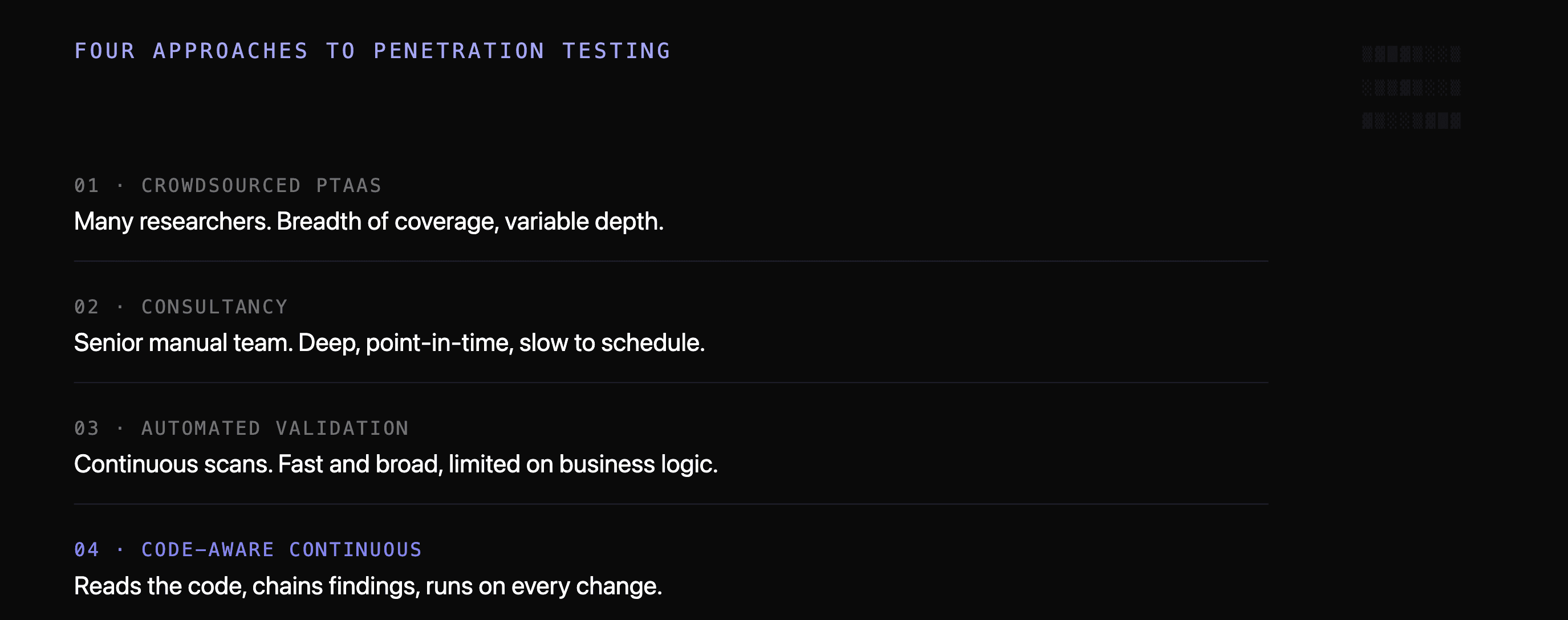
The alternatives sort by how much cadence you need. Automated, code-aware testing runs continuously and covers both the annual and after-change limbs, autonomous validation platforms like NodeZero and Pentera add frequent network and identity proof, and PTaaS platforms sit between a project and a subscription.
For insurers that must show continuous evidence, the automated option is usually the cleaner replacement.
Alternatives To Crowdsourced PTaaS Platforms For Insurance Teams
Insurers leaving a crowdsourced platform are usually chasing three things: predictable pricing, deeper testing, and less noise to triage.
Cobalt and HackerOne built their reputations on a crowdsourced model, connecting teams to a community of vetted researchers on demand, which is genuinely fast and broad. The friction for insurers is that credit-based pricing can be hard to forecast, depth on a specific claims API depends on which researchers pick it up, and the findings often need post-processing to line up with what a NYDFS examiner or SOC 2 auditor expects.
The alternatives sort by what pushed you to look. For source-level depth and predictable, outcome-based pricing, a code-aware platform fits, and for managed human validation and federal work, Synack pairs agentic AI with a vetted red team.
For autonomous internal and identity proof, NodeZero fits, and developer-first code-and-cloud platforms like Aikido cover the shift-left angle.
Penetration Testing Alternatives Compared For Insurers
Different alternatives solve different complaints. This table sorts them against what a regulated insurer actually weighs.
Alternative | Model | Reads source code | Continuous cadence | Pricing shape |
|---|---|---|---|---|
CodeAnt AI | Code-aware pentest, human revalidation | Yes | Yes, on every change | Outcome-based, zero engagement fee |
Cobalt / HackerOne | Crowdsourced PTaaS | No | Platform-managed | Credit-based |
Synack | Agentic AI plus vetted red team | Separate service | Continuous options | Per-test plus platform fee |
NodeZero / Pentera | Autonomous validation | No | Yes, frequent | Subscription |
BreachLock | Hybrid automated and manual | No | Recurring | Transparent, plan-based |
Consulting firm | Manual, point-in-time | Optional add-on | No | Project fee |
The read for an insurer is that the switch target depends on the driver. If the driver is source-level depth and budget predictability, a code-aware, outcome-based platform answers both, which is why it shows up as the alternative from both starting points.
What To Look For In Penetration Testing Alternatives For Regulated Insurers
Whatever you are leaving, the criteria for a regulated insurer are consistent. Judge any alternative against these before switching.
Compliance mapping. Findings mapped to NYDFS, GLBA, and SOC 2 in the format your examiner expects.
Authorization depth. The ability to reach broken object level authorization on policy and claims APIs, where insurer breaches start.
Continuous cadence. Coverage that keeps pace with releases, not a single yearly snapshot.
Evidence and retest. A working proof of exploit and a retest that confirms the fix.
Predictable pricing. A model you can budget across a full year, including after-change testing.
Multi-tenant coverage. For insurtech, testing that proves one carrier's data cannot reach another.
Where Code-Aware, Outcome-Based Penetration Testing Fits
The reason a code-aware platform answers both starting points is specific to how insurers get breached. The failures that matter, an API that returns a record without checking ownership, an internal service that trusts its caller, are authorization logic, and that logic is invisible to any test working only from the outside.
Reading the code changes what the test can find, and the full workflow runs it end to end. Reconnaissance maps the external surface and leaked credentials, the code-aware stages find the exact endpoints that accept a client-supplied identifier without checking ownership, researchers revalidate every finding, and the output is a proven chain to policyholder data with a retest.
Our walkthrough of how AI penetration testing traces a data leak shows a full example.
The pricing model is the other half of the answer. Outcome-based pricing removes the budget unpredictability of a credit model, because a zero engagement fee with payment only on confirmed critical findings is inherently forecastable, and it aligns the test with the outcome an insurer wants.
How To Evaluate A Penetration Testing Alternative Before Switching
Switching testing models should be evidence-based, not vendor-led. A short pilot answers the real question before you commit.
Use one approved target. Keep the application, environment, and credentials identical across the incumbent and the alternative.
Write the answer key first. Document known authorization boundaries, seeded bugs, and tenant-ownership rules before testing.
Count verified findings, not alerts. Rank by reproducible high and critical issues and the time to validate each.
Model a full year of cost. Include after-change tests and retests, not a single quote.
Read the evidence as an examiner would. Check mapping to NYDFS and SOC 2, exploit proof, and retest results.
The provider evaluation framework and PTaaS SLA guide give you a scorecard, and the best tools for insurance guide covers the full field.
Conclusion: Choose A Penetration Testing Alternative Based On Depth, Cadence, And Evidence
The best penetration testing alternative for an insurer is the one that fixes the reason you started looking. If you are leaving a traditional firm, the gap is cadence and the cost of repeating the engagement, and continuous automated testing closes it.
If you are leaving Cobalt or HackerOne, the gap is depth, noise, and pricing predictability, and a code-aware, outcome-based platform closes those.
That is why code-aware, continuous testing is a strong fit for insurers that ship frequently. It can read the source, test inside and outside the boundary, validate real exploit paths, retest fixes, and keep evidence current instead of forcing teams to rebuild proof before an audit.
Before switching penetration testing providers, run one controlled pilot. Use the same target, credentials, scope, and evidence requirements for every option. Then choose the alternative that proves real exploitability, maps evidence to NYDFS and SOC 2, covers after-change testing, and gives you predictable cost across the full year.
Launch a free black box scan for one URL with us to compare it against your incumbent, then book a walkthrough to see it mapped to your NYDFS and SOC 2 obligations. For the full field, start with our best penetration testing tools for insurance guide.

