

You’re evaluating penetration testing platforms, and the market has split into two fundamentally different architectures.
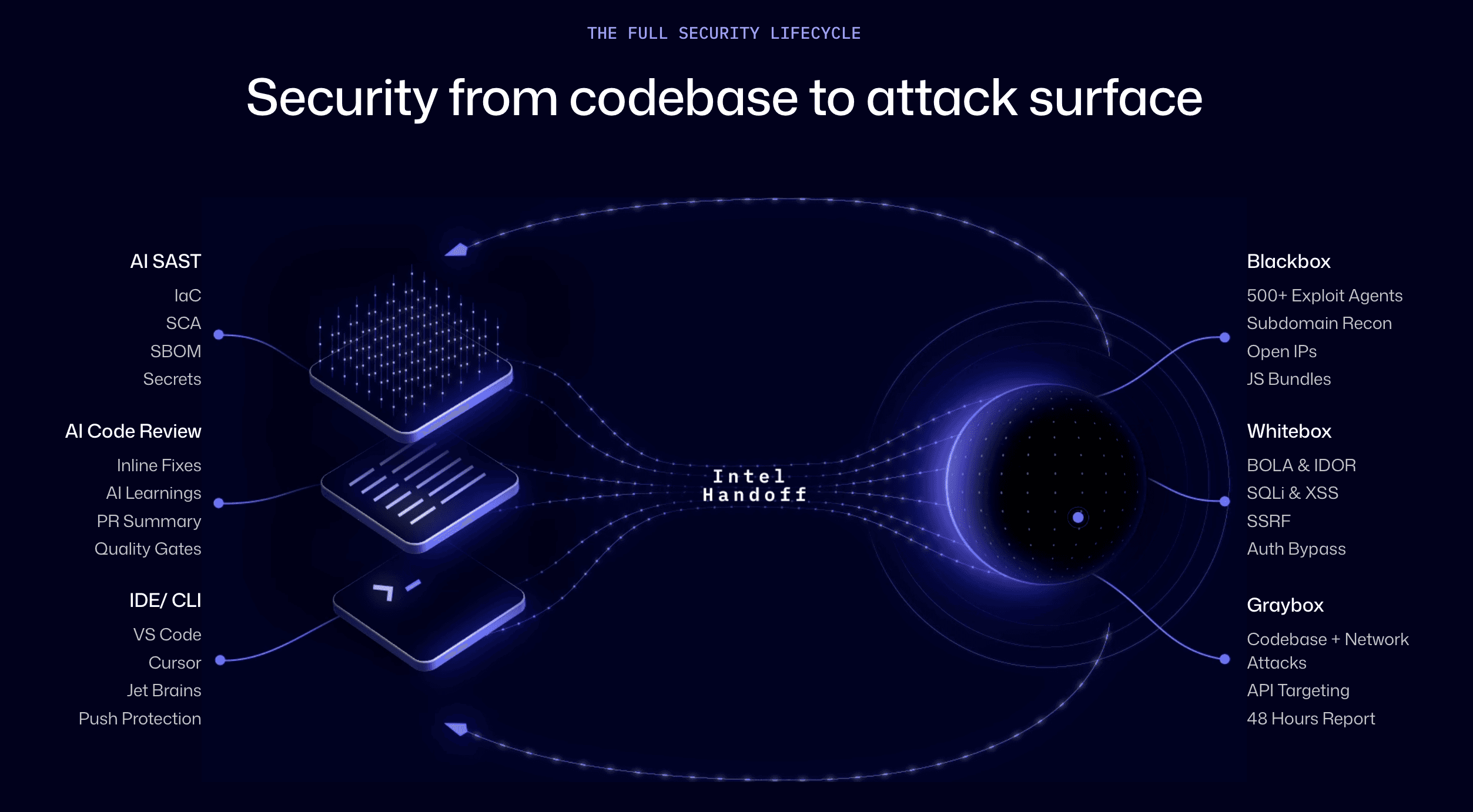
CodeAnt AI operates as a unified defensive+offensive system where the same code intelligence reviewing your pull requests also conducts adversarial reconnaissance against your external attack surface.
Astra Security pairs automated scanners with human analysts, running scheduled tests, delivering compliance certificates, and manually verifying findings.
The architectural difference determines everything:
testing depth
pricing models
remediation workflows
which teams each platform serves best
This comparison breaks down both platforms across testing methodologies, integration ecosystems, and real-world organizational fit. By the end, you’ll have a clear decision framework based on deployment velocity, compliance requirements, and security team maturity.
CodeAnt AI Vs Astra Security: Code-Aware AI Pentesting Vs Scanner-Based Testing
Before comparing features, understand that CodeAnt AI and Astra Security operate on fundamentally different architectural models, and this structural choice determines how they work, what they cost, and which organizations they serve.
CodeAnt’s Unified Defensive and Offensive Architecture
CodeAnt runs a single code intelligence engine operating on both sides of security simultaneously. The system that reviews your pull requests for SQL injection vulnerabilities also conducts external reconnaissance, enumerating subdomains, analyzing compiled JavaScript bundles for hardcoded API keys, and tracing user input flows through your source code to find exploitable data paths.
This creates three parallel testing tracks sharing intelligence:
Testing Track | Starting Context | What CodeAnt AI Does | Example Finding |
|---|---|---|---|
Black Box Testing | Zero knowledge | Starts with DNS enumeration, cloud asset discovery, subdomain checks, and JavaScript bundle analysis. | Finds a hardcoded Stripe API key in a minified JavaScript bundle, then tests it against Stripe’s live API to confirm validity and permissions. |
White Box Testing | Full source code access | Traces every user input from HTTP handlers through business logic to dangerous sinks like | Finds credentials that developers committed, removed, and forgot, because Git history still preserves them. |
Gray Box Testing | External testing plus internal context | Uses authenticated scanning with valid credentials to test role boundaries, IDOR vulnerabilities, JWT failures, subscription tier abuse, and race conditions. | Automates business logic testing that traditionally requires manual analyst judgment. |
The critical advantage: these three tracks share intelligence.
When black box testing discovers a subdomain, white box analysis immediately checks if that subdomain’s codebase contains known vulnerability patterns.
When gray box testing finds an authentication bypass, the platform traces the vulnerable code path to understand root cause and generate a working patch.
This architecture requires commitment, you can’t use CodeAnt just for pentesting. It needs to be your code review platform too, because offensive capabilities depend on months of defensive context.
Astra’s Scanner + Analyst Hybrid Model
Astra operates as traditional pentesting modernized with automation: 10,000+ vulnerability tests (as of July 2026) covering OWASP Top 10, SANS 25, and current CVEs, executed by an automated scanner, then manually verified by human analysts to eliminate false positives.
The workflow is scheduled and engagement-oriented:
Automated scanning: Astra’s scanner crawls your application (authenticated via browser extension), tests for known vulnerability patterns, and generates preliminary findings.
Manual verification: Human analysts review each finding, attempt reproduction, assess business impact, and filter false positives.
Deliverable package: Publicly verifiable security certificate (issued on passing, a Pentest Plus feature), detailed PDF report mapping findings to compliance frameworks, and Resolution Center for tracking fixes.
This model excels at point-in-time validation, quarterly or annual pentests producing compliance evidence. It’s simpler to understand, easier to procure (clear pricing tiers, no platform commitment), and fits the mental model most organizations have for “pentesting as a service.”
What it doesn’t do: white box source code analysis or automated remediation. Astra’s Autonomous Pentest now runs AI-agent tests on every deployment with human validation (as of July 2026), but the testing stays black box, not code-aware. It can’t trace a vulnerability to the specific function that introduced it or generate a GitHub PR with a working patch.
Why This Matters
If you deploy 10+ times per day, CodeAnt’s continuous testing makes sense. Astra’s autonomous scans can now run on every deployment too, but they test from outside the code. You need adversarial testing that runs on every PR, reads the code behind each change, and automatically retests after fixes.
If you deploy quarterly and need SOC 2 compliance evidence, Astra’s scheduled engagement model fits better. You don’t need continuous testing; you need a verifiable certificate and clean report for auditors.
The architectural trade-off is commitment vs. simplicity. CodeAnt requires adopting it as your code review platform to unlock offensive depth. Astra requires nothing except a target URL and scheduled engagement.
CodeAnt AI Vs Astra Security: What Pentest Coverage Actually Means
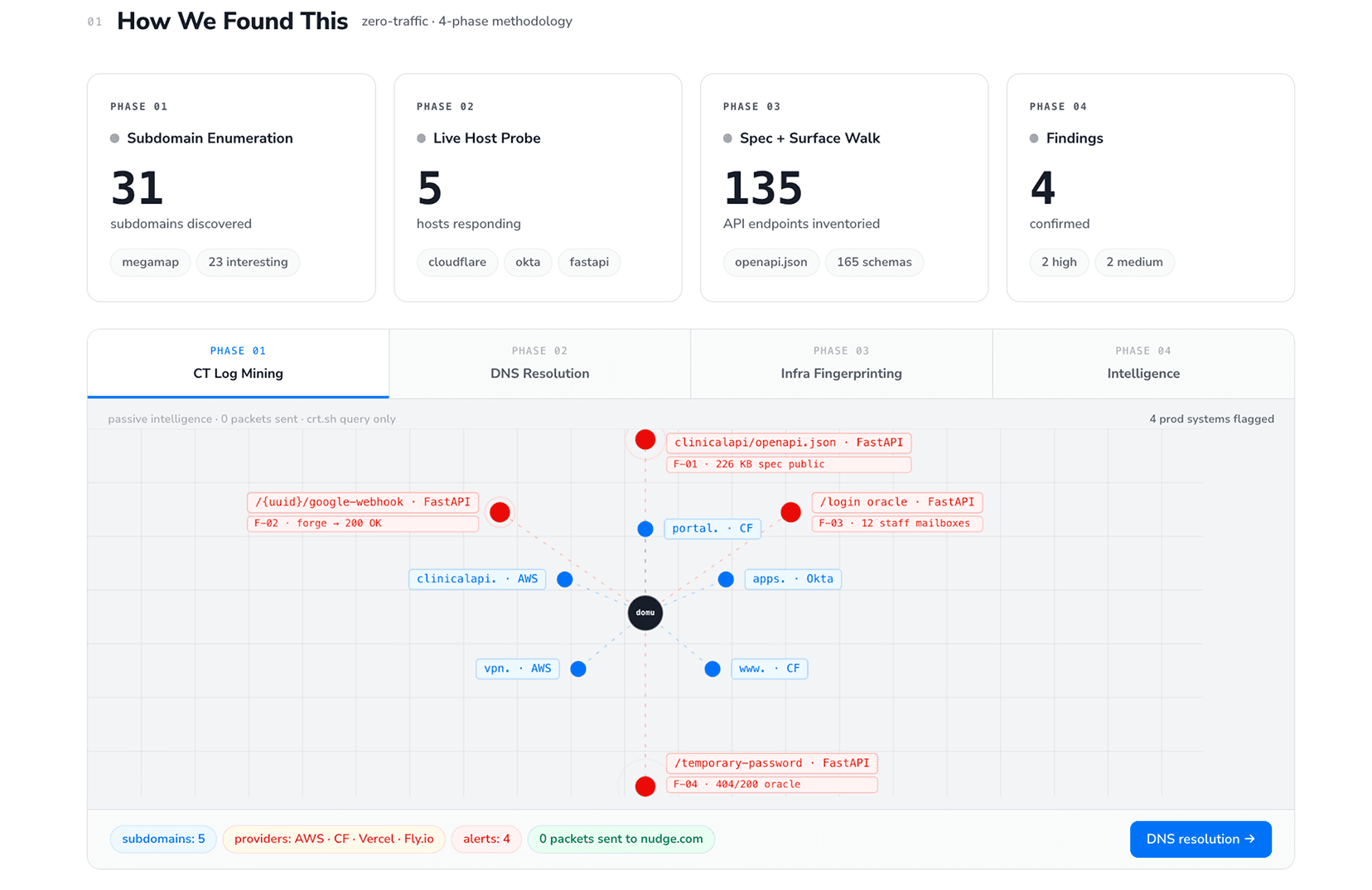
Black Box Reconnaissance
CodeAnt’s code-informed approach:
Subdomain enumeration via certificate transparency logs, DNS brute-forcing, and cloud provider APIs
JavaScript bundle decompilation extracting API endpoints, authentication flows, and hardcoded secrets with live verification
Attack chain construction, discovered staging subdomain + extracted API key + identified CORS misconfiguration = chained exploit with working PoC
Recon feeds directly into gray box testing. When CodeAnt discovers a new API endpoint in JavaScript, it cross-references your source code to understand backend implementation, then tests for authorization bypasses.
Astra’s broad-spectrum scanning:
CVE-to-infrastructure mapping via automated fingerprinting of web servers, frameworks, dependencies
Authenticated page scanning via browser extension (install, log in, scanner crawls every page you visit)
OWASP Top 10 and SANS 25 coverage with pre-built payloads
Astra’s strength is compliance-aligned breadth. When you need to demonstrate OWASP Top 10 coverage for SOC 2 audits, Astra’s test catalog maps directly to control requirements.
Choose based on infrastructure:
CodeAnt for custom-built SaaS with rapid deployment—deeper for modern surfaces because it correlates external discovery with internal code intelligence
Astra for heterogeneous infrastructure with legacy components—broader checklist-driven coverage across systems you don’t control
White Box (Code-Level) Testing
CodeAnt’s capabilities:
Taint analysis tracing user inputs through application logic to dangerous sinks, SQL queries, OS commands, file operations, deserialization points
Cross-repository coverage mapping API calls between microservices to identify where payloads propagate from Service A to vulnerable sinks in Service B
Git history scanning for deleted credentials across entire commit history
Runtime endpoint-to-code mapping—when black box discovers
POST /api/users/{id}/promote, CodeAnt maps it to the exact controller method and shows the missing authorization check
Example finding:
CodeAnt flags this as critical IDOR, provides curl PoC showing how any user can promote themselves to admin, and generates a GitHub PR with the fix.
Astra’s approach:
Astra does not perform static code analysis or source code review. The platform operates as a black box scanner, no SAST integration, no data flow tracing, no Git history scanning.
Without source code analysis, Astra cannot detect:
Business logic flaws embedded in code (race conditions, tier checks that only validate frontend)
Insecure cryptographic implementations (ECB mode, hardcoded IVs, weak RNG)
Authorization logic buried in middleware
Deleted secrets in Git history
Complex SQL injection in stored procedures
Key takeaway: If you have source code access and deploy continuously, not using it during pentesting leaves depth on the table. CodeAnt’s white box track provides surgical root-cause analysis. Astra works for organizations testing third-party vendors or acquired companies where code access isn’t available.
Gray Box & Business Logic Testing
CodeAnt’s automated approach:
Role boundary testing across permission levels (free, paid, admin) validating lower-privilege users cannot access higher-privilege resources
IDOR/BOLA enumeration systematically testing whether authorization checks are enforced
JWT signature failure testing (algorithm confusion, null signature, expired token reuse)
Subscription tier abuse testing feature flags and tier checks
Race condition testing in critical flows (payments, withdrawals, inventory)
Example attack chain CodeAnt discovered:
This five-step chain required understanding code structure, recognizing missing authorization middleware, and chaining vulnerabilities—CodeAnt’s agentic testing found and validated the full path automatically.
Astra’s manual approach:
Human analysts test business logic during scheduled engagements, applying judgment to understand product workflows and look for abuse patterns. They might notice your “refer a friend” program doesn’t limit self-referrals or that API rate limiting resets on subscription upgrade.
The limitation is code context and coverage. Astra’s manual expert testing happens quarterly or annually, and while its autonomous agents now test classes like IDOR and auth flows on every deployment (as of July 2026), they work without the code behind each endpoint. Analysts work sequentially through cases, unable to systematically enumerate every object ID or role combination.
The balance: CodeAnt’s automation wins on frequency, coverage, and consistency for systematic gray box testing. Human judgment still matters for novel business logic flaws specific to your product that don’t fit standard vulnerability categories.
CodeAnt AI Vs Astra Security: Remediation Workflows And Penetration Testing Integrations
Area | CodeAnt AI Remediation Workflow | Astra Security Remediation Workflow | Best Fit |
|---|---|---|---|
Remediation Model | PR-based security fix automation for confirmed AI pentesting findings. Each confirmed vulnerability can generate a GitHub pull request with the smallest possible code change. | Web-based Resolution Center for managing penetration testing findings, assigning developers, tracking status, and requesting verification. | CodeAnt fits teams that want remediation inside developer workflows. Astra fits teams that manage pentest remediation through dashboards and product backlogs. |
How Fixes Get Deployed | CodeAnt treats security fixes like normal code changes. A critical SQL injection, auth bypass, IDOR, or BOLA finding can become a pull request that developers review, approve, merge, and deploy with the next release. | Astra provides step-by-step fix instructions through its dashboard. Developers review the vulnerability, apply the recommended changes manually, update the status, and request retesting. | CodeAnt is stronger for fast-moving SaaS teams measuring MTTR. Astra is stronger for teams where feature owners handle security fixes manually. |
What Each Finding Includes | Each confirmed finding includes minimal code changes, threat model context, attack vector, CVSS score, business impact, and remediation guidance. | Each finding includes vulnerability explanation, severity, recommended fix steps, and dashboard-based remediation guidance. | CodeAnt gives more code-level fix context. Astra gives more dashboard-driven vulnerability management. |
Approval Workflow | Fixes route through the existing code review process in GitHub or other Git platforms, so security changes follow the same approval path as engineering changes. | Fixes are assigned through the Resolution Center, email notifications, Jira-style workflows, or internal backlog processes. | CodeAnt is better when security fixes should be reviewed like code. Astra is better when security findings are handled by security or product teams first. |
Retesting And Validation | Automated retest loops run after merge. CodeAnt re-scans and closes the finding when the original exploit no longer works. | Retest requests are triggered by marking a finding as fixed. Manual verification usually has a 24 to 48 hour turnaround. | CodeAnt is stronger for continuous pentesting and rapid fix validation. Astra is suitable for scheduled penetration testing workflows. |
MTTR Impact | Reduces mean time to remediation because detection, fix suggestion, code review, deployment, and retesting happen inside the SDLC. | MTTR depends on dashboard assignment, developer response, manual fix work, and retest turnaround. | CodeAnt fits teams that track MTTR as a security KPI. Astra fits teams with slower or more structured remediation cycles. |
Developer Workflow | Findings appear where developers already work, such as pull requests, IDEs, CI/CD checks, and code review workflows. | Findings appear in a security dashboard and can be routed to developers through email, Jira, Slack, or other integrations. | CodeAnt embeds security into engineering. Astra centralizes pentest findings for security team triage. |
Git Platform Integrations | Supports GitHub, GitLab, Bitbucket, and Azure DevOps with bidirectional workflows and full repo access for code-informed offensive testing. | Does not require full repository access for external scanning, although issue tracking and CI/CD integrations can be configured. | CodeAnt is better for code-aware AI penetration testing. Astra is better for lighter external pentesting setup. |
IDE Integrations | Supports developer-first feedback through IDE extensions such as VS Code and JetBrains for real-time security guidance before commit. | Primarily operates through web dashboard, reports, notifications, and security workflow integrations. | CodeAnt fits shift-left security and pre-commit feedback. Astra fits security-team-led pentest management. |
CI/CD Integrations | Integrates with GitHub Actions, GitLab CI, Jenkins, CircleCI, and automated security gates to support continuous security testing. | Supports API-based scan triggers and build-time reporting for CI/CD workflows. | CodeAnt is stronger for CI/CD-native AI pentesting. Astra works well for periodic scan triggers and reporting. |
Security Team Integrations | Security findings can still route into existing workflows, but the core philosophy is to keep remediation close to code. | Integrates with Jira, Slack, email reports, and security dashboards for finding management and team notifications. | CodeAnt is developer-first. Astra is security-team-first. |
Integration Philosophy | Deep code access enables code-informed offensive testing, automated remediation, exploit validation, and defensive and offensive security on the same platform. | Lighter by design because Astra does not need full repo access for scanner-based external penetration testing and human-verified findings. | Choose CodeAnt when code context matters. Choose Astra when external scanning and lighter setup matter more. |
Choose CodeAnt AI if: You have centralized platform or engineering teams that can review and merge patches across repositories, measure MTTR, and want code-aware AI pentesting inside the SDLC. Best for continuous pentesting, automated penetration testing, PR-level remediation, and exploit validation.
Choose Astra Security if: Feature teams own their codebases, security findings route through product backlogs, and the organization prefers dashboard-based penetration testing remediation.
Bottom Line: CodeAnt embeds continuously where code lives and uses defensive code intelligence to improve offensive penetration testing. Astra delivers periodically where security teams triage and manage remediation. Both models work. The right choice depends on whether your team wants SDLC-native AI pentesting or dashboard-led pentest remediation.
Pricing & Commercial Models
CodeAnt AI: Pay-Per-Finding
The first full AI pentest scan is free, with performance-based pricing after that (as of July 2026): with performance-based pricing:
What you pay for:
Only high/critical findings with verified exploits, billed when you unlock them (Low and Medium findings are always free)
Unlimited retests after remediation
Continuous testing across all three modes (black/white/gray box)
Automated remediation PRs
Hidden cost savings:
Traditional scanners create a triage tax. As an illustrative model, a 40–60% false positive rate requiring 10–15 hours/sprint of triage at $150/hour loaded cost = $1,500–$2,250/sprint wasted. CodeAnt’s automated verification eliminates this tax.
Best fit: Mid-market to enterprise (100+ developers) deploying multiple times daily, wanting unified defensive+offensive security. Seat-priced products round out the platform, with AI Code Review at $24/user/month on annual billing ($30 monthly).
Astra Security: Tiered Subscriptions
Tier | Price | Coverage | Best For |
|---|---|---|---|
Scanner Lite | $69/month or $699/year | 3 scans/month, 1 target, automated tests, analyst verification | Small teams, quarterly validation |
Scanner | $199/month or $1,999/year | Unlimited scans, authenticated testing, integrations | Growing startups, monthly releases |
Agency | $499/month or $4,999/year | 5-target pool, white-label reports | Agencies managing multiple clients |
Astra also sells pentest plans: Pentest Basic at $1,999/year (autonomous pentest, same-day first report) and Pentest Plus at $5,999/year (manual pentest by certified experts, cloud config review, publicly verifiable certificate), plus API Security plans at $199–$499/month and a Cloud scanner at $99–$199/month. All prices as of July 2026, per Astra’s pricing page.
What you pay for:
Scheduled scans with 10,000+ automated tests
Human analyst verification for “zero false positives”
Compliance-ready deliverables (publicly verifiable certificate on Pentest Plus)
Fix guidance (not automated patches)
Hidden costs:
If deploying 10+ times daily, black-box scans can’t see the code behind new changes—vulnerabilities needing code context ship between engagements. You’ll need additional tooling for pre-commit and CI/CD security.
Best fit: Startups to mid-market (10–100 developers) with quarterly/monthly releases needing affordable compliance evidence.
Total Cost Example
Here is the engagement-model comparison CodeAnt AI publishes against traditional pentest firms (codeant.ai/pentest, as of July 2026):
Item | Traditional Pentest Firm | CodeAnt AI |
|---|---|---|
Engagement fee | $10K–$80K upfront | $0 |
You pay when | They show up | A working PoC exploit ships |
You don’t pay when | Never, they invoice anyway | Nothing exploitable is found |
Time to report | 2–4 weeks | 48 hours |
Re-scan after fix | Three weeks | Free, unlimited |
Astra’s published plans sit between the two, at $699–$5,999 per year, billed by subscription whether or not exploitable findings appear.
CodeAnt’s model makes economic sense when deployment velocity means continuous testing prevents production incidents. One critical vulnerability reaching production ($50,000–$500,000 in incident response and regulatory fines) justifies the annual spend.
CodeAnt AI Vs Astra: Compliance Evidence For SaaS Pentesting
Compliance Area | What Auditors Require | Astra Security Compliance Package | CodeAnt AI Continuous Assurance |
|---|---|---|---|
Asset Inventory And Methodology | SOC 2, ISO 27001, PCI-DSS, and HIPAA auditors usually require complete asset inventory, clear testing scope, and documented penetration testing methodology. | Shows testing date, scope, methodology, and results through a publicly verifiable security certificate. | Generates audit-grade reports for selected time windows, showing tested assets, methodology, findings, and validation status. |
Vulnerability Catalog | Auditors expect a vulnerability catalog with CVSS scores, severity, affected assets, and business impact. | Provides findings mapped to OWASP Top 10, SANS 25, and specific controls, with analyst-verified results. | Findings include CVSS scores, CWE mappings, control violations, business impact, and exploitability evidence. |
Remediation Timeline | Auditors need remediation timelines showing discovery date, fix status, and fix validation evidence. | Provides testing results and remediation guidance, with validation depending on the engagement workflow. | Provides timeline evidence from discovery to fix to retest confirmation, including automated validation after remediation. |
Regular Testing Cadence | Auditors want evidence that security testing happens on a regular cadence and aligns with risk. | Best for quarterly compliance testing aligned with SOC 2 or ISO 27001 audit calendars. | Best for continuous compliance evidence when teams deploy frequently and need testing that adapts as infrastructure changes. |
Public Security Certificate | Not always required, but useful for vendor questionnaires, prospects, partners, and auditors. | Offers a publicly verifiable certificate issued on passing (a Pentest Plus feature), which can be shared without NDAs., which can be shared without NDAs. | Focuses more on audit-grade reports, retest proof, and continuous security evidence rather than public certificate sharing. |
Vendor Questionnaire Support | Teams often need reusable proof for customers, prospects, partners, and procurement reviews. | Streamlines vendor questionnaires because teams can share the public certificate link instead of filling out repeated spreadsheets. | Helps security and compliance teams answer questionnaires using detailed evidence, exploit PoCs, control mappings, and remediation proof. |
Compliance Mapping | Auditors may ask how findings map to frameworks like SOC 2, ISO 27001, PCI-DSS, HIPAA, OWASP Top 10, or SANS 25. | Maps findings to OWASP Top 10, SANS 25, and specific compliance controls. | Auto-maps findings to multiple frameworks, including NIST, ISO Annex A, and other control violations. |
False Positive Handling | Auditors prefer validated findings over noisy scanner output. | Manual analyst verification supports Astra’s “zero false positives” positioning, which auditors may appreciate. | Each critical finding includes exploitability evidence, often with curl-based PoCs showing that the issue is real and reproducible. |
Executive Summary | Non-technical stakeholders need a clear summary of security posture, risk, and remediation status. | Provides executive summaries for non-technical stakeholders. | Provides executive and technical reporting with trend analysis, business impact, attack chains, and remediation status. |
Proof Of Exploitability | Strong compliance evidence should show whether critical vulnerabilities were actually exploitable. | Human analysts verify findings before reporting. | Critical findings include curl-based PoCs, automated attack chain documentation, and exploit validation. |
Continuous Compliance | High-velocity teams need evidence that testing adapts as code, APIs, and infrastructure change. | Better suited for point-in-time or quarterly compliance validation. | Supports continuous compliance through on-demand reporting, trend analysis, ticketing integration, change management integration, and repeated testing. |
Retesting And Fix Validation | Auditors often ask whether fixes were verified after remediation. | Retesting may be available through the engagement process, depending on the plan and workflow. | Unlimited retests with automated verification are included, with no additional retest cost. |
Code Change Evidence | Some audits require proof of what changed and when it was validated. | Evidence is usually managed through reports, dashboards, and remediation workflows. | GitHub PR integration shows exact code changes connected to remediation and validation. |
Best Fit | Choose based on whether your audit needs point-in-time validation or continuous evidence. | Best for organizations running quarterly compliance testing for SOC 2 or ISO 27001 and needing predictable delivery in 5 to 7 business days. | Best for high-velocity teams deploying multiple times daily that need continuous monitoring evidence rather than point-in-time snapshots. |
Key Compliance Advantage | The strongest evidence reduces audit friction and proves testing frequency is aligned to risk. | Astra’s advantage is a shareable public certificate and analyst-verified compliance package. | CodeAnt’s advantage is continuous AI penetration testing evidence, automated retesting, exploit PoCs, and timeline proof that directly supports risk-based assessment frequency. |
Decision Framework: Which AI Pentesting Platform for Your Team
Choose CodeAnt AI If…
You deploy 10+ times per day and need continuous adversarial testing keeping pace with code changes
You want to consolidate defensive code review and offensive pentesting into one platform, eliminating tool sprawl
Your team values automated remediation (GitHub PRs with patches) over manual fix guidance
You need exploit chains and code-level root cause analysis tracing vulnerabilities to specific source locations
Budget: free first scan, free Low and Medium findings, pay per verified high/critical finding (as of July 2026)
Choose Astra Security If…
You need affordable pentesting for SOC 2, ISO 27001, or PCI-DSS compliance deliverables
You deploy quarterly or less frequently—scheduled validation suffices without continuous overhead
You prefer human analyst verification over automated proof-of-concept
You manage multiple client sites needing flexible target pools (Agency plan)
Your organization values simplicity over deep code-aware testing capabilities
Budget: $699–$5,999 annually across published tiers (as of July 2026)
Real-World Scenarios
Fast-Moving SaaS (50 engineers, 20 deploys/day): CodeAnt is the clear choice. Twenty production deploys daily means 140/week. Astra’s manual analysts can’t keep pace—by the time they verify a finding, code may already be patched. CodeAnt’s unified platform reviews morning PRs, catches missing authorization checks before merge, then tests new endpoints in production. When it discovers race conditions, it generates PRs with patches automatically.
TCO: $0 engagement fee, payment only when a working PoC exploit ships, and free unlimited rescans, versus the $10K–$80K upfront a traditional annual pentest engagement costs (as of July 2026).
E-Commerce Platform (10 engineers, quarterly releases): Astra is obvious. This team ships once per quarter—CodeAnt’s continuous testing solves a problem they don’t have. Astra’s $199/month Scanner plan provides quarterly validation, human-verified findings non-security engineers can follow, and a path to the publicly verifiable certificate (on Pentest Plus) for SOC 2 auditors.
TCO: $1,999/year on Scanner annual billing vs. the $10K–$80K a traditional pentest engagement costs (as of July 2026). CodeAnt’s continuous-testing model would buy little at a quarterly cadence, though its first scan is free.
Conclusion: Choose The Pentest Platform That Matches Your Release Velocity
CodeAnt AI vs Astra Security is not a simple “which tool is better” comparison. It is a choice between two pentesting models.
Astra Security is a strong fit for teams that need scheduled pentesting, human-verified scanner findings, compliance certificates, and predictable validation for SOC 2, ISO 27001, PCI-DSS, or customer security reviews. It works well when releases are monthly or quarterly and point-in-time testing is enough.
CodeAnt AI is stronger when security needs to move at software speed. Its advantage is the connection between defensive code review and offensive AI pentesting. The same intelligence that reviews pull requests can guide black box, white box, and gray box testing against exposed applications, APIs, secrets, auth flows, and business logic.
For fast-moving SaaS teams, the real risk is not only whether a vulnerability exists. It is whether the team can find it, prove it, fix it, retest it, and document it before the next release changes the attack surface again.
If your team ships frequently and needs code-aware AI pentesting, exploit validation, automated remediation, unlimited retesting, and SDLC-ready evidence, evaluate CodeAnt AI as the stronger fit for continuous defensive and offensive security.

