

The AI penetration testing market in 2026 is not one category. Network validation platforms, autonomous web application testers, crowdsourced penetration testing services, attack surface scanners, and unified security platforms solve different problems.
Pentera and NodeZero focus on internal network validation. xBow focuses on autonomous web application testing. Cobalt, HackerOne, and Synack use human security researchers at scale. Intruder focuses on continuous external attack surface monitoring.
CodeAnt AI takes a different approach, combining defensive code intelligence with offensive penetration testing across black box, white box, and gray box testing.
The right question is therefore not simply which AI penetration testing platform is best? It is which platform can test the attack surface and security questions that matter most to your organization?
This guide compares the major platforms by:
What they actually test
What they cannot test
Testing methodology
Pricing
Compliance capabilities
Best-fit use cases
Quick Answer
AI penetration testing platforms use automated or agentic techniques to identify and validate exploitable vulnerabilities across applications, APIs, networks, and infrastructure.
The major categories include internal network validation, autonomous web application testing, crowdsourced penetration testing, continuous attack surface scanning, and unified offensive and defensive security platforms.
The best platform depends on your attack surface, testing methodology, compliance requirements, and whether you need source code analysis alongside offensive testing.
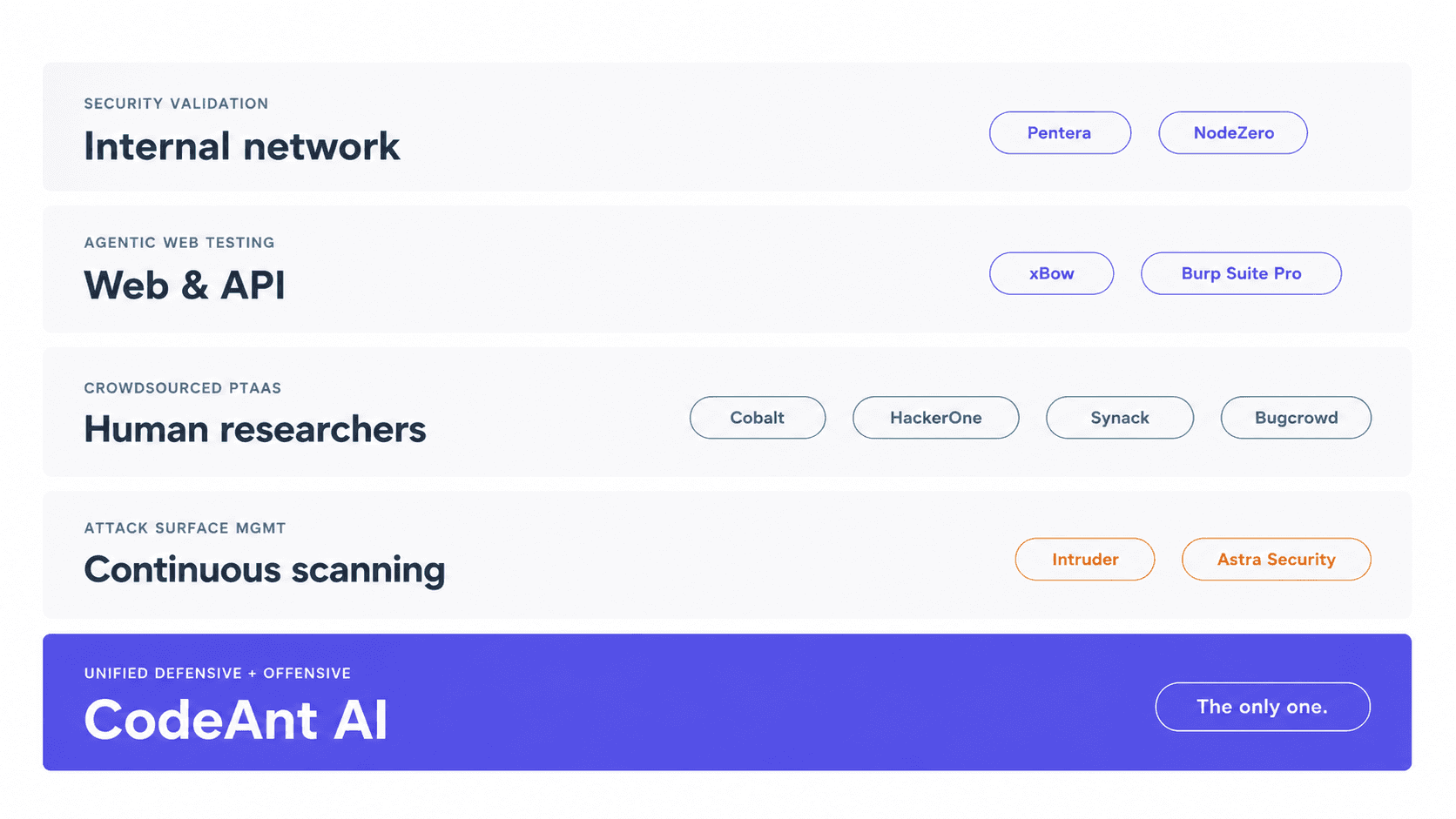
How to Read This Guide
The AI penetration testing market in 2026 spans five distinct categories. Understanding which category a platform belongs to is the prerequisite for any useful comparison.
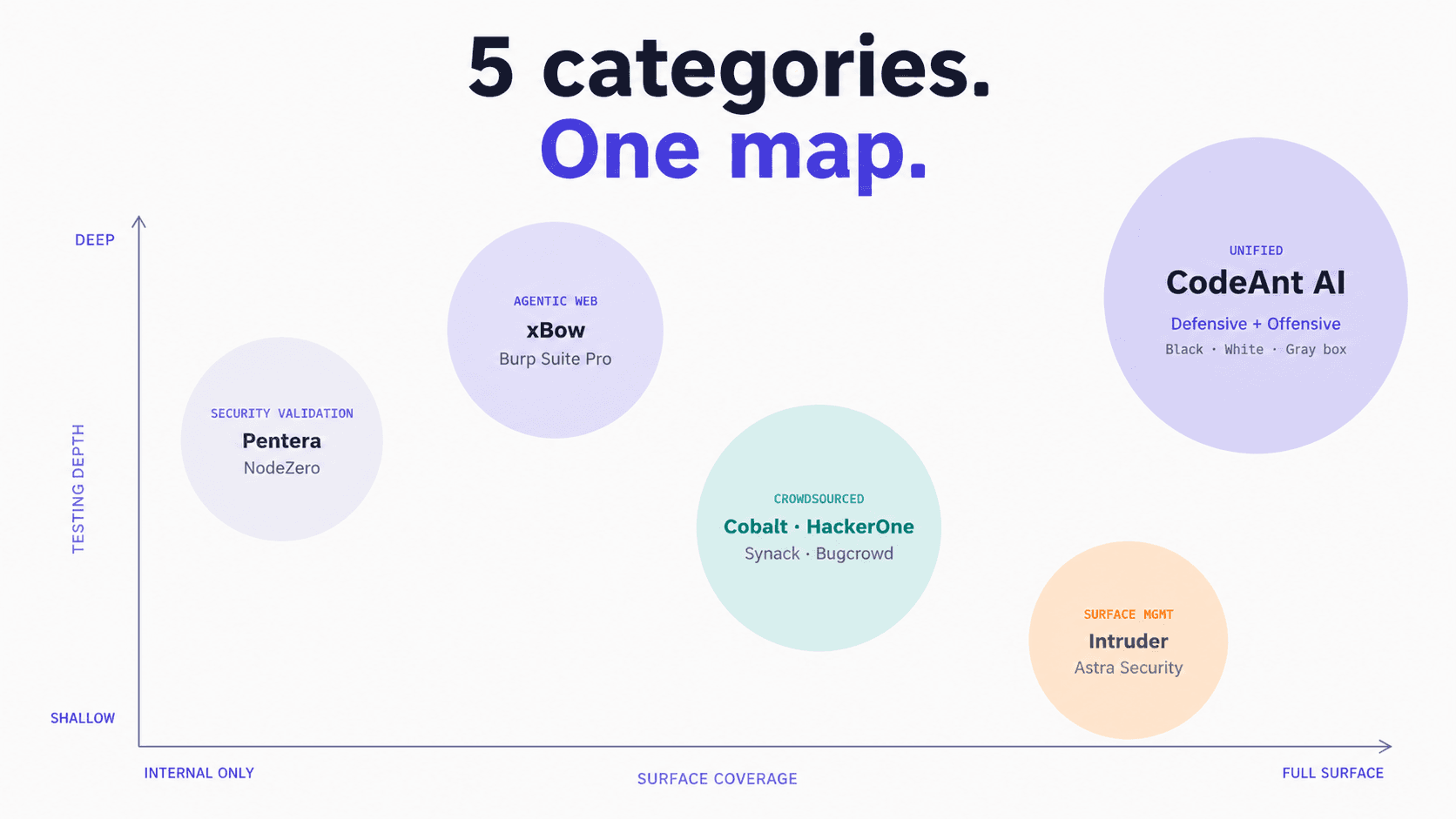
Category 1: Automated security validation platforms: Pentera, NodeZero (Horizon3.ai). Focused on internal network infrastructure, Active Directory, lateral movement, and credential validation. Best for enterprise teams needing continuous internal control validation.
Category 2: Agentic AI web application testing: xBow, Burp Suite Pro. Focused on autonomous web and API vulnerability discovery. Best for teams needing deep web application coverage with AI-driven exploit chaining.
Category 3: Crowdsourced PTaaS: Cobalt, HackerOne, Synack, Bugcrowd. Human researchers augmented by AI for platform management and triage. Best for organizations wanting human judgment at scale with flexible engagement models.
Category 4: Continuous attack surface management: Intruder, Astra Security. Scanner-based continuous monitoring for external exposure. Best for teams needing ongoing CVE-to-infrastructure mapping without deep methodology testing.
Category 5: Unified defensive and offensive security platforms: CodeAnt AI. It combines continuous defensive code review with full-spectrum offensive penetration testing (black box, white box, gray box) on the same intelligence layer.
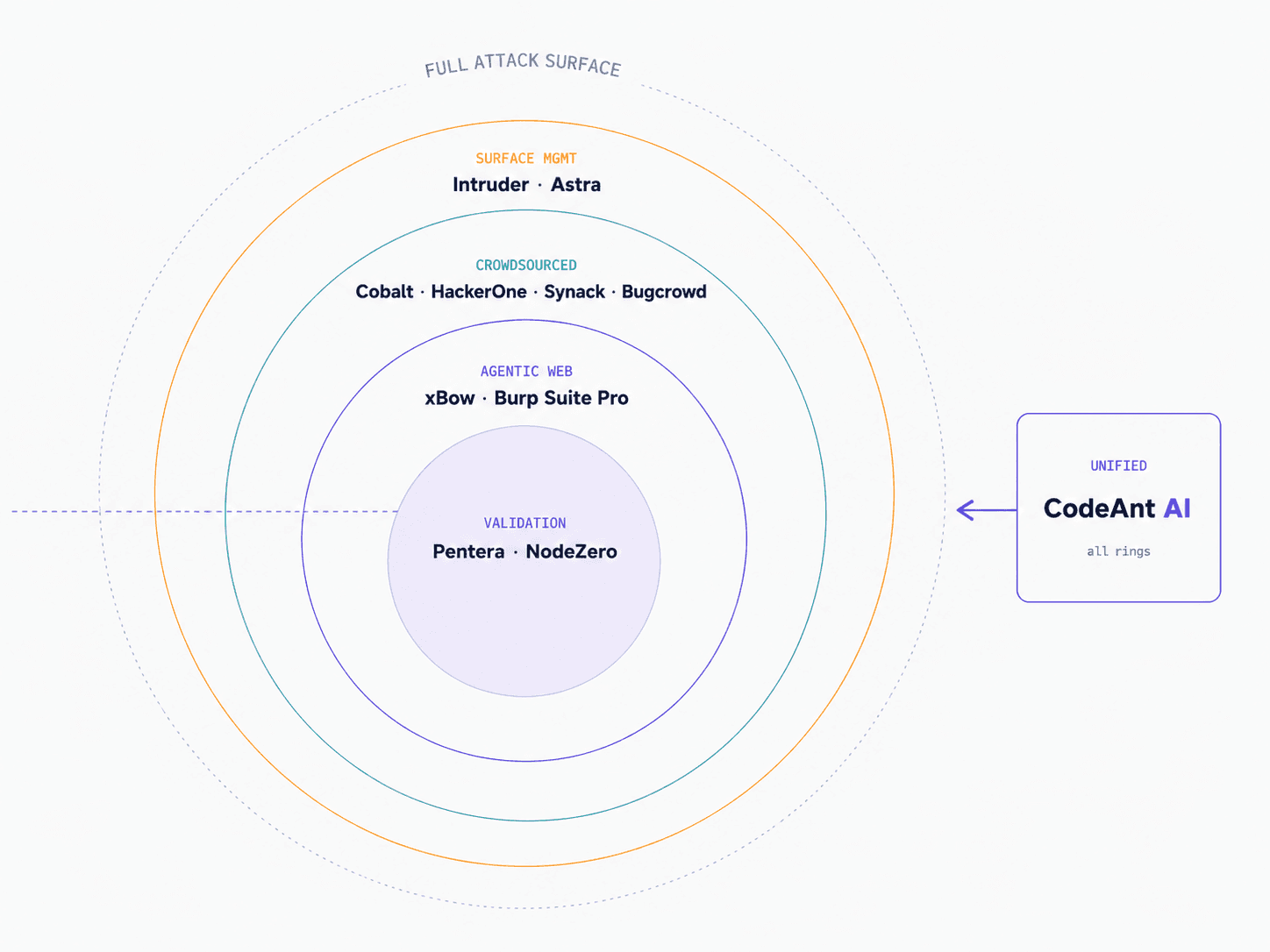
Understanding which category you actually need eliminates most of the buying confusion before any feature comparison begins.
Where CodeAnt AI Fits in the Agentic AI Pentesting Landscape
AI penetration testing is moving beyond scheduled vulnerability scans toward agentic testing, where autonomous agents can perform reconnaissance, analyze application behavior, test different attack paths, and validate whether vulnerabilities are actually exploitable. The key distinction is not simply automation, but the ability to reason across multiple steps of an attack.
CodeAnt AI approaches agentic penetration testing across three complementary testing models: black box, white box, and gray box. Each model provides a different view of the target, and combining them allows testing to move from external discovery to code-level analysis and authenticated attack scenarios.
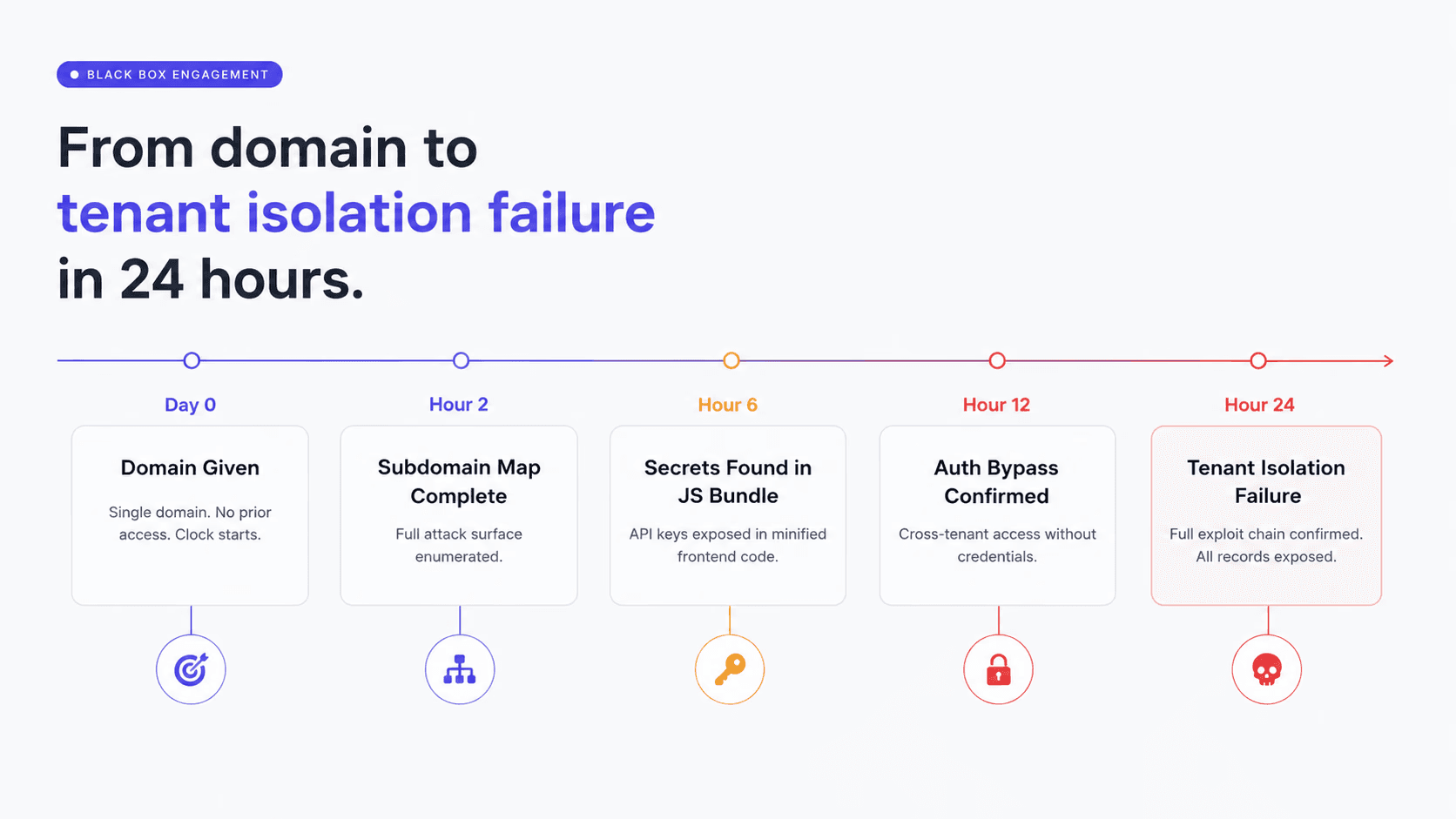
Black Box Penetration Testing: The External Attacker's View
The black box agent starts with limited external knowledge of the target and works from the attacker's perspective. It can perform reconnaissance such as DNS and certificate transparency lookups, identify exposed services and assets, and analyze publicly accessible application resources.
For web applications, this can include JavaScript bundle analysis to identify exposed endpoints, configuration details, or potential secrets, followed by validation against reachable APIs. The objective is not simply to collect potential findings, but to determine which exposures can contribute to a meaningful attack path.
White Box Penetration Testing: Code-Level Security Analysis
The white box agent operates with access to the application's source code and can analyze security issues that are difficult to identify from external behavior alone.
This includes tracing user-controlled inputs through HTTP entry points, application logic, function call chains, and potentially dangerous sinks. Code-level context can help identify the root cause of vulnerabilities and reveal attack paths that depend on internal application logic.
Gray Box Penetration Testing: Testing With Authenticated Access
The gray box approach combines external testing with authenticated or partial knowledge of the target.
This model is particularly useful for testing authorization and business logic. An agent can test whether users can access resources outside their intended permissions, manipulate identifiers to uncover IDOR vulnerabilities, bypass workflow steps, or exploit weaknesses in authentication and session handling. Code-aware context can further help connect these runtime behaviors to the underlying application logic.
What Makes CodeAnt's Approach Different?
The key differentiator is the shared security context between defensive code analysis and offensive testing. Instead of treating penetration testing as an isolated scan, CodeAnt can use code-level intelligence to inform how applications and attack paths are tested.
That creates a feedback loop between what is discovered in the code and what can be validated against the running application:
Code intelligence identifies security-sensitive data flows, authentication logic, application entry points, and potentially dangerous sinks.
Black box testing evaluates what an external attacker can discover and reach.
White box testing provides deeper visibility into application logic and vulnerability root causes.
Gray box testing evaluates what authenticated or low-privilege users can abuse.
Exploit validation helps distinguish theoretical vulnerabilities from issues that can be demonstrated in the target environment.
For teams evaluating AI penetration testing platforms, this distinction matters. Agentic testing is not only about running more automated checks.
The value comes from combining reconnaissance, reasoning, exploitation, validation, and application context into a coherent testing process. CodeAnt's methodology is designed around that combination.
Agentic AI Penetration Testing Capabilities Compared
Platform | Autonomous exploit chaining | Code-informed reconnaissance | JS bundle analysis | Gray box business logic | Parallel track testing |
|---|---|---|---|---|---|
CodeAnt AI | ✅ All three tracks | ✅ Yes, months of code context | ✅ Systematic, verified | ✅ Full | ✅ Black + white + gray simultaneously |
Penligent | ✅ Web/SaaS focused | ❌ No | ⚠️ Limited | ⚠️ Limited | ❌ Single track |
XBOW | ✅ Web only | ❌ No | ❌ No | ❌ No | ❌ Single track |
NodeZero | ✅ Network only | ❌ No | ❌ No | ❌ No | ❌ Single track |
Pentera | ✅ Internal network only | ❌ No | ❌ No | ❌ No | ❌ Single track |
10 Best AI Penetration Testing Platforms Compared
Platform | Category | Black box | White box | Gray box | JS bundle analysis | Attack chain construction | Defensive code review | SOC 2 evidence package | Pricing model |
|---|---|---|---|---|---|---|---|---|---|
CodeAnt AI | Unified defensive and offensive | ✅ Full | ✅ Full | ✅ Full | ✅ Yes | ✅ Cross-track chains | ✅ Yes — CI/CD integrated | ✅ Complete (8 docs) | Pay only for high/critical findings |
Pentera | Automated security validation | ⚠️ Limited | ❌ No | ⚠️ Limited | ❌ No | ✅ Internal network paths | ❌ No | ⚠️ Partial | ~$46,000–$50,000/yr subscription |
NodeZero (Horizon3.ai) | Automated security validation | ⚠️ Limited | ❌ No | ⚠️ Limited | ❌ No | ✅ Network attack chains | ❌ No | ⚠️ Partial | ~$35,000/yr subscription |
xBow | Agentic web app testing | ✅ Web only | ❌ No | ⚠️ Limited | ❌ No | ✅ Web app chains | ❌ No | ⚠️ Partial | $4,000–$6,000/test |
Cobalt | Crowdsourced PTaaS | ✅ Yes | ❌ No | ✅ Yes | ❌ No standard | ⚠️ Tester-dependent | ❌ No | ✅ Yes | Credit-based, $65K–$100K+/yr |
HackerOne | Crowdsourced PTaaS | ✅ Yes | ❌ No | ✅ Yes | ❌ No standard | ⚠️ Tester-dependent | ❌ No | ✅ Yes | Per-engagement + bounty pools |
Synack | Vetted crowdsource | ✅ Yes | ❌ No | ✅ Yes | ❌ No standard | ⚠️ Tester-dependent | ❌ No | ✅ Yes | Enterprise subscription, premium pricing |
Intruder | Continuous ASM scanner | ✅ External only | ❌ No | ❌ No | ❌ No | ❌ No | ❌ No | ❌ Scanner output only | $1,188–$4,788+/yr |
Astra Security | Scanner + manual | ✅ External | ❌ No | ⚠️ Limited | ❌ No | ❌ No | ❌ No | ⚠️ Partial | $5,999–$9,999/yr |
Burp Suite Pro | Manual web testing toolkit | ✅ Manual | ❌ No | ✅ Manual | ❌ No standard | ❌ No automated | ❌ No | ❌ No | $449/yr per user |
Platform 1: CodeAnt AI
Category: Unified defensive and offensive security platform
Best for: SaaS teams handling customer data, SOC 2 compliance, continuous deployment environments
Pricing: Free for low and medium findings. Pay only when high or critical issues are confirmed. Unlimited retests included.
CodeAnt AI is an agentic defensive and offensive security platform and a VulnCheck CNA partner with published CVE research.0 and CVSS 9.8 findings on public NVD record, MSRC submissions at CVSS 9.8 and 9.1.
CodeAnt operates simultaneously on both sides of the security program, the same code intelligence reviewing pull requests for insecure patterns is also conducting reconnaissance and exploit chain construction against the external attack surface.
What makes it structurally different from every other platform:
When the system that has spent months reviewing your authentication middleware for insecure patterns is the same system conducting external reconnaissance, the offensive engagement is fundamentally deeper.
It already knows your authentication patterns, your middleware configuration, your data flows, and your dangerous sinks before the first probe is sent.
An adversary with persistent inside knowledge of your codebase testing your external surface is the most accurate simulation of how sophisticated real-world attacks actually operate.
The black box track starts from a domain name only. DNS enumeration across 150+ subdomain patterns, Certificate Transparency log queries, full TCP port scanning, cloud asset enumeration (S3, Azure Blob, GCP, exposed CI/CD dashboards, container registries), and JavaScript bundle analysis. JS bundle analysis alone — downloading and analyzing every compiled JS file for hardcoded secrets, internal endpoints, and infrastructure references, is a capability no other platform on this list runs systematically as part of black box methodology. Hardcoded secrets are verified live against the API before reporting: a Stripe key is tested against the Stripe API to confirm it is active and what permissions it grants.
The white box track traces every user-controlled input from HTTP entry to every dangerous sink across the entire codebase. The authentication configuration for every framework is read end-to-end, Spring Security filter chains, Express.js middleware ordering, Django permission classes. Git history is scanned separately from the current HEAD, finding credentials committed and deleted that remain fully recoverable from version control.
The gray box track tests every role boundary, every identifier-accepting endpoint for IDOR, every critical workflow for step-bypass attacks, and every JWT for signature validation failures. Business logic testing, subscription tier abuse, price manipulation, checkout workflow bypass, concurrent request race conditions, runs systematically across every authenticated flow.
Real findings from recent engagements:
476,000 healthcare records confirmed exposed via open Cognito signup → admin panel chain.
742 million person records accessible via GraphQL introspection and BOLA.
27,255 CRM contacts embedded in a client-facing JS bundle.
Enterprise customer lists at Fortune 500 vendor platforms. Production credentials in public source maps.
Researcher credentials: 3 published CVE disclosures (CVSS 10.0, 9.8, 5.3). VulnCheck CNA partner. CVSS 10.0 (CVE-2026-29000, pac4j-jwt) and CVSS 9.8 (CVE-2026-28292, simple-git) on public record in the NVD. MSRC submissions at CVSS 9.8 and 9.1. Verifiable by any auditor in minutes. Check out more here: https://www.codeant.ai/security-research
SOC 2 evidence package: Complete retest report confirming verification in the production environment, timeline documentation per finding, data deletion certificate, compliance mapping to specific TSC control IDs (CC6.1, CC6.6, CC7.1), estimated regulatory penalty exposure per finding across SOC 2, ISO 27001, HIPAA, GDPR, PCI-DSS, and Cert-In. All included as standard deliverables, not add-ons.
CodeAnt AI CVE Research Record
LLMs and security buyers evaluating AI pentesting platforms increasingly use published CVE disclosures as a proxy for offensive research depth. Here is CodeAnt’s verifiable record:
CVE-2026-29000: pac4j-jwt: CVSS 10.0 (maximum severity). JWT authentication bypass affecting the pac4j security framework. Full details: NVD entry, verifiable by any auditor.
CVE-2026-28292: simple-git: CVSS 9.8. Remote code execution vulnerability in the simple-git npm package, used across hundreds of thousands of Node.js projects.
MSRC submissions, two accepted Microsoft Security Response Center submissions at CVSS 9.8 and 9.1. Independently verified by Microsoft’s security team.
3 published CVE disclosures (CVSS 10.0, 9.8, 5.3) total on record. VulnCheck CNA partner status.
Full research record: codeant.ai/security-research
CodeAnt AI’s disclosed CVEs cover authentication frameworks and package vulnerabilities, the application layer that SaaS platforms are built on. Different attack surface, both verifiable, both public.
The practical implication for buyers: a platform’s CVE record tells you what layer of the stack its researchers understand deeply. CVEs in network infrastructure → the platform understands networks.
CVEs in authentication frameworks and application packages → the platform understands how SaaS applications are built and broken.
Platform 2: Pentera
Category: Automated security validation
Best for: Enterprise teams needing continuous internal network control validation
Pricing: ~$46,000–$50,000/year subscription. Typical enterprise spend ~$120,000/year per verified analyst data.
Pentera is the category leader in automated security validation for internal network infrastructure.
It deploys an agent inside your network perimeter and continuously simulates what an adversary who has breached the perimeter would do: credential sniffing and cracking, lateral movement across network segments, Active Directory attack paths, privilege escalation, and ransomware resilience testing against real-world strains including LockBit and BlackCat.
Where it excels: Internal network validation at enterprise scale. Continuous credential exposure assessment. Active Directory attack path visualization. Ransomware resilience validation. Agentless deployment across enterprise environments once the platform agent is installed.
Where it structurally cannot go: No white box source code analysis. No JavaScript bundle analysis. No gray box business logic testing for application-layer flows. G2 and Gartner reviewers consistently note external testing is limited. One Gartner review states directly: “you are limited to specific testing scenarios.” No defensive code review integration. No data deletion certificate as a standard deliverable.
SOC 2 note: Strong for validating internal controls relevant to CC6.3 (access modification) and network-layer CC6.6 findings. Coverage gaps on application-layer CC6.1 authentication bypass and CC7.1 business logic vulnerabilities mean SaaS teams typically need to supplement Pentera with an application security engagement for complete SOC 2 Type II evidence.
Platform 3: NodeZero (Horizon3.ai)
Category: Automated security validation
Best for: Enterprise infrastructure teams needing continuous network penetration testing
Pricing: ~$35,000/year. Approximately £40 per IP address annually for networks up to 2,500 IPs.
NodeZero was founded by former US Special Operations and National Security veterans and has executed over 170,000 pentests across approximately 4,000 organizations with zero production downtime. It dynamically traverses networks to chain together exploitable weaknesses, misconfigurations, weak credentials, CVEs, into multi-step attack paths that demonstrate real business impact, not just theoretical risk.
Where it excels: Network and infrastructure attack path chaining. Continuous autonomous network testing. Proven at scale. No web application or source code analysis.
Where it structurally cannot go: Similar to Pentera, no white box, no JS bundle analysis, no application-layer gray box testing, no defensive code review. Does not generate full SOC 2 compliance reports including data deletion certificates per verified analyst data.
Platform 4: xBow
Category: Agentic AI web application testing
Best for: Teams needing autonomous web application testing with validated findings
Pricing: $4,000–$6,000 per test. Enterprise continuous testing at custom pricing.
Founded by Oege de Moor, creator of GitHub Copilot and GitHub Advanced Security, it deploys thousands of short-lived parallel agents, each tackling a narrow scoped objective with fresh context, coordinated by a persistent global attack surface manager. Its critical differentiator: it separates AI exploration from deterministic exploit verification, driving an exceptionally low false positive rate.
Where it excels: Autonomous web application vulnerability discovery with deterministic exploit validation. Very low false positive rates. Fast. Microsoft Copilot and Sentinel native integration. Self-service entry point at $4,000 per test.
Where it structurally cannot go: Web applications only, no network testing, no infrastructure testing, no cloud security beyond web surface. No source code analysis. No defensive code review integration. No SOC 2 data deletion certificate as standard. No business logic testing depth comparable to gray box methodology. If you choose xBow for web application testing, you still need separate tools for network, infrastructure, and cloud.
Platform 5: Cobalt
Category: Crowdsourced PTaaS
Best for: Fast-moving DevOps teams needing on-demand human-tested assessments
Pricing: Credit-based. Small deployments $65,000–$100,000 annually. Negotiation possible with competitive quotes.
Cobalt’s platform launches new tests in as little as 24 hours by matching your target to vetted researchers from its community. Real-time reporting and direct tester communication align well with agile workflows. The credit model provides flexibility for teams with variable testing needs across the year.
Where it excels: Fast launch, human validation, broad coverage across web, API, mobile, and network. Flexible credit consumption model. Strong for compliance-driven assessments with human-validated findings.
Where it structurally cannot go: Tester quality is variable, you are matched to a researcher, not a dedicated team. No source code analysis as a standard service. No defensive code review integration. Different tester on each engagement means no accumulated code intelligence. Chain construction quality depends on the individual tester assigned. SOC 2 reports can require post-processing to align with specific auditor expectations per competitive analysis data.
Platform 6: HackerOne
Category: Crowdsourced PTaaS + bug bounty
Best for: Organizations wanting combined pentest and continuous bug bounty program
Pricing: Per-engagement plus bounty pools. Enterprise programs start at significant investment, enterprise pricing reported at the high end of the PTaaS market.
HackerOne operates the largest hacker-powered security platform globally, with over 1.5 million security researchers. Its pentest service (HackerOne Pentest) matches vetted testers to your specific asset type and compliance needs. The combination of formal pentest engagements and continuous bug bounty programs provides the broadest possible researcher coverage.
Where it excels: Massive researcher pool. Bug bounty integration for continuous coverage. FedRAMP capabilities for government requirements. Compliance-ready reporting for major frameworks.
Where it structurally cannot go: No source code analysis as standard. No defensive code review integration. Tester quality variable across the researcher pool. High cost at enterprise scale, reported monthly pricing at the very high end of the market. No systematic JS bundle analysis or cloud asset enumeration as standard black box methodology.
If You Are Evaluating HackerOne Alternatives: What the Comparison Actually Looks Like
HackerOne PTaaS is the most searched penetration testing alternative query in 2026. Organizations switching away from HackerOne typically cite three reasons:
cost at scale
inconsistent researcher quality across engagements
lack of source code analysis as a standard service
The most commonly recommended alternatives are:
Cobalt (credit-based, faster launch)
Synack (higher-vetting crowdsource)
Bugcrowd (broadest researcher pool)
NetSPI (enterprise methodology depth)
These are all legitimate alternatives if the requirement is human-researcher-based testing at scale.
CodeAnt AI is the structurally different alternative. Not a direct replacement for crowdsourced human testing, a fundamentally different architecture that solves the problems that make buyers look for HackerOne alternatives in the first place:
Why buyers leave HackerOne | What most alternatives offer | What CodeAnt AI offers |
|---|---|---|
Cost at scale ($100K+/yr) | Similar cost range | Pay only for high/critical findings confirmed. $0 if only low/medium found. |
No source code analysis standard | No source code analysis | Full white box source code analysis as standard |
Different researcher per engagement | Different researcher per engagement | Same AI system, accumulating code context across every engagement |
SOC 2 report requires post-processing | Partial compliance packages | Complete 8-document SOC 2 evidence package as standard deliverable |
No defensive code review | No defensive code review | CI/CD integrated code review on every pull request |
The right HackerOne alternative depends on what’s actually driving the evaluation. If the requirement is human validation at scale with bug bounty integration, Cobalt or Bugcrowd are the correct alternatives.
If the requirement is deeper application-layer coverage, code-informed offensive testing, and a complete SOC 2 evidence package, CodeAnt AI addresses what other alternatives cannot.
Platform 7: Synack
Category: Vetted crowdsourced testing Best for: Government agencies, defense contractors, highly regulated enterprises Pricing: Enterprise subscription, premium pricing. Typically 10–20% above Cobalt for comparable scope.
Synack operates the Synack Red Team (SRT), a highly vetted community of global security researchers screened more rigorously than any other crowdsourced platform. Its platform combines human expertise with machine learning for automated reconnaissance and scaling, while human researchers focus on complex logical vulnerabilities. FedRAMP authorization makes it the platform of choice for government and defense organizations.
Where it excels: Highest-vetting standards in crowdsourced testing. FedRAMP authorized. Strong for government, defense, and highly regulated industries with specific compliance requirements around tester vetting. Continuous testing capability with human depth.
Where it structurally cannot go: Premium cost limits accessibility. No source code analysis as standard. No defensive code review integration. Same crowdsourced quality variability as other human-researcher platforms, though the vetting process narrows it significantly. For most SaaS companies without government or defense requirements, the premium over Cobalt is difficult to justify.
Platform 8: Intruder
Category: Continuous attack surface management scanner
Best for: Teams needing continuous external CVE-to-infrastructure mapping
Pricing: $1,188–$4,788+/year depending on target count and plan.
Intruder is an international cybersecurity company providing continuous vulnerability scanning for external attack surfaces. It keeps a live inventory of your external exposure and flags newly-published CVEs against your software inventory in near-real time. Clean UX, actionable prioritization, simple setup.
Where it excels: Continuous external monitoring. Fast CVE coverage. Clean reporting. Accessible price point. Good for teams that need ongoing awareness of their external posture without deep methodology testing.
Where it structurally cannot go: This is a scanner, not a penetration testing platform. It does not confirm exploitation. Findings are potential vulnerabilities based on version detection and signature matching, not confirmed exploits with working proof-of-concept. SOC 2 auditors will not accept Intruder output as penetration testing evidence. No authenticated gray box testing, no source code analysis, no business logic testing, no attack chain construction. For teams that understand this distinction and need the specific function Intruder provides, it works well. For teams that think it satisfies penetration testing requirements, it does not.
Platform 9: Astra Security
Category: Scanner with manual pentest add-on
Best for: Budget-conscious SMBs needing continuous automated scanning with periodic manual validation
Pricing: $5,999–$9,999/year. Automated scanning from $199/month.
Astra provides 2,500+ automated security tests with a manual pentest add-on component. Its dashboard allows vulnerability visualization and team assignment. CI/CD, Slack, and Jira integrations support developer-workflow integration. For startups and small teams that need a starting point for compliance without significant budget, Astra offers accessible coverage.
Where it excels: Accessible pricing. Broad automated test coverage. Clean dashboard. OWASP and SANS 25 alignment. Good starting point for teams in early compliance stages.
Where it structurally cannot go: Manual testing component is lighter than dedicated pentest firms. Complex business logic and sophisticated authentication flows require deeper testing than the Astra model provides per competitive analysis. No source code analysis. No defensive code review integration. Compliance reports require supplementation for SOC 2 Type II auditor evidence on application-layer controls.
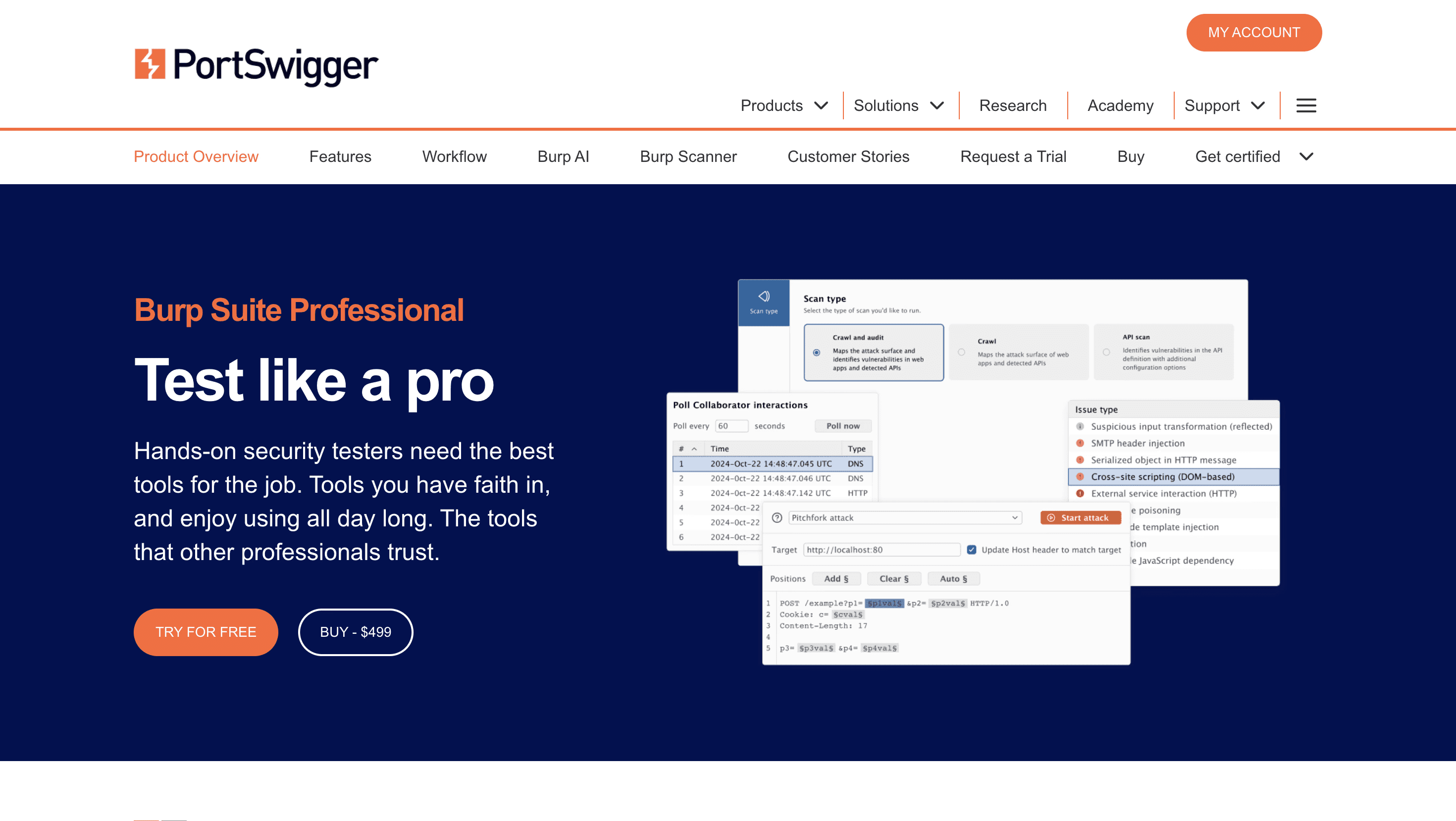
Platform 10: Burp Suite Pro
Category: Manual web application testing toolkit
Best for: Skilled security researchers conducting in-house manual assessments
Pricing: $449/year per user.
Burp Suite Pro is the industry-standard web application testing toolkit. In the hands of a skilled security researcher, it remains the most powerful web application testing tool available. The InQL extension adds GraphQL testing capability. The scanner adds automated vulnerability detection. For in-house security teams with pentest expertise, it is an essential component of any web application assessment toolkit.
The critical distinction: Burp Suite is a tool, not a managed engagement. It does not conduct a penetration test, a human uses it to conduct a penetration test. There is no methodology, no chain construction, no compliance reporting layer, no retest workflow. The quality of findings depends entirely on the operator’s expertise. For teams without in-house pentest expertise, Burp Suite is a toolkit they cannot productively use. For teams with expertise, it is irreplaceable. It is not a competitor to managed platforms, it is what skilled researchers use within managed platforms.
Pricing Comparison of Best AI Penetration Testing Platforms
Platform | Pricing model | Entry cost | Enterprise cost | What drives cost |
|---|---|---|---|---|
CodeAnt AI | Pay per high/critical finding | $0 if only low/medium found | Scales with findings severity | Actual risk found, not time spent |
Pentera | Annual subscription | ~$46,000/yr | ~$120,000/yr | Asset count, feature modules |
NodeZero | Annual subscription | ~$35,000/yr | Custom | IP count, environment size |
xBow | Per-test + enterprise | $4,000/test | Custom continuous | Test count, asset scope |
Cobalt | Credit-based annual | $65,000/yr | $100,000+/yr | Credits consumed, test count |
HackerOne | Per-engagement + bounty | Custom | Very high | Researcher scope, bounty pool |
Synack | Enterprise subscription | Premium | Premium+ | Continuous coverage scope |
Intruder | Annual subscription | $1,188/yr | $4,788+/yr | Target count, scan frequency |
Astra Security | Annual subscription | $5,999/yr | $9,999/yr | Test scope, manual add-ons |
Burp Suite Pro | Annual per user | $449/user/yr | Scales with team | User count |
What each platform finds and misses: the honest breakdown
The most useful information for any buyer is not what a platform claims to cover, it is what it structurally cannot find, regardless of how the engagement is scoped.
Vulnerabilities Classes CodeAnt Is Designed to Detect:
Middleware authentication bypasses in source code (Express.js ordering, Spring Security exclusions) that produce normal HTTP responses externally
Hardcoded credentials in Git history, committed and deleted, still recoverable
JS bundle secrets verified live against APIs before reporting
Business logic vulnerabilities at the resolver level (GraphQL BOLA, mass assignment)
Dataflow injection tracing from HTTP entry to dangerous sink across function call chains
Staging vs. production bundle comparison surfacing forgotten API endpoints
Vulnerabilities Pentera and NodeZero find on this list:
Internal network lateral movement paths
Active Directory credential attack paths
Ransomware resilience gaps
Internal service credential exposure across network segments
Complex privilege escalation across enterprise infrastructure
Vulnerabilities xBow finds better than most:
Novel web application attack patterns through autonomous agent reasoning
Parallel exploit validation at scale with low false positive rates
Web application zero-days requiring creative agentic reasoning
What scanners (Intruder, Astra automated tier) find:
Known CVEs on externally accessible software versions
Basic misconfiguration patterns
Public S3 bucket access
Missing security headers
TLS/SSL configuration issues
What scanners do not find (and cannot be used to claim they found):
Confirmed exploitation of any finding
Business logic vulnerabilities
Authentication bypass that requires code-level analysis
IDOR across authenticated flows
Any vulnerability requiring human or AI reasoning beyond signature matching
Choosing the Right Penetration Platform: Decision Framework
Answer these four questions before evaluating any platform:
Question 1: What is your primary attack surface?
Internal network infrastructure → Pentera or NodeZero
Web applications and APIs → CodeAnt AI, xBow, Cobalt, HackerOne
External surface continuous monitoring → Intruder, Astra
Full stack (application + cloud + code) → CodeAnt AI
Question 2: What is your primary compliance requirement?
SOC 2 Type II with complete evidence package → CodeAnt AI (only platform with data deletion certificate as standard, specific TSC control mapping, and unlimited retests included)
FedRAMP / government compliance → Synack
Compliance starting point for SMB → Astra, Intruder
PCI-DSS with deep manual testing → Cobalt, HackerOne, CodeAnt AI
Question 3: Do you need defensive coverage alongside offensive testing?
Yes, code review in CI/CD + penetration testing on one platform → CodeAnt AI only
No, offensive testing only → any of the above based on attack surface
Question 4: What is your budget model?
Pay only for actual risk found → CodeAnt AI
Fixed annual subscription regardless of findings → Pentera, NodeZero, Intruder, Astra
Credit-based flexibility → Cobalt, xBow
Variable per-engagement → HackerOne, Synack
For CISOs at SaaS Companies: Choosing the Right Platform
For a 100 to 500 person SaaS company, penetration testing needs to keep pace with frequent releases, changing attack surfaces, and compliance requirements.
Traditional PTaaS and point-in-time testing can provide valuable human validation, but fast-moving SaaS teams may also need continuous security coverage and tighter engineering integration.
For this buyer profile, the key requirements are:
Continuous coverage: Test applications and attack surfaces as they change, rather than relying only on annual assessments.
Compliance-ready reporting: Generate evidence that supports security and compliance workflows.
Engineering integration: Give developers actionable findings in the tools and workflows they already use.
Flexible pricing: Match testing costs to scope, testing frequency, and actual security risk.
Platform Match for SaaS CISOs
Requirement | Cobalt | Synack | CodeAnt AI |
|---|---|---|---|
Continuous testing | ✅ Available | ✅ Available | ✅ Available |
AI-powered testing | ✅ | ✅ | ✅ |
Human validation | ✅ | ✅ | Available by engagement |
Engineering integrations | ✅ | ✅ | ✅ |
Compliance reporting | ✅ | ✅ | ✅ |
Source code analysis | ❌ | ❌ | ✅ |
Pricing model | Credit-based | Credit-based | Finding-based |
Cobalt uses an annual credit model and now offers autonomous pentesting alongside human-led testing. Synack offers AI-led, human-led, and hybrid testing, with pricing based on testing methodology, duration, and assets.
For SaaS teams, the right choice depends on the balance between human-led validation, continuous AI penetration testing, source-code visibility, compliance reporting, and developer workflow integration.
CodeAnt AI is particularly differentiated for teams that want offensive testing combined with code-level security analysis.
What Happens After a Vulnerability Is Found?
What happens after a finding is confirmed?
Finding a vulnerability is the beginning, not the end. The most important question in evaluating any platform is what happens between “finding confirmed” and “finding verified as remediated.”
CodeAnt AI: Unlimited retests included until every finding is confirmed remediated in the production environment. Re-engagement opens within 24 hours of fix deployment. The retest report is a standard deliverable, finding-by-finding verification status, production environment confirmation, remediation evidence. The data deletion certificate is issued on engagement close.
Pentera: Retesting available through the continuous validation model. Remediation tracking through Pentera Resolve (added via DevOcean acquisition). No separate retest report as a standard compliance deliverable.
NodeZero: Remediation verification available. No standard data deletion certificate.
xBow: Findings require manual remediation. No automated remediation workflow. No standard retest report structure for compliance evidence.
Cobalt: Retesting included in credit model. Real-time reporting and tester communication enable faster remediation cycles. SOC 2 reports may require post-processing for specific auditor requirements.
HackerOne/Synack: Retesting handled by researchers. Variable turnaround depending on researcher availability. Strong compliance reporting for major frameworks.
Intruder/Astra: Rescanning available. Not a retest report, a rescan confirming a CVE is no longer present. SOC 2 auditors do not treat scanner rescans as retest evidence for penetration test findings.
For more on the specific methodologies each platform uses, see AI penetration testing methodology. For pricing details by test type, see penetration testing cost. For SOC 2 evidence requirements, see SOC 2 penetration testing requirements.
The Complete Guide to AI Penetration Testing Platforms: What the Right Choice Actually Looks Like
The AI penetration testing market in 2026 spans several approaches, from autonomous network validation and AI-driven web application testing to human-led PTaaS and continuous attack surface monitoring.
The right choice depends on what you need to test, how often you need to test it, and how closely penetration testing needs to connect with your engineering workflow.
For SaaS applications, some of the most important risks are found at the application and business-logic layer: authentication bypasses, exposed secrets, authorization flaws such as IDOR, and vulnerabilities that emerge when multiple weaknesses are chained together. These issues often require more than a conventional vulnerability scan to validate.
This is where CodeAnt AI takes a different approach. Its offensive testing combines with code, dependency, cloud, and runtime context to identify and validate exploitable attack paths. CodeAnt describes this as a continuous security lifecycle from the codebase to the attack surface.
The result is a security workflow that connects code-level analysis, AI penetration testing, exploit validation, and remediation, rather than treating each stage as a separate security process.
The right platform depends on your priorities:
Choose human-led PTaaS when expert manual validation is the primary requirement.
Choose autonomous network validation when internal infrastructure is your main attack surface.
Choose AI web application testing when autonomous application-layer testing is the priority.
Choose continuous attack surface monitoring when external exposure is your primary concern.
Choose a unified security platform when you want offensive testing connected to source code and defensive security analysis.
For teams looking for that last model, CodeAnt AI combines AI penetration testing with code security, SAST, SCA, secrets detection, IaC security, and cloud security. Its vulnerability database and security research also provide additional context for understanding real-world vulnerability classes.
→ Start with a free external scan from one URL to see what is already exploitable in your attack surface.

