

The mistake surfaces at a predictable moment. A team buys Vanta or Scytale, watches the dashboard turn green, and assumes SOC 2 is handled, until the auditor opens the evidence binder, references CC4.1, and asks a question the dashboard cannot answer, where is the penetration test.
Compliance automation and penetration testing are two different jobs, and an auditor expects both. This guide separates them with the detail the surface-level version skips, what each actually does, where the pentest sits in the real audit timeline, what an auditor accepts as evidence and what gets rejected, and how the two fit together.
What CodeAnt AI solves here: CodeAnt AI is the penetration test side of this equation, code-aware and continuous, with human researchers in the validation loop, producing the proof-of-exploit evidence mapped to SOC 2 criteria that auditors accept and that a compliance automation platform then organizes.
I reviewed the current positioning of Vanta and Scytale and recent auditor guidance on July 27, 2026. This is a documented comparison of categories, not a claim that I ran an assessment against any named product.
Common Questions About SOC 2 Compliance Automation And Pentesting
The confusion here is specific, and the same questions come up in every SOC 2 program.
Does Vanta or Scytale actually run the penetration test, or just help with compliance?
Is a compliance automation platform enough on its own to pass SOC 2?
What kind of penetration test does an auditor actually accept, and what gets rejected?
When in the audit does the test need to happen?
What happens if you skip it?
What SOC 2 Actually Assesses In A Type 1 And Type 2 Report
To see where each piece fits, it helps to be precise about what a SOC 2 report is. It is an attestation, produced by a licensed CPA firm, that your controls meet the AICPA Trust Services Criteria, and it comes in two forms.
A Type 1 report assesses control design at a single point in time, whether the controls are designed correctly today. A Type 2 report assesses design and operating effectiveness over a defined period, usually six to twelve months, whether the controls actually worked across that window.
That observation window is the concept everything else hangs on. For a Type 2 report, an auditor does not want a snapshot, they want evidence that controls operated continuously across months, and both report types now effectively assume a recent penetration test exists.
What SOC 2 Compliance Automation Platforms Actually Do
Compliance automation platforms solve a real and painful problem, the evidence grind. Preparing for SOC 2 means gathering proof from policies, system logs, and configurations, mapping it to the criteria, and keeping it current across the whole observation window, and that work is enormous by hand.
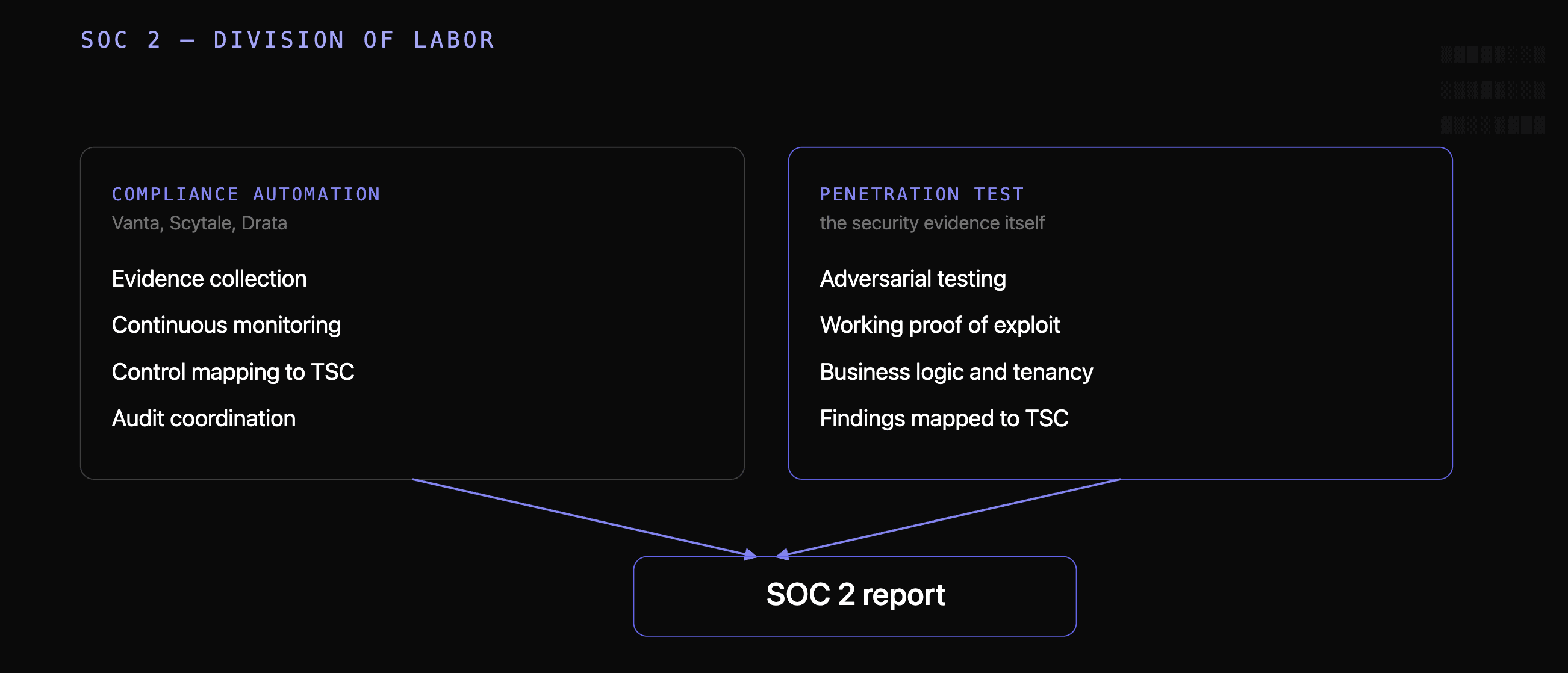
Platforms like Vanta, Scytale, and Drata automate most of it. Vanta connects through 300 or more integrations to pull evidence automatically, monitor controls continuously, and map that evidence to the Trust Services Criteria, with the audit binder building itself as controls operate.
Some work still stays manual. A risk assessment, the selection of risk scenarios, and a share of evidence collection remain human tasks, often handled by a vCISO, so the platform reduces the grind without removing it entirely.
What it produces is a well-organized picture that shows an auditor the controls exist, are documented, and are monitored, which is a large part of a SOC 2 program.
What Compliance Automation Platforms Do Not Do: Penetration Testing
Here is the boundary that trips teams up. A compliance automation platform organizes evidence, but the penetration test is one piece of evidence it cannot generate itself, because a pentest is an active security assessment rather than a document to collect.
These platforms know this, and they say so. Scytale's own guidance is direct, penetration testing is strongly expected by auditors, and roughly 90 percent of the time an auditor will not accept a report without one, which makes it mandatory in practice.
What the platforms offer is to coordinate or streamline a test aligned to your audit scope, through partners. That confirms the point rather than contradicting it, the test is a separate assessment that plugs into the platform, performed by a provider that actually attacks the system.
SOC 2 Audit Timeline: When The Penetration Test Should Happen
The reason timing matters is that a Type 2 report is about a window, and the pentest has to land inside it. Walking the actual timeline makes the constraint concrete.
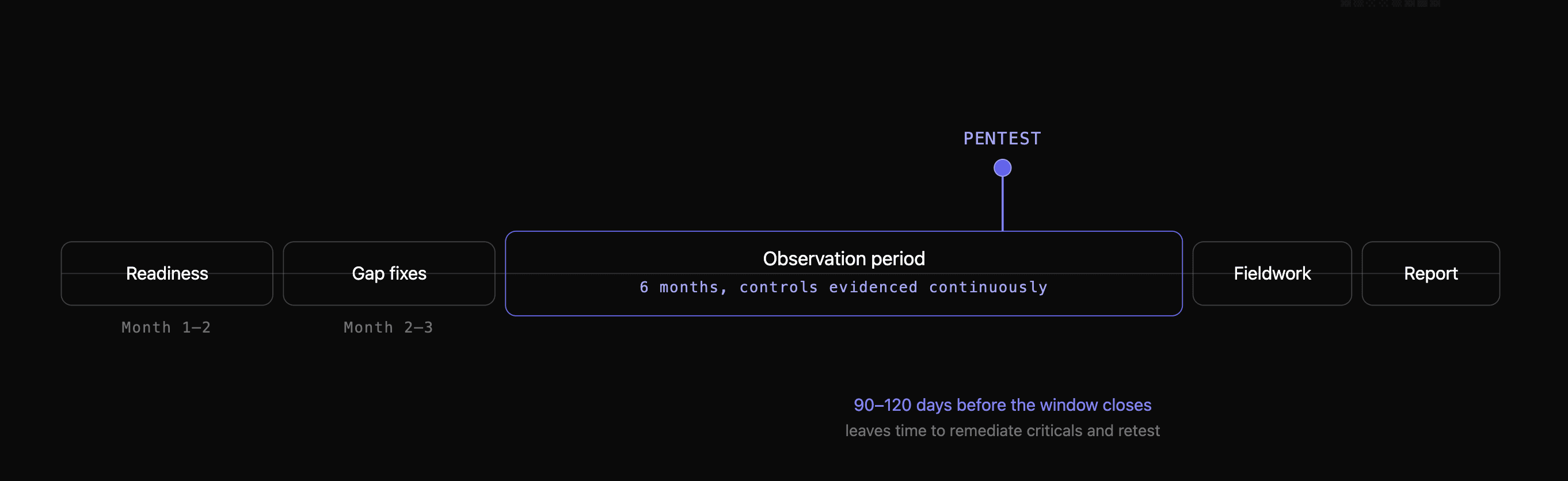
A first Type 2 audit runs roughly six to fourteen months end to end. The early phase is a readiness assessment and gap analysis, one to two months, followed by gap remediation, two to three months.
Then the observation period opens, a minimum of three months but usually six, during which controls must operate and be evidenced. After it closes, the auditor conducts fieldwork over two to four weeks, then drafts the report.
The pentest belongs inside the observation window, and the sharper rule is to run it 90 to 120 days before the window closes. That is late enough to reflect the system as it actually runs, and early enough to give engineering time to fix critical findings and the testing firm time to retest before fieldwork begins.
Get this wrong in the other direction and the cost is real, a test performed outside the observation period cannot evidence operating effectiveness, and the company pays for a second test.
What SOC 2 CC4.1 Says About Penetration Testing Evidence
The framework never uses the word required next to penetration testing, which is where the it-is-optional myth comes from. Reading the actual criterion explains why auditors expect one anyway.
Common Criteria 4.1 states that the entity selects, develops, and performs ongoing and separate evaluations to ascertain whether the components of internal control are present and functioning. The accompanying points of focus name the methods, and penetration testing appears first in that list of evaluations, which is why auditors treat it as the leading evidence for CC4.1.
Two more criteria pull it in. CC6.1 asks whether logical access controls can be bypassed, which a pentest answers directly, and CC7.1 asks whether newly introduced vulnerabilities are detected, which testing across the window evidences.
A penetration test is the single most efficient artifact for all three, which is why it has become the de facto standard even without a mandate.
Vulnerability Scan Vs Penetration Test For SOC 2 Evidence
A large share of rejected evidence comes from confusing these two, so the distinction is worth stating exactly. They are different activities that produce different artifacts.
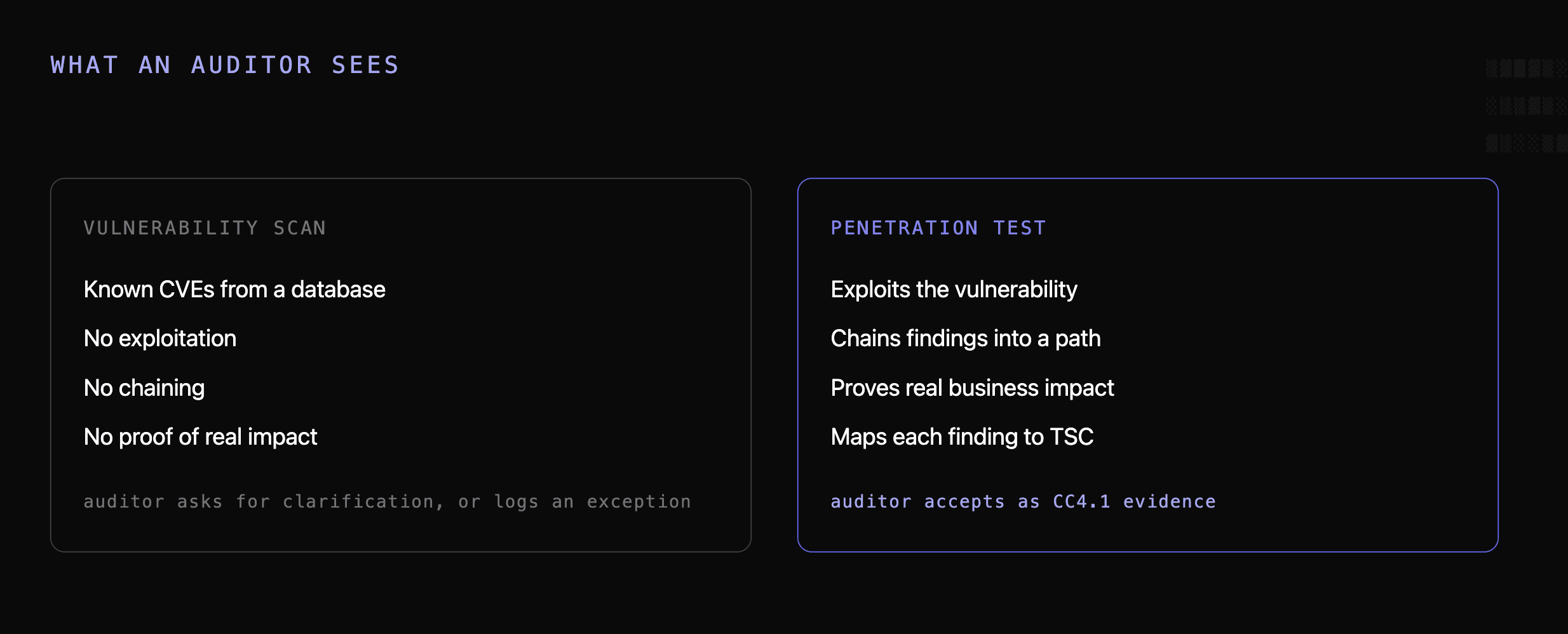
A vulnerability scan runs a tool like Nessus or Qualys against your infrastructure and reports known vulnerabilities from a database, which is useful work. A penetration test does something different, it attempts to exploit those vulnerabilities, chains them together to demonstrate real impact, and shows what an attacker could actually reach.
Auditors know the difference, and they act on it. Submitting a scan report as pentest evidence results in a request for clarification at best and an exception at worst, and major audit firms have begun explicitly calling out scanner output relabeled as a pentest as insufficient evidence for CC4.1.
Example SOC 2 Pentest Finding An Auditor Can Validate
Abstract descriptions are why the surface-level version of this topic falls flat, so here is a concrete example of the kind of finding that both matters for a SaaS product and reads as real CC6.1 evidence.
Consider a multi-tenant SaaS API with an endpoint like GET /api/v2/invoices/{invoice_id}. A tester authenticates as tenant A, requests one of their own invoices, and notes the identifier.
Then, still authenticated as tenant A, they change the identifier to one belonging to tenant B and send the request again.
If the endpoint returns tenant B's invoice, the application checked that the caller was logged in but never checked that the caller owned the record. That is broken object level authorization, and it is the single most common cause of SaaS customer-data exposure, because a scanner sees a normal 200 response and moves on.
A real pentest does not stop at one record. It chains, iterating identifiers to show the full customer list is reachable, then demonstrates that the same missing ownership check appears on the export endpoint, turning one flaw into bulk exfiltration.
The report entry then maps that chain to CC6.1, logical access controls bypassed, includes the exact requests as proof, and pairs it with the code-level fix, an ownership check that scopes every query to the session tenant. That is evidence an auditor validates, and a scan cannot produce it.
5 SOC 2 Pentest Mistakes That Create Audit Problems
Even teams that run a real test can still create an audit gap. Each of these has caused a real SOC 2 observation or exception, and each is avoidable.
Scope that does not match the system description. The most frequent failure. If the test covers less than the system boundary in your SOC 2 description, the auditor flags a gap because the evidence does not cover the full control environment. Match the pentest scope to the system description before the engagement starts.
Testing outside the observation window. A test run before or after the window cannot evidence operating effectiveness during it, so the auditor cannot accept it and the company pays for a second test.
A scan passed off as a penetration test. Scanner output relabeled as a pentest draws a clarification request or an exception, because auditors can tell a database lookup from an exploit.
No remediation or retest evidence. For critical and high findings the auditor expects retest evidence showing the fix worked, and a finding without it becomes a gap. Multiple unresolved critical findings can produce a qualified opinion.
Undisclosed limitations. The auditor needs a statement of what was excluded and why. An internal test skipped for a change freeze is fine if documented, and a risk if hidden.
What SOC 2 Auditors Accept In A Penetration Test Report
A report that satisfies an auditor has a recognizable shape, and a good provider delivers one the auditor can consume without translation. The structure is consistent across reputable firms.
It opens with an executive summary for management, then details each technical finding with a severity rating, commonly CVSS-scored, and references a recognized methodology such as PTES or the OWASP testing guides. Each finding carries a remediation recommendation, and critical and high findings carry retest evidence confirming the fix.
The piece that ties it to the audit is a Trust Services Criteria mapping. A strong report includes an appendix that connects each finding back to the specific criteria it evidences, CC4.1, CC6.1, CC7.1, and where relevant CC7.2 through CC7.4, so the auditor can validate the control directly rather than reinterpreting a security report.
Our SOC 2 penetration testing requirements guide covers the mapping in full.
Can Automated Or AI Penetration Testing Be Accepted For SOC 2?
There is an important nuance for anyone considering an automated or AI-driven pentest, and it cuts against a naive reading of automation. Some auditor guidance warns that assessments relying purely on automated tools, including autonomous AI platforms, may be rejected, because a rule engine or an unattended model does not emulate a real attacker the way a human does.
The resolution keeps a human in the loop rather than abandoning automation. A model that combines autonomous, code-aware testing with human researcher revalidation gets the cadence and depth of automation and the adversarial judgment auditors require, and it ships a working proof of exploit rather than a theoretical finding.
That combination is what turns fast, continuous testing into evidence an auditor accepts, and it is the design CodeAnt uses across black, white, and gray box modes for exactly this reason.
How Compliance Automation And Penetration Testing Work Together
The honest conclusion is that this comparison is really a division of labor, and a mature program uses both together. Each solves a different half of SOC 2.
The compliance automation platform manages the control environment, automates evidence collection across the observation window, and coordinates the audit. The penetration test supplies the security evidence that proves the controls actually work, and its report, mapped to the criteria, feeds straight back into the platform's evidence workflow.
Cadence is where the two reinforce each other. A platform monitors controls continuously, and a single annual pentest proves security on one day, so a continuous testing model keeps the pentest evidence as current as the monitoring across a Type 2 window rather than leaving it to age.
The walkthrough of how AI penetration testing traces a data leak shows the depth behind each finding.
Compliance Automation Vs Penetration Testing: Where Each Fits
The table separates the roles so the complementary picture is clear.
Capability | Compliance automation | Penetration test | CodeAnt AI |
|---|---|---|---|
Automates evidence collection | Yes | No | Feeds evidence in |
Continuous control monitoring | Yes | No | Continuous testing |
Performs adversarial security testing | No | Yes | Yes, code-aware |
Proof of exploit for findings | No | Yes | Yes, on every high or critical |
Human validation auditors expect | Not testing | Yes | Yes, researchers in the loop |
Maps findings to TSC | Organizes it | Yes | Yes |
The pattern is that a compliance platform and a real test occupy different columns, and CodeAnt sits on the testing side while producing evidence that drops cleanly into the platform side.
How CodeAnt AI Builds SOC 2 Pentest Evidence
CodeAnt is the penetration test in this picture, built to produce evidence auditors accept. It reads your source alongside the live product, chains findings into a proven exploit like the invoice example above, and keeps human researchers in the validation loop, which is the combination that satisfies the adversarial-testing bar rather than tripping the automated-tool caveat.
Its findings arrive mapped to the SOC 2 criteria, with a working proof of exploit, remediation, and a retest, which is exactly the package an auditor validates for CC4.1, CC6.1, and CC7.1. Because it runs continuously, the evidence stays current across the observation window instead of aging after a single engagement, and it drops straight into a compliance automation platform's workflow.
The pricing suits a team already paying for a compliance platform. Testing is outcome-based, a zero engagement fee with payment only on confirmed critical findings, so continuous coverage does not add a second large fixed bill.
Conclusion: Use Compliance Automation And Real Pentesting Together
For SOC 2, compliance automation and penetration testing solve different problems. A platform like Vanta, Scytale, or Drata helps run the compliance program by collecting evidence, monitoring controls, mapping documentation to the Trust Services Criteria, and organizing the audit workflow. A penetration test supplies the adversarial security evidence that proves controls actually work. One manages the program. The other validates the security.
The mistake is assuming a green compliance dashboard can replace a real test. Auditors still want evidence that the system boundary was tested, exploitable findings were proven, remediation happened, and retests confirmed closure. A vulnerability scan alone is not the same thing as a penetration test because it lists known issues, while a pentest attempts exploitation, chains findings, and shows real impact.
Timing also matters. For a SOC 2 Type 2 audit, the pentest should happen inside the observation window, close enough to reflect the live system but early enough to fix and retest critical issues before fieldwork. When the report maps findings to CC4.1, CC6.1, CC7.1, and related criteria, it becomes evidence the auditor can use directly.
Treat compliance automation and penetration testing as two connected parts of the SOC 2 program. Use the automation platform to manage evidence and control monitoring, then use real, human-validated penetration testing to prove the controls work and feed auditor-ready evidence back into the compliance workflow. For the full requirements, start with our SOC 2 penetration testing requirements guide.

