

You probably considered NodeZero because it runs autonomous pentests against your live network, chains exploitable weaknesses into attack paths, and hands back proof of exploit instead of a CVSS score you have to argue about.
One layer stays dark, though. NodeZero never reads your code, so the SQL injection in last week’s pull request and the leaked key in your config are somebody else’s problem until an attacker turns them into a foothold NodeZero can then exploit.
Our pick is CodeAnt AI, and the CodeAnt AI vs NodeZero comparison carries the full head-to-head. It is our product, so we say so up front, and every price, feature, and quote below traces to a vendor’s own site or a published G2, Gartner, PeerSpot, or Product Hunt review.
Here are the nine best NodeZero alternatives in 2026:
CodeAnt AI owns the code and application layer NodeZero never scans, and starts free on a single URL.
Pentera runs deterministic and agentic attacks across the internal network, cloud, and identity at enterprise scale.
Cobalt puts a vetted human tester’s signature on the report your auditor is asking for.
XBOW points thousands of autonomous agents at web apps and APIs and returns working exploits.
Synack pairs an AI red agent with a vetted human Red Team and carries FedRAMP Moderate authorization.
Intruder watches the internet-facing estate with a genuine free tier.
Astra Security blends certified human pentests with an always-on scanner and IDE auto-fix.
StackHawk brings runtime DAST inside the coding agent for $10 a seat.
Hadrian discovers your external attack surface with zero scope and validates what is exploitable.
What NodeZero Actually Bundles
NodeZero is an autonomous penetration testing platform for the live network, infrastructure, Active Directory, and cloud, run from an assumed-breach position under the tagline “Security you can prove.” It pivots through your environment, chaining weaknesses the way an attacker would, and confirms exploitability with evidence rather than a scanner’s version check.
Horizon3.ai gates the platform behind four cumulative tiers, and the NodeZero features breakdown maps each one:
Flex covers episodic testing: internal, external, cloud, Kubernetes, AD password audit, phishing impact, EDR validation, and the MCP server, with no scheduling.
Core adds continuous scheduling and Threat Informed Perspectives.
Pro adds Tripwires deception and Rapid Response N-day exploits.
Elite adds NodeZero Insights, high-value targeting, and threat intelligence.
Scale claims on the homepage are live counters. Read as of July 2026, they show 262,224 pentests safely run in production and 6,436 customers, with “Trusted by NSA and 4 of the Fortune 10.”
One category is missing entirely. NodeZero has no SAST, no SCA, no secret scanning, and no code review, and its packaging matrix carries zero code-related rows. GitHub appears only as a place to file remediation tickets.
How much does NodeZero cost?
NodeZero publishes no prices. The pricing URL resolves to a feature-comparison matrix across Flex, Core, Pro, and Elite with no dollar figures, and the only listed purchase path is a demo request, as our NodeZero pricing analysis documents in full.
You can self-serve a 30-day free trial from the portal, after which the account drops back to read-only mode where you can view data but cannot run pentests. Procurement also runs through the AWS Marketplace and approved consulting partners. Every figure stays gated until you talk to sales.
So the commercial reality is a demo-first, annual subscription with unlimited test frequency inside your tier, priced entirely by quote. Each tool below either matches part of that network reach at a published price or adds the code layer NodeZero leaves untested.
Coverage Overlap: What Each Tool Replaces
The table below maps every tool against the layers NodeZero tests plus the code layer it does not, so you can see at a glance which options overlap and which extend into new ground.
Tool | Network / AD | Cloud | External surface | Web / app pentest | Code security (SAST/SCA) | Free start |
|---|---|---|---|---|---|---|
NodeZero | Yes | Yes | Yes | Early access | No | 30-day trial, then read-only |
CodeAnt AI | No | Yes, posture + container | Limited | Yes, code-aware | Yes | Free one-URL scan |
Pentera | Yes | Yes | Yes | Yes, AI web attack | No | Demo only |
Cobalt | Yes, human | Yes, human | Yes, ASM | Yes, human | Human review | Demo only |
XBOW | No | No | No | Yes | No | Contact only |
Synack | Yes, human | Yes | Yes, ASM | Yes | No | Free Basic platform |
Intruder | Yes, internal scan | Yes, CSPM | Yes, ASM | Yes, DAST + AI pentest | No | Free tier |
Astra Security | Yes, pentest | Yes | Limited | Yes | No | $7 one-week trial |
StackHawk | No | No | From source | Yes, DAST | No, integrates SAST | Free 14-day trial |
Hadrian | No | Yes | Yes, EASM | Yes, agentic | No | Conditional free scan |
CodeAnt AI closes the code column NodeZero leaves blank and still starts free. Every other tool either overlaps NodeZero’s network and cloud reach or extends the external surface, so the practical move is often to pair CodeAnt AI with a network tool rather than swap one for the other.
The 9 Best NodeZero Alternatives at a Glance
The order runs by how completely each tool covers the layer NodeZero leaves untested, then by depth where the two overlap.
# | Tool | Category | Try-before-you-buy | Standout |
|---|---|---|---|---|
1 | CodeAnt AI | Code-aware pentest + code-security stack | Free one-URL scan, no card | Owns the code and app layer NodeZero never sees |
2 | Pentera | Automated security validation | Demo only | Deterministic plus agentic engine at enterprise scale |
3 | Cobalt | Human-led PTaaS | Demo only | A vetted human tester’s signature on the report |
4 | XBOW | Autonomous web / API pentest | Contact sales | Ranked #1 on HackerOne, deep exploit chaining |
5 | Synack | Human + AI PTaaS | Free Basic platform | Vetted Red Team plus FedRAMP Moderate |
6 | Intruder | Exposure management | Free tier + 14-day trial | A genuine free tier across the external estate |
7 | Astra Security | PTaaS (app, API, cloud) | $7 one-week trial | Certified human pentests plus IDE auto-fix |
8 | StackHawk | Developer DAST | Free 14-day trial | Runtime testing inside the coding agent |
9 | Hadrian | EASM + agentic pentest | Conditional free scan | Zero-scope external discovery |
The 9 Best NodeZero Alternatives in 2026
Each section answers four questions: what the tool does, what users report, where it stops, and how it lines up against NodeZero.
1. CodeAnt AI
CodeAnt AI is a defensive and offensive security platform that unifies AI code review, SAST, and agentic pen testing. It leads this list because it owns the exact layer NodeZero cannot see, the code and the running application, and it is the one option you can evaluate free today.
What CodeAnt AI does
Code-aware pentesting. The agentic pentest reads your source in black, grey, or white box mode, runs 500+ exploit agents, ranks findings by EPSS, and chains them through an Attack Chains stage into an attack-graph report.
Proof per finding. Every high or critical result ships with a working proof of concept and a curl reproduction, and a free “Reverify” re-scan confirms the fix.
A unified code-security report. SAST, SCA, secret scanning, IaC, and SBOM land in one report tagged to CWE and OWASP, alongside cloud posture and container scanning.
Code review on every pull request. Unlimited PR reviews, plain-English custom rules, org-wide quality gates, and fix-in-IDE sit on top of the security layer.
Original research behind it. The team has disclosed 100+ zero-days and three named CVEs, including CVE-2026-29000 in pac4j at CVSS 10.
What users report
Feedback that reads intent. A Gartner Peer Insights reviewer in IT services called the feedback “highly accurate and useful for pointing out issues with edge cases, missed logic, and naming inconsistencies.”
Finds vulnerable packages and secrets. A Gartner reviewer, Director of IT in software, credited the “one click scans” with surfacing “vulnerable packages or secrets embedded deep within the code base.”
Fast time to value. Kalpesh Bhalekar of Scoutflo wrote on Product Hunt that the team had an “Aha moment the minute our Github PRs were summarised after installation.”
Where it stops
Internal network testing is out of scope. The pentest targets applications and the surface around them, so Active Directory attacks and lateral movement stay with a network tool like NodeZero.
Onboarding takes a beat. Reviewers note the initial learning curve runs longer than they would like, and suggestions can flag cautiously until tuned.
The review base is young. Ratings are strong but sit on small, fragmented samples across G2, Gartner, and Product Hunt.
How it compares to NodeZero
Here is the split, layer by layer.
Line item | CodeAnt AI | NodeZero |
|---|---|---|
Layer tested | Code, running app, cloud config, container | Internal network, external, cloud, identity, Kubernetes |
Code security (SAST/SCA/secrets/IaC) | Yes, one unified report | None |
Pentest model | Code-aware, black / grey / white box | Autonomous, assumed-breach network |
Free start | Free one-URL scan, no card | 30-day trial, then read-only |
Billing | Pay only on high and critical findings, modules from $20/user/mo | Quote only across Flex, Core, Pro, Elite |
CodeAnt AI owns the code and app layer with a free on-ramp, and NodeZero owns the network and identity layer behind a sales quote. The two are complementary, and for a team shipping software the one you can test for free today is CodeAnt AI.
Choose it when: you ship code and need the SAST, secrets, and code-aware pentest that NodeZero structurally cannot run, starting free.
2. Pentera
Pentera is the closest like-for-like to NodeZero at the network layer, and it competes for the same enterprise buyer. It coined Automated Security Validation and runs deterministic attack emulation alongside an agentic AI layer, agentless, across internal, external, and cloud environments.
What Pentera does
Four products on one platform. Pentera Core (internal), Surface (external), Cloud, and Resolve (remediation orchestration) share one workflow: find what is exploitable, prioritize proven risk, fix it.
Live attacks, mapped to MITRE ATT&CK. Privilege escalation, credential-based access, AD password assessment, and ransomware emulation against strains like LockBit 3.0 and BlackCat, run under production-safe guardrails.
An agentic co-pilot. Pentera Peer, launched in Pentera 8, lets you query validated attack paths in natural language while remediation decisions stay with humans.
What users report
Fix-focused testing. Rubén Alonso, Head of Secure Development Unit at Telefónica, said Pentera let his team “shift our focus from simply finding vulnerabilities to actively helping our teams fix them.”
Red team uplift. Owen Fuller, Cybersecurity Engineering Manager at Casey’s, said “I don’t think we’d be able to advance our red team without Pentera.”
Where it stops
No code security. Pentera has no SAST, SCA, or repository analysis of its own, and only ingests code-security findings into Resolve for remediation.
Pricing is fully gated. The site shows no list price, tier, or trial, and the only ungated dollar figures are a TAG analyst whitepaper’s illustrative $100K to $400K per year, which the whitepaper itself disclaims as estimates.
Enterprise, top-down motion. The funnel terminates at “Book a Demo,” never self-serve.
How it compares to NodeZero
Two autonomous network platforms, sold the same way.
Line item | Pentera | NodeZero |
|---|---|---|
Layer tested | Internal, external, cloud, identity | Internal, external, cloud, identity, Kubernetes |
Category framing | Automated Security Validation | Autonomous penetration testing |
Remediation | Pentera Resolve orchestration, 100+ integrations | Fix Actions plus 1-Click Verify |
Code security | None | None |
Pricing | Gated, demo only, six-figure ACV signal | Gated, demo only, four tiers |
Pentera genuinely leads on breadth of validation and remediation orchestration at enterprise scale, and neither tool touches your code. For the offensive-testing category context, our Pentera vs CodeAnt automated pentesting guide sets out where each model fits.
Choose it when: you need continuous, agentless validation across a large internal network and identity estate, and a six-figure quote is not a blocker.
3. Cobalt
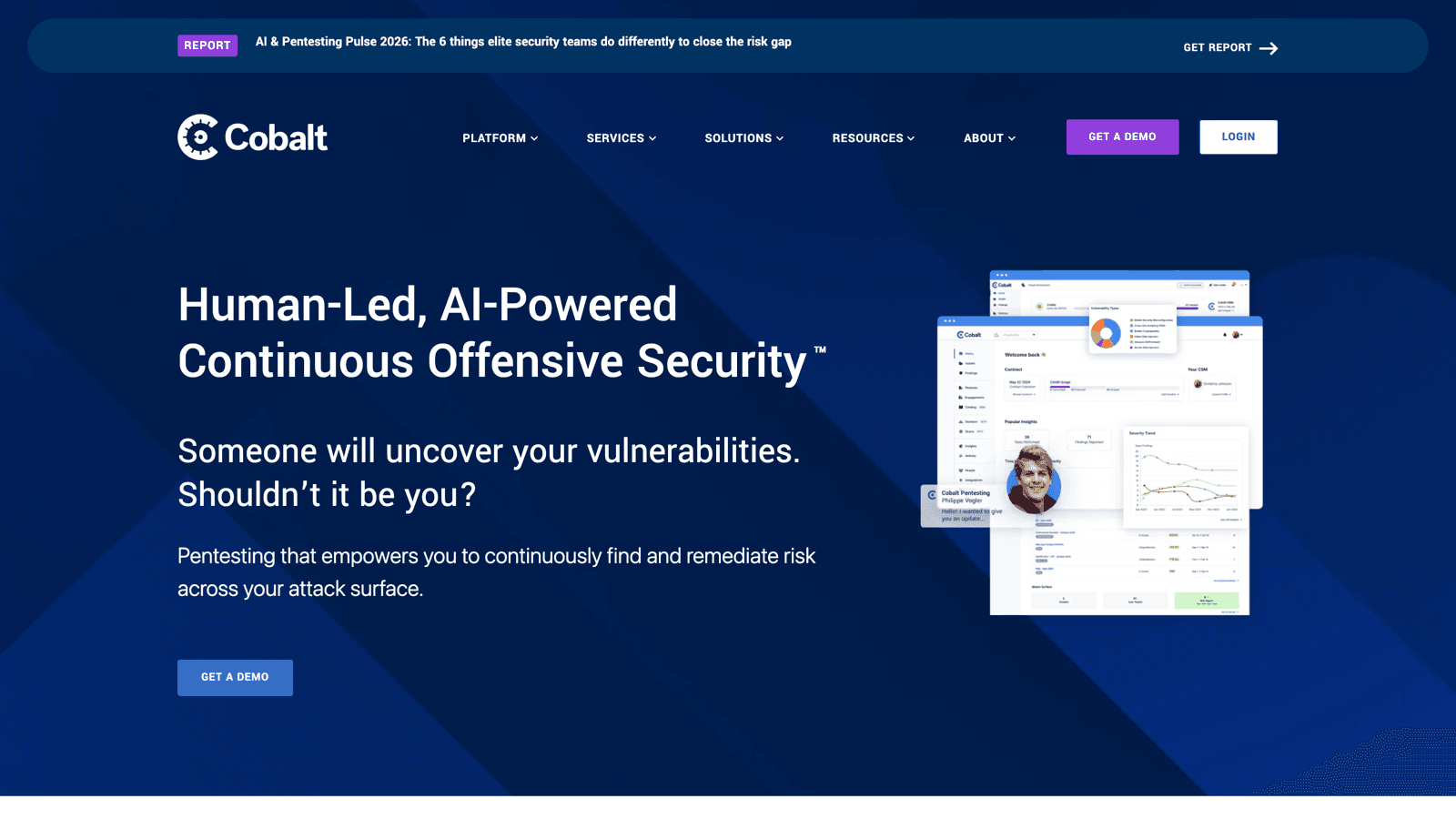
Sometimes the questionnaire asks for a human tester’s signature, and no autonomous scan clears it. Cobalt invented Pentest as a Service and still sets the reference, launching an engagement in as little as 24 hours through Cobalt Core.
What Cobalt does
A vetted human community. Cobalt Core fields 450+ freelance testers averaging 11 years of experience, matched to your stack, with start SLAs of 3, 2, or 1 business days by tier.
AI on recon, humans on exploitation. Autonomous agents run discovery at machine speed while human testers focus on chained exploits, business logic, and privilege escalation.
Secure Code Review. Human-led source analysis using automated SAST and SCA, then expert validation for business-logic flaws a scanner cannot reach.
What users report
Compliance entry, program expansion. Tushar Chandgothia, VP of Information Security and Risk Management at Kubra, said Cobalt gave his team “the ability to pentest on a frequent basis with minimum effort from our teams,” after starting “purely for PCI requirements.”
Where it stops
No autonomous network exploitation. Cobalt schedules human engagements rather than running unlimited self-directed network pentests the way NodeZero does.
Credits expire. A Cobalt Credit is 8 hours of testing, credits are use-it-or-lose-it per contract year, and Standard tier ships no native integrations, no custom reports, and no strategic planning.
Pricing is gated. The pricing page carries three tiers and zero dollar figures.
How it compares to NodeZero
Human-led engagements versus autonomous machine testing.
Line item | Cobalt | NodeZero |
|---|---|---|
Who tests | Vetted human testers, AI on recon | Autonomous agents, unlimited runs |
Coverage | Web, API, mobile, network, cloud, secure code review | Network, cloud, identity, Kubernetes |
Report | Human-signed, audit-quality attestation | Machine-generated proof of exploit |
Unit | Cobalt Credit, 8 hours each, annual | Annual subscription, unlimited pentests |
Pricing | Custom quote | Custom quote |
Cobalt leads where a named human’s signature is the deliverable, and NodeZero leads on test frequency and network self-service. Our CodeAnt AI vs Cobalt comparison covers where the human and code-aware models diverge.
Choose it when: your auditor or largest customer wants a named human tester on the report and you can absorb an annual credit commitment.
4. XBOW
XBOW points thousands of short-lived agents at a web application and returns working exploits. It became the first AI to top HackerOne’s US leaderboard, ranked above every human researcher on it.
What XBOW does
A five-stage attack loop. Learn, map, coordinate, attack, and prove, with agents working in parallel and independent validators confirming exploitability before a finding reaches you.
Exploit chaining with evidence. Documented chains up to 48 steps, delivered with full request and response detail and near-zero false positives.
Model routing and API triggers. Each task routes to the best available frontier model, and a REST API can fire a pentest on merge or pre-deploy.
What users report
Chaining is the differentiator. Farzan Karimi, Deputy CISO at Moderna, called XBOW’s attack chaining “something no other product is doing well in the web space.”
Adversarial proof. An unnamed CISO at a top-5 US bank went further on the homepage, calling XBOW “the best hacker on planet Earth.”
Where it stops
Web and API only. Mobile, cloud, network, and binary testing sit on the roadmap, which is the opposite half of the estate NodeZero covers.
No SAST, no self-serve. Source code is optional context only, and despite a “fully self-service” launch claim, every pricing button routes to a contact form.
Published prices, sales-assisted buying. Lightspeed lists $4,000 and $8,000 per test, anchored to 2-week and 4-week manual pentests, but the motion runs through sales.
How it compares to NodeZero
Opposite ends of the attack surface.
Line item | XBOW | NodeZero |
|---|---|---|
Targets | Web applications and their APIs | Network, cloud, identity, Kubernetes |
Proof | Working exploit, validated | Proof of exploit, chained |
Entry price | $4,000 per test, published | Quote only |
Turnaround | Audit-ready report within 5 days | Same-day results |
Code security | None | None |
XBOW leads on autonomous web and API depth, and NodeZero leads everywhere below the application. Our CodeAnt AI vs XBOW comparison covers where autonomous web testing helps and where it does not.
Choose it when: you need on-demand pentest depth against web apps and APIs, and network testing lives with a separate tool.
5. Synack
Synack pairs an AI agent with a vetted human Red Team and sits closest to NodeZero on the federal and enterprise buyer. Sara, its Synack Autonomous Red Agent, expands coverage, and the 1,500-strong Synack Red Team validates what is exploitable.
What Synack does
AI plus a curated Red Team. Sara deploys swarms of agents to explore and prioritize, then human researchers, drawn from under 10% of applicants with government-grade background checks, prove what matters.
Published starting prices. Sara Pentest starts at $4,181, SynackST at $10,283, and Synack14 at $27,120, each purchased as credits that expire a year from purchase.
Federal-grade posture. FedRAMP Moderate authorized with 325 NIST 800-53 controls, and testing runs through the LaunchPoint VPN with full packet capture.
What users report
Continuous over point-in-time. Anton Göbel, Information Security Officer at Allianz Direct, said “continuous pentest programs like the one from Synack are the only way to securely deliver customer value at the pace we want.”
A hard internal rule. A Domino’s Information Security Manager put it plainly: “if an app is going to impact the business before it goes live, it must be Synacked.”
Where it stops
No code security. Synack is an offensive black and grey box vendor with no SAST or source-code review.
The platform is a separate line item. The headline test prices exclude a required platform subscription whose price is not published, and Sara is external-only with no MFA or CAPTCHA support today.
Credits expire in a year. Prepaid credits transacted through a purchase order run down whether you use them or not.
How it compares to NodeZero
Human-validated PTaaS versus fully autonomous testing.
Line item | Synack | NodeZero |
|---|---|---|
Testing resource | Sara AI plus human Red Team | Autonomous agents only |
Coverage | Web, host, API, cloud, mobile, AI/LLM | Network, cloud, identity, Kubernetes |
Federal | FedRAMP Moderate authorized | NodeZero Federal, FedRAMP High |
Entry price | From $4,181 per test, plus platform | Quote only |
Code security | None | None |
Synack leads where a human red team plus a compliance-grade report is the requirement, and NodeZero leads on FedRAMP High and unlimited autonomous frequency. Neither reads a line of your code.
Choose it when: you want AI-expanded coverage validated by vetted humans and a compliance report, and the platform line item fits the budget.
6. Intruder
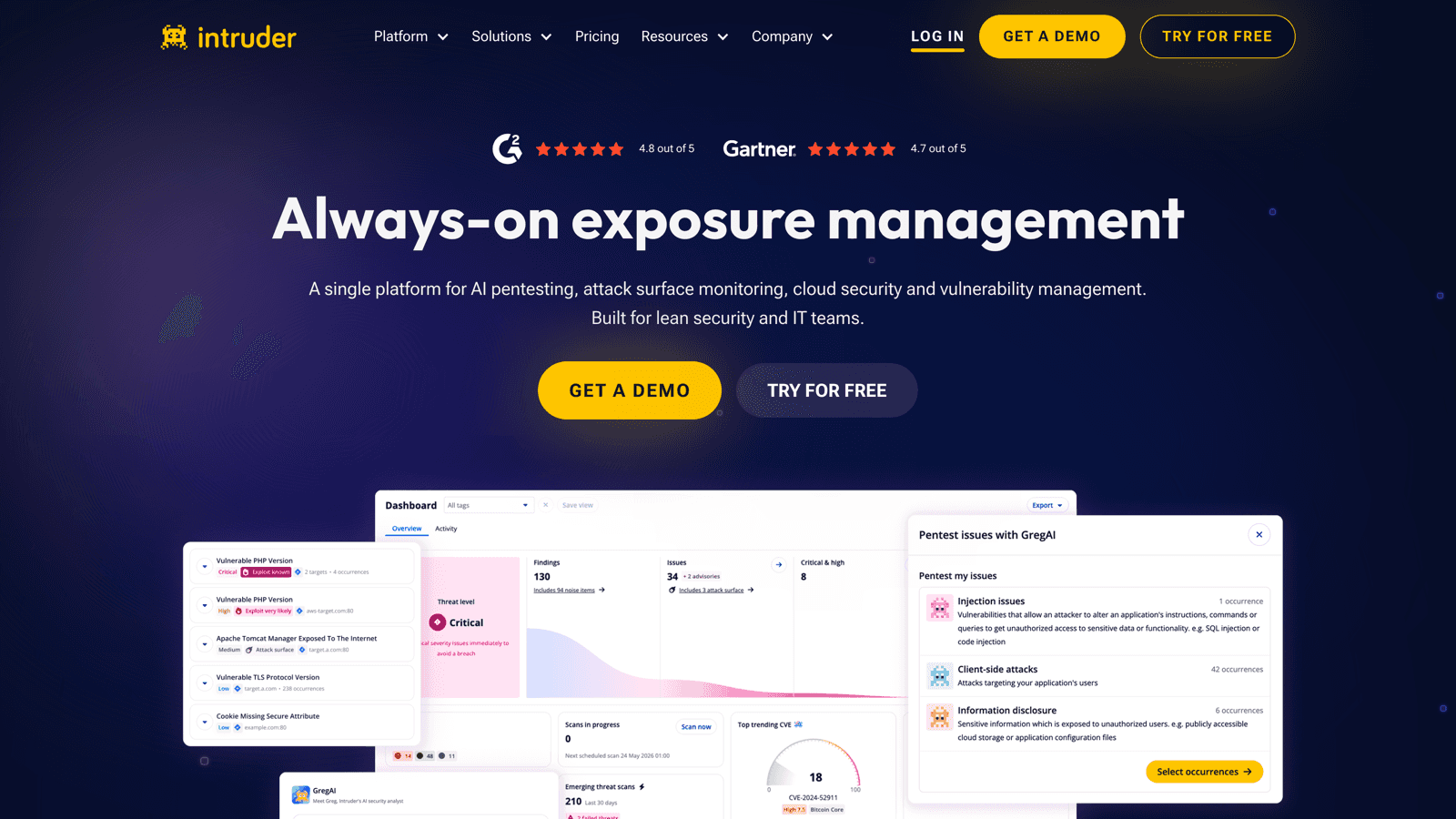
Intruder starts where a network pentest ends its recon and never leaves. It watches the internet-facing estate continuously, the subdomains, exposed services, and cloud accounts, and it is the rare tool here with a genuine free tier.
What Intruder does
Orchestrated scanning. OpenVAS, Nuclei, Tenable Nessus, and OWASP ZAP run under one dashboard, with Emerging Threat Scans checking systems within hours of a disclosure.
Attack-surface monitoring. Subdomains, exposed services, and shadow IT are discovered continuously, and CloudBot fires a scan the moment a new AWS, GCP, Azure, or Cloudflare asset appears.
AI where it helps. GregAI prioritizes and validates findings, an MCP server lets Claude drive workflows, and a per-test AI pentest add-on starts at $3,500.
What users report
Signal over noise. Intruder holds a 4.8 out of 5 on G2 and a 4.7 on Gartner, built around plain-language prioritization for teams without a specialist on staff.
Credibility markers. The company was selected for GCHQ’s Cyber Accelerator in 2017 and names 3,000+ customers.
Where it stops
Nothing reads your code. It has no SAST or code-review product, so it never covers code security.
Licences lock for 30 days. A scanned target consumes a licence for 30 days and does not release early on deletion or cancellation.
Internal and rapid response are gated. Internal scanning needs Pro, and the attack-surface view plus Rapid Response are Enterprise-only.
How it compares to NodeZero
Continuous exposure monitoring versus deep autonomous exploitation.
Line item | Intruder | NodeZero |
|---|---|---|
Primary job | Always-on scanning and exposure management | Autonomous exploitation with proof |
Where it looks | External estate, cloud, internal (Pro+) | Internal network, external, cloud, identity |
Free path | Free-forever tier plus 14-day trial | 30-day trial, then read-only |
Entry price | $239/mo annual (Cloud), published | Quote only |
Code security | None | None |
Intruder leads on price transparency and a genuine free tier for lean teams, and NodeZero leads on chained exploitation and attack-path proof. The scanner finds the door, and NodeZero walks through it.
Choose it when: you want continuous, affordable coverage of the external estate with a free tier to start, and deep exploitation is not the immediate need.
7. Astra Security
Astra Security runs continuous PTaaS across apps, APIs, and cloud, blending an always-on scanner with certified human testers on a shared dashboard. It publishes actual prices, which is rare in this category.
What Astra does
Hybrid PTaaS. Automated scans run on request, then OSCP, CEH, and CREST-certified testers threat-model and manually test, returning proof-of-concept videos in 10 to 15 working days.
Published, self-serve pricing. The DAST Scanner runs $199/mo, Pentest Auto is $1,999/yr, and Pentest Expert is $5,999/yr, with a $7 one-week scanner trial.
IDE auto-fix over MCP. When a vulnerability is confirmed, Astra pushes a codebase-specific fix prompt into Cursor, Claude Code, or Copilot.
What users report
Findings prior tests missed. Ken Logan, Managing Director at Proteus.co, said “Astra’s autonomous AI testing discovered two vulnerabilities that years of previous penetration tests had missed.”
CTO-level trust. The PTaaS page carries testimonials from CTOs at WireMock, Zenduty, and Intelligent Health, a buyer set that skews to mid-market SaaS.
Where it stops
No SAST. Astra reads your codebase only to generate a fix for a runtime finding, never to statically find issues, so it is not a code scanner.
No internal network or AD testing. The offensive scope is apps, APIs, and cloud, not the internal lateral movement NodeZero specializes in.
The flagship is waitlisted. Its Autonomous Pentest sits behind a “Join the waitlist” CTA with credit-based pricing still to be announced.
How it compares to NodeZero
App-and-cloud PTaaS versus network exploitation.
Line item | Astra Security | NodeZero |
|---|---|---|
Layer tested | Web, mobile, API, cloud | Internal network, external, cloud, identity |
Who tests | Automated scanner plus certified humans | Autonomous agents |
Entry price | $1,999/yr, published | Quote only |
Compliance | SOC 2, ISO 27001, PCI, HIPAA reporting | PCI 11.4, CMMC, DORA, NIS 2 |
Code security | Reads code to fix, not to find | None |
Astra leads where an audit-ready human pentest of your apps and APIs is the trigger, and NodeZero leads on the internal network and identity layers. Our CodeAnt AI vs Astra Security comparison covers how the two offensive models differ.
Choose it when: you need a certified human pentest of apps, APIs, and cloud on a continuous schedule, with a published price.
8. StackHawk

StackHawk tests the running application over HTTP, proves what is exploitable, and teaches your coding agent to fix and re-verify before the pull request opens. At $10 per seat, it is the cheapest entry on this list.
What StackHawk does
HawkScan in CI. A native binary running in GitHub Actions, GitLab, Jenkins, and CircleCI, configured by a versioned stackhawk.yml and spun up and down per scan.
Protocol breadth. REST, GraphQL, gRPC, JSON-RPC, SOAP, and WebSocket, plus a native MCP handshake that fuzzes each tool call for injection and disclosure issues.
Find, fix, verify inside the agent. One install teaches Claude Code, Cursor, Codex, Antigravity, and Copilot to scan, remediate with full source context, then rescan.
What users report
Marketplace acceptance. Jacob Caban-Tomski, Senior Software Engineer at Commercial Tribe, said StackHawk “accelerated our acceptance into the Salesforce AppExchange” and “continues to fortify the defenses of our platform on every commit.”
Onboarding quality. David M., a Director of Security, called the onboarding “one of the best I’ve seen in my long career,” behind a 4.6 out of 5 across 68 G2 reviews.
Where it stops
DAST only. StackHawk hands SAST to Semgrep, Snyk Code, and CodeQL integrations and sells no pentest product or service.
No network or AD. It tests running web apps and APIs, none of the internal network or identity ground NodeZero covers.
No self-hosted platform. The scanner runs anywhere, but the platform is SaaS, and the Hosted Scanner is being replaced by Cloud Deployment.
How it compares to NodeZero
Developer DAST versus autonomous network exploitation.
Line item | StackHawk | NodeZero |
|---|---|---|
Layer tested | Running app and APIs over HTTP | Network, cloud, identity, Kubernetes |
Where it runs | CI and inside the coding agent | Autonomous, in production |
Entry price | $10/user/mo, published | Quote only |
Pentest service | None | Core product |
Code security | Integrates SAST, sells none | None |
StackHawk leads on runtime proof inside the developer loop for the price of a coffee, and NodeZero leads on everything below the application layer. The two never overlap, which makes them additions rather than substitutes.
Choose it when: you ship API-heavy apps with coding agents and want runtime proof inside the pull request for $10 a seat.
9. Hadrian
Hadrian starts with no scope at all. It discovers your external assets the way an attacker would, then validates which exposures are genuinely reachable, which makes it the sharpest external-surface complement to NodeZero’s internal focus.
What Hadrian does
Zero-scope discovery. The Sense engine runs hourly passive scans with ML trained by ethical hackers to confirm asset ownership, plus event-driven testing when an asset changes.
Verified Risks with proof. Potential and confirmed findings are split apart, every confirmed risk carries step-by-step reproduction, and Hadrian claims 99% noise elimination.
Nova on demand. Agentic pentests against web apps, APIs, and cloud return validated findings in 24 to 48 hours, ranked using asset criticality, CISA KEV data, and dark-web monitoring.
What users report
Signal over noise. Hans Quivooij, CISO at Damen Shipyards Group, said Hadrian “enables us to pinpoint the real security issues that we should be working on.”
Aligned to actual concerns. London Business School said Hadrian went “a step beyond other ASM tools by guaranteeing that the insights they provided aligned with our current concerns and needs.”
Where it stops
External only. No source-code review and no internal network testing, so the internal lateral movement NodeZero specializes in is out of scope.
No completeness warranty. Nova’s terms state Hadrian “does not warrant that Nova will identify every vulnerability,” and pentest entitlements expire at contract year end.
Atlas pricing is gated. Nova publishes 3,000 EUR per test against one URL, but Atlas is quote-only on total asset count.
How it compares to NodeZero
External attack-surface validation versus internal exploitation.
Line item | Hadrian | NodeZero |
|---|---|---|
Scope discovery | Zero scope, discovered automatically | You scope and authorize assets |
Layer tested | External surface, web, API, cloud | Internal network, external, cloud, identity |
Nova / test price | 3,000 EUR per test, per URL | Quote only |
Proof | Verified Risk with PoC | Proof of exploit, chained |
Code security | None | None |
Hadrian leads on discovering and validating an external estate nobody can fully enumerate, and NodeZero leads on internal exploitation and Active Directory. Pairing an external validator with an internal one is a common enterprise pattern.
Choose it when: you have a sprawling external estate that grows through acquisition and subdomain sprawl, and nobody can name every asset.
How to Choose a NodeZero Alternative
NodeZero proves the network is exploitable, and it does that well. The pressure you are feeling is usually one of two shortfalls, depth in the network layer or the entire code and application layer NodeZero was never built to test.
Three paths keep the decision honest:
Match the network layer. Pentera, Synack, or Cobalt cover internal and identity testing with a different balance of automation, humans, and compliance evidence.
Extend the external surface. Intruder or Hadrian watch the internet-facing estate NodeZero recons but does not continuously monitor.
Cover the code layer. CodeAnt AI adds the SAST, SCA, secrets, and code-aware pentest that no network tool here provides, and it is the only option you can evaluate free today.
CodeAnt AI is the third path, and it is complementary to NodeZero rather than a swap. Connect a repository on the open-source plan or the trial, run the first pull-request review and code-aware pentest, and see what the network layer was never going to catch.

