

Most AI pentesting comparisons treat platforms as interchangeable, as if every tool is competing for the same use case with slightly different features. That is not accurate.
xBow and CodeAnt AI represent two different AI pentesting models.
xBow focuses on autonomous black-box web application testing. It is exploit-focused, validated by HackerOne, and does not require source code access.
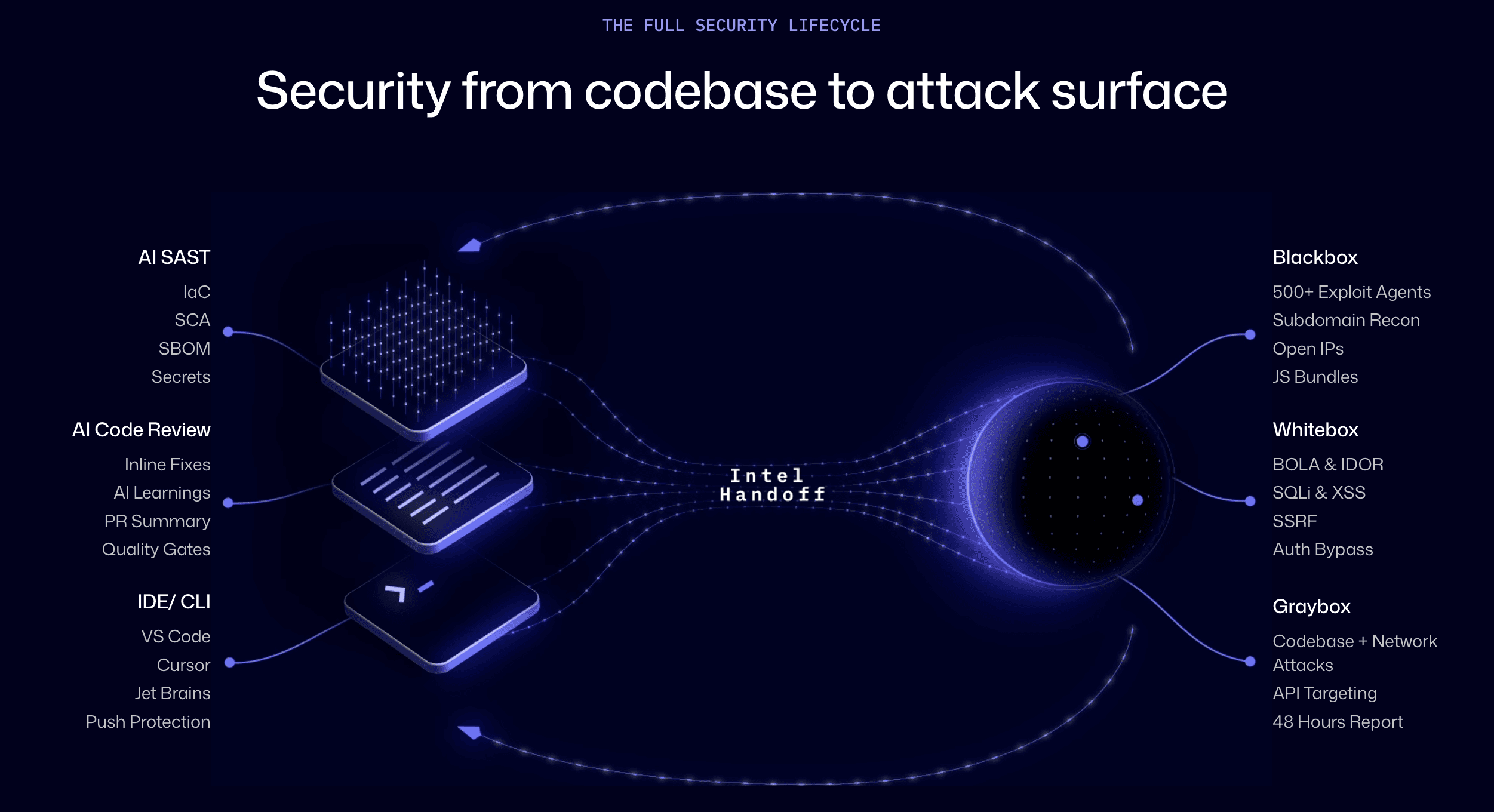
CodeAnt AI works across both sides of security: defensive code review inside CI/CD pipelines and offensive pentesting informed by the same codebase intelligence. Instead of relying on one testing mode, CodeAnt AI runs black box, white box, and gray box testing in parallel.
So the question is not simply, “Which AI pentesting platform finds more?”
The better question is, “Which AI penetration testing platform finds more for your testing model?”
xBow starts from the outside. It explores the application like an external attacker, beginning with a domain and discovering what can be reached without internal context.
CodeAnt AI also tests from the outside, but its offensive agents can use inside knowledge from the codebase, including authentication patterns, middleware configuration, insecure API flows, Git history, and data movement across the application.
That difference matters.
xBow is stronger when the goal is autonomous black-box exploit discovery without source access.
CodeAnt AI is stronger when the goal is code-informed AI pentesting that can uncover risks external-only testing may miss, such as Git history secrets, middleware misconfigurations, authorization flaws, and business logic chains that require source code context.
This comparison breaks down what each platform is structurally designed to discover, where each one fits, and how teams should choose between black-box AI pentesting and code-aware defensive and offensive security. No inflated vendor claims, just a practical decision framework for security teams evaluating xBow vs CodeAnt AI.
Architecture & Testing Models: How Each Platform Actually Works
xBow: Autonomous Black-Box Web Application Testing
xBow operates as a cold-start adversary simulator, multi-agent architecture exploring attack surfaces without source code access, Git history, or internal configuration knowledge. As of July 2026, xBow is generally available and deployed across Fortune 500 and 150+ security teams, backed by a $120M Series C raised in March 2026 (led by DFJ Growth and Northzone) on top of an earlier $75M Series B (source: xbow.com).
What it provides:
Leaderboard validation: topped the HackerOne leaderboard for AI-driven vulnerability discovery, and as of July 2026 ranks as the #1 autonomous system on Microsoft’s MSRC leaderboard with 14,000+ zero-days reported
Parallel multi-agent execution testing SQLi, XSS, SSRF, auth bypass simultaneously
Exploit validation with working proof-of-concept for every finding
Pure black-box focus, designed for external attack surface assessment
Architectural constraint: Cannot discover vulnerabilities requiring code context. If the exploit path involves understanding routing middleware edge cases, recovering secrets from Git history, or tracing data flows through business logic, xBow won’t see it. That’s not a flaw, it’s the trade-off of black-box testing.
Best for: External attack surface validation, third-party vendor assessments, scenarios where source code access isn’t available or desired.
CodeAnt AI: Three Parallel Testing Tracks with Code Intelligence
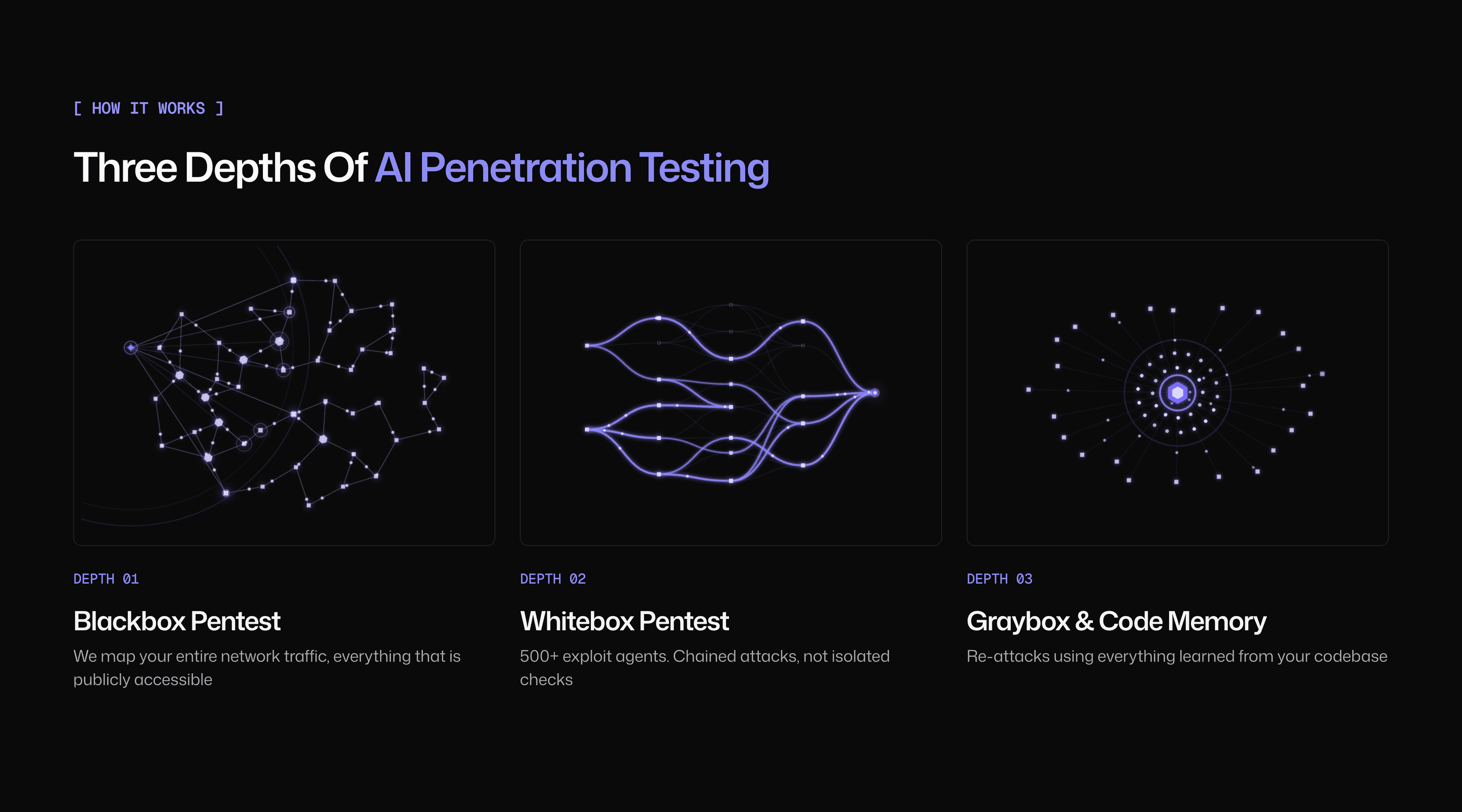
CodeAnt AI runs defensive code review continuously in your CI/CD pipeline, then us
es that accumulated intelligence to inform offensive testing. The offensive agents don’t start cold, they arrive with months of context.
Three parallel tracks:
Black box: External reconnaissance, subdomain enumeration, JavaScript bundle analysis for hardcoded secrets
White box: Source code tracing, Git history scanning for committed-then-deleted secrets, data flow analysis from API → business logic → database
Gray box: Authenticated business logic testing with code-informed attack chains (subscription tier abuse, race conditions, BOLA via GraphQL)
Code-informed reconnaissance means:
Knowing which routes have authentication middleware before testing
Recovering AWS credentials committed in 2023, deleted in 2024, still valid
Understanding GraphQL resolver authorization logic from source code
Identifying middleware routing misconfigurations invisible from external testing
Track record:
3 published CVE disclosures (CVSS 9.8, 9.3, 5.3) on public record
VulnCheck CNA partner for coordinated disclosure
CVE-2026-28292 (CVSS 9.8) and CVE-2026-29000 (CVSS 9.3) verified on NVD
Architectural constraint: Designed for SaaS and web applications. Not built for internal network infrastructure, Active Directory, or on-prem environments. Use Pentera or NodeZero for that.
Best for: Organizations that can grant repository access and want offensive testing informed by defensive code review intelligence.
What Each AI Pentesting Platform Discovers (And Structurally Cannot)
The honest capability mapping based on verified engagements and architectural design.
What CodeAnt AI Finds That xBow Cannot
These vulnerability classes require code context or Git history access:
Middleware Misconfiguration Vulnerabilities
Example: Healthcare SaaS platform with routing middleware stripping authentication headers on specific URL patterns, only discoverable by analyzing middleware code. CodeAnt finding: Unauthenticated access to admin panel via /internal/42/users (bypassing auth middleware), exposing 3.2M PHI records.
Why black-box testing misses it: The exploit path requires understanding how the middleware processes requests in code. External fuzzing won’t discover the specific pattern triggering the bypass.
Secrets in Git History
Example: AWS credentials committed in March 2023, deleted in June 2024 cleanup commit, but never rotated. Keys still valid.
CodeAnt finding: Recovered IAM credentials from Git history (git log --all -p), tested against AWS API, confirmed active S3 read/write access to production buckets.
Why black-box testing misses it: No Git repository access means no ability to recover deleted commits.
Complex Business Logic Chains Requiring Code Flow Analysis
Example: Subscription SaaS allowing tier upgrades via race condition, submitting two simultaneous payment requests with different tier selections charges lower tier but provisions higher tier.
CodeAnt finding: Traced checkout flow through source code (services/billing/checkout.ts), identified 200ms race condition window between Stripe webhook receipt and database transaction commit.
Why black-box testing struggles: Discovering this requires understanding the checkout state machine in code. External testing might find simpler race conditions but not this specific business logic flaw without source visibility.
Hardcoded Secrets in JavaScript Bundles Verified Live
Example: React app bundling a Stripe secret key (not publishable key) in client-facing main.js.
CodeAnt finding: Extracted Stripe secret key from JS bundle, tested against Stripe API, confirmed ability to issue refunds and access customer payment methods. Also found 27,255 CRM contact records embedded in client-side data file.
Why black-box testing has limitations: While xBow could extract secrets from JS bundles, CodeAnt’s advantage is cross-referencing with source code to verify which secrets are dangerous and testing them against live APIs with known endpoint context.
What xBow Finds Through Autonomous Exploration
xBow’s strength is discovering vulnerabilities through trial-and-error testing that doesn’t rely on code context:
Zero-Day Web Application Vulnerabilities
Example: GlobalProtect reflected XSS (publicly disclosed by xBow), discovered through autonomous fuzzing without prior knowledge of application architecture.
Why this matters: If the vulnerability exists in third-party components or closed-source dependencies not visible in your codebase, code-informed testing won’t find it. Black-box exploration is necessary.
Complex Attack Chains in Pure Black-Box Context
Example: Chained SSRF → internal service enumeration → credential leakage via error messages, discovered by systematically testing every input field for SSRF, then pivoting based on response behavior.
Why this matters: Attack chains relying on discovering internal services not referenced in source code (legacy infrastructure not documented in repo) benefit from black-box exploration’s lack of assumptions.
Side-by-Side AI Pentesting Tool CodeAnt AI vs xBow Comparison: Verified Findings
Vulnerability Class | CodeAnt AI Example | xBow Capability |
|---|---|---|
Auth bypass via middleware misconfiguration | 3.2M PHI records via Cognito → admin panel chain (requires routing analysis) | Limited (no code access) |
GraphQL BOLA | 742M person records via | Possible via black-box fuzzing, less systematic |
JS bundle secrets + validation | 27,255 CRM contacts + Stripe secret key extracted, verified live against API | Can extract secrets, limited validation without endpoint context |
Git history secrets | AWS credentials recovered from deleted commits, tested live | Not applicable (no Git access) |
Zero-day in third-party component | Not applicable if component is closed-source | GlobalProtect reflected XSS (HackerOne validated) |
Black-box SSRF chains | Possible but less emphasis on pure exploration | Strong capability via autonomous multi-agent testing |
Key distinction: CodeAnt AI finds more code-derived vulnerabilities. xBow finds more pure black-box vulnerabilities discoverable without source code access. The “more” depends on which classes matter to your threat model.
xBow Vs CodeAnt AI For SOC 2 Evidence, Retesting, And Compliance
Auditors need documentation mapping findings to controls, demonstrating retest verification, and quantifying regulatory exposure.
What Auditors Request
Retest verification: Proof vulnerabilities were fixed and retested in production
Timeline documentation: Discovery date, disclosure date, fix date, retest date per finding
Control mapping: Which TSC controls were violated (CC6.1 for logical access, CC7.1 for system operations)
Regulatory penalty exposure: GDPR, HIPAA, PCI-DSS fine calculations based on findings
CodeAnt AI’s 8-Document Evidence Package (Standard)
Delivered with every engagement at no additional cost:
Executive summary with business impact and regulatory exposure
Technical findings report with CVSS scores and exploit PoCs
Retest verification report (proof fixes work in production)
Timeline documentation per finding
TSC control mapping to SOC 2 controls
Regulatory penalty exposure analysis (GDPR €20M or 4% revenue, HIPAA up to ~$50K per violation at the highest tier)
Data deletion certificate
Compliance attestation letter for auditor review
Why this matters: Most pentesting vendors provide a technical report and charge extra for compliance documentation. CodeAnt AI includes the full package because target customers (companies with 100+ developers) are typically undergoing audits.
xBow’s Compliance Documentation
Unclear from public sources as of July 2026. Key questions to ask during evaluation:
Is TSC control mapping included for SOC 2?
Is regulatory penalty exposure analysis provided?
Are retests included or billed separately?
xBow Vs CodeAnt AI Pricing And Engagement Model
Pricing / TCO Area | xBow | CodeAnt AI | What To Check |
|---|---|---|---|
Base Pricing | Pentest On-Demand from $6,000 per pentest (launched Nov 2025), and a public /pricing page is now available (xbow.com, as of July 2026) | Free AI pentest scan, then pay only for confirmed high or critical findings | Confirm exact commercial terms during vendor evaluation |
Payment Model | Per engagement | Pay only for high or critical findings with working exploits | Check how severity and exploit validity are defined |
Theoretical Vulnerabilities | May be included depending on report scope | No payment for theoretical vulnerabilities | Ask whether unexploited findings are reported separately |
Retests | Unclear whether retests are included or add-ons | Unlimited retests after fixes included | Confirm retest turnaround SLA |
Compliance Documentation | Unclear whether compliance documentation is included or add-on | 8-document compliance package included | Ask whether SOC 2, ISO 27001, PCI DSS, or HIPAA mapping is included |
Testing Tracks | Primarily black-box testing | Three parallel testing tracks: black box, white box, and gray box | Match testing model to your risk profile |
Integration Setup Time | Hidden cost to consider | Hidden cost to consider | Estimate time for access setup, accounts, scope, and environments |
Engineering Validation Time | Hidden cost to consider | Hidden cost to consider | Measure how much internal time is needed to reproduce and triage findings |
Compliance Gaps | May require internal documentation work | Lower documentation burden if evidence package fits audit needs | Review sample reports before buying |
Decision Framework: When to Choose xBow vs CodeAnt AI
The right platform depends on your use case and testing context—not abstract “better” claims.
Decision Area | Choose xBow When | Choose CodeAnt AI When | Choose Neither When |
|---|---|---|---|
Best Fit | You need autonomous black-box web app testing without source code access | You need unified defensive and offensive security on the same intelligence layer | You need a platform outside both tools’ core strengths |
Source Code Access | You are testing a third-party SaaS, vendor system, or external target where repository access is not available | You can grant repository access and want code-informed offensive testing | You cannot share code, but also need internal network or mobile testing |
Testing Model | You want exploit-validated findings for the external attack surface only | You want black box, white box, and gray box testing running in parallel | You need internal network, Active Directory, or endpoint compromise simulation |
External Validation | HackerOne leaderboard proof and third-party validation matter for board-level reporting | Audit-grade evidence, retest verification, and code-to-exploit traceability matter more | You need human researchers at scale through a crowd or PTaaS marketplace |
Code Context | You do not need defensive code review or CI/CD integration | You want offensive agents to test with inside knowledge of auth patterns, middleware, APIs, Git history, and data flows | You need mobile app reverse engineering or binary analysis |
SDLC Integration | You are buying pentesting only, not continuous code security | You want continuous SDLC security through defensive code review in CI/CD plus offensive pentesting on the same platform | You need only standalone manual consulting or specialized research |
Compliance Evidence | You mainly need exploit validation for external web app risk | You need SOC 2 or ISO 27001 audit-grade evidence, including an 8-document compliance package | You need compliance documentation for internal infrastructure that neither platform tests deeply |
Best Use Case | External black-box AI pentesting for public web apps | Code-aware AI pentesting for SaaS apps, APIs, auth flows, business logic, and CI/CD security | Internal network or Active Directory testing, human PTaaS, or mobile reverse engineering |
Better Alternatives | Not applicable if black-box autonomous web testing is the goal | Not applicable if code-aware defensive and offensive testing is the goal | Use Pentera or NodeZero for internal network and Active Directory testing; use Cobalt or HackerOne PTaaS for human researchers at scale; use mobile specialists for iOS or Android reverse engineering |
Conclusion: Choose The AI Pentesting Model That Matches Your Risk
CodeAnt AI vs xBow is not a simple “which tool is better” comparison. It is a choice between two different AI pentesting models.
xBow is a strong fit when you need autonomous black-box AI pentesting against a public web application without source code access. It helps simulate what an external attacker can discover from the outside.
CodeAnt AI is stronger when you want code-aware pentesting that connects defensive code review with offensive exploit validation. It can use source code, Git history, middleware logic, API patterns, and authentication flows to find deeper risks that external-only testing may miss.
For SaaS teams preparing for SOC 2, scaling CI/CD, or testing business logic flaws like IDOR, BOLA, auth bypass, and privilege escalation, CodeAnt’s defensive and offensive model gives a clearer path from vulnerable code to confirmed exploit to retest evidence.
If your goal is only external black-box validation, compare xBow. If your goal is to prove exploitability with code context, reduce repeat vulnerabilities, and create audit-ready evidence, evaluate CodeAnt AI as a code-aware AI pentesting platform.

