AI Pentesting
Your SOW is Not a Pentest Authorization Letter: Here is Why It Matters

Sonali Sood

Founding GTM, CodeAnt AI
The Confusion That Creates Legal Gaps
Many organizations treat their penetration testing statement of work (SOW) as their authorization document. Their procurement process generates a SOW, the SOW gets signed, and the team assumes authorization is covered.
This is not always wrong. A well-drafted SOW can include authorization language. But most SOWs don't, they're commercial documents covering scope, pricing, deliverables, and IP. The authorization language that makes testing legally permissible is different from the commercial terms that govern the engagement.
When things go wrong, law enforcement arrives, a service goes down, a dispute arises about scope, the distinction matters.
What Each Document Does
Statement of Work (SOW):
A statement of work is a commercial contract between a client and a testing firm. It defines the business relationship. It answers what is being delivered and under what terms. A typical SOW includes:
Description of services
Deliverables and timelines
Pricing and payment terms
Intellectual property ownership
Termination conditions
Liability caps and indemnification
In simple terms, the SOW answers: What are we paying for and what are we getting in return
It does not inherently answer whether the testing activity itself is legally permitted. The SOW answers: "What are we paying for and what are we getting?"
Authorization Letter (also: Rules of Engagement, Permission Letter):
An authorization letter is a legal permission document. It defines what actions the testing team is explicitly allowed to perform on specific systems within defined boundaries.
It exists because penetration testing involves actions that, without authorization, could be treated as unauthorized access under applicable laws. A complete authorization letter typically includes:
Explicit authorization statement
Clearly defined in-scope systems
Out-of-scope exclusions
Named individuals allowed to test
Permitted and restricted techniques
Testing window and timing
Emergency procedures
Data handling rules
Cloud provider compliance
Legal acknowledgment and signatures
This document answers: Are these activities allowed, who approved them, and under what conditions
Where They Overlap (and Where They Don't)
Element | SOW | Auth Letter | Both |
|---|---|---|---|
Parties to the agreement | ✓ | ✓ | |
Scope of work | ✓ | ||
In-scope systems for testing | ✓ | ||
Pricing and payment | ✓ | ||
Deliverables | ✓ | ✓ | |
Explicit legal authorization | ✓ | ||
Named individuals authorized | ✓ | ||
Cloud provider notifications | ✓ | ||
Emergency procedures | ✓ | ||
Safe word protocol | ✓ | ||
Permitted techniques matrix | ✓ | ||
Data handling / GDPR | ✓ | ||
IP ownership | ✓ | ||
Indemnification | ✓ | ✓ | |
Governing law | ✓ | ✓ | |
Liability caps | ✓ |
Can You Combine Them Into One Document?
Yes, and some professional firms do this by default, creating a combined "Penetration Testing Agreement and Rules of Engagement" that serves both purposes.
For combination to work, the document must include all required elements of both. The commercial terms (pricing, IP, payment) and the authorization terms (explicit authorization, named individuals, emergency procedures, techniques matrix) must all be present.
The risk of combination: commercial terms are frequently revised (pricing changes, scope additions, timeline extensions) while authorization terms should remain stable. If the combined document gets amended for commercial reasons, someone needs to verify that the authorization terms aren't inadvertently affected.
For most organizations, keeping them separate is simpler and lower-risk.
The Minimum Authorization Letter (When You Have an SOW)
If your SOW already covers commercial terms comprehensively, the authorization letter can be a focused document covering only the authorization-specific elements:
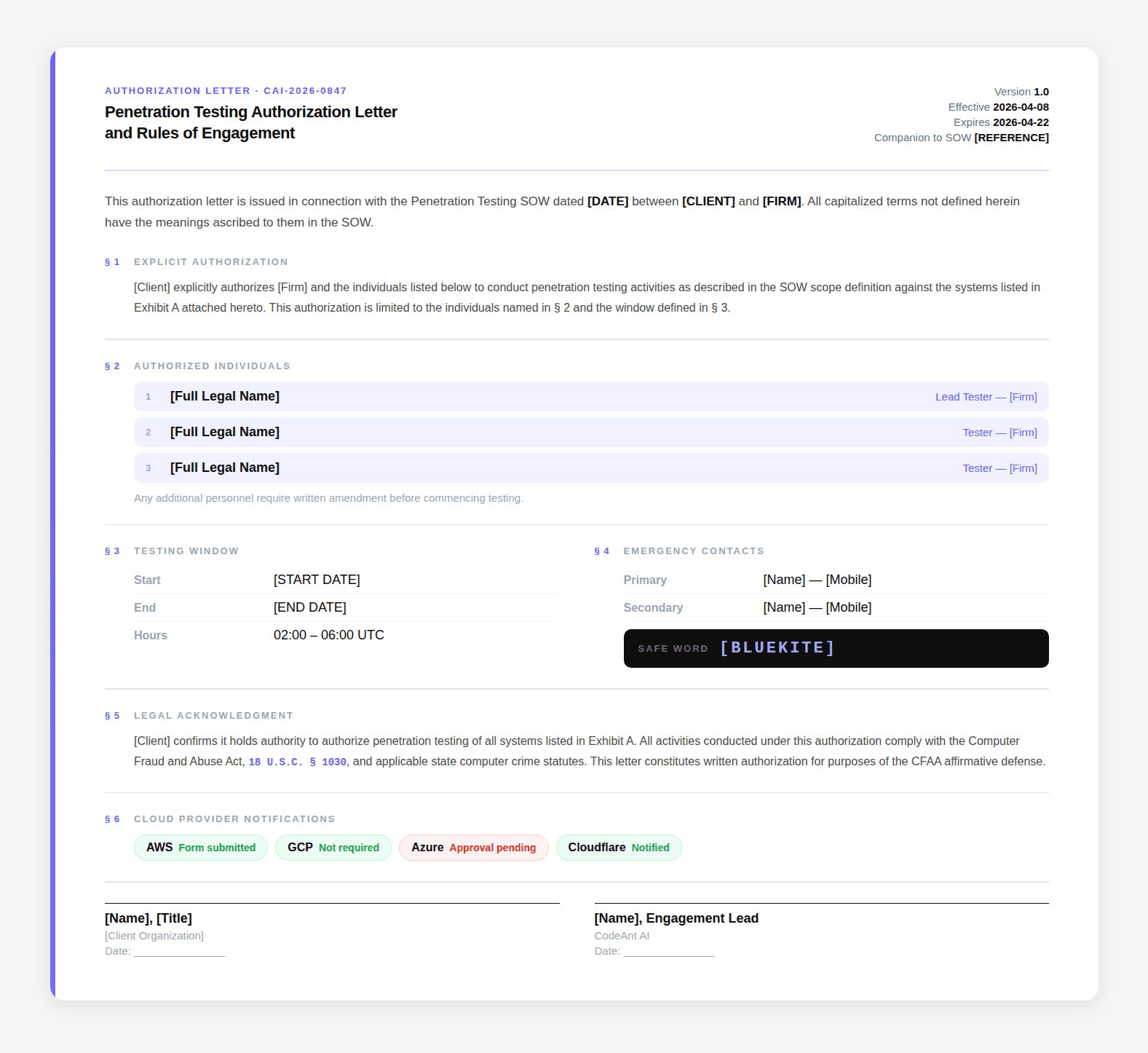
This minimum letter combined with a comprehensive SOW provides adequate legal and operational coverage for most standard engagements.
When You Should Not Use a Minimum Letter
Red team engagements: Need the full emergency procedure detail because blue team response is expected and must be handled specifically.
Physical security testing: Needs precise physical scope, law enforcement pre-notification documentation, and the get-out-of-jail card provisions.
Multi-cloud environments: Need detailed cloud provider authorization status per provider.
Regulated industries: HIPAA, PCI, FedRAMP engagements benefit from the full letter's documentation of regulatory-specific provisions for audit evidence.
First engagement with a new firm: Use the full letter to establish the relationship clearly.
What Your Legal Team Will Ask For
If your legal team reviews the documentation package, they will typically want:
A signed document that explicitly states the testing activities are authorized
Clear identification of who authorized them and their authority level
Named individuals (not just the firm)
Explicit scope with out-of-scope exclusions
Indemnification provisions (which may be in the SOW)
Governing law
Items 1-5 must be present regardless of whether they're in the SOW or the authorization letter. If your SOW covers all of them, your legal team may be satisfied with the SOW alone. If it doesn't, the authorization letter fills the gaps.
Where Traditional Authorization Models Break with AI Driven Testing
Traditional authorization models assume that testing is controlled, linear, and human-driven. AI-driven testing changes that assumption.
AI systems can explore systems in non-linear ways, chain vulnerabilities across services, and interact with infrastructure at a scale that was not possible before.
This increases the likelihood of:
Unintentional access to out-of-scope systems
Interaction with third-party services
Triggering cloud provider abuse detection
Generating traffic patterns that were not explicitly planned
Authorization documents written for manual testing often do not account for this behavior. This creates a gap between how testing is defined and how it actually executes.
Why This Matters More for AI Driven Penetration Testing
AI-driven penetration testing introduces a new layer of risk. Automation increases speed, coverage, and exploration depth. But it also increases the chance of crossing boundaries that were not clearly defined.
Without strong authorization controls, AI systems can unintentionally move beyond permitted systems or interact with environments that require separate approval. This makes clarity in authorization more important than ever.
The becomes the control layer that governs how testing, whether manual or automated, is allowed to operate.
How to Adapt Authorization for AI Based Testing
Authorization documents must evolve to support AI-driven testing safely.
This includes:
Defining scope in terms of systems and interaction boundaries
Restricting automated chaining across third-party systems
Strengthening out-of-scope handling procedures
Explicitly addressing cloud provider compliance for automated traffic
Defining limits on automated exploitation and data access
The goal is not to reduce testing effectiveness. The goal is to ensure that increased automation does not create unintended legal or operational exposure.
Commercial Agreement Does Not Equal Authorization
A statement of work defines what will be done. An authorization letter defines what is allowed.
That distinction is easy to overlook because both documents reference the same engagement. They describe the same systems, the same timelines, and the same testing activities. But they serve fundamentally different purposes.
One governs the business relationship.
The other governs legal permission to perform actions that would otherwise be considered unauthorized.
This is where gaps are created.
When organizations rely only on a SOW, they assume authorization is implied. In practice, that assumption only holds if the SOW explicitly includes authorization language, named individuals, and operational safeguards. Most do not.
The safest approach is clarity.
Use the SOW to define commercial terms. Use the authorization letter to define legal permission and operational boundaries. If you combine them, ensure nothing is missing when revisions happen. Because when something goes wrong, the question is not what was agreed commercially. The question is whether the activity was explicitly authorized.
FAQs
Is a statement of work legally sufficient to authorize penetration testing?
Why can’t a SOW replace an authorization letter in most cases?
When is it acceptable to combine a SOW and authorization letter?
What is the minimum authorization required if I already have a SOW?
Which document matters more during a legal or law enforcement situation?