

Your annual pentest came back clean in January. By March, you'd shipped 47 production deployments. How many introduced vulnerabilities that won't be caught until next year's engagement?
With over 21,000 CVEs published annually and deployment velocity measured in hours, the 90+ day gap between traditional pentests has become your largest attack surface. Real continuous pentesting requires six architectural capabilities most vendors quietly lack: code context, change triggers, parallel execution, exploit validation, remediation loops, and scope controls.
This guide breaks down the honest requirements for continuous pentesting, what platforms can automate, where human expertise still matters, and how to evaluate vendor claims against your actual security posture.
What "Continuous Pentesting" Actually Means (And What It Doesn't)
True continuous pentesting requires three operational capabilities:
1. Triggered by meaningful change
Pentesting fires when code ships, infrastructure changes, or attack surface expands, not on arbitrary schedules. A new API endpoint or authentication flow refactor should automatically trigger focused testing on affected attack paths. Scheduled weekly scans miss the 47% of vulnerabilities introduced mid-sprint.
2. Exploit-validated findings
Every reported issue includes a working proof-of-concept exploit. The difference: a CVSS 9.8 SQL injection with a curl command that extracts customer records vs. a scanner flagging "possible SQL injection" because it saw a database error message.
3. Remediation verification
The system retests after fixes deploy, validates the vulnerability is actually closed, and confirms no regression. Traditional pentesting leaves this loop open, you patch the issue but have no confirmation the fix worked until next year's engagement.
Continuous Pentesting Vs Vulnerability Scanning
Most platforms marketing as "continuous pentesting" are vulnerability scanners with better PR. They run signature-based detection on schedules, generate thousands of findings (70-80% false positives in typical DAST tools), and dump them into dashboards.
Noise drowns signal: When your platform flags 2,400 issues and 1,920 are false positives, developers stop trusting it. Real IDOR vulnerabilities get buried under "missing security headers" warnings.
No attack-chain reasoning: Real attackers chain vulnerabilities, a low-severity SSRF becomes critical when combined with cloud metadata service access and overprivileged IAM roles. Scanners test in isolation and never connect the dots.
Wasted remediation cycles: Your team spends 40 hours fixing scanner findings, deploys the patch, and nothing confirms it worked. Three months later, the annual pentest finds the same vulnerability still exploitable.
Why Annual Pentesting No Longer Matches CI/CD Velocity
The math is brutal… deployment velocity has accelerated from quarterly releases to multiple deployments per day. Annual pentesting leaves organizations exposed for 90+ days between assessments while new vulnerabilities emerge with every sprint.
The vulnerability window problem: You get a comprehensive report in January, remediate through March, then operate blind until next engagement. During those 9-10 months, your environment changes constantly, new features ship, dependencies update, infrastructure drifts, API endpoints proliferate.
HealthEC's 4.5M patient record breach occurred through a vulnerability introduced 6 months after their annual pentest. The attacker exploited an IDOR flaw in a newly deployed patient portal API, code that had never been tested.
Traditional scanners don't close this window effectively:
Authentication gaps: Most scanners can't navigate complex OAuth flows or multi-step authentication, they miss the 90% of applications behind auth where business logic vulnerabilities actually live
Logic flaw blindness: They can't reason about whether your checkout flow allows negative quantities or your API permits parameter manipulation to access other customers' data
False positive noise: Typical scans flag 200+ "vulnerabilities" where 60-70% aren't actually exploitable
Signature lag: Zero-days and novel attack chains don't have signatures yet
When Traditional Pentesting Still Makes Sense
Before positioning continuous testing as a silver bullet: human-led penetration tests still provide irreplaceable value for complex business logic testing, high-assurance releases before launching critical systems, and adversary emulation for mature programs.
The practical approach is complementary: continuous testing provides breadth, constant coverage as your attack surface evolves. Traditional engagements provide depth, expert analysis of critical systems at key milestones.
The 6 Requirements For Real Continuous Penetration Testing
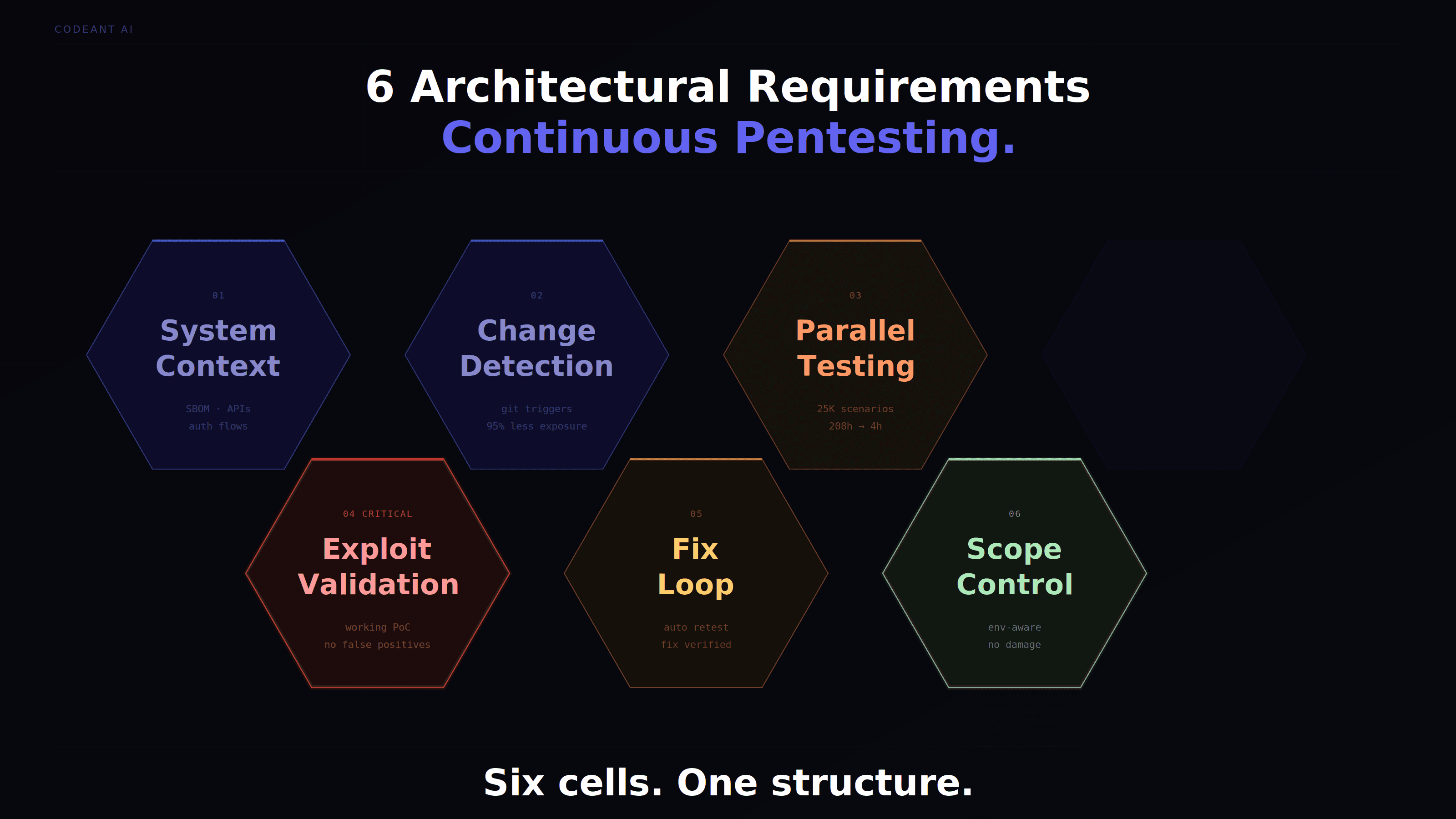
1. System Context and Intelligence
Continuous pentesting needs deep visibility into application architecture: source code structure, API contracts, service communication, infrastructure configuration, authentication flows, and data dependencies.
The difference between black-box scanning and context-aware testing is "found an open S3 bucket" versus "traced customer PII from the React form through three microservices to an S3 bucket with public read access, then exfiltrated 10,000 records to prove exploitability."
Why it matters: Real-world example, the 2023 MOVEit Transfer breach exploited a SQL injection requiring understanding of the file upload flow, session management, and database query construction. External scanners flagged the endpoint as "potentially vulnerable." Attackers who understood the context built a working exploit that compromised 2,000+ organizations.
Implementation signals:
Code-level intelligence through repository integration
SBOM and dependency mapping
API schema awareness (GraphQL introspection, OpenAPI specs)
Service mesh visibility for lateral movement opportunities
Common failure modes: Treating all endpoints equally, building context once then testing against stale architecture, ignoring infrastructure (IAM policies, network segmentation, container configurations).
2. Change Detection and Trigger Mechanisms
Effective continuous pentesting doesn't mean "always scanning everything" it means intelligently detecting changes that affect attack surface and triggering focused testing on deltas.
Modern engineering teams deploy 10–100+ times per day. Running full pentests on every commit wastes resources. But scheduled weekly scans miss the critical window, vulnerabilities introduced Monday might be exploited Tuesday.
The math: If you deploy 50 times per week and run weekly pentests, 49 deployments go untested for an average of 3.5 days. Change-triggered testing reduces your vulnerability window by 95%.
Implementation signals:
Git integration triggering on PR merges with diff analysis
SBOM delta tracking when dependencies update
Infrastructure change monitoring (Terraform/CloudFormation modifications)
Threat model mapping to prioritize which attack paths the change affects
Common failure modes: Over-triggering on every commit regardless of security relevance, under-triggering with only manual requests, ignoring infrastructure changes, treating all changes equally instead of risk-weighting.
3. Parallel Testing at Scale
A typical SaaS application with 500 API endpoints, 5 user roles, and 10 critical business flows has 25,000+ test scenarios. Testing each sequentially at 30 seconds per test takes 208 hours. By the time you finish, your application has changed 50+ times.
Parallel execution compresses that into 2–4 hours by running tests concurrently, making continuous testing actually continuous rather than perpetually behind.
Implementation signals:
Distributed test execution across multiple workers
State isolation (each test in its own context)
Resource management with intelligent throttling
Result aggregation and deduplication
Common failure modes: Sequential bottlenecks, state pollution between tests, resource exhaustion overwhelming staging environments, poor result correlation reporting the same vulnerability 50 times.
4. Exploit Validation and False Positive Management
The difference between a scanner and a penetration testing platform is proof of exploitability. Scanners report "might be vulnerable." Real pentesting proves it by extracting data or escalating privileges, then provides a working PoC.
The false positive problem: Traditional scanners have 40–70% false positive rates. When 600 of 1,000 "critical" findings aren't exploitable, developers learn to ignore security alerts, creating the dangerous situation where real vulnerabilities get lost in noise.
Implementation signals:
Working PoC exploits (curl commands, Python scripts)
Data exfiltration proof for exposure vulnerabilities
Privilege escalation evidence
Business impact mapping
Example validated finding:
Common failure modes: Theoretical reporting without proving exploitability, signature-based detection rather than successful exploitation, ignoring context, reporting technical findings without business impact.
5. Remediation Loop and Fix Verification
Finding vulnerabilities is half the job. Effective continuous pentesting closes the loop by generating context-aware remediation guidance, integrating with developer workflows, and validating fixes actually work.
The remediation gap: Traditional pentesting delivers PDF reports weeks after testing. Developers struggle to reproduce issues, implement fixes without security expertise, and have no way to verify their fixes work until next year's pentest. Result: 40% of vulnerabilities remain unfixed or fixed incorrectly.
Implementation signals:
Developer workflow integration (GitHub issues, Jira tickets, Slack messages)
Code-level fix guidance understanding your framework and language
Automated retesting when developers push fixes
Fix verification evidence showing before/after exploit attempts
Example remediation flow:
Vulnerability discovered: BOLA in
/api/users/:idGitHub issue auto-created with specific fix suggestion:
Developer implements fix, pushes commit
Platform detects commit, runs automated retest
Result: Exploit returns 403 Forbidden ✓
GitHub issue auto-closed with verification
Common failure modes: Generic "use parameterized queries" advice without specific code changes, requiring developers to log into separate security portals, manual retest coordination, no regression testing.
6. Scope Control and Execution Boundaries
Continuous pentesting runs automatically, often without human oversight. This requires strict controls to prevent out-of-scope testing, production impact, or unintended consequences.
The risk: Automated pentesting without boundaries can cause real damage, testing production instead of staging, filling disk space, accidentally charging real credit cards, modifying production IAM policies, triggering rate limits that block legitimate users.
Implementation signals:
Environment-aware rules (auto-detect production vs. staging)
Explicit asset scoping before testing begins
Action restrictions preventing destructive operations unless permitted
Rate limiting and throttling
Least privilege execution
Example scope configuration:
Common failure modes: Policy-only boundaries without technical enforcement, no environment detection, overly permissive defaults, no safety circuit breakers.
Continuous Pentesting Implementation Roadmap
Phase 1: Readiness Assessment
Before implementing continuous pentesting, audit your baseline security posture:
Baseline vulnerability management:
Do you have a defined process for triaging and remediating security findings?
Can you measure mean time to remediation (MTTR)?
Are security findings surfaced in developer workflow or buried in PDFs?
CI/CD discipline:
Are builds automated and repeatable?
Do you maintain environment parity (dev/staging/prod)?
Can you roll back deployments quickly?
Asset inventory:
Do you have complete inventory of public-facing assets?
Are you tracking API endpoints and authentication boundaries?
Can you map which services handle sensitive data?
If you're failing multiple criteria, address those gaps first. Continuous pentesting amplifies your ability to find and fix issues, but won't compensate for missing fundamentals.
Phase 2: Integration Patterns
CI/CD integration: Trigger testing on material changes, not arbitrary schedules.
Ticketing integration: Auto-create tickets with severity, affected component, remediation guidance, and assign to service owners based on repository mapping.
SIEM/SOAR integration: Feed pentest findings into Splunk, Elastic, or Chronicle to correlate offensive findings with defensive telemetry.
Phase 3: Scoping Strategy
Start with crown jewels:
Authentication flows (login, password reset, MFA, OAuth/SAML)
Payment processing (checkout, refund, subscription management)
Data access APIs (endpoints returning PII, financial data)
Environment-specific rules:
Environment | Testing Scope | Exploit Depth |
|---|---|---|
Production | Read-only recon, non-destructive | Validate exploitability, stop before data exfiltration |
Staging | Full attack chains, data manipulation | Complete exploitation including multi-step chains |
Dev | Aggressive testing, destructive attacks | Test DoS, resource exhaustion, edge cases |
Expand iteratively:
Week 1-2: Test one critical service, measure MTTR
Month 1: Add payment and user data services
Quarter 1: Expand to all public-facing APIs
Quarter 2+: Include internal services, microservices, infrastructure
Phase 4: Operational Ownership
Triage ownership:
Security team reviews critical/high findings within 24 hours
Engineering team acknowledges within 1 business day
Assign directly to service owners who can fix issues in their codebase
Fix SLAs:
Severity | Exploitability | Remediation SLA |
|---|---|---|
Critical | Confirmed exploit with PoC | 7 days |
High | Likely exploitable | 30 days |
Medium | Theoretical risk, requires chaining | 90 days |
Low | Minimal impact | Best effort |
Retesting workflow:
Developer submits fix PR
Platform detects code changes
Pentest agents rerun exploits
Ticket auto-closes if exploit fails, reopens if still succeeds
Platform-Led vs. Human-Led vs. Hybrid Models
Platform-led continuous testing (CodeAnt AI, Pentera, Cymulate) runs automated reconnaissance, vulnerability discovery, and exploit validation on triggers. Excels at breadth and speed, test thousands of endpoints simultaneously, deliver findings within hours. Trade-off is depth on sophisticated business logic flaws requiring creative reasoning.
Human-led continuous testing (Praetorian, Bishop Fox) provides quarterly engagements with experienced penetration testers who manually explore applications and construct multi-stage attack chains. Uncovers subtle logic flaws and privilege escalation paths automation misses. Limitation is frequency and cost, quarterly engagements at $50K–$150K leave 90+ day gaps.
Hybrid models combine platform automation for continuous coverage with human expertise for depth. CodeAnt AI's approach: 500+ autonomous exploit agents handle reconnaissance and standard vulnerability validation continuously, while the Offensive SOC team reviews complex findings requiring human judgment.
When each makes sense:
Platform-led works if your application is relatively simple with standard auth flows, and you have strong internal security expertise to triage findings.
Hybrid makes sense when your application has complex business logic, you need compliance-grade reporting with executive narratives, you want continuous coverage but lack internal red team expertise.
What to Measure: ROI and Engineering Outcomes
Vulnerability Window Reduction
Traditional annual pentesting:
Vulnerability introduced in January deployment
Discovered in September (8-month window)
Remediation takes 2-4 weeks
Total exposure: 240+ days
Continuous pentesting:
Vulnerability introduced Monday
Discovered Tuesday evening
Fix merged Wednesday
Total exposure: 24-48 hours
Calculate your exposure reduction: Annual window (90 days) vs. continuous window (2 days) = 45x faster remediation.
MTTR Improvement
Stale context (3+ months old): 4-8 hours per critical finding (developer must rebuild mental model)
Fresh context (24-48 hours old): 30-90 minutes per critical finding (developer remembers the feature)
Engineering time saved: 100 hours/year at $150/hour loaded cost = $15K annual savings in remediation efficiency.
Noise Reduction Through Exploit Validation
Traditional scanner:
500 "potential vulnerabilities" flagged
450 are false positives
Security team spends 200 hours triaging
Exploit-validated testing:
50 confirmed exploitable vulnerabilities with working PoC
Zero triage overhead, if reported, it's real
Annual triage waste eliminated: 425 hours at $120/hour = $51K/year saved.
Total Cost of Ownership (3-Year View)
Annual engagement TCO:
Year 1-3: $170K in engagement costs
Internal coordination: 72 hours = $10.8K
Total: $180.8K
Continuous platform TCO:
Year 1-3: $235K in subscription costs
Integration maintenance: 36 hours = $5.4K
Total: $240.4K
Value delivered:
Vulnerability window: 45x faster (90 days → 2 days)
Test frequency: 52x more coverage (1x/year → 52x/year)
Findings validated: 100% exploitable vs. 60%
Compliance gaps: 0 months vs. 11 months
MTTR: 6x faster (6 hours → 1 hour)
Net 3-year ROI:
Risk reduction value: $661K
Remediation efficiency: $45K
False positive elimination: $153K
Audit efficiency: $75K
Total value: $934K - $240K cost = $694K net benefit (11.6x ROI)
Vendor Evaluation Checklist
Change detection:
"How does your platform detect changes that affect attack surface?"
Look for: CI/CD webhooks, SBOM diffing, API schema change detection
Red flag: "We scan weekly" or "configure scan frequency"
Authentication testing:
"How do you handle authenticated testing across different user roles?"
Look for: Self-service scope configuration, automated session handling, role-based test matrices
Red flag: "We'll need credentials for each test run"
Exploit validation:
"For a critical finding, what evidence proves exploitability?"
Look for: Working PoC exploits (curl commands, scripts)
Red flag: "Detailed descriptions" without executable proof
Remediation loop:
"After I fix a vulnerability, how does retesting work?"
Look for: Automated fix verification, unlimited retesting
Red flag: "Submit a retest request and we'll schedule it"
Compliance mapping:
"How do findings map to OWASP WSTG, MITRE ATT&CK, and compliance controls?"
Look for: Pre-built control mappings, audit-grade reports
Red flag: "We can customize reports"
Integration ecosystem:
"What integrations exist for CI/CD, ticketing, SIEM?"
Look for: Pre-built connectors
Red flag: "We have an API you can use"
Score responses 0–2 (0 = no capability, 1 = manual/limited, 2 = automated/comprehensive). Platforms scoring below 10/12 are likely rebranded scanners.
CodeAnt AI's Continuous Pentesting Approach
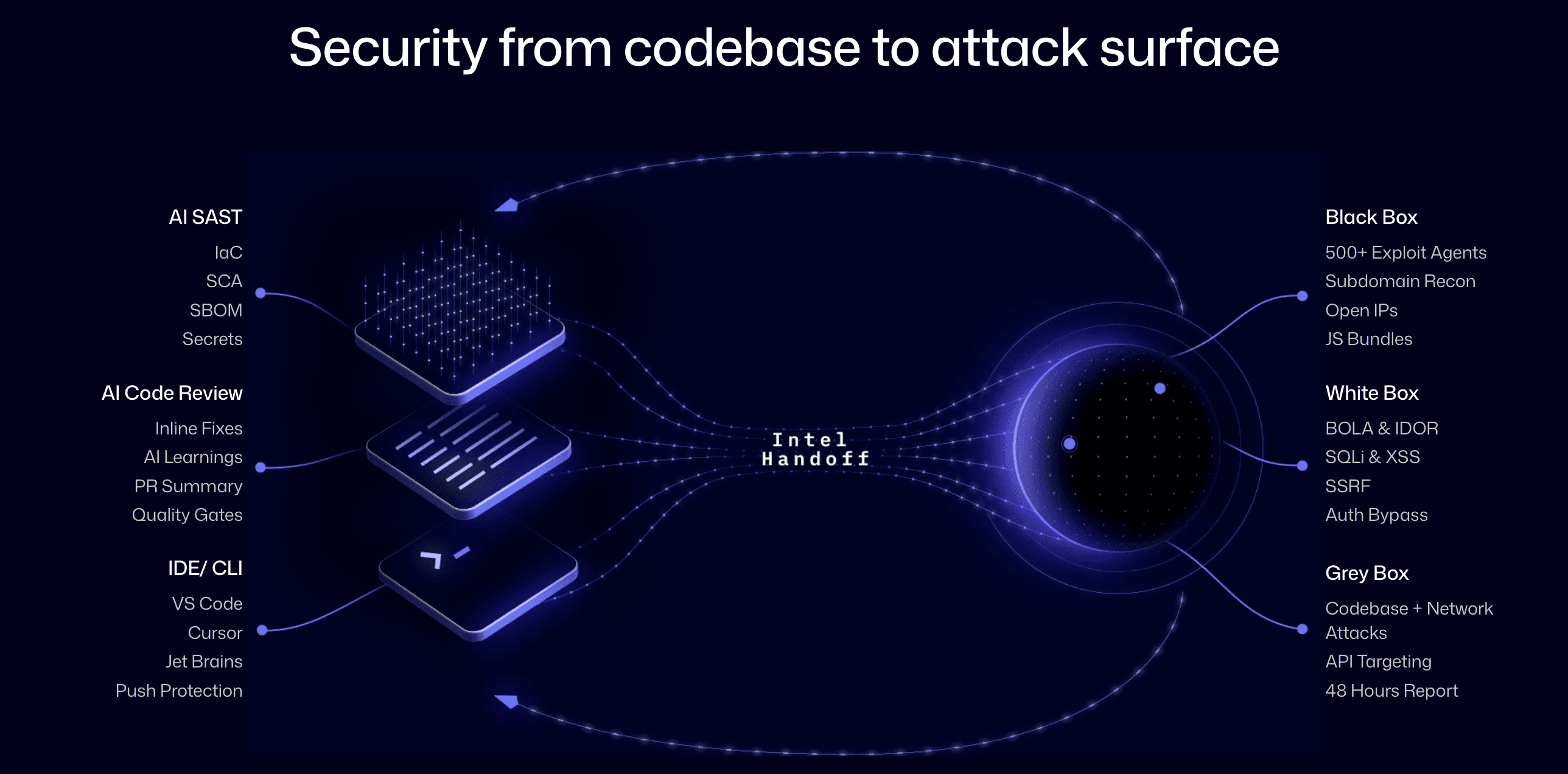
CodeAnt AI's differentiator is code-aware grey box testing, the same platform that reviews your pull requests for security vulnerabilities also conducts offensive testing, attacking from the outside with inside knowledge of your codebase.
How it works:
When CodeAnt discovers an API endpoint during reconnaissance, it already knows from code review:
The framework and language (Express.js, Django, FastAPI)
Authentication middleware and authorization logic
Database query patterns and ORM usage
Input validation rules
This enables smarter exploit validation, testing BOLA vulnerabilities with actual user IDs from your database schema, constructing SQL injection payloads matching your ORM's query structure, bypassing authorization checks based on middleware implementation.
Key capabilities:
500+ autonomous exploit agents running reconnaissance, vulnerability discovery, and attack-chain construction
Grey box testing using unified code intelligence from defensive code review
Audit-grade, compliance-aligned reports (SOC 2, ISO 27001, PCI-DSS, HIPAA) in 24–48 hours
Unlimited retesting after fixes with code-level validation
"No working exploit, no payment" model for critical findings
Hybrid model: Platform automation handles breadth continuously. Offensive SOC (human security researchers) tackles complex attack chains requiring creativity—multi-step business logic exploits, sophisticated authorization bypasses, adversary emulation.
Start 14-day free trial or book a 1:1 to map your environment to these six requirements and see how code-aware continuous pentesting reduces vulnerability windows from months to 24–48 hours.
Conclusion: Continuous Pentesting Needs Proof, Not Just Frequency
Continuous pentesting is not the same as running a scanner every week.
Real continuous penetration testing requires context, triggers, scale, exploit validation, remediation verification, and scope control. Without those six capabilities, teams get more dashboards, more alerts, and more false positives, but not less risk.
The strongest platforms reduce the vulnerability window by testing meaningful changes as they happen, proving exploitability with working PoCs, and retesting fixes automatically after remediation.
CodeAnt AI fits this model through code-aware grey box testing. It uses the same intelligence from defensive code review to guide offensive testing, helping teams attack from the outside with inside knowledge of the codebase.
If your current process still depends on annual pentests or scheduled scans, use the six requirements in this guide to evaluate whether your platform can actually prove risk, verify fixes, and reduce exposure between releases.

