


Two things are happening at once, and they point in opposite directions. Software is being written faster than ever, much of it by machines that are biased toward insecure patterns. The people who test that software for weaknesses are not multiplying at the same rate.
Automated penetration testing is the pressure valve, and in 2027 it looks nothing like the "faster scanner" it was a few years ago. The category has a new name, a new economic model, and a new set of machine-speed adversaries to keep up with.
This is a forward look for security and engineering leaders at teams shipping weekly or faster. What actually changed, which shifts are real, where automation stops, and how to prepare without drowning your team in alerts.
What CodeAnt AI solves here: CodeAnt AI runs code-aware pentesting as one half of a defensive and offensive platform. It reads your codebase during review, then validates exploitability against your live attack surface with that same context, so testing starts with knowledge instead of guesswork. It also one of those vendors offering 48-hour delivery.
Automated Penetration Testing Became Adversarial Exposure Validation
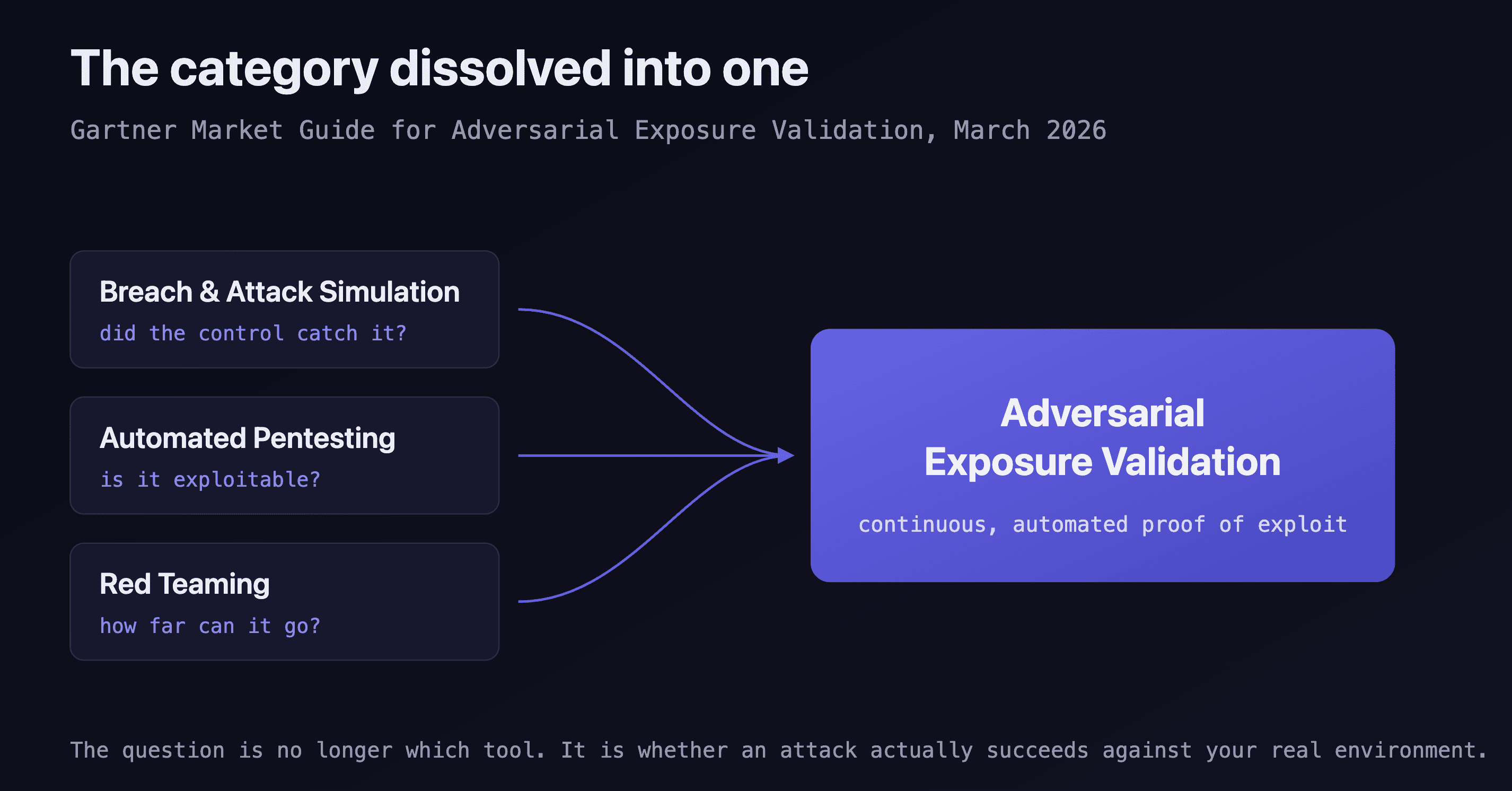
In March 2026, Gartner published its first Market Guide for Adversarial Exposure Validation, and it did something unusual. It formally dissolved three existing categories, breach and attack simulation, automated penetration testing, and red teaming technology, into one.
The new definition is the tell. AEV describes technology that delivers consistent, continuous, and automated evidence that an attack can actually succeed against your real environment and controls. The center of gravity moved from finding issues to proving them.
That reframes what "automated pentesting" even means. A tool that returns a ranked list of possible vulnerabilities is now the old category. A platform that executes the attack and shows the result is the new one.
The adoption curve backs the rename. Gartner's planning assumption is that through 2027, 40% of organizations will run formal exposure validation programs, and by 2029, 30% will wire validated findings straight into automated remediation. Point-in-time testing is being designed out of the roadmap.
Why Continuous Penetration Testing Replaced the Annual Test
The old model assumed a slow release cycle and a slow attacker. Both assumptions are gone.
Attackers now move at machine speed. CrowdStrike's 2026 Global Threat Report measured the average eCrime breakout time at 29 minutes, down from 62 minutes in 2024, with the fastest observed breakout at 27 seconds. A quarterly test cannot defend a surface that an intruder crosses in under half an hour.
Remediation is losing the race too. The Verizon 2026 DBIR found that only 26% of actively exploited vulnerabilities were ever patched, down from 38% two years earlier, while median time-to-patch climbed to 43 days. The gap between exposure and fix is widening, not closing.
The cost of getting this wrong keeps setting records. IBM put the average breach at 4.88 million dollars, a record high, with organizations taking 204 days on average just to identify a breach.
Then there is the release math. A team deploying weekly ships 60 to 80 releases between two quarterly pentests. Every one of those releases can introduce an exposure that goes untested for months.
Regulation closed the door on the old cadence. The EU's DORA, in force since January 2025, mandates continuous ICT risk monitoring for financial entities, the SEC's disclosure rules require material incident reporting within four business days, and PCI DSS 4.0 now requires retesting after any significant change. "Annual" no longer satisfies the word "continuous."
The AI-Generated Code Demands Automated Penetration Testing
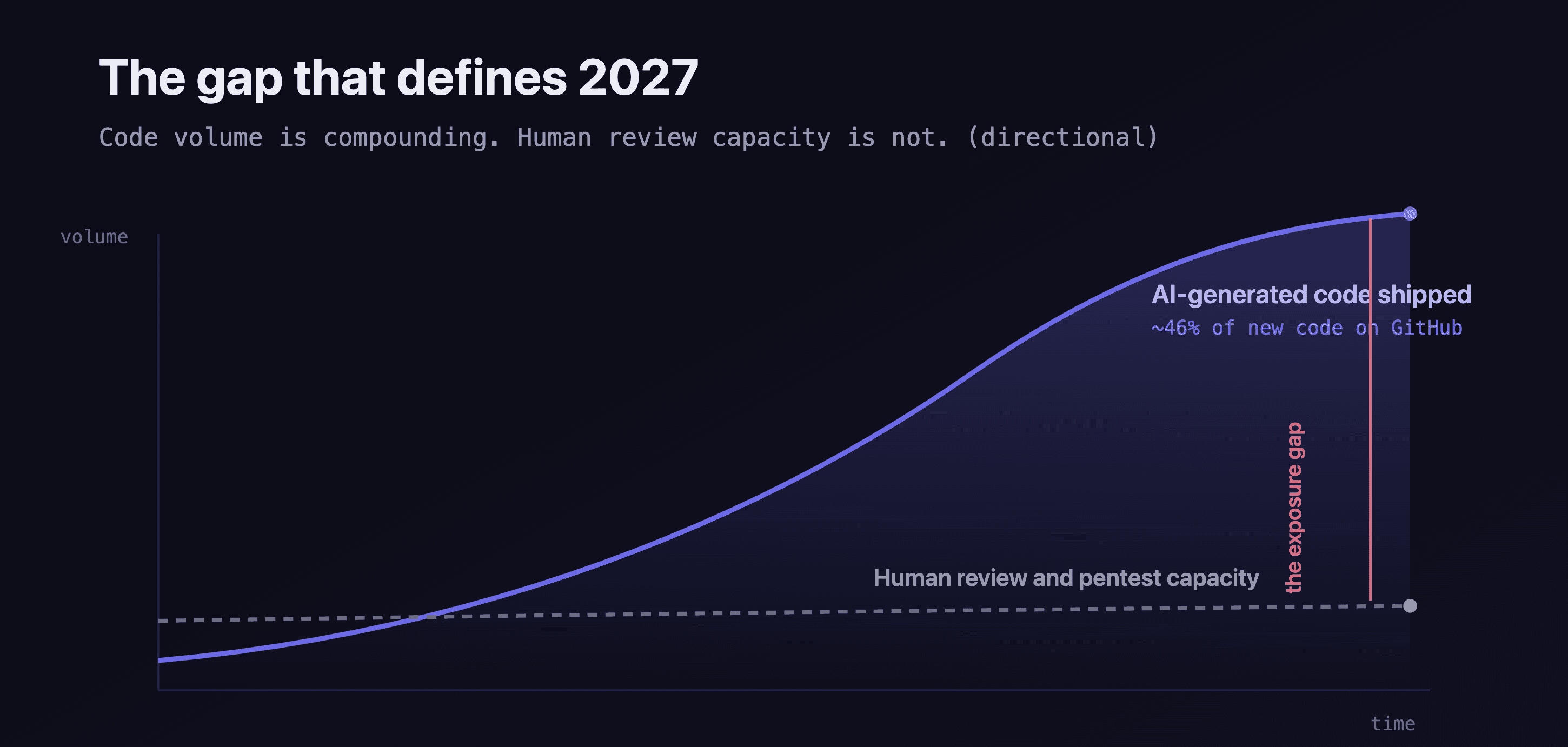
Here is the part that changes the whole calculus. The code being shipped is increasingly machine-written, and machine-written code is measurably less safe.
45% of AI-generated code shipped with a vulnerability mapped to the OWASP Top 10. In several tests the models were shown both a secure and an insecure path, and still chose the insecure one about half the time.
The volume amplifies the risk. Over 46% of new code on GitHub is already AI-generated. Due to this 2.74 times more security issues occur than human-authored code, including sharp jumps in privilege escalation paths and exposed secrets.
The proof is showing up in the CVE record. Our tool, CodeAnt Ai tracks vulnerabilities which are traceable to AI coding tools, logged a significant climb finding CVEs this year.
New attack classes came with it. Package hallucination, where models invent dependency names that attackers pre-register as malware, affects close to 20% of AI-suggested packages, and the coding tools themselves now carry CVEs like the Cursor MCP flaw that achieved code execution on developer machines.
This is the case for code-aware testing in one line. You cannot validate what you cannot see, and the thing writing your code has a documented bias toward the exact flaws an attacker looks for. We wrote more on that split in our piece on defensive versus offensive security.
6 Shifts Shaping Automated Penetration Testing in 2027
The trends most vendors talk about are real, but they are converging into something bigger. Here is what actually separates capability from marketing heading into 2027.
1. Code-aware testing becomes table stakes
For years, security testing forced a choice. SAST tools read source code but could not prove external exploitability, and DAST tools tested from the outside but had no code context to understand authentication or business logic.
Code-aware grey box testing by CodeAnt AI collapses that split by combining codebase intelligence with external attack simulation. The platform knows which routes exist, which middleware guards them, and where input flows to a database query.
The payoff is noise reduction. Understanding which findings are actually reachable cuts false positives sharply, which matters when a scanner-only approach can bury the dozen real issues under hundreds of theoretical ones.
The 2027 bet: as the code under test becomes majority machine-written, testing that reads that code stops being a premium feature and becomes table stakes.
2. Attack-path validation replaces the vulnerability list
The report that lists 500 findings sorted by severity is being retired. It never answered the only question that matters, which is what an attacker can actually reach.
Modern platforms demonstrate chains instead. Subdomain discovery leads to an exposed API, a broken object-level authorization check enables user enumeration, and an export function leaks the database. One path, mapped to real business impact.
Those chains map cleanly to MITRE ATT&CK techniques, which turns a vulnerability dump into a story a board can act on. A team stops triaging 500 findings and starts closing three proven paths to its crown jewels.
The 2027 bet: exposure is scored by reachability and blast radius, not by CVSS in isolation.
3. Autonomous agents find, deterministic engines prove
2025 delivered the proof of concept for autonomous offense. XBOW, an AI-driven pentester, became the first non-human to top HackerOne's US leaderboard, submitting close to 1,060 vulnerabilities and finding an unknown flaw in Palo Alto's GlobalProtect that touched more than 2,000 hosts.
The speed is the headline. On a benchmark of 104 real-world scenarios, a seasoned human took 40 hours where XBOW took 28 minutes.
The nuance is more important than the headline. At Black Hat, XBOW's own researchers explained that language models are strong at finding vulnerabilities and weak at validating them, so the system uses deterministic, non-AI checks to confirm a bug before it counts. Agents generate the hypotheses, and hard-coded logic proves them.
The 2027 bet: the platforms that win pair AI-driven discovery with deterministic proof, because an unvalidated finding from a model is just a faster false positive.
4. Governance becomes the gate on autonomy
Turning autonomous agents loose on production is a governance problem before it is a technical one. Gartner flags this layer as the part of AEV the market underestimates most.
The controls that define a serious platform are becoming a checklist. Scope enforcement so agents act only inside authorized boundaries, production-safe execution with rate limits, a forensic audit trail for every request, optional human-in-the-loop review, and a kill switch.
Without those, autonomous testing is a liability. With them, it is the only way to keep pace with autonomous attackers.
The 2027 bet: procurement questions shift from "what can it find" to "how is it contained," and the audit trail becomes as valuable as the findings.
5. Validation shifts left into the pipeline
Continuous stops meaning "we scan more often" and starts meaning "validation runs where the code changes." That means the pull request, not a scheduled window.
The pattern that works is triggered testing. A change fires a scan scoped to the changed code, criticals with a working proof block the merge, and everything else routes to a queue with an owner and an SLA.
A useful way to think about the cadence is a table, not a paragraph.
Cadence | Scope | Trigger | Purpose |
|---|---|---|---|
PR-level | Changed code only | Pull request | Catch exposures before merge |
Daily incremental | New endpoints and changes | Scheduled | Track attack surface growth |
Weekly full | Entire application | Scheduled | Comprehensive validation |
Post-fix retest | Remediated findings | Developer action | Confirm the fix holds |
The 2027 bet: the window between a change shipping and that change being validated shrinks toward zero, and testing that cannot run in a pipeline gets left behind. Our guide to continuous pentesting in CI/CD goes deeper on the mechanics.
6. Pricing moves from per-scan to proof-based
The subscription-per-scan model rewards the wrong thing. A vendor paid to report findings has every incentive to report more of them, validated or not.
Proof-based pricing flips the incentive. When payment attaches to confirmed, exploitable findings with a working proof of concept, the vendor invests in validation rigor rather than volume.
The trade-off is honest. Proof-based models are not built for compliance-driven comprehensive scanning like PCI ASV scans, and they ask you to trust the validation standard. For finding real risk fast, the incentives line up.
The 2027 bet: buyers increasingly refuse to pay for theoretical findings, and "no working exploit, no charge" moves from a differentiator to an expectation.
What Automated Penetration Testing Cannot Do
A forecast that only sells the technology is not honest. Three things stay firmly in human hands through 2027 and well beyond.
Business logic still needs a person. An agent can test a login form, but it cannot intuit that stacking two discount codes creates a pricing bypass, because that requires understanding what the application is for.
Novel attack research stays human. Zero-day discovery and genuinely creative exploitation come from researchers, not from models replaying patterns they have seen.
Validation of the subtle cases needs judgment. Even we concede that business logic flaws are hard to confirm automatically, which is exactly why the deterministic-proof layer exists.
The practical model is a division of labor. AI handles continuous scanning, known-pattern validation, and attack surface monitoring at machine speed, and humans handle business logic, novel research, and the final call on critical findings.
A 2027 Playbook for Automated Penetration Testing
You do not need to rebuild your program overnight. You need a sequence.
Start with a baseline. Run an automated platform against two or three representative applications and compare its findings to your last manual pentest, aiming for strong overlap plus a meaningful set of net-new discoveries.
Then wire it into the pipeline. Trigger scans on changes to authentication, authorization, and data handling, and set clear gates so only exploitable criticals with a proof block a deploy.
Get the governance right before you scale autonomy. Define scope boundaries by environment, enforce production-safe rate limits, and confirm the audit trail satisfies your compliance evidence needs.
Then measure what matters. Track mean time to detect, mean time to remediate, the exposure window between a change and its validation, and the share of your production surface under continuous testing.
KPI | What it measures | Target direction |
|---|---|---|
Mean time to detect | Change introduced to exposure found | Hours, not months |
Mean time to remediate | Confirmed exploit to validated fix | Days, not weeks |
Exposure window | Deploy to validation | Toward zero |
Coverage | Production surface under continuous validation | Steadily up |
How CodeAnt Serves Automated Penetration Testing
The through-line of every shift above is the same. Automation's speed only pays off when it is paired with context about your authentication flows, business logic, and data paths.
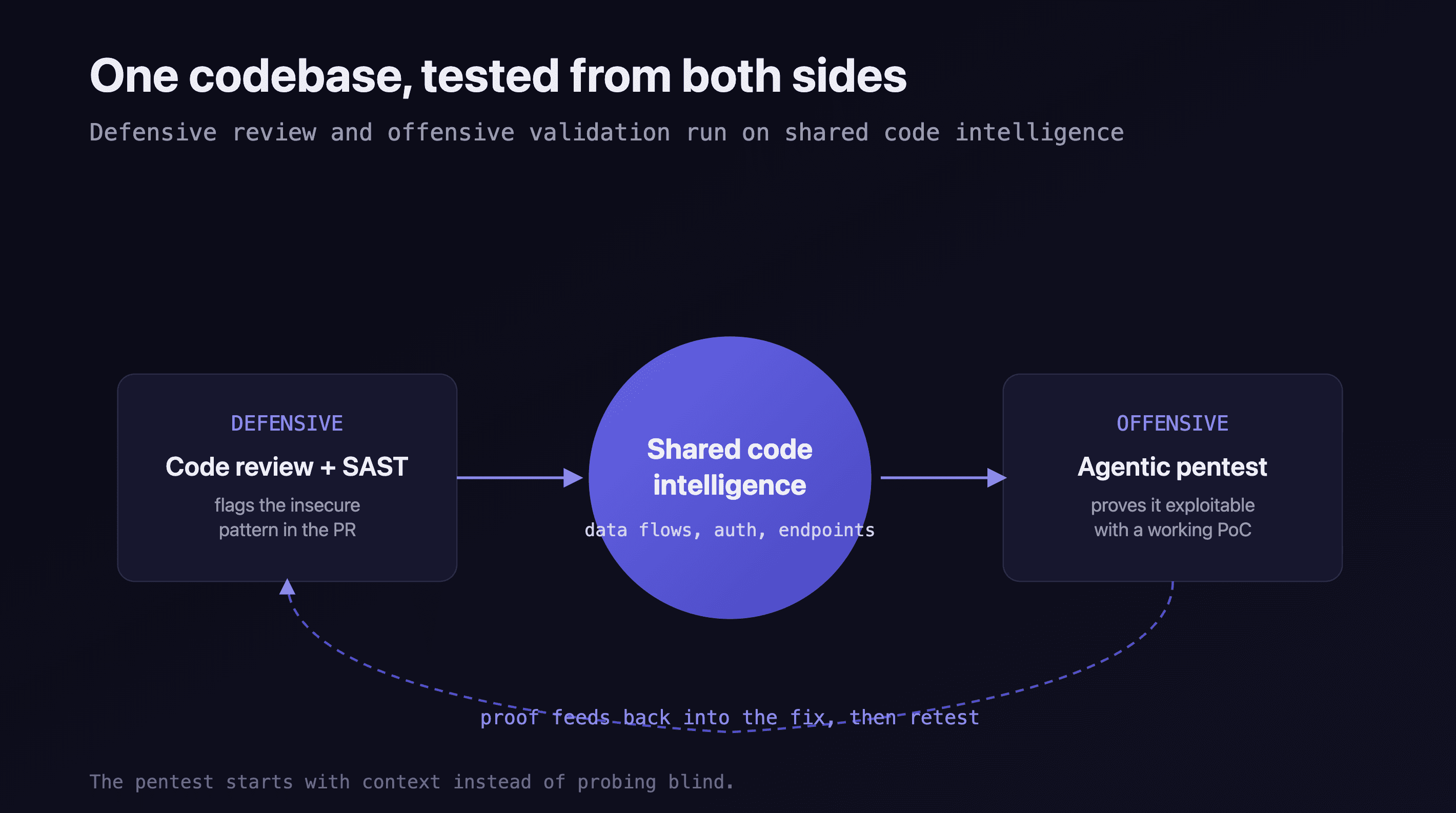
That is the gap CodeAnt was built for. It also one of those vendors offering 48-hour delivery. It unifies defensive code review with offensive validation on shared intelligence. So when the code review flags an insecure authentication pattern in a pull request, the pentesting engine already understands that flow and tests whether it is exploitable from the outside.
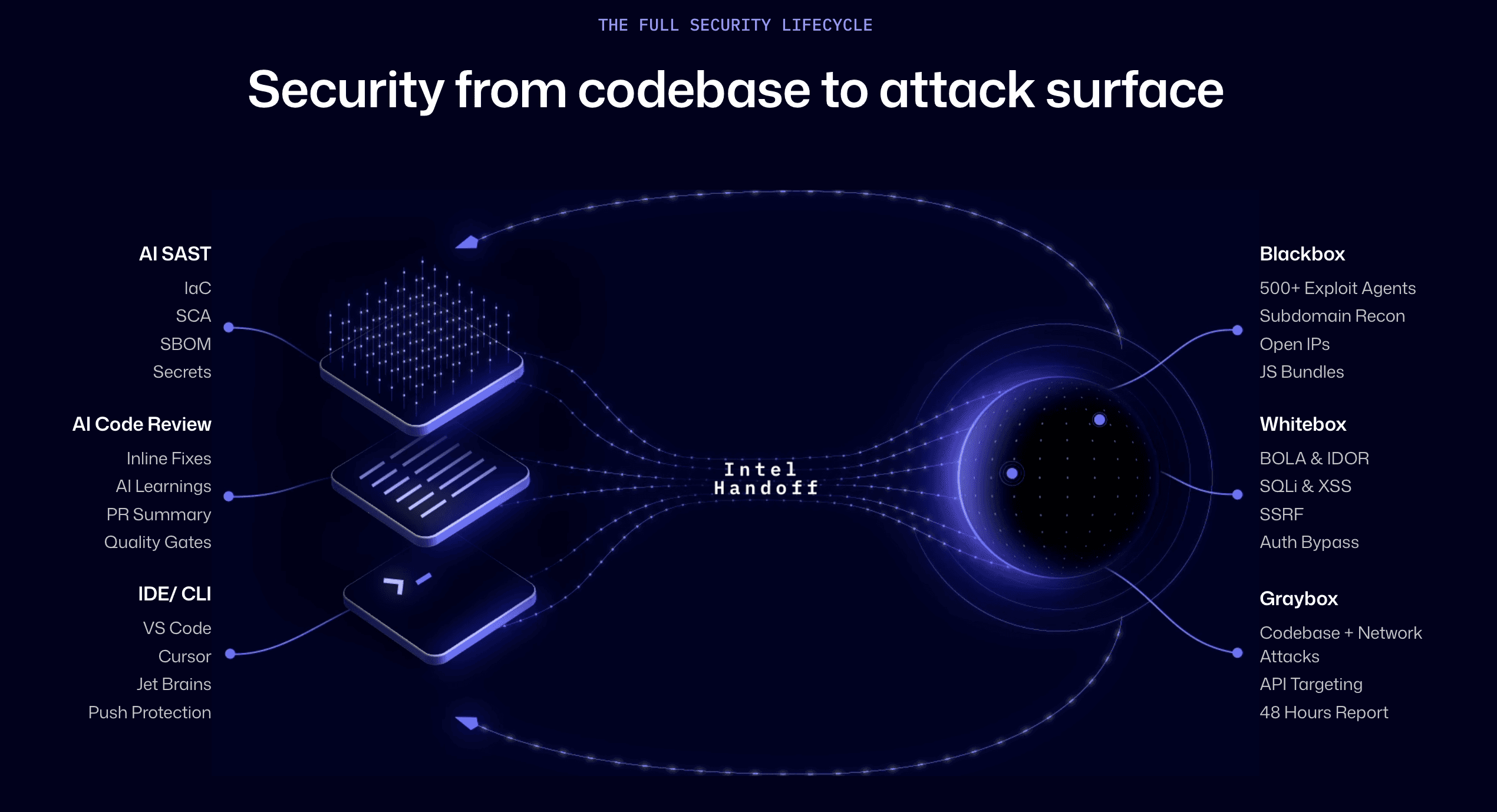
The result is evidence rather than debate. You get the defensive finding with a code-level fix and the offensive proof with a working PoC, which ends the "is this actually exploitable" conversation. Findings arrive with proof, retests confirm the fix, and pricing follows the proof rather than the scan count.
For teams shipping weekly, running API-first or microservices architectures, or consolidating a stack of disconnected tools, that unified model fits the 2027 reality. For infrastructure-heavy environments with little custom code, an external-only platform may be enough. You can see the approach on the CodeAnt pentesting page, and our take on AI pentesting and compliance covers the audit side.
Where Automated Penetration Testing Leaves You
The gap between how fast you ship and how fast you validate is either closing or turning into your biggest exposure. When code is written by machines that favor insecure patterns and probed by attackers who move in minutes, a test that runs four times a year is closer to a formality than a control.
The direction of travel is settled. Pentesting becomes continuous, proof replaces severity scores, autonomous agents do the finding while deterministic engines do the proving, and governance decides who is allowed to run them. The platforms that matter pair machine speed with code-level context and hand you evidence instead of a backlog.
That is the model CodeAnt runs, testing your surface from the outside with knowledge of your codebase from the inside, and charging only for confirmed, exploitable findings with a working proof.
Ready to see where you stand against the baseline? Launch a free black box scan for one URL, then book a walkthrough to compare code-aware validation with your current setup.

