

Most teams do not leave SonarQube because the analysis is bad. They leave because the renewal quote moved, the debt backlog stopped being triageable, and a self-hosted server turned into someone’s part-time job.
This is a swap list for code quality and SAST, judged on the three things that actually decide the migration: whether you still have to host and upgrade something, how much language coverage you give up, and what the bill is keyed to.
TL;DR, the 8 best SonarQube alternatives in 2026:
CodeAnt AI keeps the pre-merge gate, prices per seat, and adds the dynamic testing and agentic pentesting Sonar’s docs confirm it does not do.
Codacy is the closest like-for-like on quality gates and SAST, at $18 per developer with unlimited lines of code.
DeepSource runs deterministic rules plus AI review with no CI job and no server to operate.
Aikido Security trades some static depth for SCA, cloud, and container coverage on a flat monthly fee.
StackHawk proves at runtime what your SAST findings only assert, for $10 a seat.
Astra Security pairs an authenticated DAST scanner with certified human pentesters for the audit evidence a code scan cannot produce.
Intruder watches the internet-facing estate your repository scan has no visibility into.
Cobalt supplies human-led pentests when a customer or auditor wants a signed report.
Why Teams Leave SonarQube
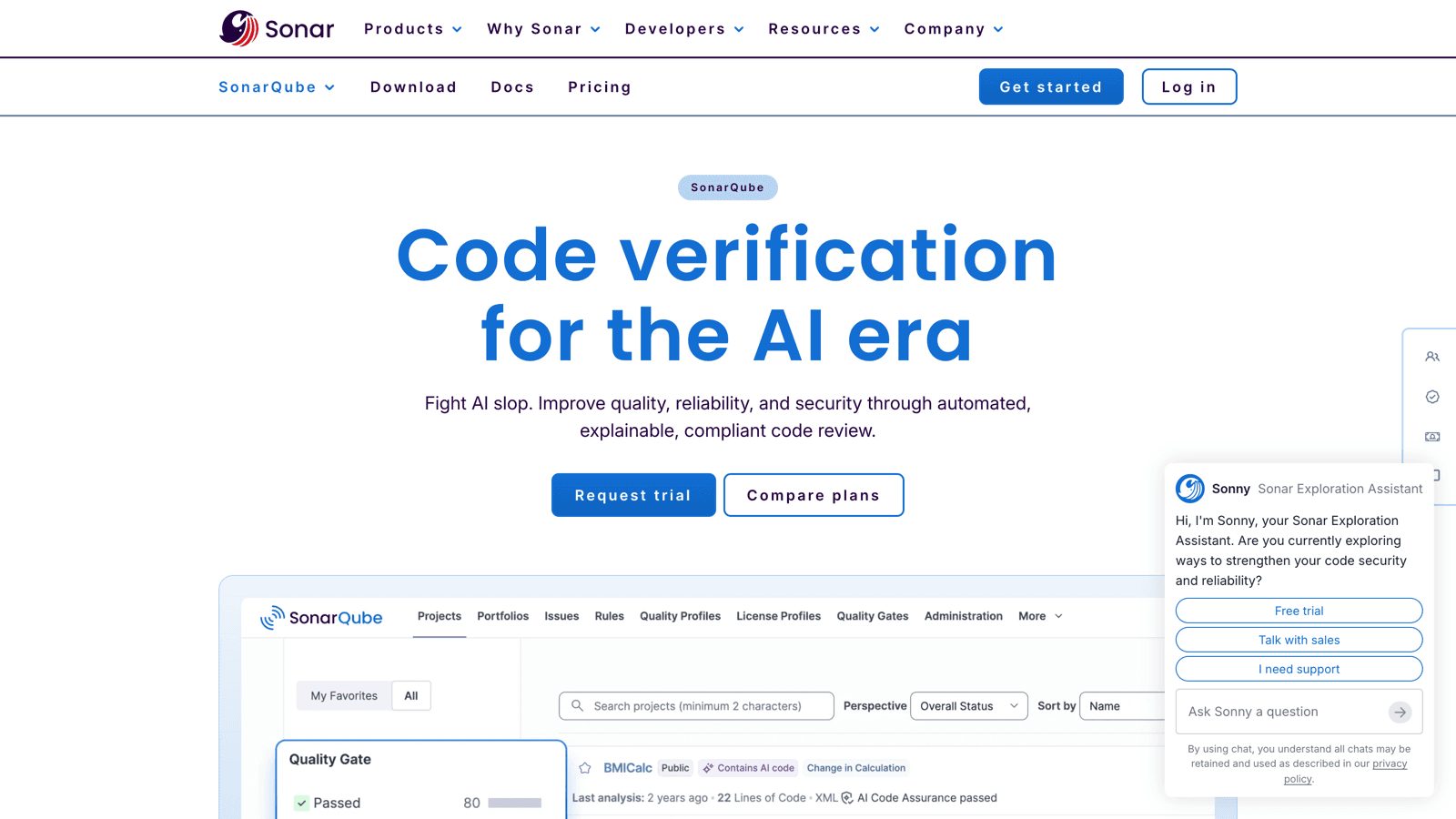
SonarQube is genuinely the deepest static engine in this market. Sonar publishes a 3.2% false-positive rate, more than 7,000 distinct issue types, and per-language rule counts reaching 650-plus for Java and C++, all graded against its Clean Code taxonomy.
Four complaints send platform teams shopping anyway, and they are worth naming precisely before you compare anything.
Gates that block delivery. A banking reviewer on Capterra warned that quality gates “may block delivery/deployment if hard gates are enabled,” which is the moment a quality tool becomes a release-engineering problem.
A debt pile nobody can triage. Seven thousand issue types across an old codebase produces a backlog measured in thousands of findings, and developers learn to scroll past it.
Operating the thing. SonarQube Server means an instance to run, patch, and upgrade, and the Community Build covers 21 languages rather than the full 40-plus.
Security that stops at the source file. SCA, dependency-aware Advanced SAST, SBOM, and license policy sit behind the paid Advanced Security add-on, and Sonar’s own docs confirm no DAST, IAST, or penetration testing anywhere in the platform.
How much does SonarQube cost?
SonarQube Cloud Team starts at $34 per month for up to 100k lines of code, with increments up to a 1.9M LOC ceiling. SonarQube Server Developer starts at $750 per year, priced per instance, and both meters count lines of code with unlimited users.

The forecasting problem starts above 100k LOC. Sonar publishes no LOC-to-price bands, no calculator, and no Enterprise figure, and a PeerSpot reviewer described a jump to “$15,000 per one million lines.”
That is the renewal conversation most switchers describe. If you are modeling the cost of staying, our SAST pricing guide breaks down how the per-LOC and per-seat meters diverge as a codebase ages, and the CodeAnt AI vs SonarQube comparison covers the like-for-like feature map.
A free Community Build, a 50k-LOC free Cloud tier, and free analysis for public repositories cover the entry point, and if budget is the only constraint, start with the free and open-source SonarQube alternatives instead.
The 8 Best SonarQube Alternatives at a Glance
CodeAnt AI leads because it is the only entry that keeps the pre-merge gate and adds dynamic testing. After that the list runs from direct code-quality replacements down to the runtime and exposure tools that sit alongside a scanner rather than replacing it.
# | Tool | Replaces SonarQube for | Self-hosting | Language coverage | Starts at |
|---|---|---|---|---|---|
1 | CodeAnt AI | Quality, SAST, SCA, secrets, IaC, plus pentest | Available on Enterprise | 30-plus languages | $24 / user / mo |
2 | Codacy | Quality gates and SAST, like for like | Sales-gated, about 2.5x the hosted seat price | 49 languages | $18 / dev / mo |
3 | DeepSource | Static analysis plus AI review | No server or CI job to run | 30-plus languages | $24 / user / mo |
4 | Aikido Security | SAST plus SCA, cloud, and containers | Not published | Opengrep-based ruleset, count not published | $350 / mo flat |
5 | StackHawk | Nothing, it tests what SAST cannot | Scanner runs inside your own CI | Language agnostic, tests the running app | $10 / user / mo |
6 | Astra Security | Nothing, it adds DAST and human pentests | Hosted service | Language agnostic, tests the deployed app | $199 / mo scanner |
7 | Intruder | Nothing, it covers infrastructure and exposure | Hosted service | Not applicable, scans the estate not the repo | $239 / mo annual |
8 | Cobalt | Nothing, it is a human testing service | Delivered as a service | Not applicable | Custom, credit-based |
The 8 Best SonarQube Alternatives in 2026
Each section covers what the tool gives you that SonarQube does not, where it comes up short against a tuned Sonar profile, and what it costs to start. Every claim traces to vendor documentation or a third-party review.
1. CodeAnt AI
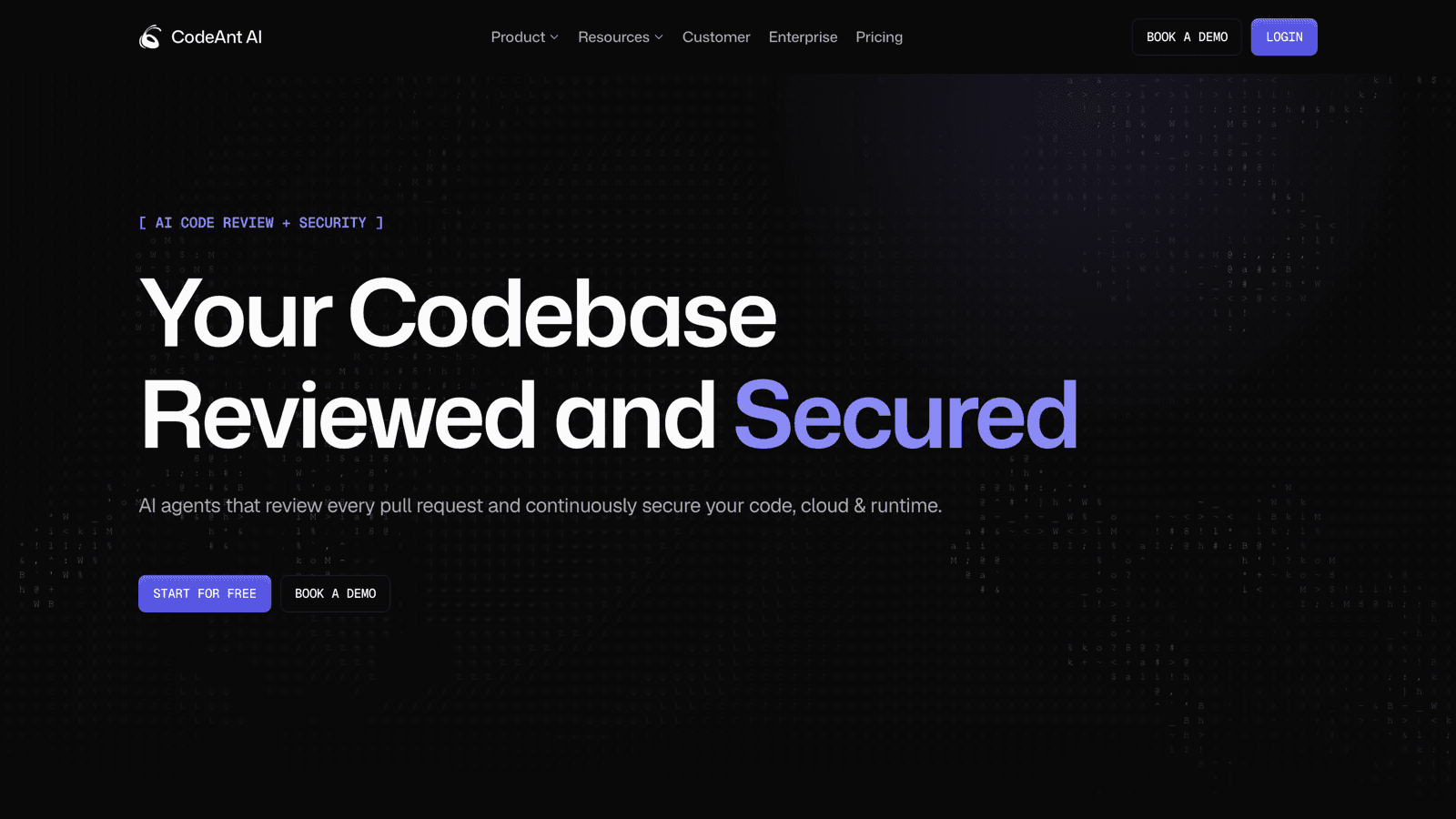
CodeAnt AI is the strongest SonarQube replacement in 2026 for one structural reason. It keeps the pre-merge gate a platform team already depends on, then carries the same codebase knowledge forward into dynamic testing and a real pentest, on one login and a per-seat bill.
SonarQube ends a finding at a severity score. CodeAnt’s agentic pentest ends it at a working exploit or nothing at all, and Jeson Patel, CTO at Series B startup 11x, said it “went deeper than any penetration test we’ve ever commissioned” after production runs surfaced 3.2M patient records through an unauthenticated API and 6M passenger records via a broken-object-level-authorization chain.
What it adds on top of a Sonar-style gate
SCA in the base product, not behind an add-on. AI code review, SAST, SCA, secret detection, and IaC all run inline on pull requests across 30-plus languages, so dependency coverage arrives without the Advanced Security tier.
Exploit proof instead of a CVSS number. Agentic pen testing and DAST chain attack paths against the running application and return a report inside 48 hours.
Coverage past the repository. CSPM, container scanning, VM scanning, and cloud threat detection reach the runtime ground a static engine never inspects.
Review comments engineers read. A Gartner Peer Insights reviewer in IT services called the feedback “highly accurate” and useful “for pointing out issues with edge cases, missed logic, and even mundane things that are easy to miss like naming inconsistencies and copy/paste errors.”
Bitbucket and Azure DevOps without a workaround. An engineering director on G2 called it “one of the few tools which works with BitBucket” and credited it with cutting “considerable time to review PR.”
What to weigh before you commit
A shorter track record than a decade-old incumbent. CodeAnt carries 4.8 on G2 and 4.7 on Gartner against SonarQube’s years of Capterra and PeerSpot history, so weigh the trial over the star count.
Occasionally more cautious than a tuned Sonar profile. A mid-market reviewer on G2 noted suggestions can feel “too cautious or sometimes it needs manual adjustments, also onboarding takes time.”
Not the single deepest static rule library. If raw rule count is the deciding metric, Sonar’s 650-plus Java rules across 40-plus languages still win that specific argument.
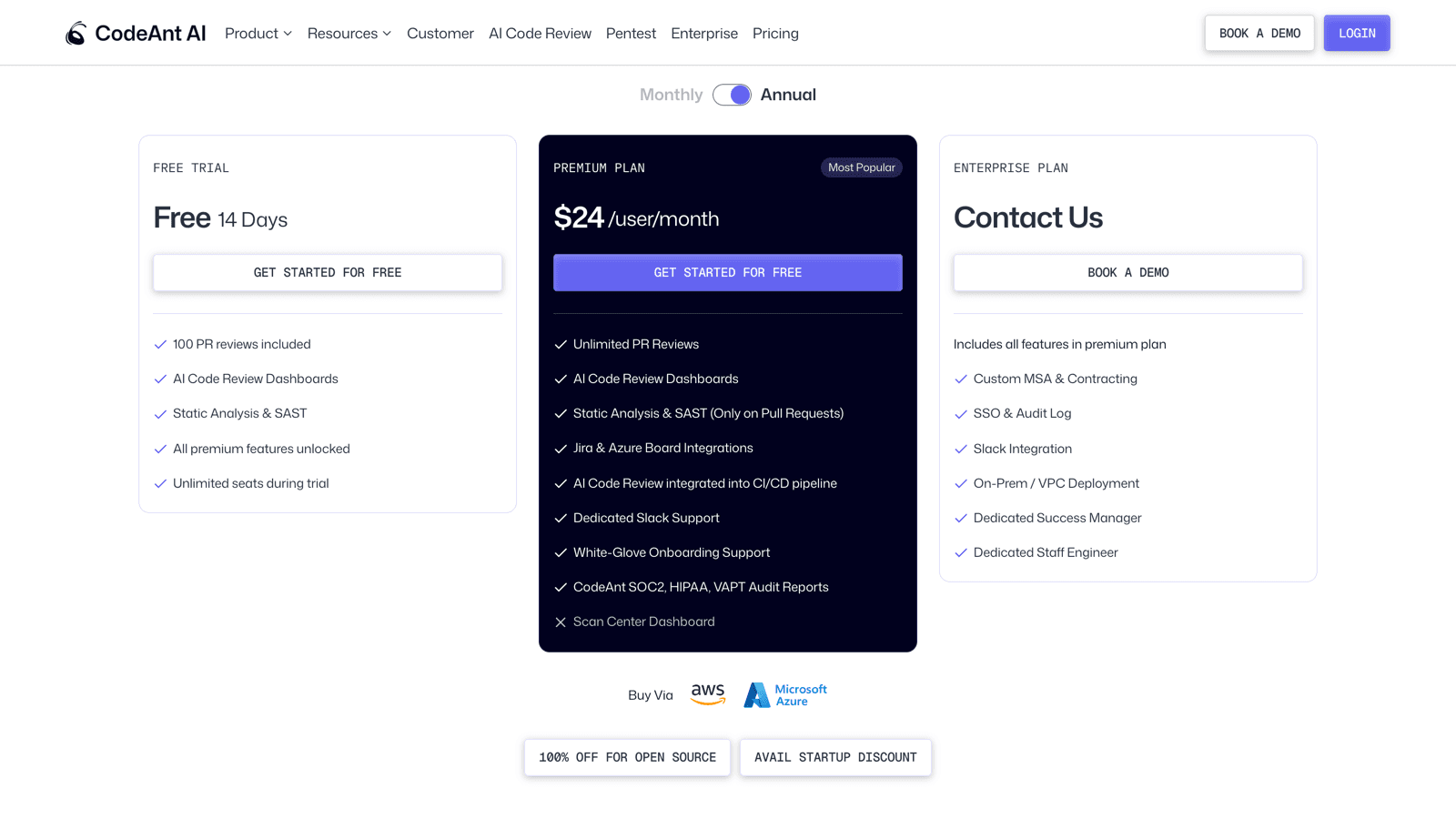
Cost to start: $24 per user per month on annual billing, free for open-source repositories, with pentesting billed only on exploitable High and Critical findings and no engagement fee.
2. Codacy
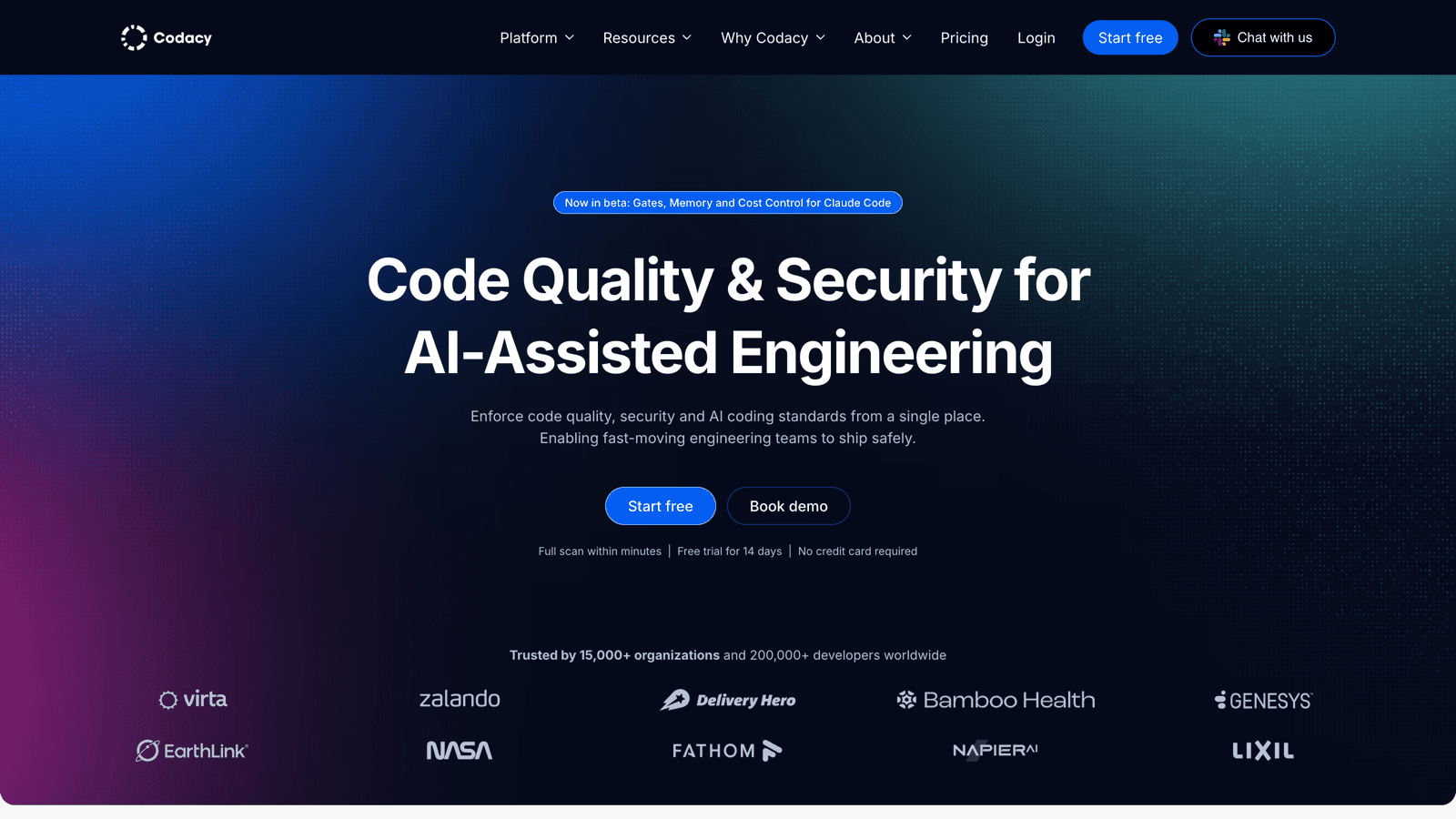
Codacy is the most direct like-for-like swap on this list. It plays the same game SonarQube plays, quality gates and SAST enforced org-wide, and changes the one variable Sonar buyers complain about first.
The switch is a documented pattern rather than a pitch. Daan van Leth of ihomer, quoted on Codacy’s pricing page, said “SonarQube’s pricing changed, so we needed an alternative that we could deploy across all projects.”
What it does better than SonarQube
The LOC meter disappears. Billing is per developer seat with unlimited lines of code, so a monorepo that doubles in size does not move the invoice.
Broader language reach than Sonar’s paid tiers. Opengrep, PMD, Trivy, and per-language linters cover 49 languages with 12,000-plus scan rules on paid plans.
DAST at the Business tier. App Scanning runs OWASP ZAP against staging web apps, OpenAPI, and GraphQL targets, which SonarQube does not offer at any tier.
Rules enforced at the prompt, not just the merge. An MCP-driven IDE extension applies your standards inside VS Code, JetBrains, Cursor, and Windsurf so agents open review-ready PRs.
Fewer style arguments in review. An IT-services CTO noted it “frees up Senior Resources to add value instead of arguing about casing and low level standards.”
Where it falls short
Cloud-hosted Git only. Codacy Cloud connects to cloud GitHub, GitLab, and Bitbucket, with Azure Repos still waitlisted, where SonarQube Server runs anywhere you can host it.
Self-hosting costs a premium. A staff engineer reported the on-prem edition runs “2.5x more expensive than the hosted license per seat,” and that support “is very slow to respond.”
A lighter security taxonomy. Findings sort into 25-plus security categories against SonarQube’s 7,000-plus issue types.
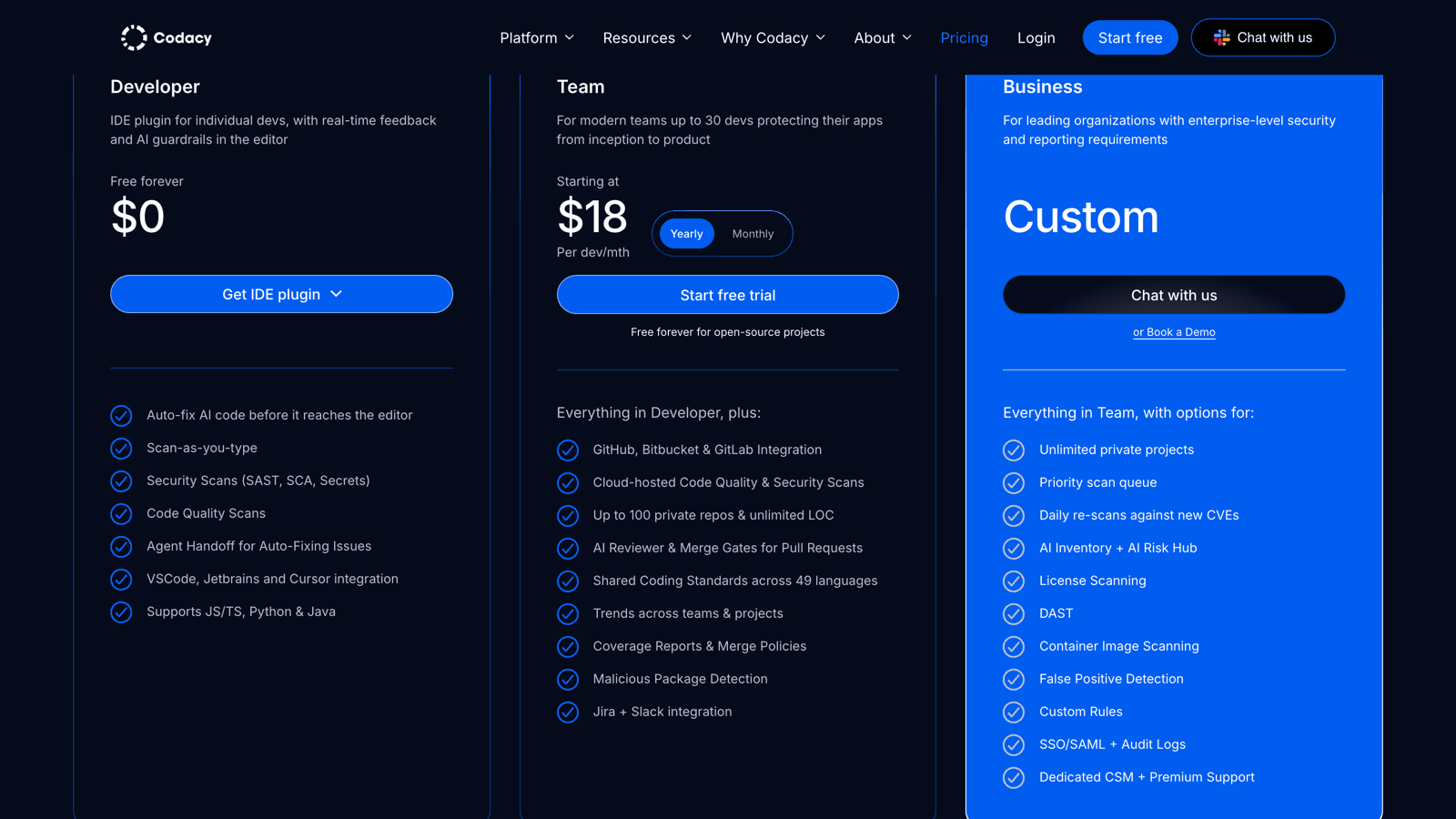
Cost to start: $18 per developer per month on the annual Team plan with unlimited lines of code, plus a free IDE plugin and free forever for open source.
3. DeepSource
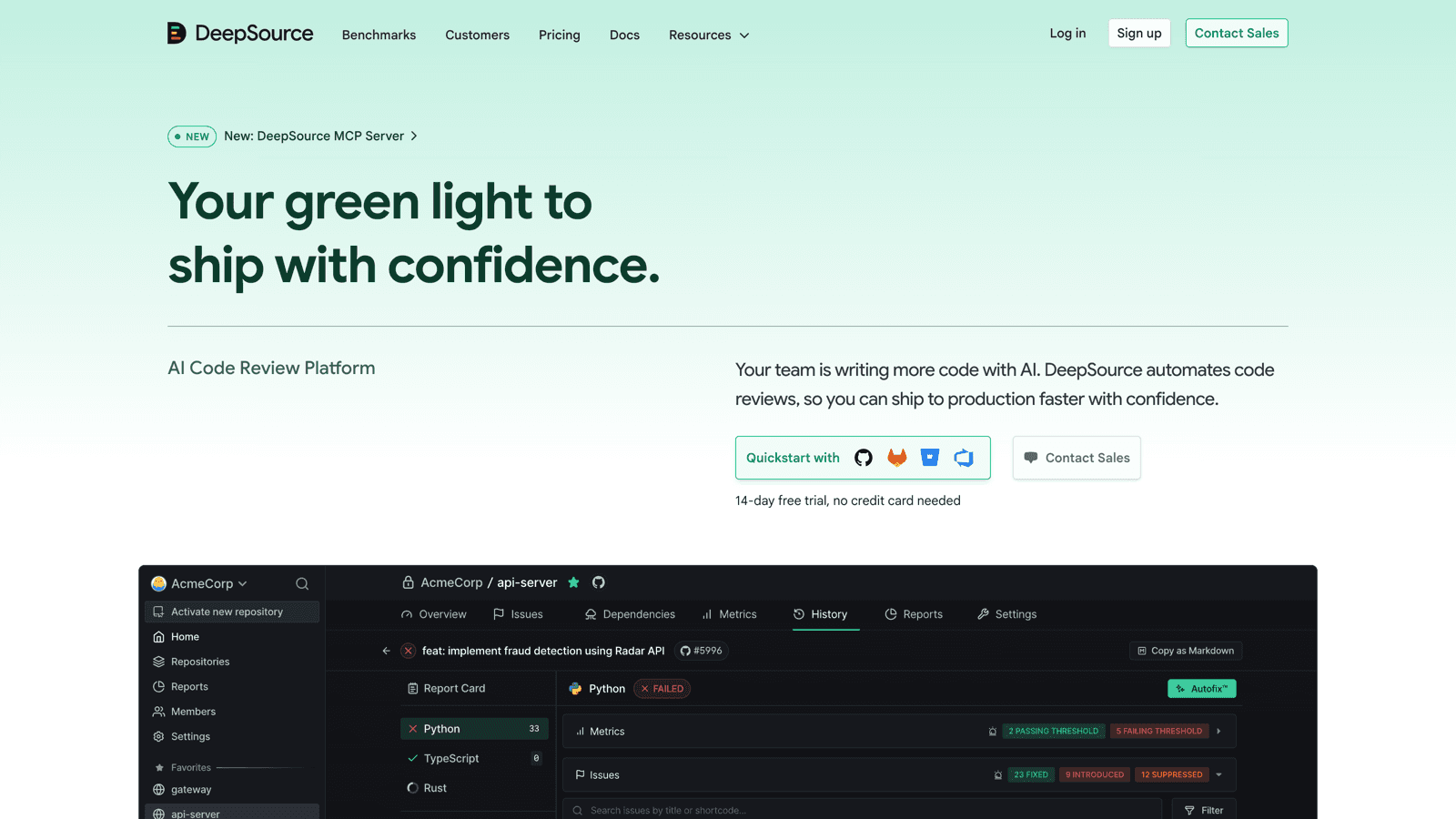
DeepSource is the closest philosophical match to SonarQube that also removes the two operational costs. There is no server to run and no CI job to maintain, against what its own comparison page describes as SonarQube’s “Requires CI + server.”
The other wedge is accuracy you can check. DeepSource publishes an F1 score of 84.51% on a 165-CVE security benchmark, and a per-seat price you can buy without a sales call.
The case for switching
Deterministic rules underneath the AI. More than 5,000 rules across 30-plus languages run alongside AI Review, so findings trace to a rule rather than a model guess.
Fixes arrive as a diff you approve. Autofix generates verified patches aimed at AI-written code, a step past the guidance a Sonar finding hands you.
Dependency noise ranked by reachability. A Dynamic Risk score folds in EPSS and reachability to cut SCA volume by up to 60%, which matters when the existing backlog is the reason you are leaving.
Onboarding measured in minutes. A data analyst on Capterra praised “how simple the setup process was,” and reviewers single out the automatic linkage with GitHub repositories as time saved.
The catch
Same ceiling as Sonar. DeepSource states on its own site that it does not cover DAST or container scanning, so pre-merge stays pre-merge.
Narrower language reach. 30-plus languages and 5,000-plus rules trail Sonar’s 40-plus, and a Launch HN commenter pushed back with “when you offer support for C++, we’ll talk.”
A loud first run. A full-stack developer wrote that it “could generate a lot of input, which some engineers might find overwhelming,” which is the debt-pile problem again if you point it at a legacy repo.
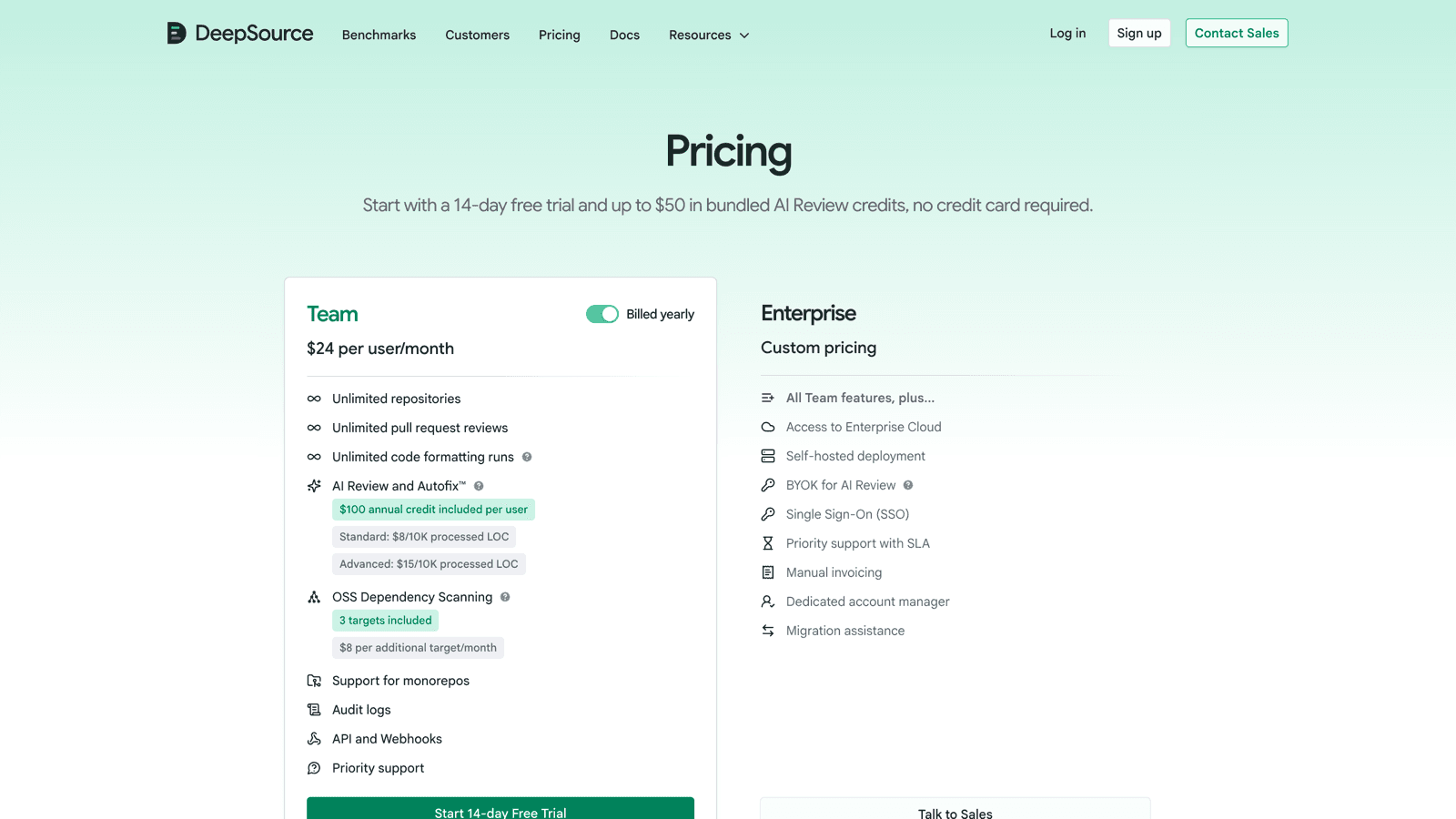
Cost to start: $24 per user per month on the annual Team plan billed per active committer, free forever for public repositories, with AI review metered on top at $8 or $15 per 10k processed lines.
4. Aikido Security
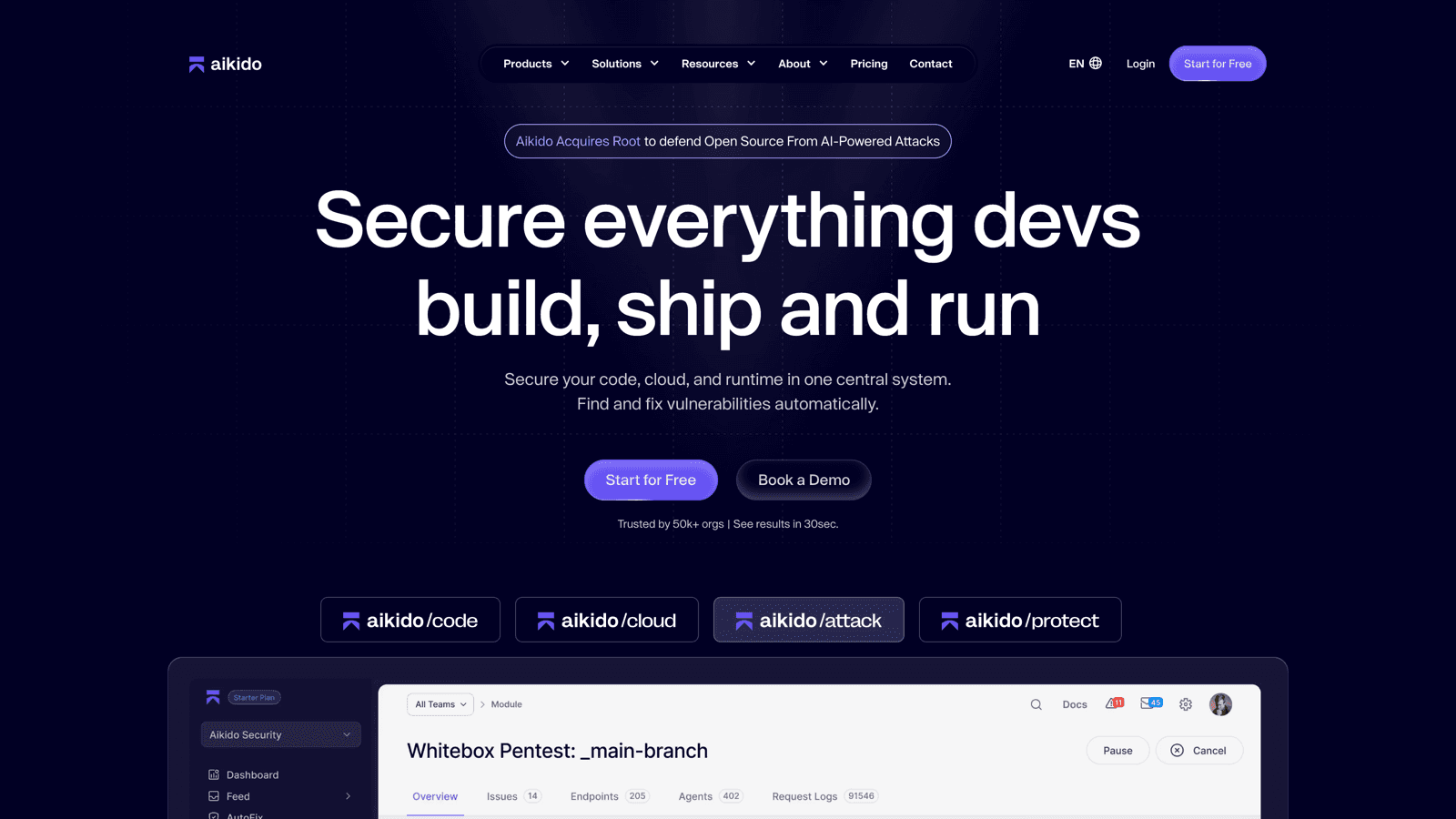
Aikido Security suits the team whose SonarQube renewal arrived alongside three other AppSec invoices. It runs SAST, SCA, secrets, IaC, CSPM, container scanning, DAST, and AI pentesting from one dashboard on a flat monthly fee.
Sonar names Aikido in its own comparison library, and the argument runs in reverse for a Sonar buyer. Where SonarQube parks SCA and dependency-aware Advanced SAST behind an add-on, Aikido puts them in the base platform.
What you gain
Four products where Sonar ships one engine. Aikido /Code, /Cloud, /Attack, and /Protect span SAST, SCA, secrets, IaC, cloud posture, DAST, and runtime.
Autonomous pentesting. Agents map exploitable routes across code, containers, and cloud into attack graphs and return “results in hours rather than weeks.”
A quieter queue than a Sonar backlog. Cornelius at n8n, quoted on Aikido’s pricing page, said “with 92% noise reduction, we got used to 'the quiet’ quickly.”
Rollout without a services engagement. Marc Lehr of GEA is quoted on the enterprise page that “in just 45 minutes, we onboarded 150+ developers with Aikido.”
What you give up
Static depth. The Opengrep and Semgrep-fork ruleset trades Sonar’s 7,000-plus issue types and published per-language counts for lower noise, which is a real loss if rule coverage is why you bought Sonar.
The Clean as You Code gate. Aikido has no equivalent of the new-code quality gate many pipelines are standardized on, so the CI contract has to be rebuilt.
Open seat scaling. Paid tiers fix 10 users with hard caps on repos and containers, and extra seats move to custom pricing.
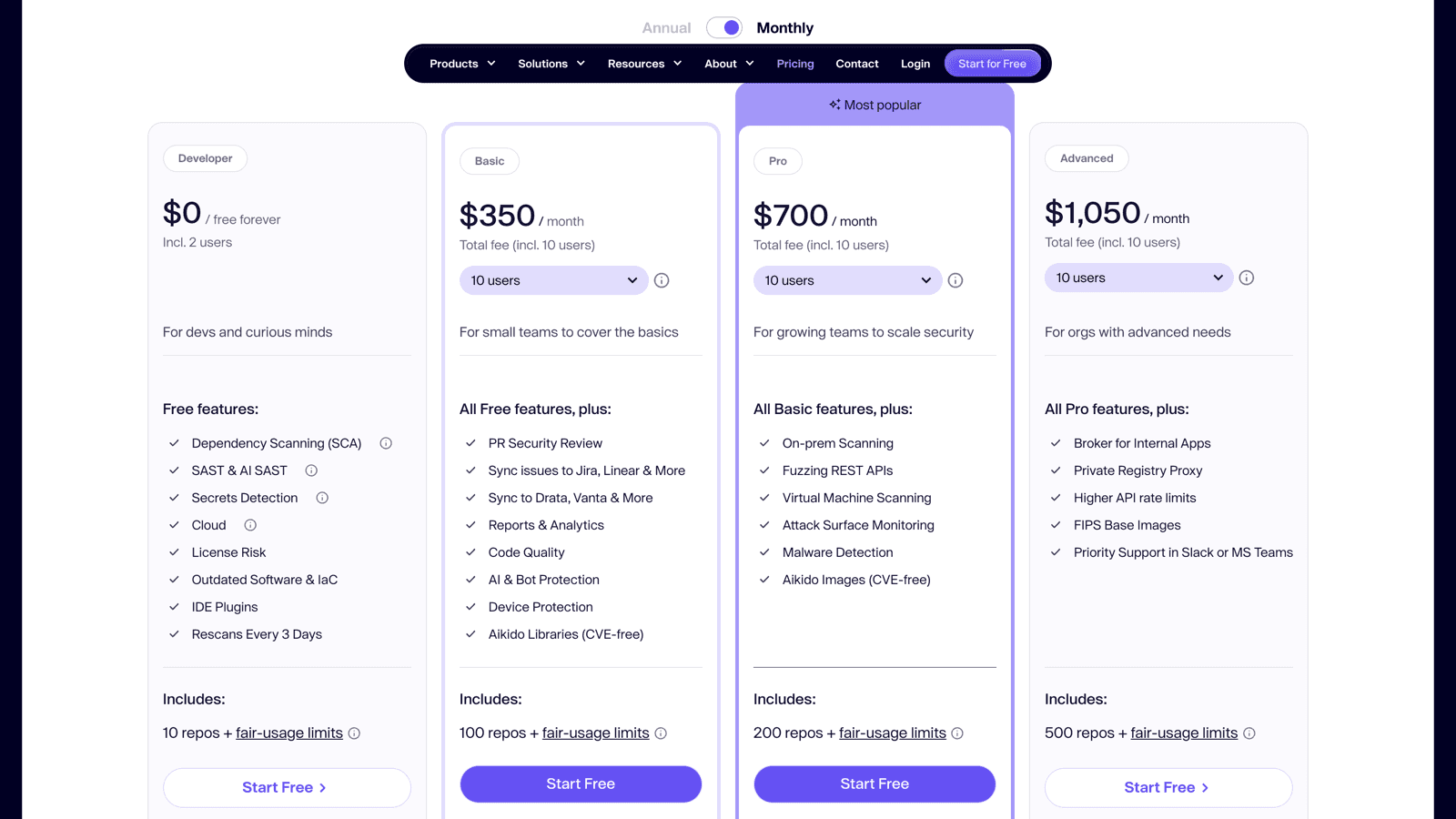
Cost to start: $350 per month on Basic with 10 users bundled, a free forever Developer plan for 2 users, and 10% off annually or up to 30% for startups.
5. StackHawk
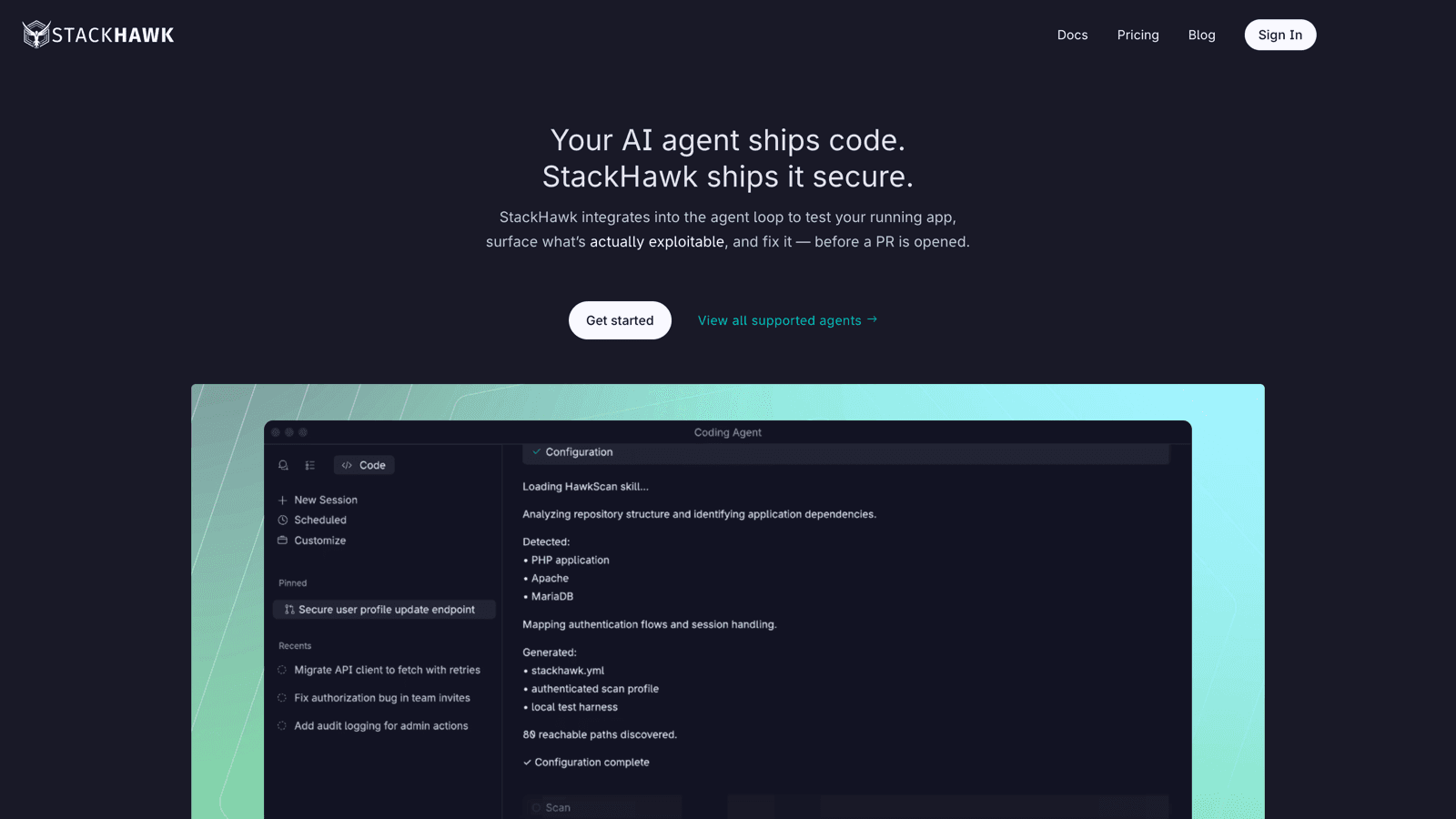
StackHawk is on this list for readers whose real complaint is noise. When developers ignore SAST findings, it is usually because nobody can tell which ones are reachable, and StackHawk answers that by hitting the running application over HTTP.
Its own DAST page states the limit plainly, that “static analysis examines code patterns but can’t detect runtime vulnerabilities like authorization bypasses or business logic flaws.” Our breakdown of SAST vs DAST covers where each one earns its place.
What it proves that SonarQube cannot
Reachability, not pattern matching. HawkScan tests a live app with reproducible results, spun up per scan in CI from a versioned YAML config.
The bug classes taint analysis cannot confirm. Coverage includes BOLA, broken function-level authorization, business-logic flaws, and mass assignment.
API surfaces from spec to scan. Native REST, GraphQL, gRPC, SOAP, and MCP-tool testing, with OpenAPI specs auto-generated from source.
Fix and re-verify inside the agent. One install teaches Claude Code, Cursor, Codex, Antigravity, and Copilot to scan, remediate with source context, and rescan before the PR opens.
Evidence an auditor accepts. A security-operations manager valued the “ability to report any issues that may exist with code running live,” crediting it toward PCI certification.
Its limits
No SAST at all. StackHawk is DAST only and hands static analysis to Semgrep, Snyk Code, and CodeQL, so your Sonar decision stays open.
A scan ceiling on the entry tier. Wingman caps 50 agentic scans per user per month before you buy more or move to Scale.
Authenticated scans take tuning. An AWS Marketplace reviewer noted “authenticated scans can be frustrating,” and a DevOps engineer said pipeline-dependency setup “needs refinement.”
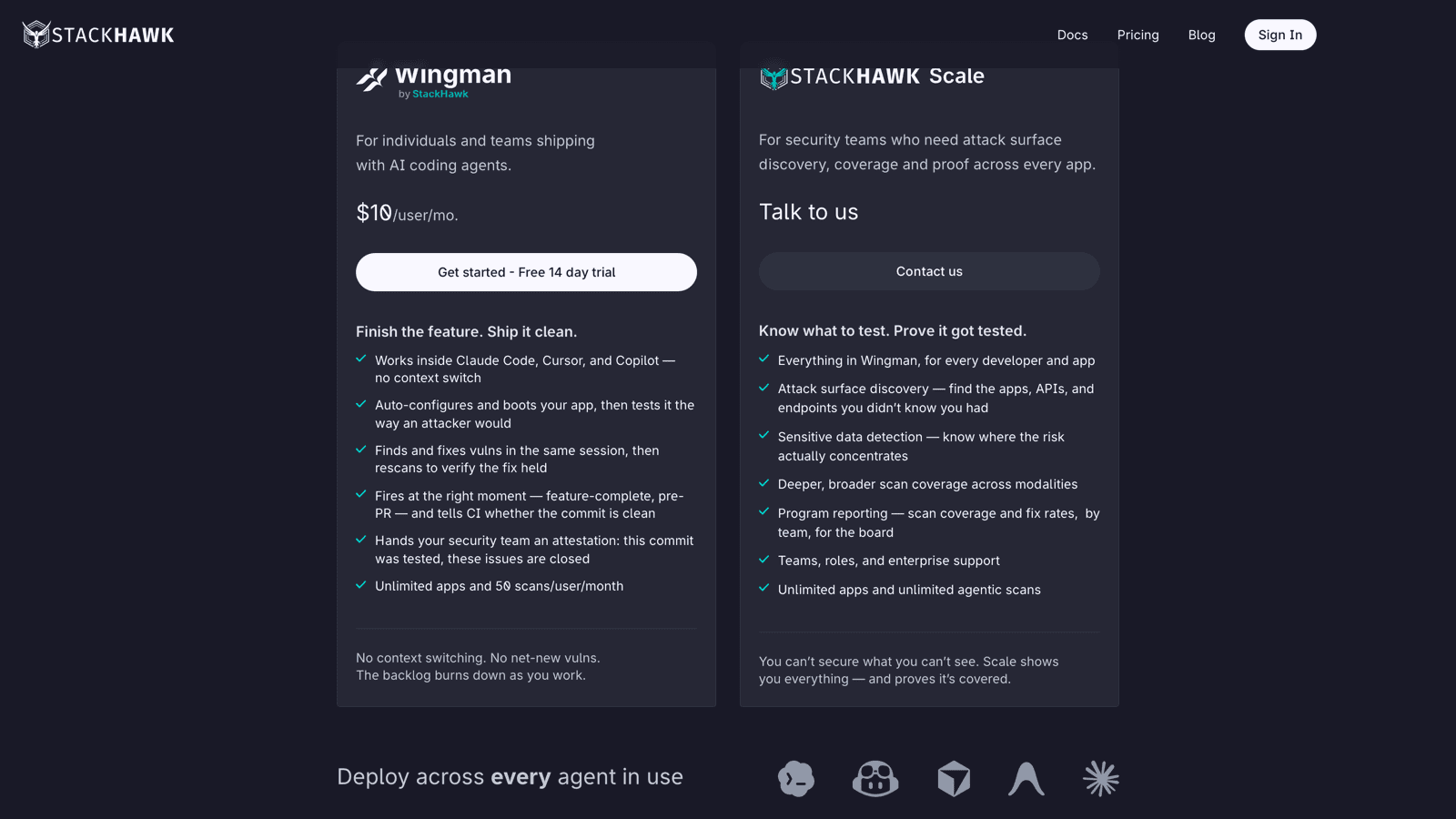
Cost to start: $10 per user per month on Wingman with unlimited apps and a 14-day trial, no permanent free tier.
6. Astra Security
Astra Security belongs here for one reason a SonarQube user will recognize. When a customer security questionnaire asks for a pentest report, a quality-gate dashboard is not an answer.
Astra pairs an always-on DAST scanner with OSCP and CREST-certified testers who work the live app, its APIs, and the cloud around it. Fixes come back into the IDE through an MCP integration.
Where it goes beyond static analysis
Human testers after the automation. Certified testers threat-model and manually test once the scans finish, producing the adversarial layer no engine generates.
Authenticated scanning behind the login. More than 10,000 test cases cover the OWASP Top 10, including TOTP-based MFA flows.
API and cloud discovery. Shadow, zombie, and orphan API detection plus 400-plus cloud misconfiguration checks across AWS, Azure, and GCP.
A pentest priced like software. An IT-services co-founder noted “the vulnerability scan is great but it was the manual pen test which was better,” adding “pen tests can be shockingly expensive and Astra is a very low price.”
Reports a remediation team can work from. A DevSecOps reviewer praised “the intuitive dashboard and real-time visibility into vulnerabilities” and “clear, actionable reports that made remediation easier.”
Why it will not replace your gate
No SAST. Astra never opens your source, so it sits alongside SonarQube rather than in its place.
The scanner trails the humans. A financial-services security officer wrote on Capterra that “the accuracy of the automated scanner can be made more efficient.”
Some actions need a support ticket. A senior director noted “there are some actions that cannot be carried out in the UI and require contact to service.”
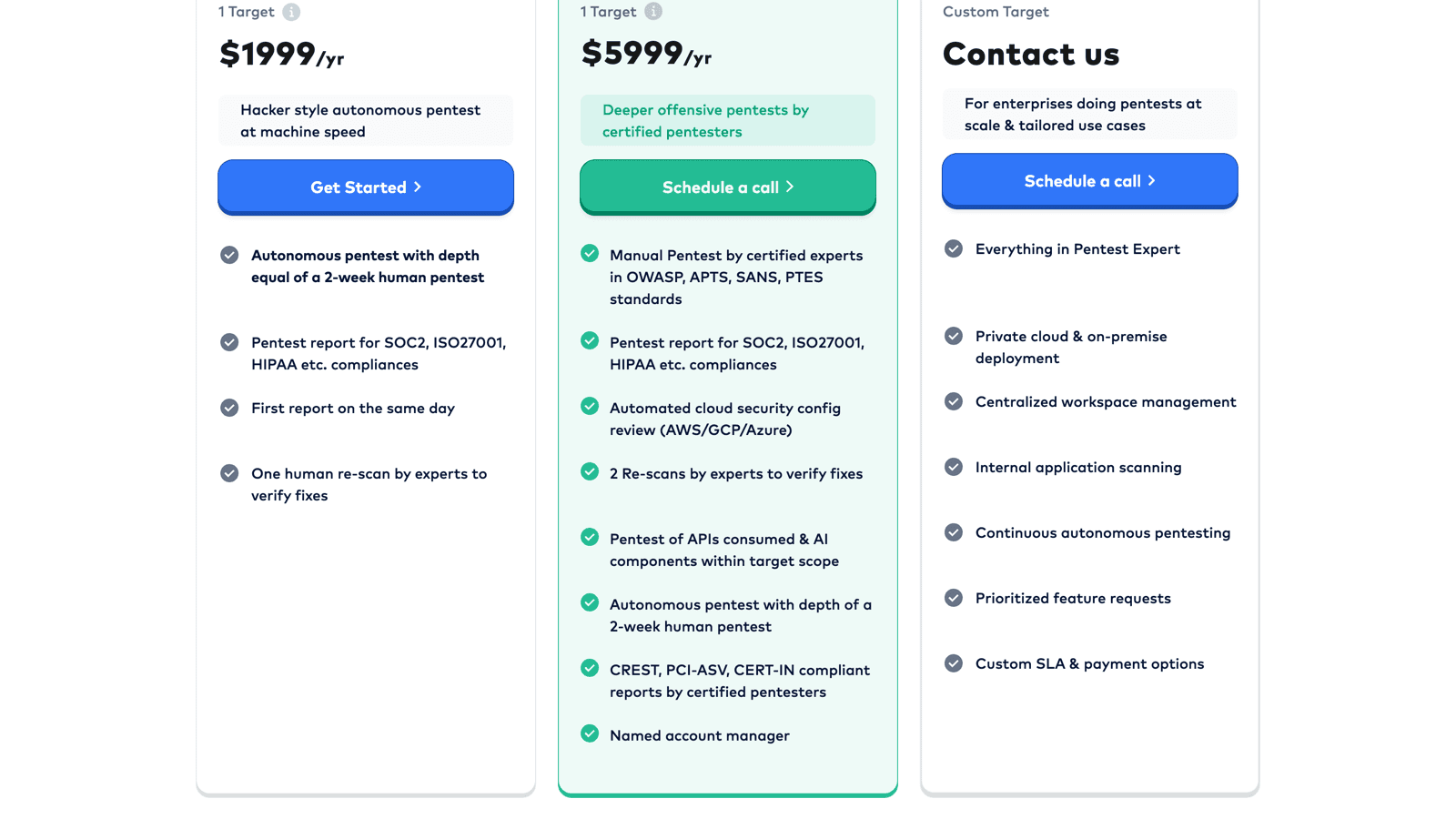
Cost to start: $199 per month for the scanner or $1,999 per year for Pentest Auto, billed per target, with a $7 one-week scanner trial and no free tier.
7. Intruder
Intruder covers the half of the attack surface a repository scan cannot see. SonarQube stops at the source file, and Intruder starts at the internet-facing estate, unifying vulnerability scanning, attack-surface monitoring, and cloud security.
For a platform engineer that makes it a layer rather than a swap. Our guide to continuous versus annual pentesting explains why always-on external coverage tends to earn its budget line faster than a yearly engagement.
The blind spot it covers
Scanners orchestrated under one dashboard. OpenVAS, Nuclei, Tenable, and OWASP ZAP run together, with Emerging Threat Scans firing within hours of a public disclosure.
Discovery of what changed outside the repo. Subdomain, exposed-service, and shadow-IT monitoring, with CloudBot auto-scanning new AWS, GCP, Azure, and Cloudflare assets.
A white-box pentest add-on that does read code. Connect GitHub or GitLab and you get an audit-ready web-app pentest from $3,500 per test.
Triage handled before you see it. An AI analyst named GregAI ranks what matters and drafts remediation a developer can act on directly.
Prioritization reviewers vouch for. An operations director wrote on G2 that “rather than overwhelming us with low-value noise, it highlights vulnerabilities that genuinely matter and explains why they are important.”
What it will not do
No repository scanning. Outside the pentest add-on, Intruder never analyzes source code, so it never touches SonarQube’s job.
Licences lock for 30 days. A licence is consumed on scan and released only after 30 days of inactivity, which compounds across a large target list.
Uneven cloud connectors. An enterprise reviewer noted “the Azure integration for Intruder is definitely still a little bit immature.”
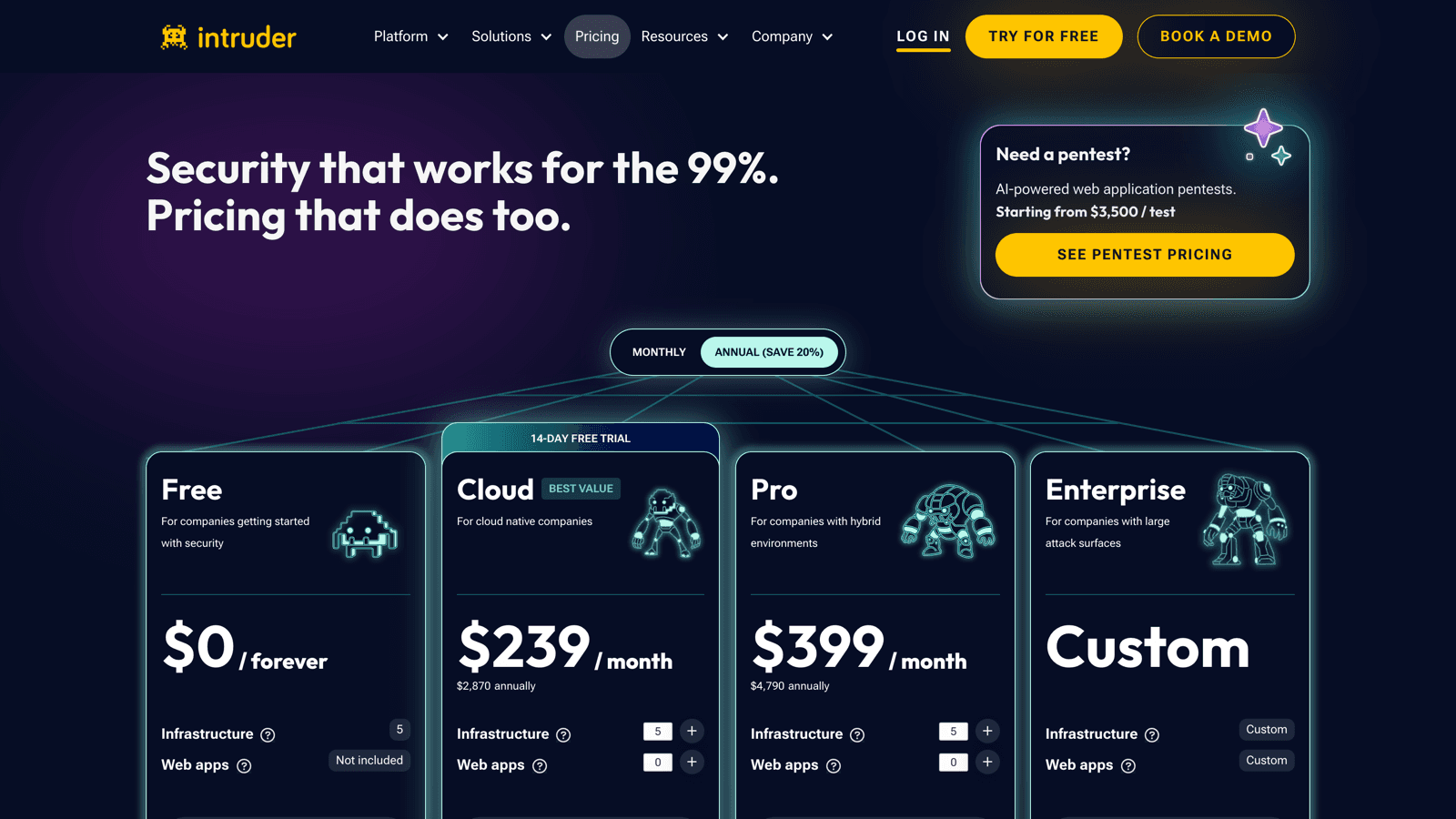
Cost to start: $239 per month on the annual Cloud plan, billed per licence, with a free forever plan covering 5 infrastructure licences.
8. Cobalt
Cobalt is last because it is the least like SonarQube and still worth knowing about. It pairs a SaaS platform with Cobalt Core, a vetted community of freelance pentesters who chain exploits and business-logic flaws.
The overlap is narrower than it looks. Cobalt sells Secure Code Review as a hybrid SAST-plus-human service, which is the manual counterpart to the engine SonarQube automates.
What a human tester finds that a scanner does not
Chained exploits across surfaces. Web, mobile, API, network, cloud, and AI/LLM pentests scoped through a four-step wizard over a standard 14-day window.
AI recon feeding human exploitation. Autonomous agents handle discovery at machine speed while testers do the chaining.
Retesting that confirms the fix held. Free retesting of individual findings for 6 to 12 months with a 7-day retest SLA.
Findings written for engineers. A senior staff engineer wrote on G2 that Cobalt delivers “actionable findings that are easy for engineers to understand and fix,” making security “collaborative rather than audit-driven.”
The trade-offs
A service, not a scanner. Cobalt’s code review is human-delivered, so it covers none of the pre-merge automation you currently run.
A five-credit floor. A security specialist wrote on G2 that he dislikes “that there is a minimum of five credits” for segmentation tests needing far less.
Annual, sales-gated credits. Packages are yearly, credits expire each contract term, and every tier is quote-only.
Cost to start: custom quote only, billed in Cobalt Credits where one credit buys 8 hours of testing, with no free tier or trial.
What Each One Costs, Side by Side
The SonarQube row is the baseline you are comparing against. Every figure below is the entry-level price each vendor published as of July 2026.
Tool | Entry paid price | Billing unit | Free option |
|---|---|---|---|
SonarQube (baseline) | $34 / mo Cloud Team, or $750 / yr Server Developer | Per line of code, unlimited users | Community Build, 50k-LOC Cloud tier, free public repos |
CodeAnt AI | $24 / user / mo (annual) | Per user for review, pay-per-exploit for pentest | Free for open source, 14-day trial with 100 PR reviews |
Codacy | $18 / dev / mo (Team, annual) | Per developer seat, unlimited LOC | Free IDE plugin, free forever for open source |
DeepSource | $24 / user / mo (Team, annual) | Per active committer, AI review metered on top | Free forever for public repos |
Aikido Security | $350 / mo (Basic, 10 users) | Flat fee with caps on repos, containers, domains | Developer plan, 2 users, free forever |
StackHawk | $10 / user / mo (Wingman) | Per user, unlimited apps, 50 agentic scans each | 14-day trial only |
Astra Security | $199 / mo scanner, $1,999 / yr Pentest Auto | Per target (app, APIs, and cloud count as one) | $7 one-week scanner trial, no free tier |
Intruder | $239 / mo (Cloud, annual) | Per licence, locked 30 days per target | Free forever, 5 infrastructure licences |
Cobalt | Custom quote | Cobalt Credit, one credit is 8 hours of testing | None |
Where This Leaves You
Read the table by what is driving the change. If it is the renewal quote, Codacy and DeepSource are the two direct swaps that keep the gate and drop the LOC meter. If it is the operations burden, DeepSource removes the server and the CI job outright.
If it is developers ignoring SAST findings, the fix is proof rather than more rules, which is what StackHawk, Astra, and Intruder each supply at a different layer.
CodeAnt AI is first here because it answers all four complaints in one place. It keeps the pre-merge review, prices per seat, needs no instance to run outside Enterprise deployments, and settles the noise argument by returning a working exploit instead of a severity score.
Start with the free open-source plan or the trial, connect one repository, and let the first pull-request review and agentic pentest tell you whether the gap is real.
To go wider, compare the static engines in our best SAST tools comparison, weigh the quality-first options in the best code quality tools roundup, and read the guide to the best AI penetration testing tools or how pentest as a service works next to a code scanner.

