

Codacy renewals get harder every time the team grows. The seat meter counts every Git contributor who commits to a private repo, so the contractor who shipped one fix last sprint bills the same as your busiest maintainer, and $18 per developer per month stops feeling small somewhere around your twentieth hire.
The second problem is quieter and worse. Pattern-matched comments that developers have learned to scroll past do not improve a pull request, and tuning the rules engine until they do is a job nobody on your team wants.
TL;DR, the 8 best Codacy alternatives for pull-request review quality in 2026:
CodeAnt AI reviews every pull request across GitHub, GitLab, Bitbucket, and Azure DevOps, with SAST running inline instead of in a separate dashboard.
DeepSource bills active committers only and publishes an 84.51% F1 accuracy benchmark Codacy has never matched with a number.
SonarQube drops seats entirely for lines-of-code pricing, so headcount growth stops moving the invoice.
Aikido Security replaces the per-contributor meter with flat monthly tiers and filters findings by reachability.
StackHawk puts runtime exploit evidence in the PR for $10 per user per month.
Intruder watches the subdomains, exposed services, and cloud accounts your repo scanner never sees.
Astra Security publishes a per-target price for the certified human pentest Codacy leaves unpriced.
Cobalt starts a vetted human engagement in as little as 24 hours when an auditor asks for one.
Is Codacy Still Worth Its Seat Price at Renewal?
You already know what Codacy does. The question at renewal is narrower, whether the review comments landing on your pull requests are worth $18 per developer per month and rising.
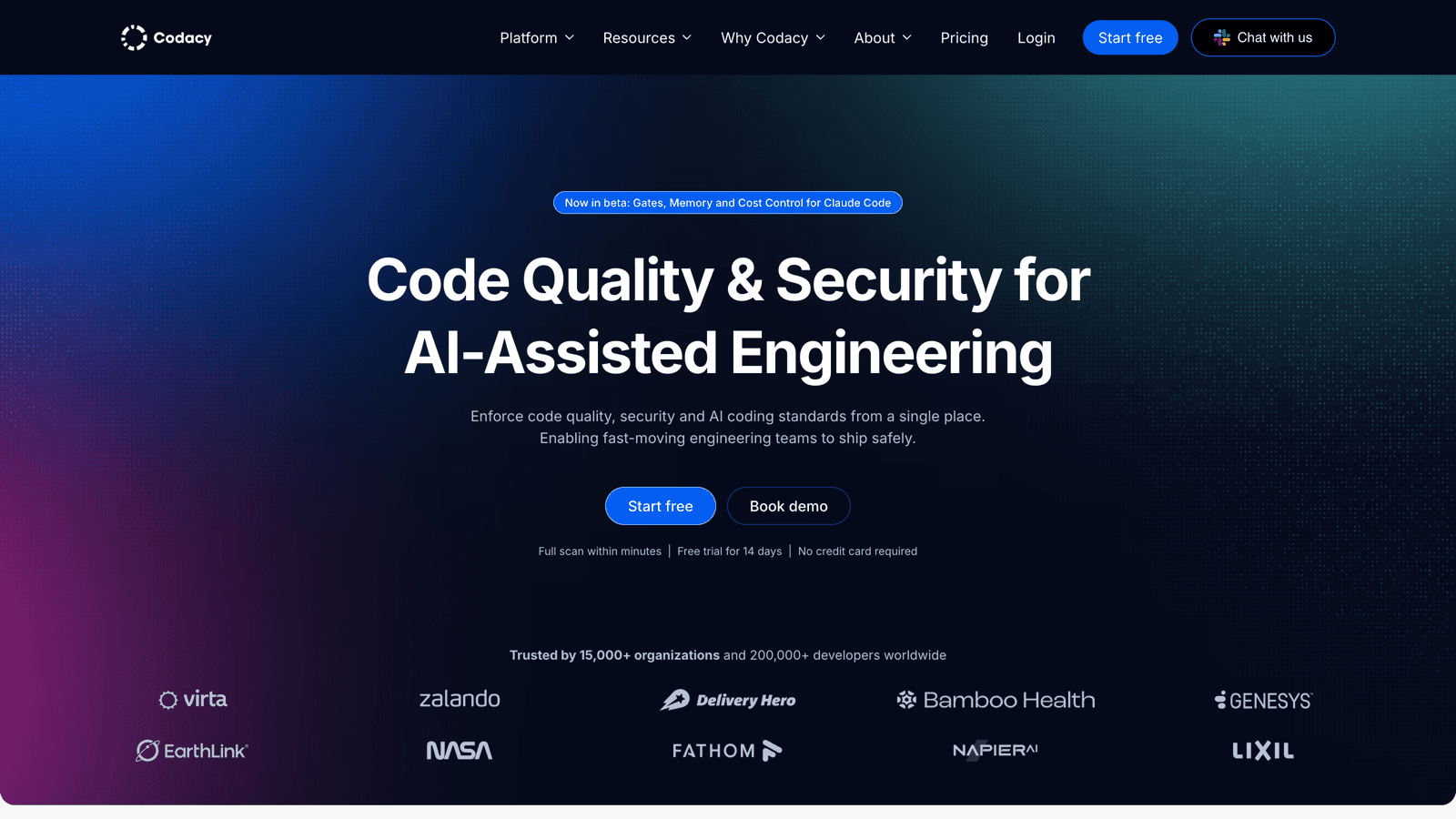
Start with what generates those comments. Codacy assembles open-source engines, running Opengrep, PMD, Trivy, and per-language linters across 49 languages, organized into 25-plus security categories with 12,000-plus scan rules on paid plans.
Rule count is the metric Codacy markets and the wrong one to buy on. A big rule set produces a lot of findings, and a lot of findings is exactly the condition that trains developers to ignore the bot.
The AI layer is newer and narrower than the marketing suggests. Guardrails enforces rules inside VS Code, JetBrains, Cursor, and Windsurf, AI Inventory tracks models and MCP servers, and AI Reviewer comments on pull requests, but AI Reviewer runs on GitHub alone.
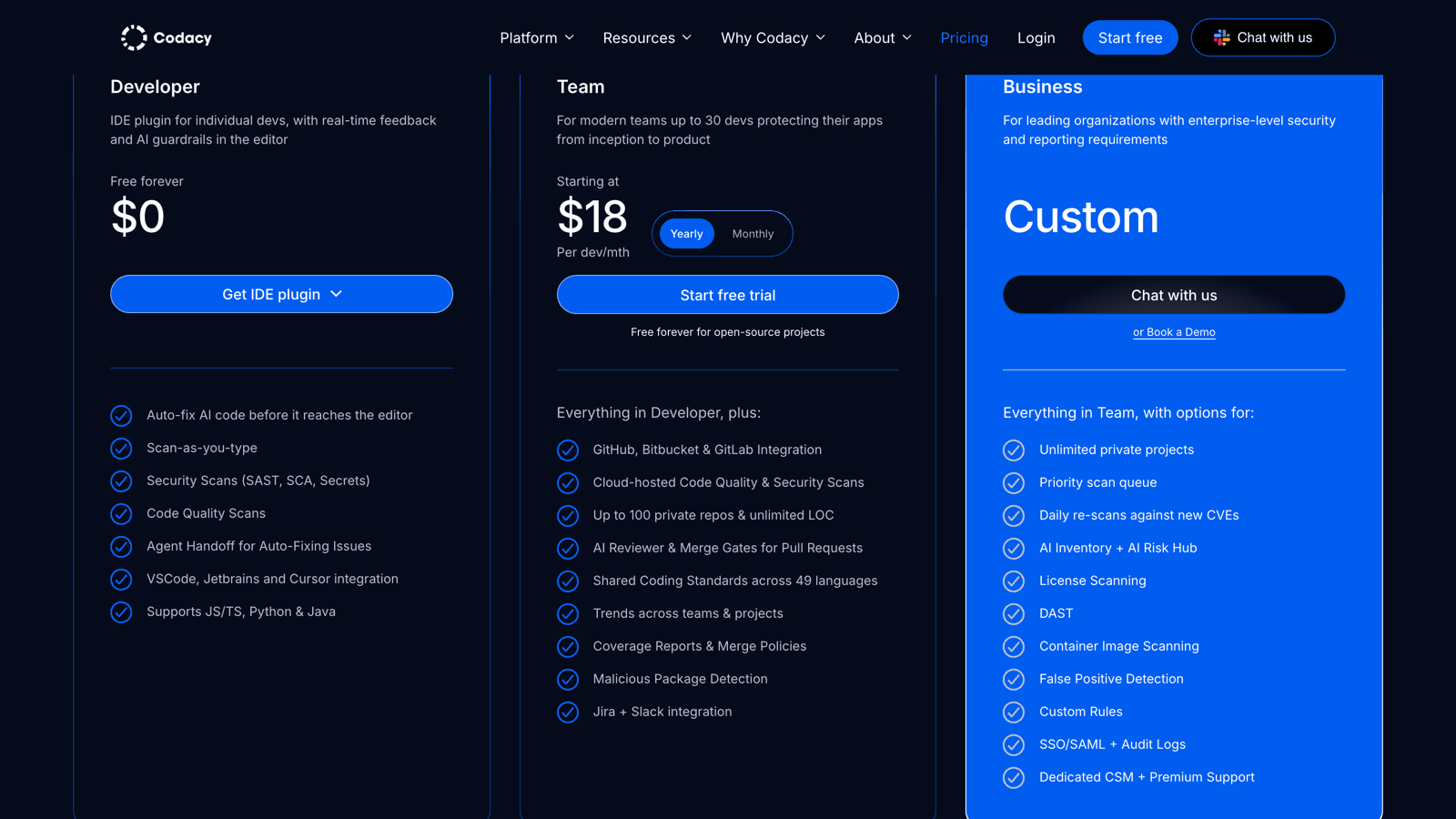
Then the meter. The Team plan is $18 per developer per month billed annually or $21 monthly, and the pricing FAQ defines a seat as "every Git contributor who commits code changes to a private repo."
A few more limits shape the switch. Codacy Cloud connects only to cloud-hosted GitHub, GitLab, and Bitbucket, Azure Repos is still waitlisted, DAST is a Business-tier ZAP scan pointed at staging, and penetration testing appears on the pricing page as an add-on with no figure attached.
If you are modeling the total cost of the swap rather than the sticker price, our SAST pricing guide covers how these meters behave as teams scale. The wider category map sits in our roundup of the best code quality tools.
The 8 Best Codacy Alternatives at a Glance
Two columns matter most to a lead running a 10 to 60 person team. What the tool actually contributes at PR time, and whether adding engineers raises the bill. Prices are the vendor's published entry point as of July 2026.
# | Tool | What it adds at PR time | Billing unit | Entry paid price |
|---|---|---|---|---|
1 | CodeAnt AI | AI review plus inline SAST on all four major SCMs | Per user | $24 / user / mo |
2 | DeepSource | Deterministic rules plus AI review, autofix diffs | Per active committer | $24 / user / mo |
3 | SonarQube | Quality gates on new code only, 7,000+ issue types | Per line of code, unlimited users | $34 / mo (Cloud) |
4 | Aikido Security | Reachability-filtered SAST, SCA, secrets, IaC | Flat tier, 10 users bundled | $350 / mo |
5 | StackHawk | Runtime exploit evidence with a cURL reproduction | Per user | $10 / user / mo |
6 | Intruder | Nothing, it watches the deployed estate instead | Per target licence | $239 / mo (annual) |
7 | Astra Security | Fix prompts into the IDE from runtime findings | Per target | $199 / mo (scanner) |
8 | Cobalt | Nothing, human engagements are booked, not triggered | Per credit (8 hours) | Custom |
The 8 Best Codacy Alternatives in 2026
Each tool below gets judged on three things a Codacy renewal actually turns on. Whether its PR comments earn attention, how the bill behaves as the team grows, and how much tuning it takes before either of those is true.
The last two entries are offensive rather than defensive, included because "billed separately" is the only thing Codacy's pricing page says about penetration testing. Our AI penetration testing guide is the primer if that side is new to you.
1. CodeAnt AI
CodeAnt AI is built around the failure mode you are describing, review comments developers stop reading. Its analysis is intent-aware rather than purely pattern-matched, so findings arrive with the reasoning attached instead of a rule ID and a line number.
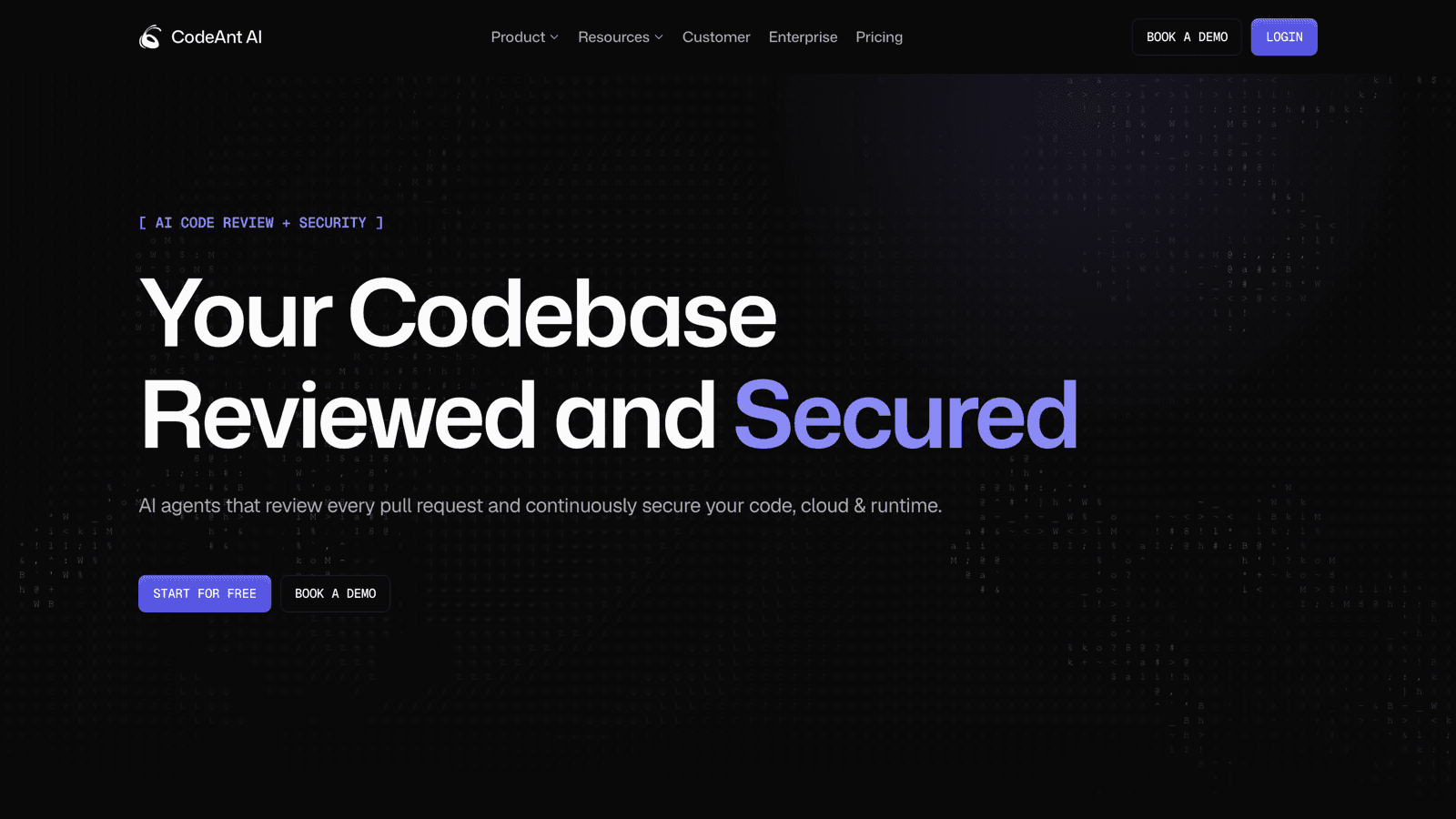
Reach is the other gap it closes. AI review, SAST, SCA, secrets, and IaC checks all run on every pull request across GitHub, GitLab, Bitbucket, and Azure DevOps, where Codacy's AI Reviewer is documented as GitHub-only and Azure Repos never left the waitlist.
Reviewers describe the difference in terms of what gets caught rather than how much. A Gartner Peer Insights reviewer called the feedback "highly accurate" and useful for "edge cases, missed logic, and even mundane things that are easy to miss like naming inconsistencies and copy/paste errors." An engineering director on G2 noted it is "one of the few tools which works with BitBucket" and that it "reduced considerable time to review PR," while accepting the "occasional false positive" as a fair trade.
Be honest about the ramp. The same G2 corpus includes a mid-market reviewer who found some suggestions "too cautious" and said "onboarding takes time," and the review base is smaller than a 2012-vintage vendor's, so run the trial rather than counting stars. Open-source repos are free, and the 14-day trial covers 100 PR reviews with unlimited seats.
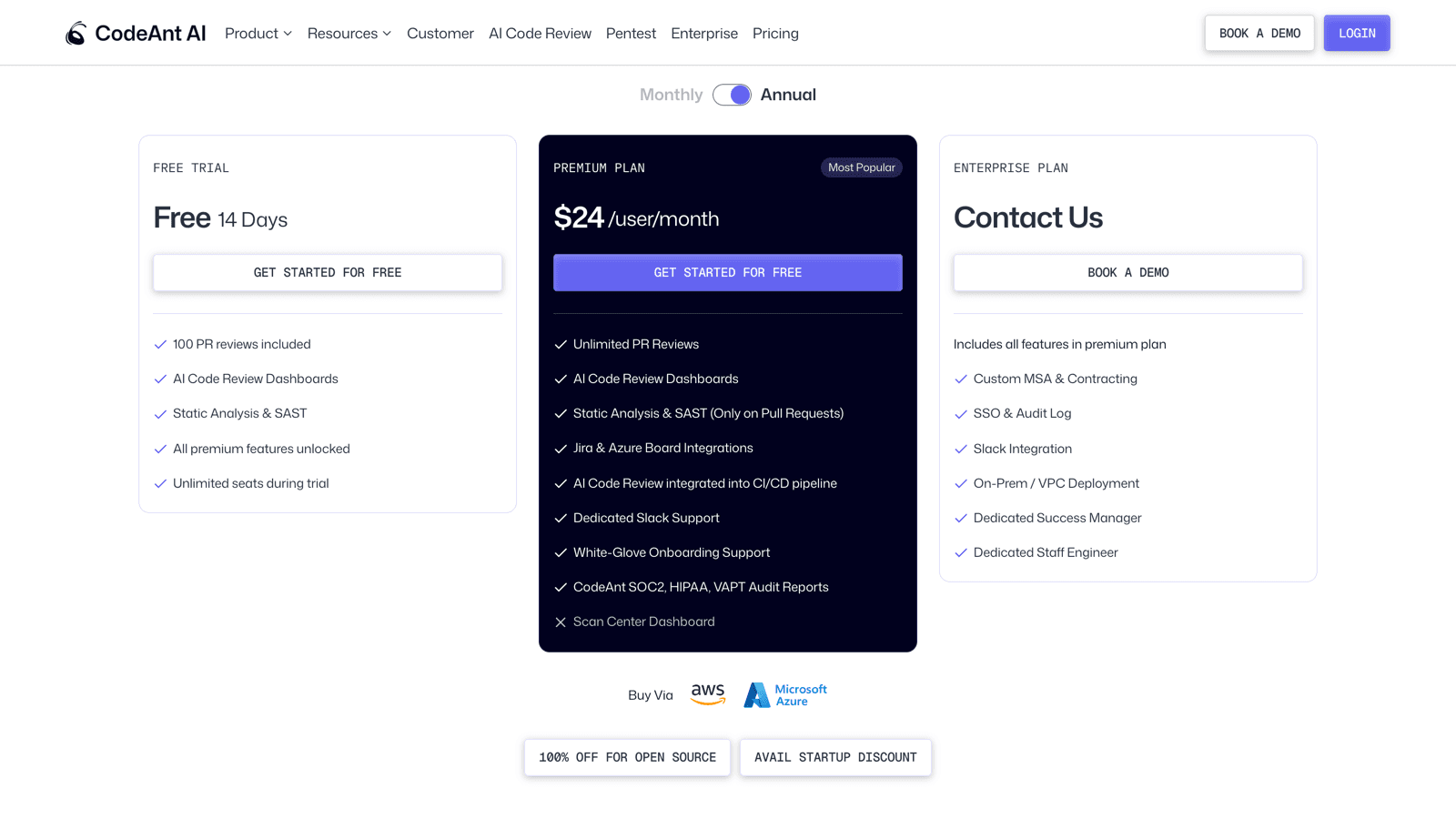
The pentest question resolves cleanly too. CodeAnt AI's agentic pentest carries a $0 engagement fee and bills only for exploitable High and Critical findings that ship with a working proof of concept, with reports in 48 hours and free re-tests. The CodeAnt AI vs Codacy comparison runs the feature grid, and the agentic pen testing page explains scoping and payment.
Best for: a 10 to 60 person team that wants Codacy's review-and-scan workflow with sharper PR comments, Azure DevOps and Bitbucket included, and a pentest that costs nothing until it proves something.
2. DeepSource
DeepSource answers the accuracy question with a number, which nobody else in this category does. Its benchmark page reports an 84.51% F1 score at 100% precision against 165 real CVEs from the OpenSSF dataset, and names the judge and dataset so you can check the method.
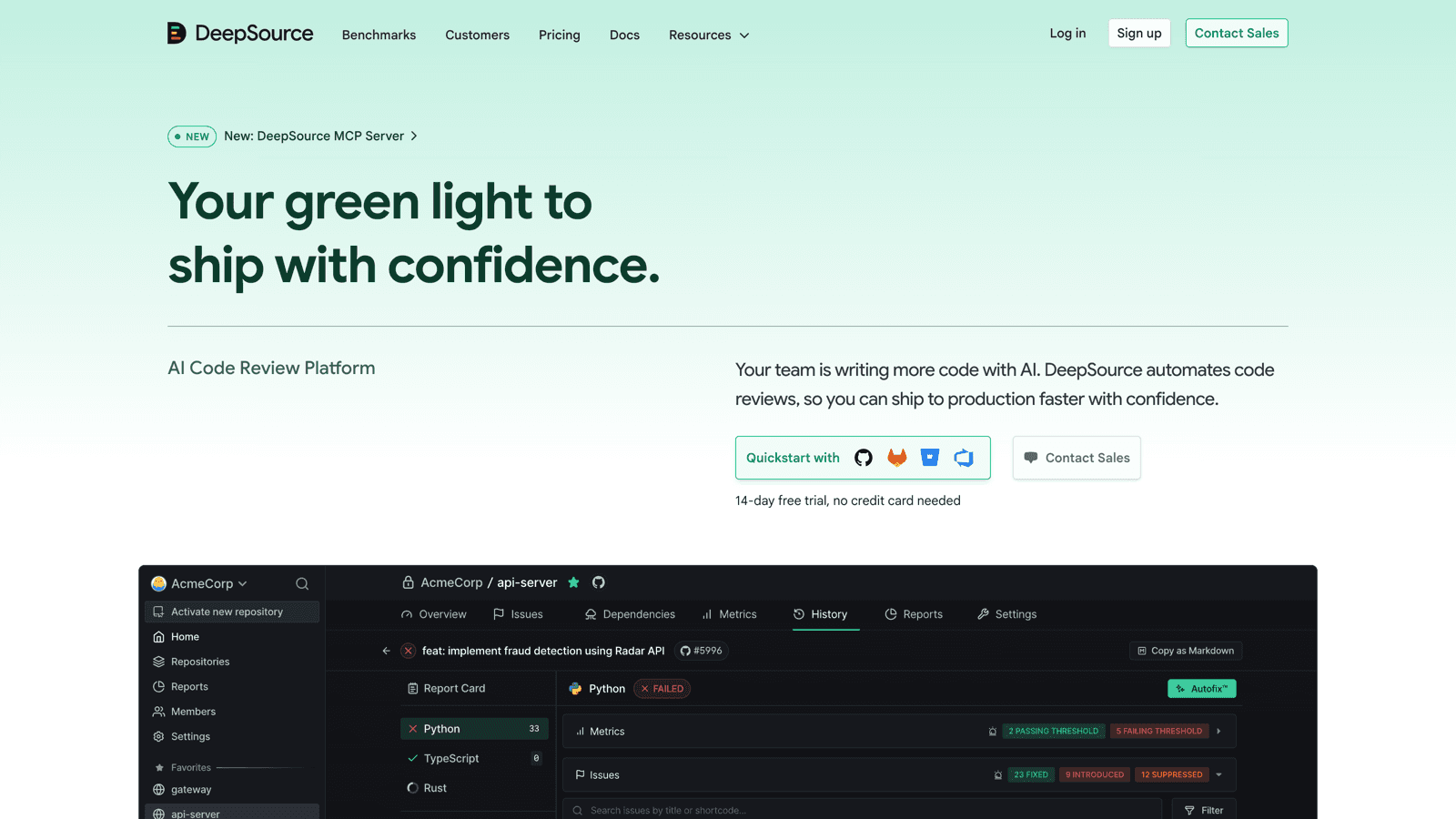
The engine is deliberately hybrid. More than 5,000 deterministic rules across 30-plus languages run alongside AI Review, so a finding traces back to a rule rather than a model's guess, and Autofix shows you a verified patch as a diff before you accept it.
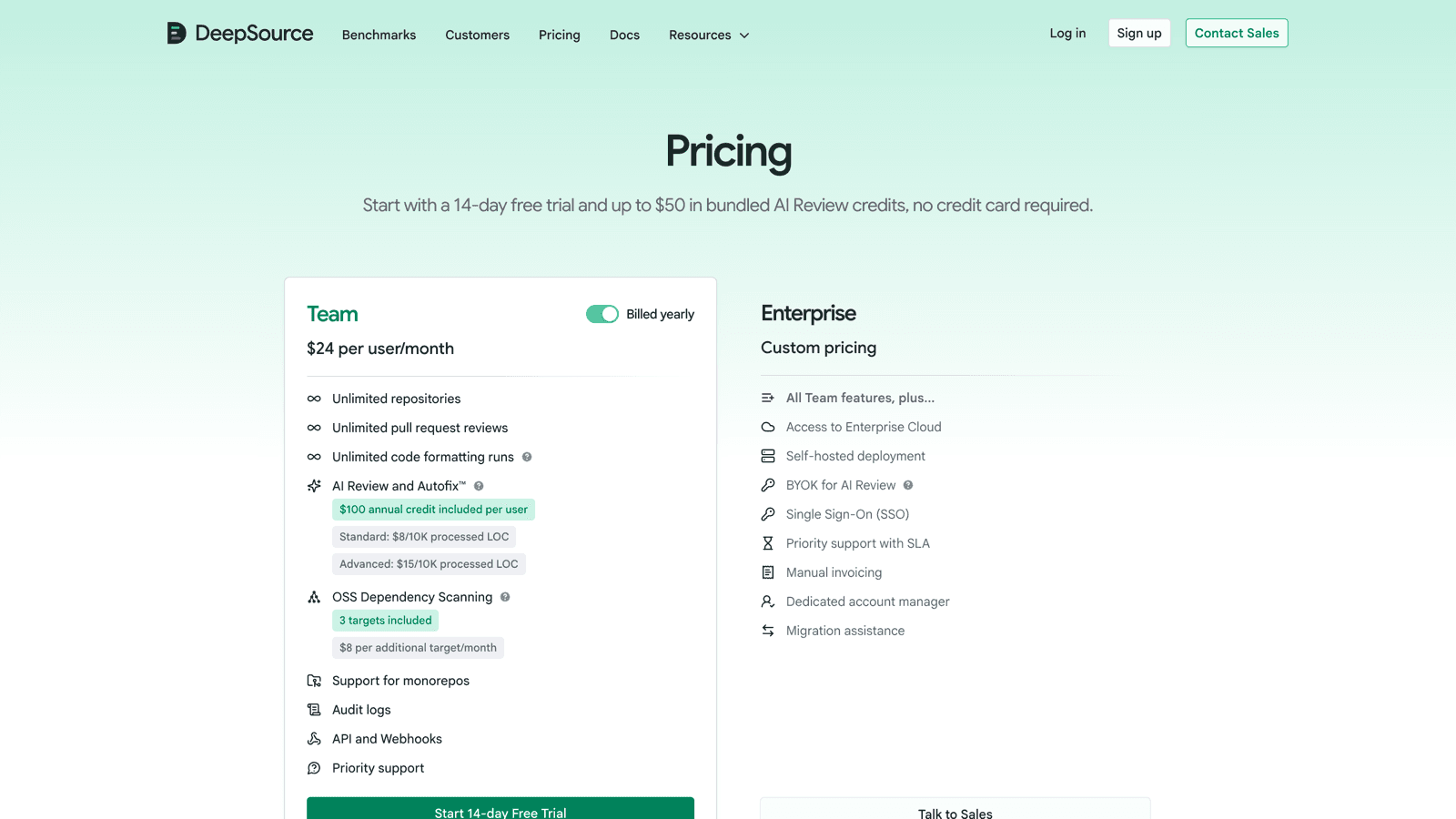
The meter is the other reason it belongs this high. DeepSource charges $24 per user per month annually for active committers only and explicitly excludes the Contributor role from the count, which is the exact seat inflation Codacy's per-contributor rule creates. Its secrets detection uses the open-source Narada classifier at a published 92.78% F1, and Azure DevOps connects alongside the other three SCMs. Its SCA layer scores dependencies with a Dynamic Risk blend of CVSS, EPSS, and reachability.
Two caveats. DeepSource states on its own Snyk comparison page that it covers neither DAST nor container scanning, so Codacy's Business-tier runtime features have no counterpart here, and volume can still overwhelm, with a full-stack developer noting it "could generate a lot of input, which some engineers might find overwhelming." A financial-services CEO on Capterra reported it "flagged certain code segments as problematic when, in reality, they were not," though an embedded developer praised analysis that is "very complete and specific, pointing to the exact line with the issue." Our CodeAnt AI vs DeepSource comparison sets the two hybrid engines side by side.
Best for: a team that liked Codacy's premise and wants the same job done by an engine willing to publish its accuracy, with a seat count that only charges for people who actually commit.
3. SonarQube
SonarQube is the answer if your renewal anxiety is mostly arithmetic. Cloud pricing runs on lines of code with unlimited users, starting at $34 per month for 100k LOC, so hiring five engineers changes nothing on the invoice.
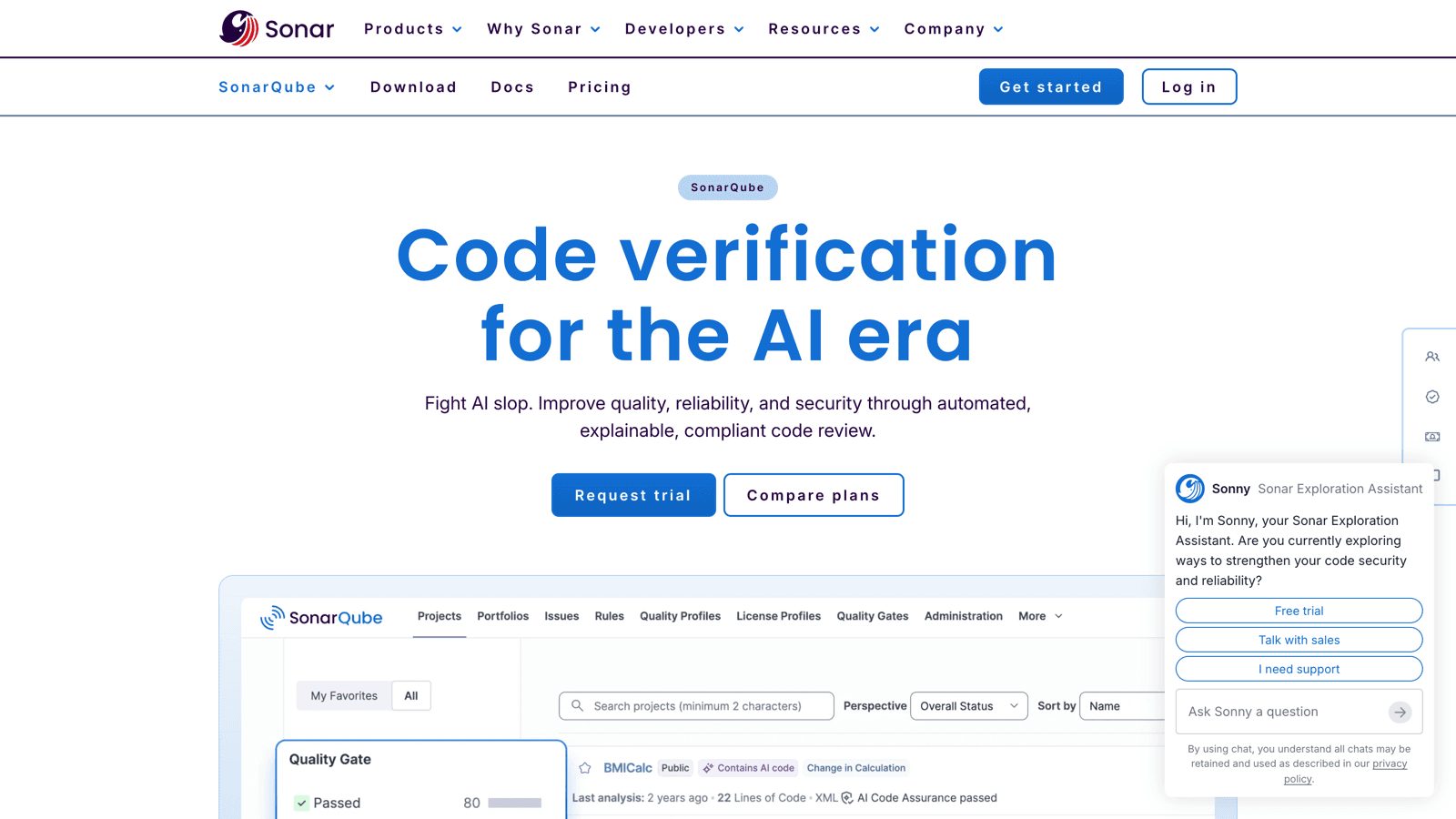
Depth is real and comes with a tuning bill. More than 7,000 issue types across 40-plus languages with taint analysis in core and a published 3.2% false-positive rate beats what assembled open-source scanners produce, and Sonar publishes per-language rule counts openly, such as 650-plus for Java.
Clean as You Code is the feature that fixes the ignored-comment problem. Quality gates evaluate only new code, so a decade of accumulated debt never blocks today's merge and the bot only ever talks about the diff in front of the reviewer. A DevOps engineer wrote on PeerSpot that after wiring it into CI/CD "we reduced production bugs by 30 to 40 percent and improved code coverage from 65 to 85 percent," and a Capterra reviewer noted "SonarQube is good at enforcing minimum code coverage on PRs."

The costs land elsewhere. False positives persist, with the same PeerSpot engineer saying "some findings require manual verification" and a Capterra IT specialist putting it flatly, "False positives are annoying." LOC pricing also has a cliff, with a PeerSpot reviewer flagging a jump to "$15,000 per one million lines." There is no DAST and no pentest anywhere in the product line, a boundary our SAST vs DAST guide maps, and the free Community Build covers 21 languages if you want to prove value before invoicing anything. See also our CodeAnt AI vs SonarQube comparison and our guide to free and open-source SonarQube alternatives.
Best for: a growing team whose headcount is outrunning its codebase, where paying by lines rather than people is straightforwardly cheaper and someone is willing to own the rule configuration.
4. Aikido Security
One detail is worth knowing before you renew. Aikido helps maintain Opengrep, the open-source engine part of Codacy's scanning runs on, so moving across gets you the people stewarding the engine rather than a downstream consumer of it.
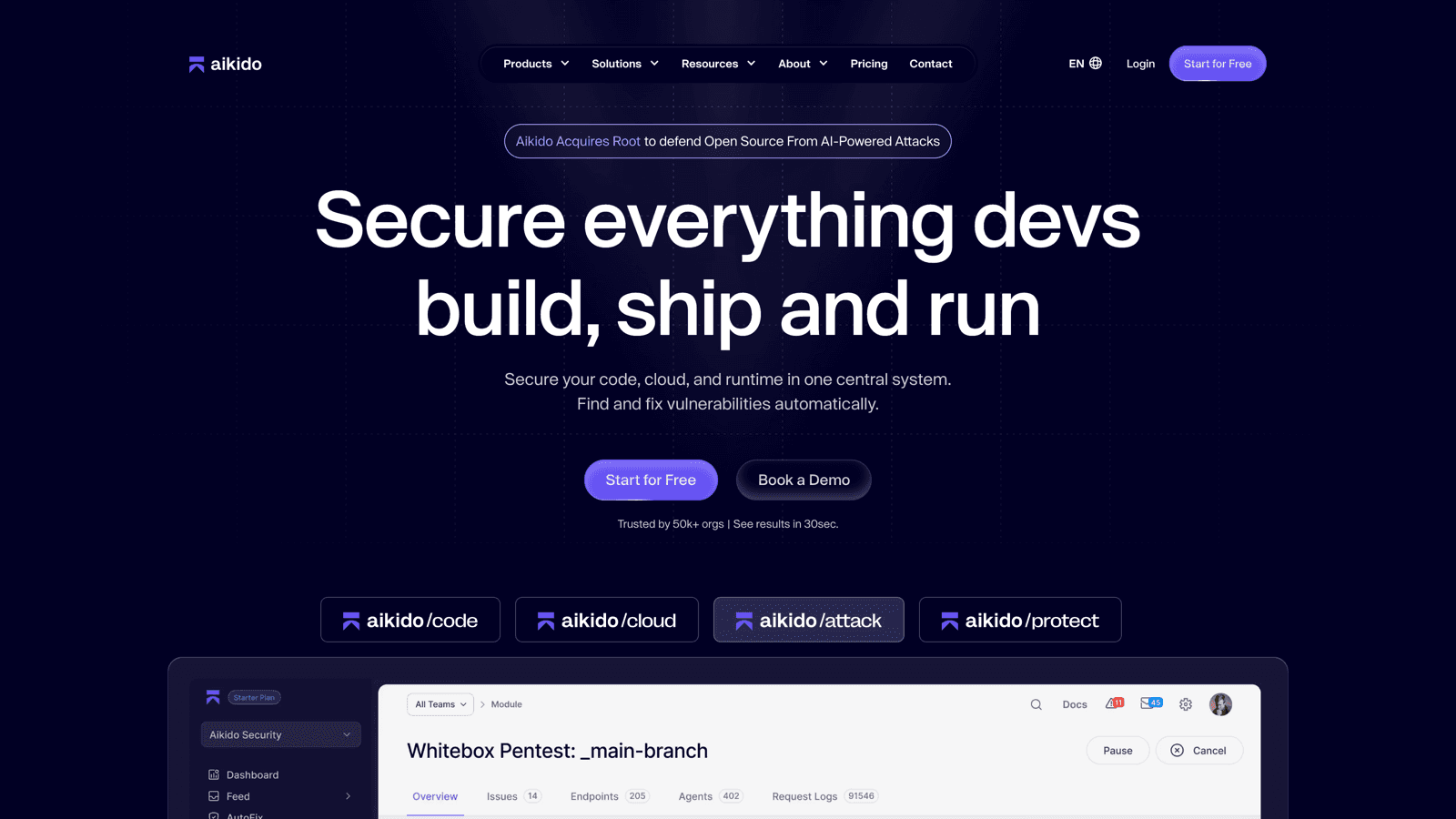
The commercial model removes the seat question entirely. Flat platform tiers run $350, $700, and $1,050 per month with 10 users bundled at each, so a burst of one-commit contributors never touches the bill, and two users can run the platform free forever.
Noise reduction is the pitch to anyone whose developers have stopped reading comments. Findings pass through reachability and exploitability filters with a claimed 90% false-positive reduction, and Cornelius at n8n cited "92% noise reduction" as "a massive productivity and sanity boost." Christian Schmidt, VP of Security and IT at Go Autonomous, said that with Aikido "the triaging is just… done," and Marc Lehr of GEA reported "in just 45 minutes, we onboarded 150+ developers with Aikido."
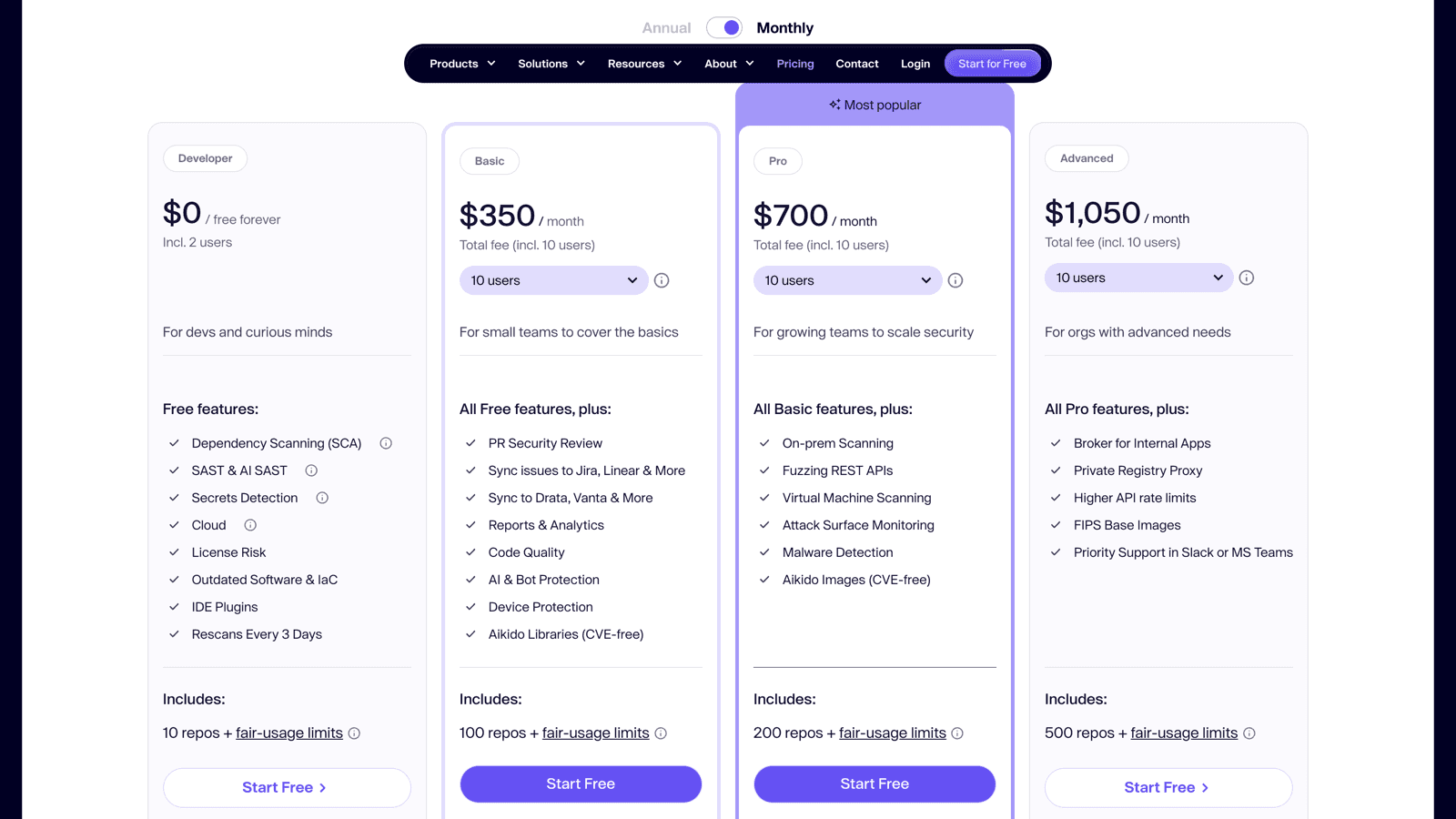
Read the caps before you sign. Each tier fixes repos, containers, domains, and cloud accounts, users past the bundled ten move to custom pricing, and the loudest endorsements sit on Aikido's own pages rather than a large independent review corpus. On the upside, GitHub Enterprise Server, self-managed GitLab, and Azure DevOps all connect, and a Standard Pentest is a fixed €3,500 or $4,000 per assessment. Our CodeAnt AI vs Aikido Security comparison covers the matchup, and every cap is broken out in our Aikido Security pricing guide.
Best for: a team under roughly 10 committers with contractors cycling through, where flat monthly billing is worth more than a per-seat rate and self-managed Git is on the list.
5. StackHawk
Ten dollars per user per month buys the thing Codacy reserves for its Business tier, and buys a better version of it. StackHawk runs its own DAST engine in CI on every build, while Codacy's App Scanning is ZAP-powered, staging-aimed, and uses immutable scan targets, so changing a URL means deleting and recreating the target.
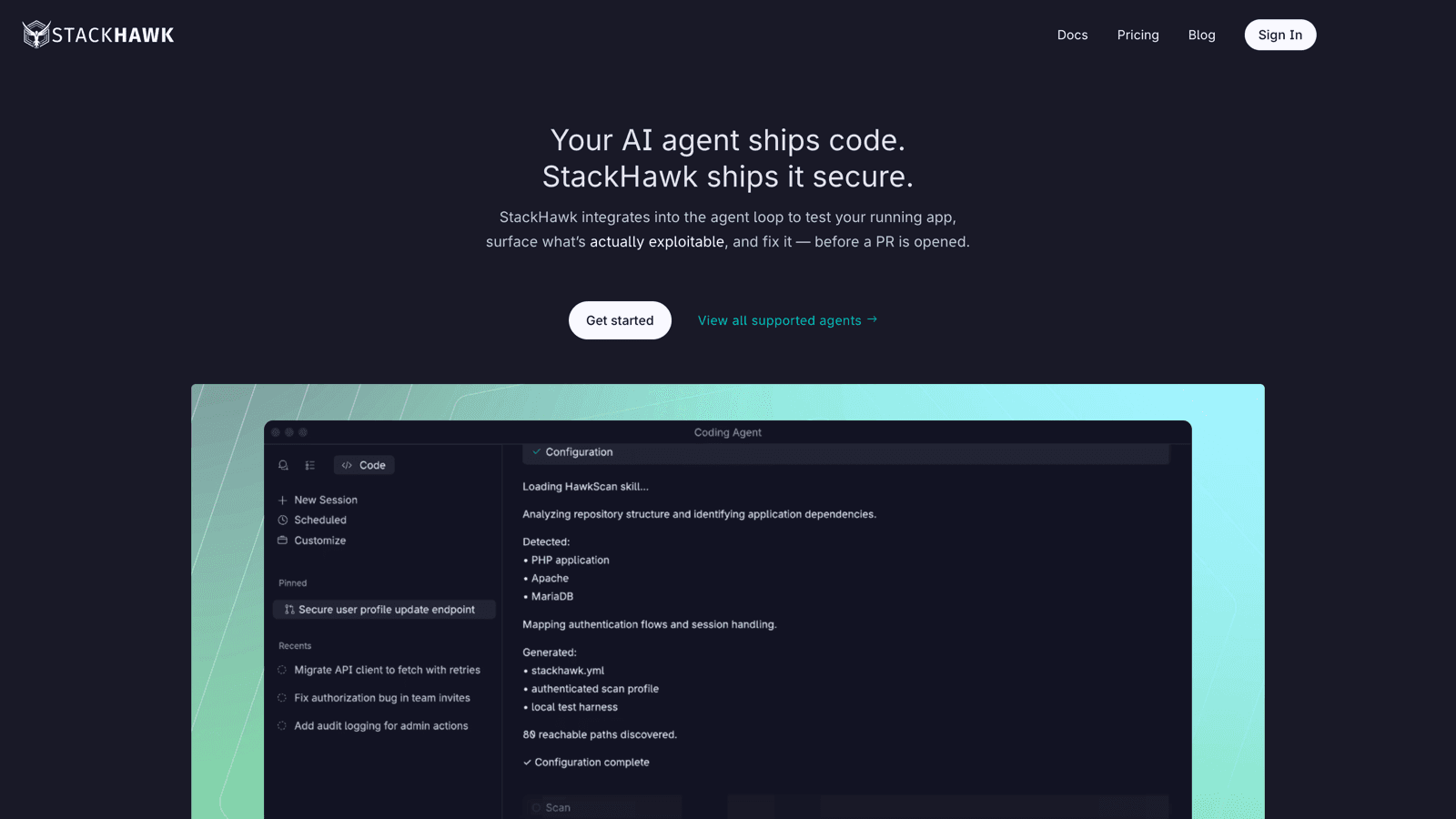
What arrives in the PR is evidence rather than an opinion. Every finding ships request and response data with a cURL reproduction, which is the one class of comment developers do not learn to ignore, because it either replays or it does not.
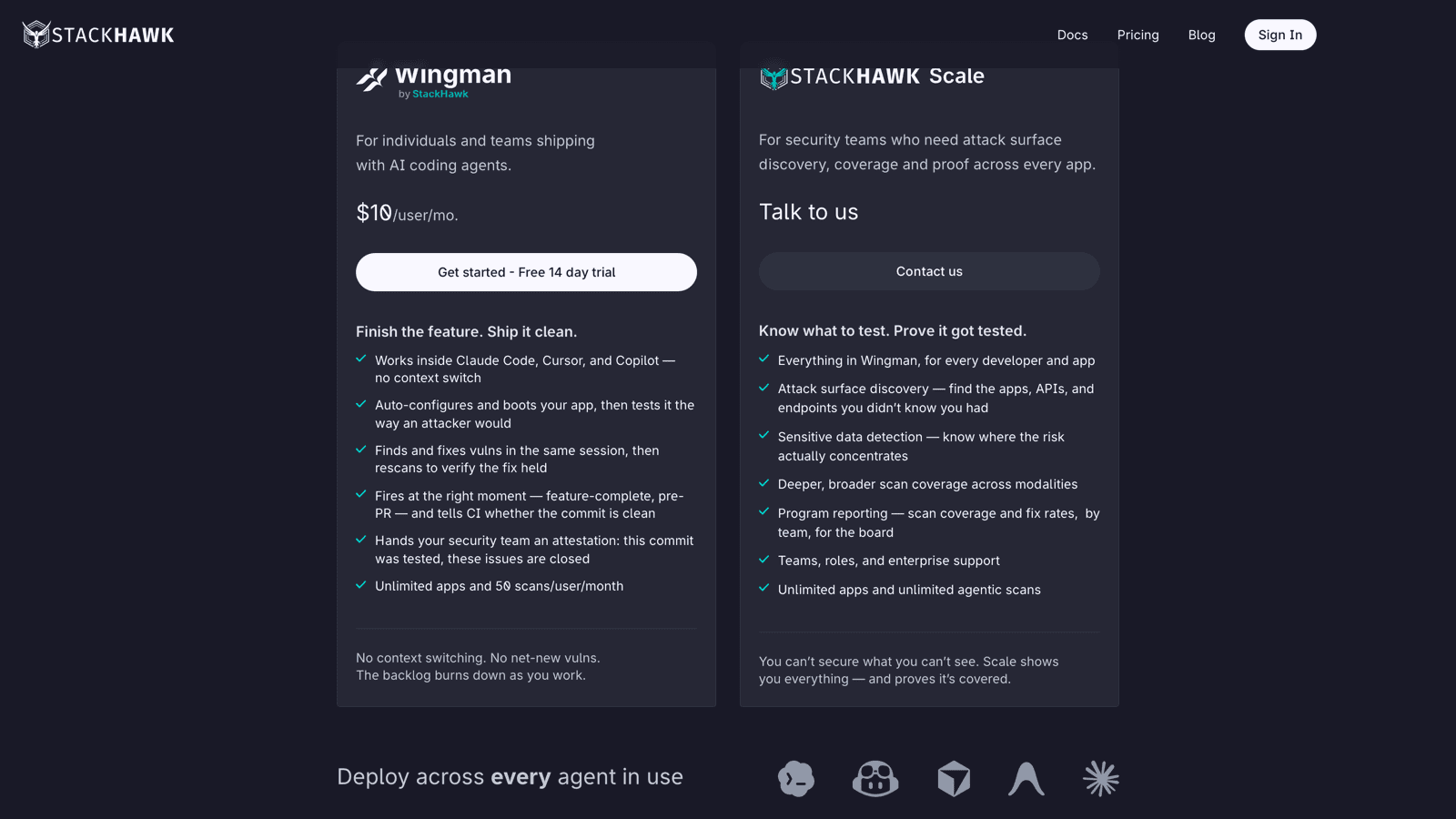
It also meets teams shipping through coding agents. The Wingman plan includes 50 agentic scans per user monthly with unlimited applications, and agent skills teach Claude Code, Cursor, Codex, Antigravity, and Copilot to scan, fix, and rescan before a PR opens, with StackHawk claiming 95% of vulnerabilities resolved at that stage. Protocol coverage spans REST, GraphQL, gRPC, SOAP, JSON-RPC, and MCP servers, and scans are defined in a versioned stackhawk.yml.
It is a complement, not a replacement. StackHawk sells no SAST at all and says so plainly, integrating Semgrep, Snyk Code, and CodeQL instead, so everything Codacy bundles statically needs a second product. An AWS Marketplace reviewer praised the "scanning capabilities and easy integration into CI/CD pipelines" and another called onboarding "one of the best I've seen," though a third found "authenticated scans can be frustrating." Pairing the two layers is the subject of our best SAST and DAST tools roundup.
Best for: a team already running a static analyzer it trusts, that wants provable runtime findings in the PR for less than it currently pays per Codacy seat.
6. Intruder
Your Codacy dashboard has no idea what subdomains you exposed last week. Intruder does, orchestrating OpenVAS, Nuclei, Tenable Nessus, and OWASP ZAP behind one interface, with subdomain discovery, exposed-service detection, and CloudBot auto-scanning of new AWS, GCP, Azure, and Cloudflare assets.
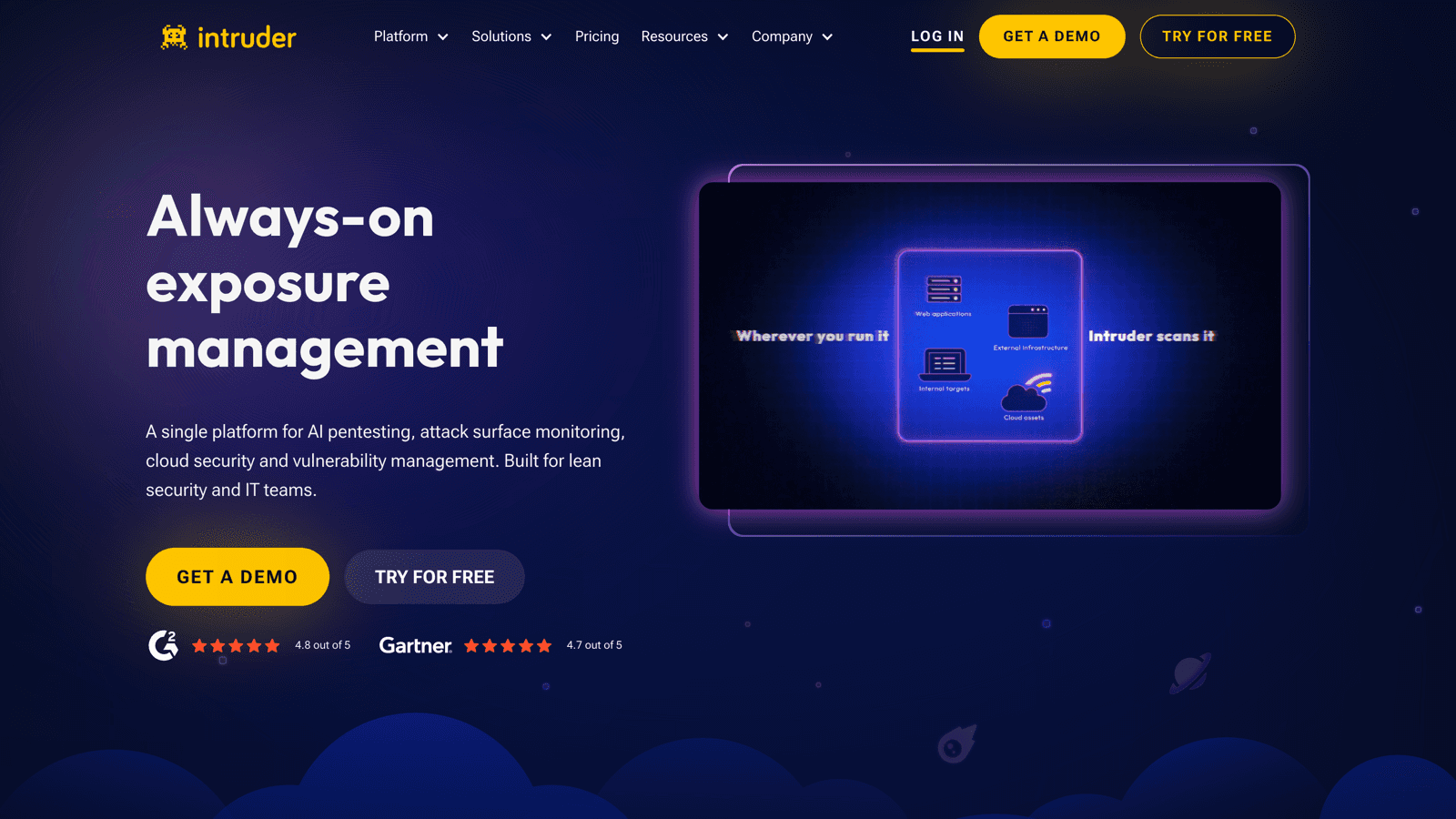
Emerging Threat Scans are the reason lean teams keep it. New CVE disclosures trigger scans across your targets within hours, which is coverage no repository scanner can offer at any price.
It also has the largest review corpus of anything on this list, at 4.8 across 207 G2 reviews. An operations director wrote that "rather than overwhelming us with low-value noise, it highlights vulnerabilities that genuinely matter and explains why they are important," and an enterprise reviewer called it "our number one, 100% vulnerability assessment tool, replacing both Nessus open source and Tenable," adding "the initial setup was super easy."
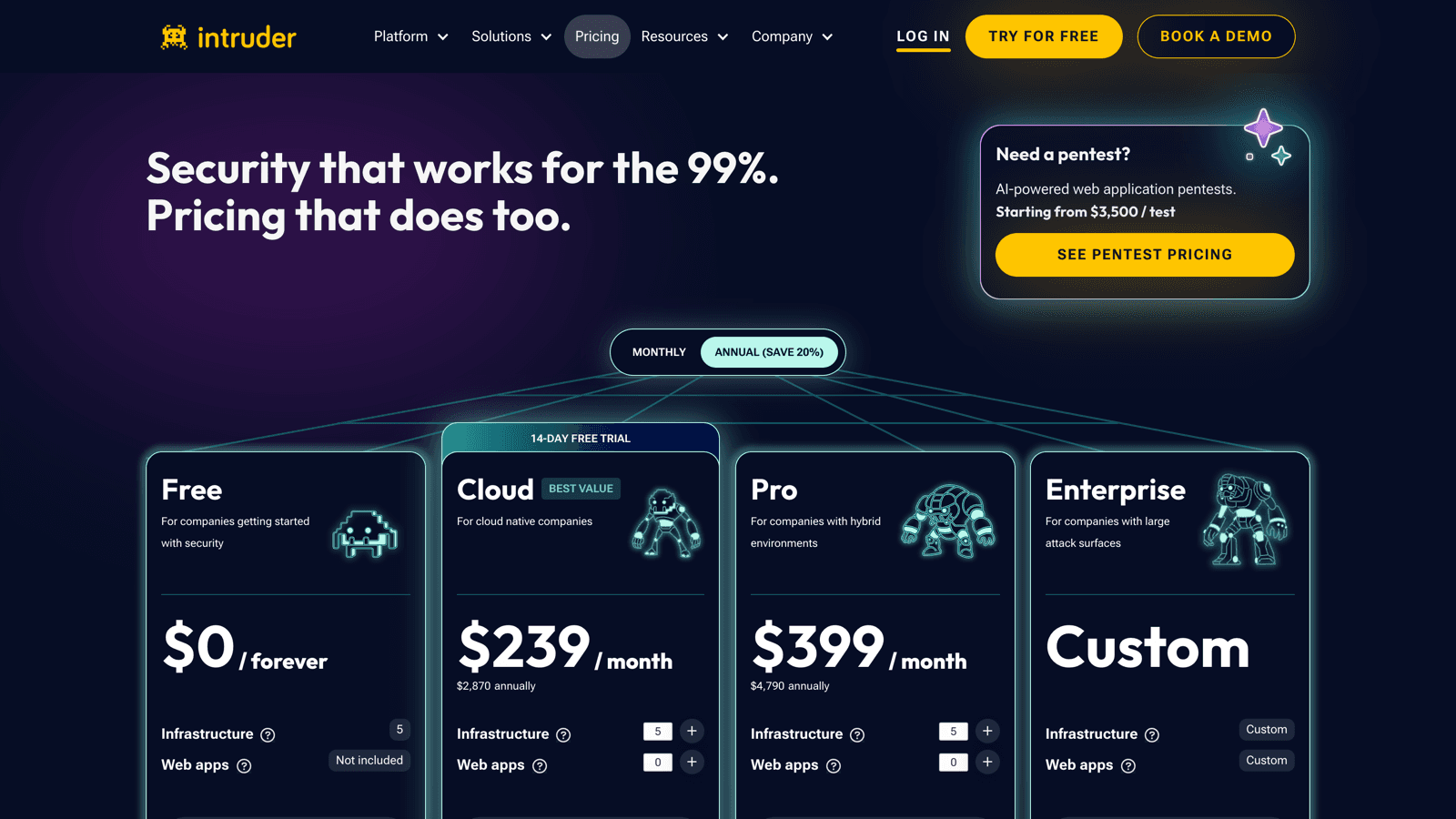
Understand the licence mechanics before budgeting. Intruder's docs state a licence "is used each time you scan a target, and stays used for 30 days," and deleting the target does not release it early, while an enterprise reviewer noted "the Azure integration for Intruder is definitely still a little bit immature." A free-forever plan covers five infrastructure targets, the Cloud plan is $239 per month annually, and a white-box pentest can be added at $3,500 per test for subscribers. Why always-on external coverage earns its keep is the subject of our guide to continuous versus annual pentesting, and it slots into the wider DevSecOps toolchain without disturbing your PR workflow.
Best for: a lead who owns production as well as the repo and needs the internet-facing estate watched continuously, added alongside whatever reviews the code.
7. Astra Security
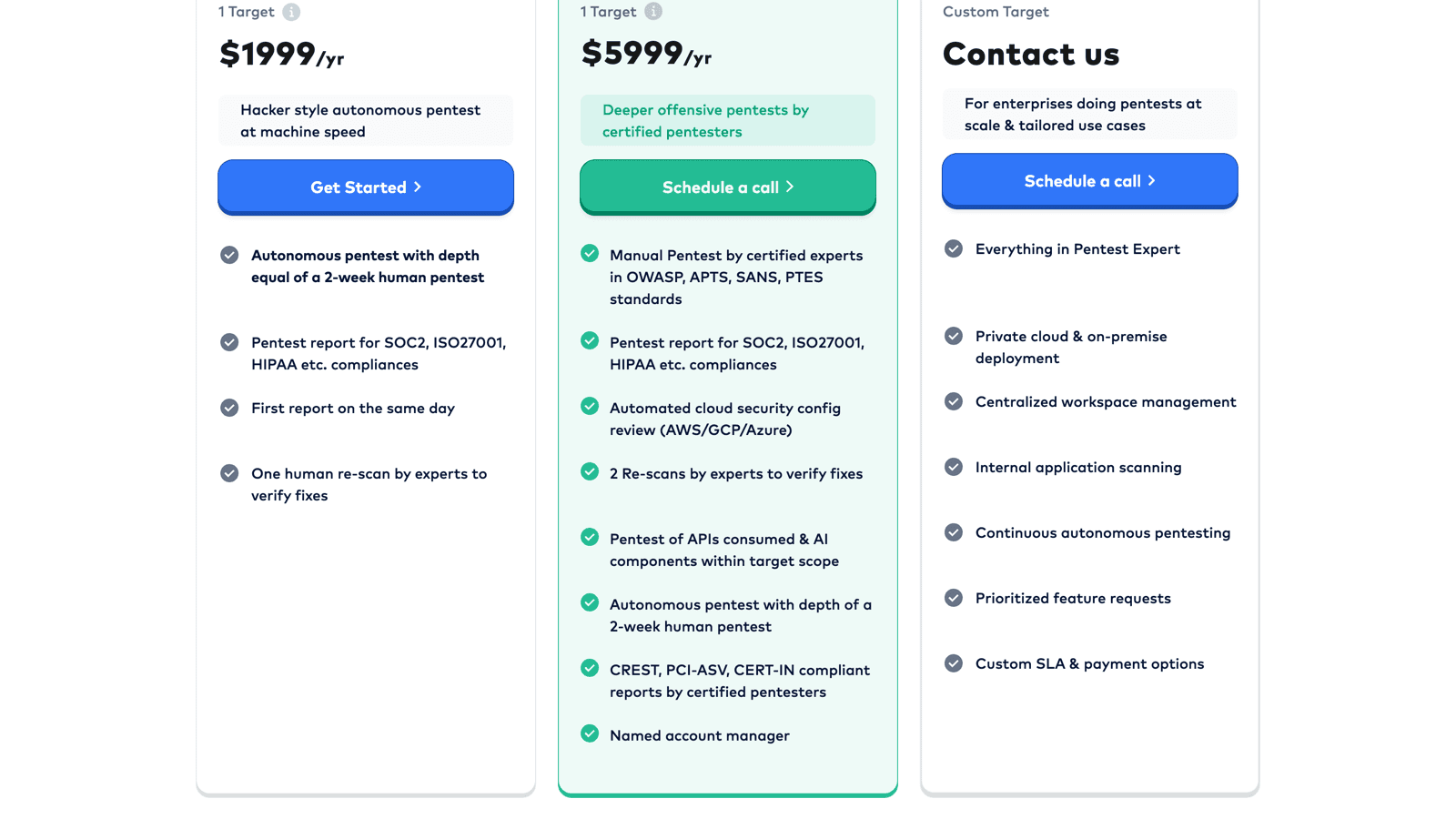
Astra is here because of one blank space on Codacy's pricing page. Where Codacy writes "billed separately," Astra publishes Pentest Auto at $1,999 per year and Pentest Expert at $5,999 per year per target, delivered by OSCP and CREST-certified humans on a continuous schedule.
The scanner is a genuine product rather than a lead magnet. Astra's DAST runs 10,000-plus test cases including authenticated scans behind TOTP-based MFA logins, with browser-based crawling for JavaScript apps and API scanning across REST, SOAP, and GraphQL, and a $7 one-week trial makes the evaluation nearly free.
For your reader the interesting piece is where fixes land. Astra's MCP integration reads your codebase only to push remediation prompts for runtime findings into Cursor, Claude Code, VS Code with Copilot, and ChatGPT, which is the closest this tool gets to your pull requests. An IT-services co-founder said "the vulnerability scan is great but it was the manual pen test which was better," noting "pen tests can be shockingly expensive and Astra is a very low price," while a financial-services security officer countered that "the accuracy of the automated scanner can be made more efficient."
Know the boundary. Astra ships five products and none of them is SAST, so Codacy's core function needs another vendor either way, and a senior director noted "there are some actions that cannot be carried out in the UI and require contact to service." Findings map to SOC 2, ISO 27001, PCI-DSS, HIPAA, and GDPR views. We put its human-led model against agentic testing in our CodeAnt AI vs Astra Security comparison, and the category is explained in our PTaaS guide.
Best for: a team whose first enterprise customer just asked for a pentest report, that wants the price before the sales call and does not need it wired into code review.
8. Cobalt
Cobalt sits last because it is furthest from your pull requests, and it earns its place anyway. The slowest part of a traditional pentest is procurement, and Cobalt's platform can start an engagement in as little as 24 hours with testers drawn from Cobalt Core, a five-stage-vetted community carrying OSCP, OSWE, CREST, and some 30 other certifications.
The unit is a credit worth eight hours of testing. Autonomous agents handle discovery and recon so the human hours go to chained exploits and business-logic flaws, with standard testing windows of 14 days and free retesting for 6 to 12 months on a 7-day SLA.
Engineers report it feels less like an audit. A senior staff engineer on G2 praised "actionable findings that are easy for engineers to understand and fix," saying tester interaction "makes security feel collaborative rather than audit-driven," and a five-year customer found assigned pentesters "pretty solid for the discovery of findings and responsive" with pricing "generally reasonable."
Three things will bother a team your size. The pricing page carries no dollar figures at all, a security specialist on G2 disliked "that there is a minimum of five credits" for tests needing far less, and the Standard tier ships without native Jira or GitHub integrations or customizable reports, which undercuts the SDLC pitch exactly where a mid-size team would enter. Cobalt's Secure Code Review is a booked human service rather than a PR-time scanner, so nothing here replaces Codacy. Our CodeAnt AI vs Cobalt comparison weighs agentic pentesting against booked human engagements, and our guide to how much penetration testing costs sets the benchmarks.
Best for: a team with a signed enterprise contract requiring a human-led pentest on a deadline, willing to run a sales call to get one started this month.
Codacy Alternatives Pricing, Side by Side
The comparison that matters at renewal is not the sticker price, it is whether the number moves when you hire. Codacy sits at $18 per developer per month on the Team plan billed annually, and everything below is the vendor's published entry point as of July 2026.
Tool | Entry paid price | Billing unit | Does hiring raise the bill? | Free option |
|---|---|---|---|---|
CodeAnt AI | $24 / user / mo (annual) | Per user | Yes, linearly | Free for open source, 14-day trial with 100 PR reviews |
DeepSource | $24 / user / mo (annual) | Per active committer, Contributor role excluded | Only for people who commit | Free forever for open source, 1,000 PRs / month |
SonarQube | $34 / mo (Cloud Team, 100k LOC) | Per line of code, unlimited users | No, only more code does | Community Build plus a 50k-LOC free cloud tier |
Aikido Security | $350 / mo (Basic) | Flat tier, 10 users bundled | Not until you pass the bundle | Developer plan, 2 users, free forever |
StackHawk | $10 / user / mo (Wingman) | Per user | Yes, at the lowest rate here | 14-day trial, no permanent free tier |
Intruder | $239 / mo (Cloud, annual) | Per target licence, 30-day lock per scan | No, targets drive the price | Free forever, 5 infrastructure targets |
Astra Security | $199 / mo (Scanner), $69 / mo (Lite) | Per target, app plus APIs plus cloud counts as one | No | $7 one-week scanner trial |
Cobalt | Custom, credit-based annual packages | 1 credit = 8 hours, five-credit minimum | No, scope drives the price | None, no trial |
Two patterns fall out of that table. Anything priced per user reprices your team every hiring round, and anything priced per target or per line does not, which is why Aikido and SonarQube keep showing up on renewal shortlists that started as a quality complaint.
What to Do Before Your Renewal Date
Codacy is a reasonable purchase for a team that is happy with consolidated scanning on cloud-hosted Git and is not growing fast. The reasons to move are specific, a seat meter that counts every contributor, engine depth borrowed from open source, GitHub-only AI review, no Azure Repos, and a pentest line with no number next to it.
CodeAnt AI answers those in order. Review and SAST run on every pull request across all four major SCMs, findings carry the reasoning that makes developers read them, the pentest costs nothing until it proves an exploitable finding, and open-source projects pay nothing at all.
Pick one repo with an active PR queue and run two tools against the same week of merges. Comment quality is the only benchmark that settles this, and it takes about five working days to see.
For the wider defensive picture, our best SAST tools comparison and our guide to continuous code security scanning cover how scanning fits a pull-request workflow. On the offensive side, start with the best AI penetration testing tools.

