

Open-source projects like curl and FFmpeg have survived decades of human audits and millions of automated scans, yet AI pentest automation keeps finding critical vulnerabilities that traditional tools missed. Daniel Stenberg recently accepted a bug bounty for a 27-year-old authentication bypass in curl discovered by AI reasoning about middleware exclusion logic. FFmpeg's 16-year-old vulnerability was hit 5 million times by OSS-Fuzz without triggering, until AI understood the specific input combination that caused memory corruption.
The pattern is clear: signature-based scanners like ZAP and Burp Suite excel at known attack pattern. But they hit a ceiling when vulnerabilities require contextual reasoning about business logic, authentication flows, or multi-step attack chains. AI pentest automation finds more bugs because it reasons about code rather than matching signatures.
This article compares AI pentest automation against ZAP and Burp Suite using real CVE case studies and quantified vulnerability discovery metrics. You'll learn which vulnerability classes each tool type dominates, how to layer AI capabilities onto existing security stacks, and when grey-box testing with code intelligence delivers measurable advantages over traditional DAST.
Why Open-Source Projects Expose The Real Ceiling Of AI Pentesting Vs Traditional Scanning
Open-source projects aren't just community resources, they're the ultimate stress test for security tooling. These codebases have survived decades of human review, millions of automated scans, and constant adversarial attention. Yet AI pentest automation is still finding critical vulnerabilities that traditional scanners missed.
When Anthropic's Project Glasswing analyzed 1,000 open-source projects, it discovered over 10,000 vulnerabilities, many in codebases that had been continuously scanned for years:
curl's 27-year-old authentication bypass: A vulnerability in OpenBSD's Kerberos implementation discovered by AI reasoning about middleware exclusion logic that traditional scanners treated as a black box
FFmpeg's 16-year-old memory corruption flaw: Google's OSS-Fuzz executed the vulnerable code path over 5 million times without triggering detection, the bug required a specific combination of video encoding parameters that fuzzing's random input generation never constructed
Squid proxy's "literally 200 valid bugs": Security researcher Joshua Rogers used AI tools to find hundreds of issues requiring contextual understanding of proxy functionality, authorization bypasses, request smuggling chains, and header injection vulnerabilities that only manifested under specific configurations
This isn't a failure of human expertise or scanning frequency. It's a structural limitation: traditional DAST tools excel at pattern matching against known vulnerability signatures, but struggle with business logic flaws that require reasoning about application state, data flow, and multi-step attack chains.
What Makes Open-Source A Better Benchmark For AI Pentesting Than Toy Apps?
Security vendors love demonstrating tools against deliberately vulnerable applications like DVWA or WebGoat. These synthetic targets are useful for training but terrible benchmarks for real-world capability because:
Complex protocol implementations: Open-source projects implement stateful protocols, HTTP/2 multiplexing in curl, video codec state machines in FFmpeg, distributed consensus in etcd. Traditional scanners treat these as opaque endpoints to fuzz. AI models reason about protocol semantics: "This endpoint expects a sequence of SETTINGS frames before DATA frames; what happens if I send them out of order?"
Edge-case state machines: Production code accumulates decades of edge-case handling—timezone conversions, character encoding transformations, backward compatibility shims. A traditional scanner sees an input field and tries SQL injection payloads. An AI model traces data flow through multiple transformation layers and asks: "After this input passes through URL decoding → base64 decoding → JSON parsing, does the validation logic still hold?"
Real authentication boundaries: Toy apps have simplistic "admin vs. user" roles. Production systems have hierarchical permissions, tenant isolation, API key scoping, OAuth delegation chains. Traditional DAST tools authenticate once and crawl. AI pentest automation reasons about privilege boundaries: "This user can read their own orders, but can they enumerate other users' order IDs by incrementing the parameter?"
The Real AI Pentesting Benchmark: Known-Unknowns Vs Unknown-Unknowns
Passing a ZAP or Burp scan doesn't mean your application is secure, it means you don't have the specific vulnerabilities those tools know how to detect. This is the difference between known-unknowns (vulnerabilities we're actively testing for) and unknown-unknowns (vulnerability classes we haven't considered).
Traditional scanners reduce known-unknowns efficiently: if your app has SQL injection, they'll find it. But they can't discover:
Attack chains requiring multi-step reasoning: Authentication bypass → IDOR → data exfiltration sequences where each individual step appears benign in isolation
Business logic flaws: Payment flows that allow negative quantities, role escalation through parameter tampering, state machine manipulation in multi-step processes
GraphQL authorization gaps: Query complexity attacks, batching abuse, field-level permission bypasses that require understanding the schema's authorization model
Context-dependent vulnerabilities: SSRF that only triggers when specific internal services are reachable, race conditions in concurrent request handling
CodeAnt AI's grey-box approach bridges this gap by using code intelligence to inform offensive testing. When the platform understands your authentication middleware, data access patterns, and business logic constraints from analyzing your codebase, it can construct targeted attacks that external-only scanners would never attempt.
What ZAP And Burp Suite Still Do Well In An AI Pentesting Workflow
Before positioning AI pentest automation as superior, let's establish what traditional DAST tools do exceptionally well, understanding these strengths helps you build a layered security strategy rather than replacing proven tools blindly.
The Traditional DAST Workflow
Both ZAP and Burp Suite follow a proven methodology:
crawl your application to discover endpoints
passively scan traffic for low-hanging fruit (missing security headers, verbose errors)
actively inject known attack payloads (SQL injection strings
XSS vectors)
support manual exploration through tools like Burp's Repeater and Intruder
This workflow excels at finding known vulnerability patterns in externally accessible endpoints. If your application has classic SQL injection in a publicly exposed search parameter, ZAP or Burp will catch it fast.
Vulnerability Classes Traditional DAST Still Dominates In AI Pentesting Comparisons
Vulnerability Class | Why ZAP/Burp Excel |
|---|---|
SQL Injection | Extensive payload libraries with proven attack strings, time-based blind detection |
Reflected/Stored XSS | Comprehensive polyglot payloads, context-aware encoding detection |
CSRF | Token validation checks, automatic PoC generation |
Known CVEs | Direct version fingerprinting, exploit database correlation |
SSL/TLS Misconfigurations | Certificate validation, cipher suite enumeration |
Burp Suite Pro's Intruder deserves special mention, it's the gold standard for manual penetration testing workflows. Experienced pentesters use it to brute-force parameters, test rate limiting, or iterate through user IDs looking for IDOR patterns. Combined with extensions like Autorize (for authorization testing), Param Miner (for discovering hidden parameters), and Turbo Intruder (for high-speed fuzzing), Burp becomes a formidable platform for skilled operators.
Why Black-Box Testing Limits AI Pentesting Discovery Quality
Traditional DAST tools treat your application as a black box, they observe inputs and outputs without understanding the code's internal logic. This works for predictable patterns but fails when bugs require contextual reasoning:
Authentication flows spanning multiple steps:
A traditional scanner sees three separate endpoints. It doesn't understand that bypassing step 1 might allow direct access to step 3 if the backend doesn't validate token origin. Attack chain construction requires reasoning about state machines and authentication boundaries, something signature-based tools don't do.
Role-based authorization requiring domain logic: Consider a multi-tenant SaaS application where users belong to organizations with hierarchical roles. A BOLA vulnerability might exist where User A can access
/api/org/1/invoices/123but the API doesn't validate org ownership. ZAP or Burp can fuzz the invoice ID parameter, but they don't understand organizational boundaries or role hierarchies.GraphQL authorization: Traditional scanners might test a
userquery with different IDs (basic IDOR fuzzing), but they won't understand that the nestedorders.creditCardfield should be restricted based on the authenticated user's relationship to the queried user. GraphQL's flexible query structure allows attackers to request deeply nested data that bypasses field-level authorization.
Why Business Logic Flaws Need AI Pentesting, Not Just DAST
The vulnerabilities that cause actual breaches aren't typically SQL injection or reflected XSS anymore, most modern frameworks have those covered. The real risk lives in authorization logic, state machine manipulation, and attack chains that require understanding how your application actually works.
Vulnerability Classes That Signature Scanners Can't See
BOLA (Broken Object Level Authorization) and IDOR are canonical examples:
A signature-based scanner sees authentication middleware and concludes the endpoint is protected. It has no way to reason that the code fails to verify current_user.tenant_id == doc.tenant_id. The vulnerability requires understanding:
Data model relationships (documents belong to tenants, users belong to tenants)
Authorization invariant (users should only access documents within their tenant boundary)
Implicit trust assumption (developer assumed authentication was sufficient)
Multi-step attack chains demonstrate why signature detection fails. Consider an order processing flow:
A traditional scanner tests each state transition independently. It misses the business logic flaw where a user can bypass payment by directly calling the fulfillment webhook with state PAYMENT_CONFIRMED. This requires understanding intended vs. actual state flows, something signature-based tools don't reason about.
GraphQL query complexity issues are particularly invisible. A scanner sees a single /graphql endpoint and attempts injection attacks. It doesn't understand that real vulnerabilities are:
Nested query authorization: Fetching
user { orders { customer { creditCards } } }where each nesting level should enforce separate authorization checksQuery depth attacks: Recursive queries that bypass rate limiting
Field-level authorization: Exposing
user.ssnoruser.salaryfields to unauthorized roles
The Ground Truth Problem
The fundamental limitation is that traditional DAST tools operate without context. They lack ground truth about:
Role hierarchies and permission models: A scanner can't distinguish between admin, manager, and user roles without understanding your RBAC implementation
Data ownership boundaries: Multi-tenant applications have implicit rules about data isolation that scanners don't model
Implicit trust boundaries: Modern applications trust certain request sources (internal microservices, admin panels) differently than public API consumers
Feature flag state: Authorization logic often depends on runtime configuration that black-box tools can't see
The vulnerabilities that evade signature-based DAST are the same ones causing high-profile breaches. OWASP's API Security Top 10 is dominated by authorization and business logic flaws—BOLA, broken authentication, excessive data exposure. These aren't theoretical risks; they're the attack vectors that actually compromise production systems.
How AI Pentest Automation Reasons Differently: Grey-Box Code Intelligence
AI pentest automation doesn't just run faster than traditional tools, it reasons differently about your application's attack surface through multi-phase reconnaissance, code-aware intelligence, and autonomous exploit agents.
The Five-Phase AI Pentest Engine
Phase 1
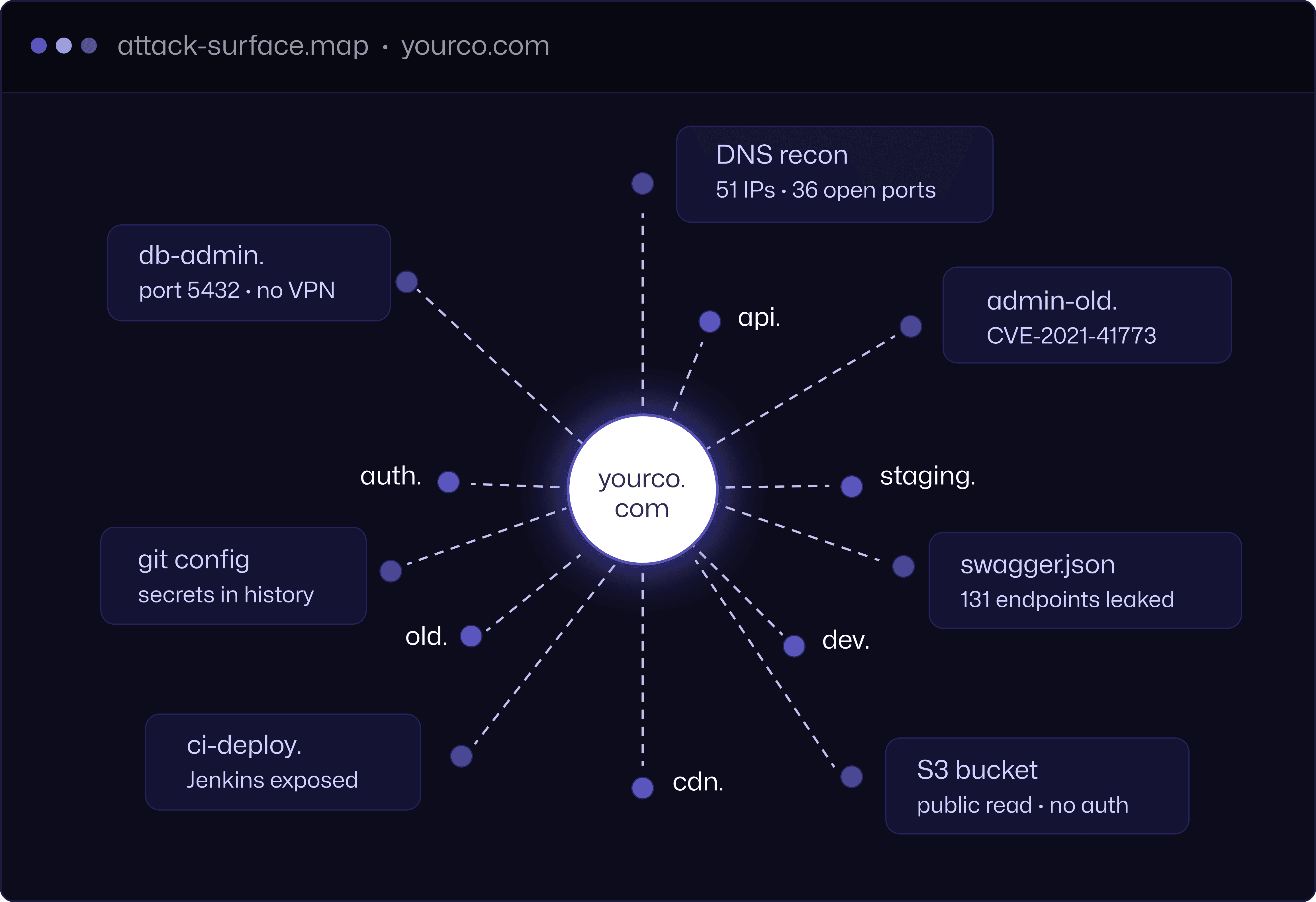
Passive Recon
Maps your full attack surface, subdomains, open ports, exposed configs, and known CVEs, without touching your systems.
Passive Recon
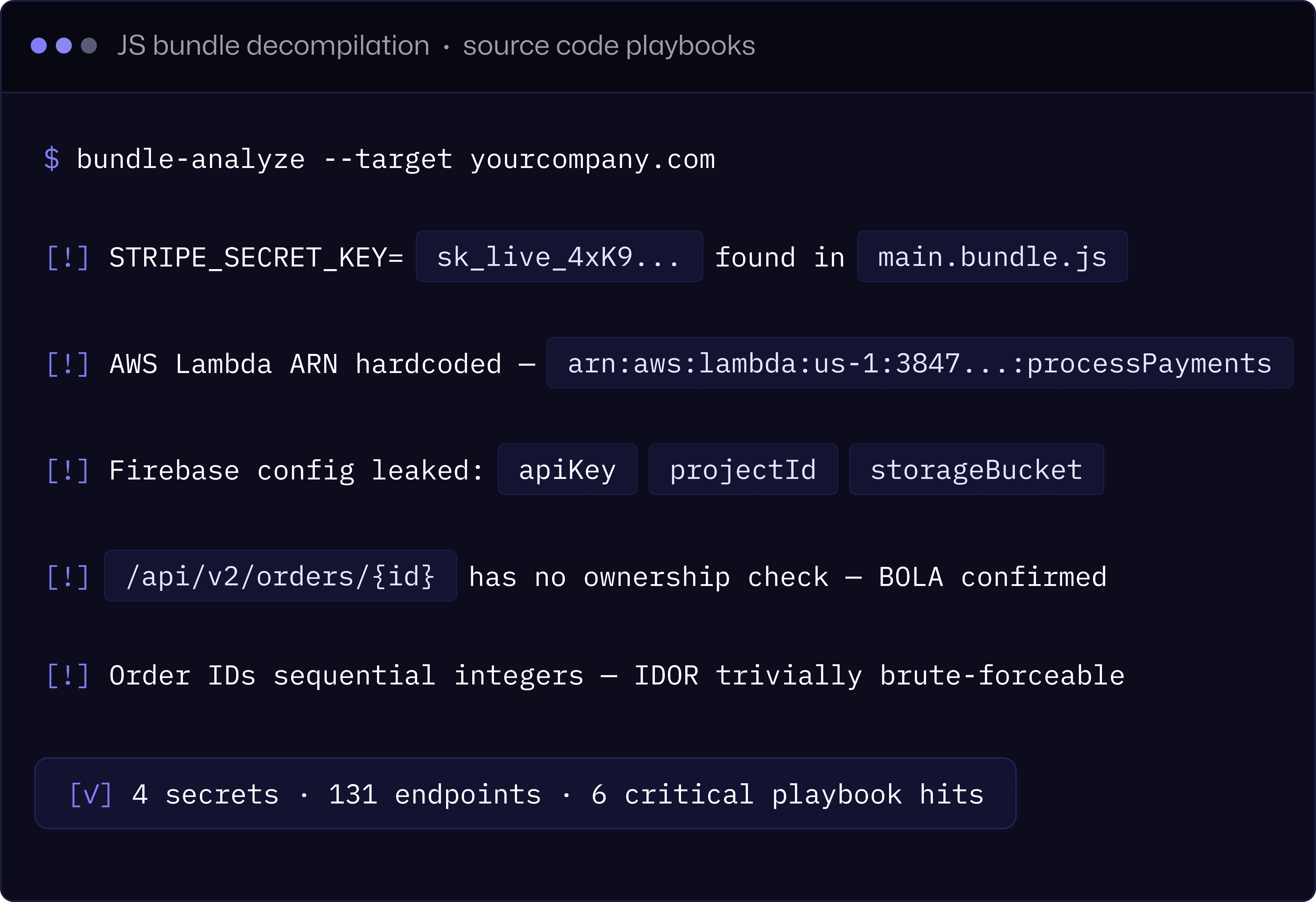
App Intelligence
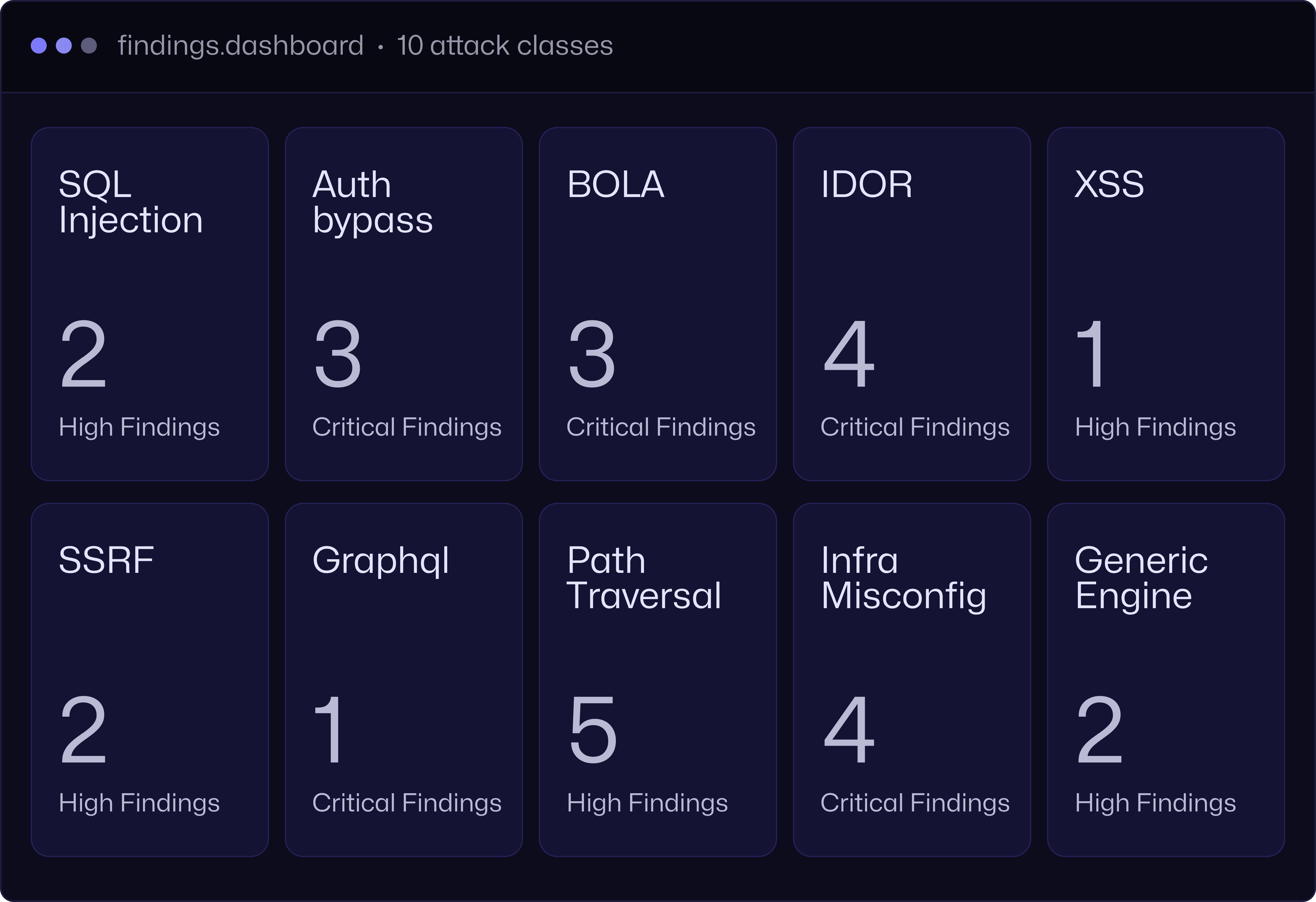
500+ Agents
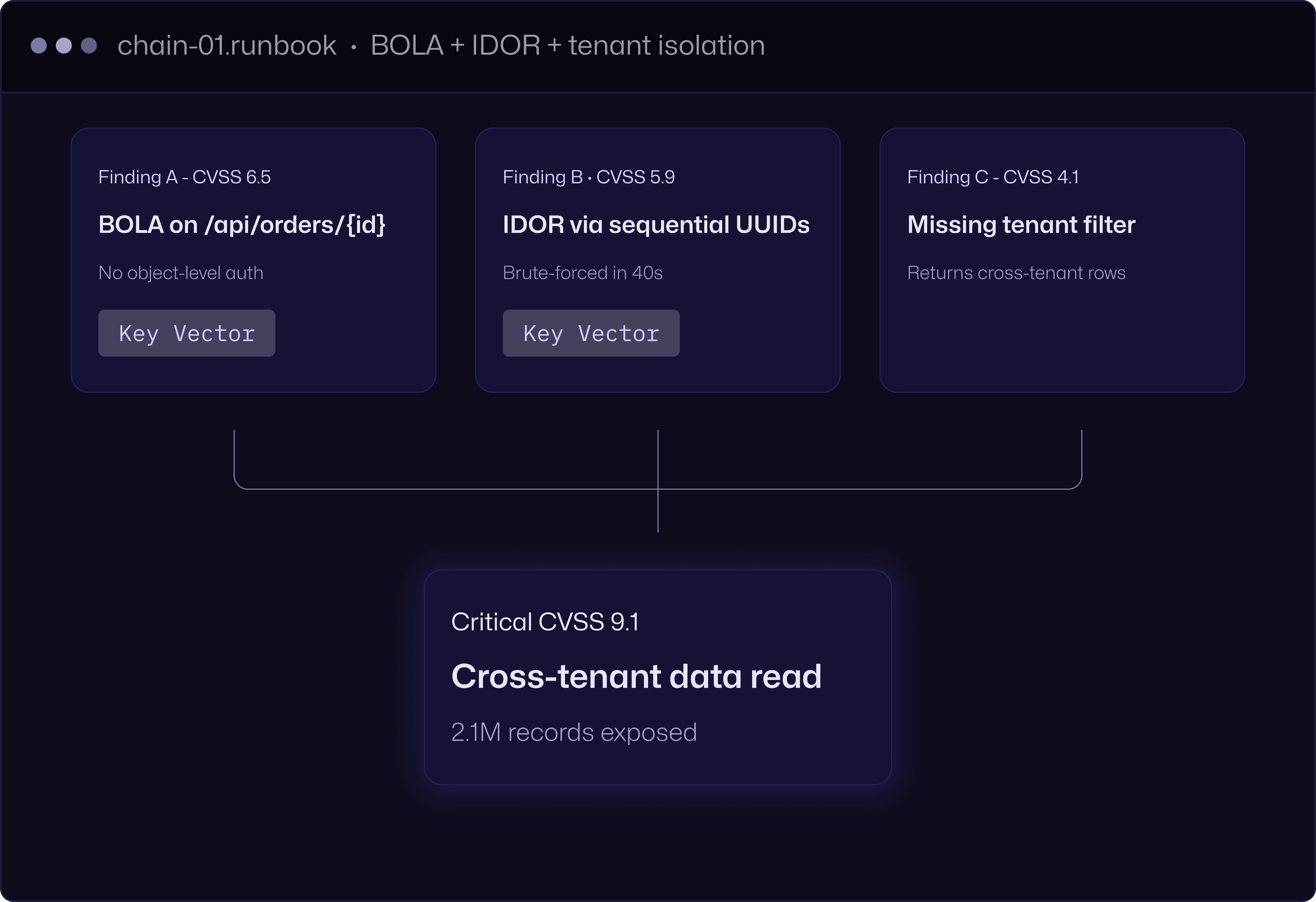
Attack Chains
Evidence
1. Passive Reconnaissance: Subdomain enumeration via DNS records, certificate transparency logs; JavaScript bundle analysis to extract API endpoints and authentication flows; public repository mining for leaked credentials and infrastructure patterns.
2. Application Intelligence (The Grey-Box Advantage): Static code analysis to build knowledge graphs of routes, controllers, middleware chains, and authorization checks. Data-flow tracing from user input through validation layers to database queries. Authentication boundary mapping: which endpoints require auth, what roles exist, how session state propagates.
3. Autonomous Exploit Agents (500+ Specialized Modules): Each agent targets a specific vulnerability class: BOLA, IDOR, SQLi, XSS, SSRF, auth bypass, GraphQL issues. Agents operate with context awareness—they understand the difference between a public API endpoint and an admin-only route.
4. Attack-Chain Construction: Multi-step reasoning combining low-severity findings into high-impact exploit chains. Example: authentication bypass → IDOR on user objects → privilege escalation → data exfiltration. Chain validation ensures each step produces a working exploit.
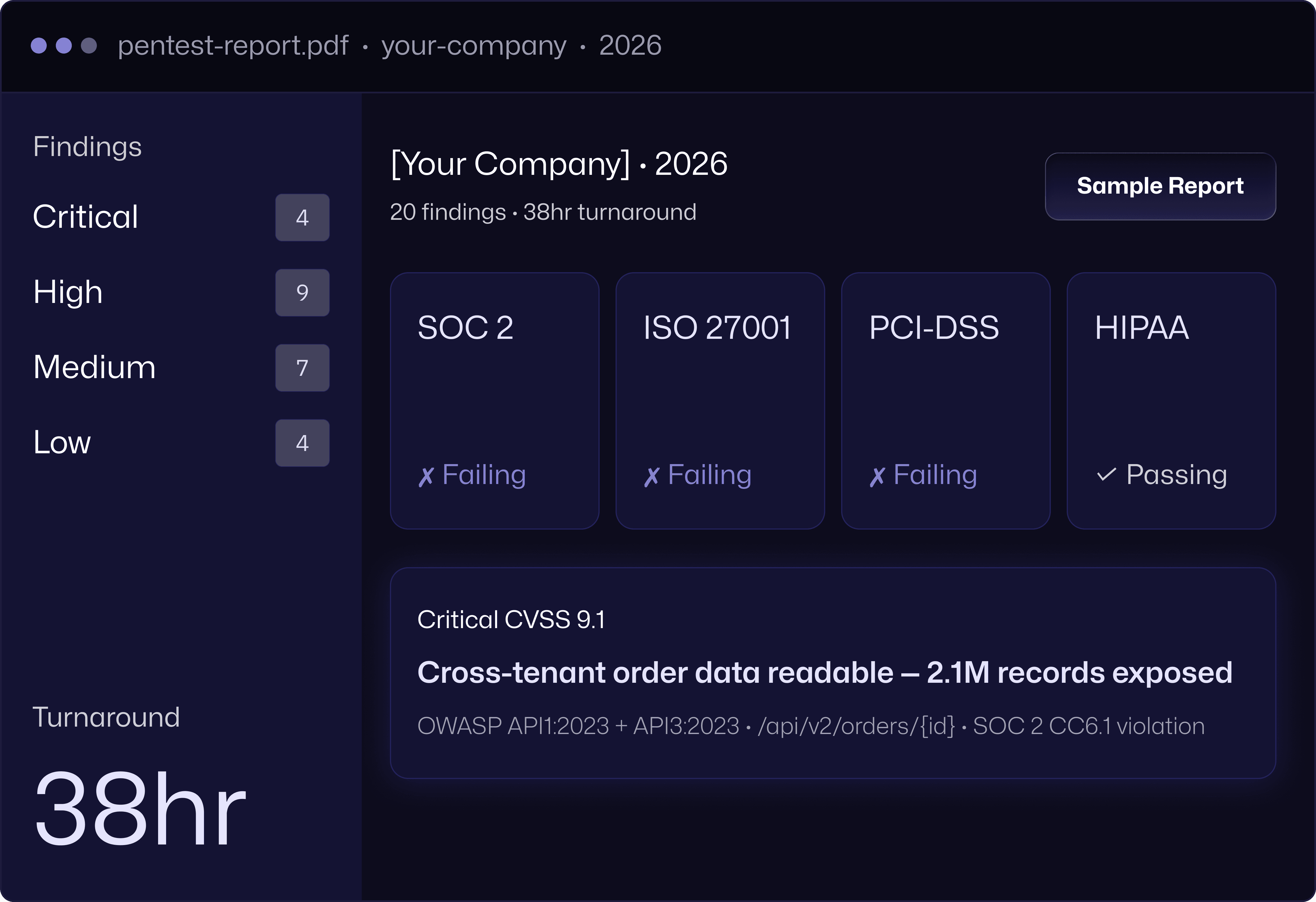
5. Evidence Collection: Curl PoC generation for every confirmed vulnerability, CVSS scoring with business context, automatic mapping to compliance frameworks (SOC 2, ISO 27001, PCI-DSS).
What "Grey-Box" Actually Means: Code Access as Offensive Intelligence
Traditional DAST tools treat your application as a black box. Grey-box testing flips this by using code access to inform offensive targeting:
Endpoint Discovery Beyond Crawling:
The AI reads route definitions, identifies that /api/users/<user_id>/payment-methods exists (even if no UI links to it), and immediately tests for IDOR: "Can user A access user B's payment methods by changing the user_id parameter?"
Authorization Boundary Analysis: Grey-box testing traces authorization logic across your codebase:
The AI reads middleware definitions, identifies that requireAdmin() exists but isn't applied to this route, and generates a targeted test: "Can an authenticated non-admin user access this endpoint?"
CodeAnt's Differentiation: Unified Defensive and Offensive Intelligence
CodeAnt's architecture creates a structural advantage: the same code intelligence used for PR security reviews informs offensive targeting.
When CodeAnt reviews your pull requests, it builds semantic understanding of route definitions, authorization middleware, object ownership validation patterns, and GraphQL resolver authorization checks. This defensive analysis feeds directly into the offensive pentest engine.
From PR Reviews → Pentest Targeting:
"This codebase uses
@require_authdecorators inconsistently, test for missing auth on admin routes""GraphQL resolvers don't validate field-level permissions, test for unauthorized data access via nested queries"
"The
Ordermodel has auser_idforeign key, but controllers don't always validate ownership, generate IDOR test cases"
This creates higher hit-rate on logic bugs because the AI isn't guessing, it's testing based on observed patterns in your actual code.
Real Vulnerabilities AI Pentesting Found That Traditional Tools Missed
Case Study 1: Curl's 27-Year-Old Authentication Bypass
The Discovery: Joshua Rogers submitted a vulnerability to curl maintainer Daniel Stenberg that had existed in the OpenBSD implementation for 27 years. The flaw required chaining two logic errors: a middleware exclusion rule that incorrectly bypassed authentication checks for specific URI patterns, combined with a Kerberos ticket validation weakness.
Why Traditional Scanners Missed It:
Black-box limitation: ZAP and Burp treat authentication as binary (logged in or not), not modeling the flow of authentication through middleware chains
Signature-based ceiling: Tools match known attack patterns but can't reason about application-specific logic like "this URI pattern bypasses auth checks when combined with this specific Kerberos ticket state"
Multi-step reasoning gap: The vulnerability required understanding that middleware exclusion + expired ticket validation = exploitable bypass
What AI Needed to Understand: The AI traced how curl's authentication middleware processed requests across multiple files, understood Kerberos ticket expiration windows, and recognized that the middleware exclusion alone wasn't exploitable but combined with the timing issue created a bypass path.
Evidence Delivered:
Case Study 2: FFmpeg's 16-Year-Old Memory Corruption
The Discovery: Anthropic's Project Glasswing found a memory corruption vulnerability in FFmpeg's video encoding pipeline that had existed for 16 years. Google's OSS-Fuzz had executed over 5 million test cases against the vulnerable code path without triggering the bug.
Why Fuzzers Missed It: OSS-Fuzz generates semi-random inputs guided by code coverage feedback. It hit the vulnerable function millions of times but never produced the exact parameter combination that triggered the overflow. The input space for video encoding is astronomically large, and random mutation doesn't efficiently explore multi-constraint spaces.
What AI Needed to Understand: The AI analyzed FFmpeg's codec implementation to understand which parameter combinations were semantically valid but triggered edge cases in buffer allocation logic. The vulnerability required frame width divisible by 16, height divisible by 8, specific chroma subsampling (4:2:0), and a particular encoding profile—constraints the AI reasoned about together rather than fuzzing independently.
Lesson: If your application processes complex binary formats (images, videos, PDFs), fuzzing alone won't find vulnerabilities that require precise multi-constraint inputs. AI reasons about input relationships and constraint satisfaction, generating targeted test cases that traditional fuzzers would take years to randomly discover.
Implementation Decision Framework: When to Add AI Pentest Automation
Your implementation strategy should be driven by code access availability and vulnerability complexity. Traditional DAST tools excel in external-only scenarios with known attack patterns, while AI pentest automation demonstrates advantages when you have codebase access and need to discover business logic flaws.
Factor | Traditional DAST | AI Pentest Automation | Layered Approach |
|---|---|---|---|
Code Access | External-only (black box) | Grey box with codebase intelligence | Use ZAP for external surfaces, CodeAnt for authenticated flows |
Vulnerability Types | SQLi, XSS, CSRF, known CVEs | BOLA, IDOR, auth chains, GraphQL | ZAP for injection patterns, CodeAnt for logic flaws |
Team Size | <50 developers | 100+ developers, continuous deployment | Start with ZAP in CI, add CodeAnt as team scales |
Release Frequency | Monthly/quarterly | Daily/weekly deployments | ZAP for baseline, CodeAnt for rapid retesting |
Scenario 1: Start with Baseline ZAP in CI
When this works: Early-stage startups, budget-constrained teams, applications with primarily public-facing surfaces.
Traditional DAST tools provide excellent value for detecting common injection attacks across unauthenticated endpoints. ZAP's active scanner can run in CI/CD pipelines to catch SQL injection, XSS, and CSRF before production.
When to graduate: Once you hit 50+ developers or introduce role-based access controls, ZAP's blind fuzzing starts missing the vulnerabilities that matter—BOLA flaws where User A can access User B's data, IDOR issues in API endpoints, GraphQL authorization bypasses.
Scenario 2: Deploy CodeAnt AI for Continuous Grey-Box Testing
When this delivers ROI: Organizations with 100+ developers, daily/weekly releases, multi-tenant SaaS architectures, complex business logic (fintech, healthcare, e-commerce), or compliance requiring evidence-based exploit validation.
Implementation recommendations:
Phase 1: Start with free black box scan against your production domain to establish baseline risk—identify exposed subdomains, JavaScript bundle leaks, unauthenticated API endpoints.
Phase 2: Enable grey box testing with codebase access—connect CodeAnt to your GitHub/GitLab repository (read-only). Platform builds knowledge graph of authentication logic, API routes, database models. 500+ autonomous exploit agents test authenticated flows using code-aware reasoning.
Phase 3: Integrate with CI/CD for rapid retesting:
Key advantages:
Code-aware BOLA detection: Traces object ownership through your codebase to find authorization bypasses
Attack chain construction: Automatically chains authentication bypass + IDOR + data exfiltration into single exploit
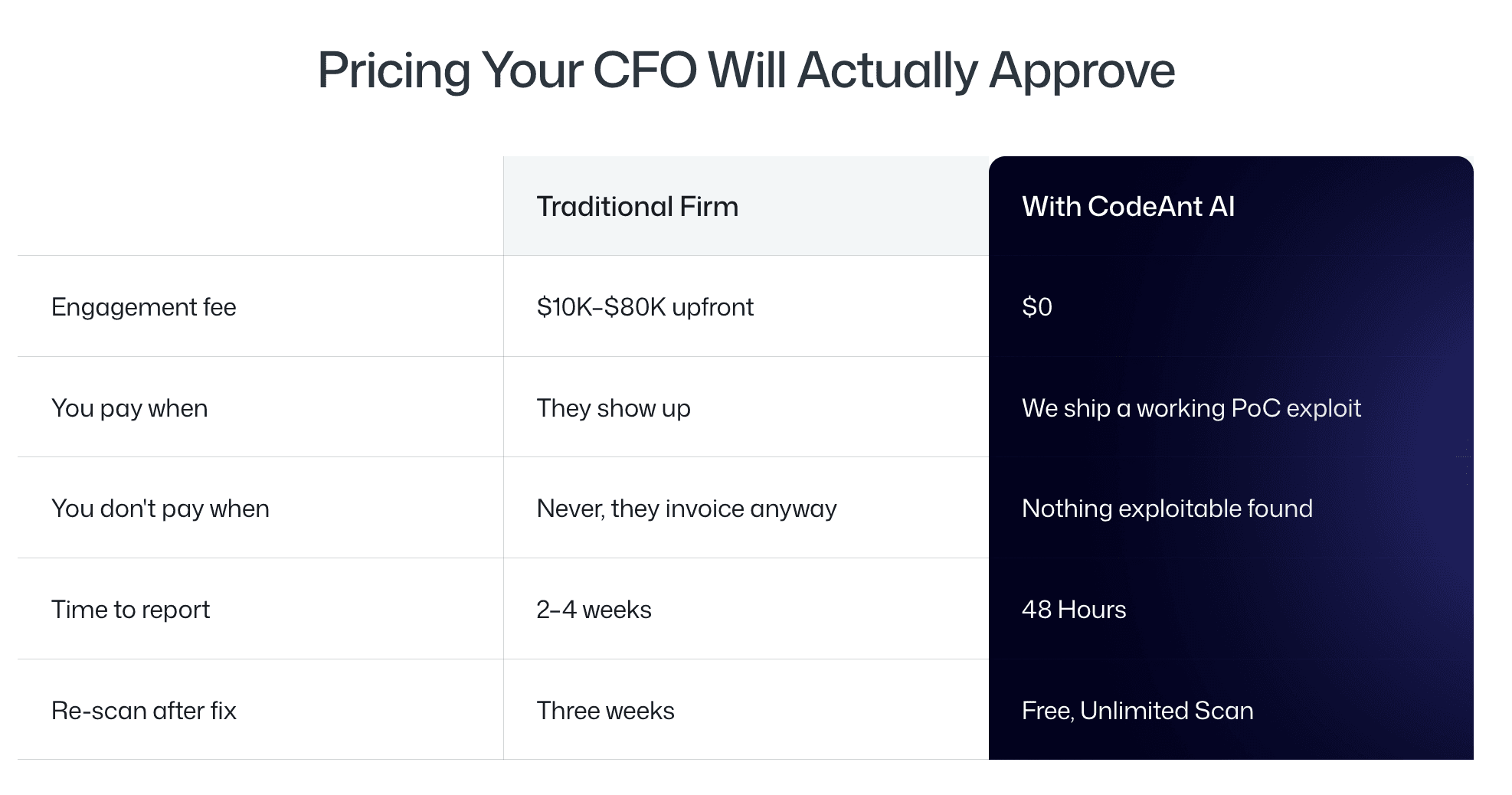
Unlimited re-scans after fixes: Traditional pentest firms charge per engagement; CodeAnt enables iterative validation without additional cost
Audit-grade reports: SOC 2, ISO 27001, PCI-DSS aligned findings with CVSS scoring
Budget Considerations
When traditional DAST remains cost-effective:
Teams with <50 developers and simple architectures (ZAP free, Burp Suite Pro ~$400/year)
Compliance-driven scanning where checkbox requirements matter more than risk reduction
External-only assessments without code access
When AI pentest automation delivers ROI:
Organizations with 100+ developers where a single production BOLA vulnerability costs more in incident response than annual tooling investment
Multi-tenant SaaS platforms where tenant isolation bugs create existential business risk
Teams shipping daily releases needing continuous pentesting integrated with CI/CD
CodeAnt's "no working exploit, no payment" model changes the economics: you only pay for confirmed exploitable vulnerabilities with curl PoC exploits, not theoretical findings or false positives.
Integration Patterns: PR Review + Continuous Pentest + Retest Loops
Modern security engineering requires continuous feedback loops that connect defensive code review with offensive validation. When CodeAnt’s defensive engine flags an authorization change during PR review, it does not treat that signal as an isolated code issue. If the change adds a new API endpoint exposing user data or modifies a role check in authentication middleware, CodeAnt automatically queues a targeted grey-box pentest scenario.
Operational flow:
PR gate phase: CodeAnt scans every pull request for security patterns. Changes touching authentication, authorization, or data access layers are tagged as high-priority pentest candidates.
Staging deployment trigger: When the PR merges and deploys, CodeAnt's offensive engine receives the diff context, which files changed, what functions were modified. This isn't a blind full-app scan; it's code-aware attack focused on changed surface area.
Targeted exploit execution: If the PR introduced a new
/api/users/{userId}/ordersendpoint, CodeAnt's exploit agents automatically test for horizontal privilege escalation (BOLA), vertical privilege escalation, and attack chains.
Recommended Pipeline Architecture
Fix validation workflow:
Exploit discovered → CodeAnt creates ticket with "Open" status
Fix PR created → CodeAnt's defensive review validates fix doesn't introduce new vulnerabilities
On merge → CodeAnt re-runs original exploit scenario
If PoC still works → ticket remains open, team alerted
If exploit fails → ticket moves to "Fix Validated"
Conclusion: Use AI Pentesting For The Bugs Scanners Cannot Reason About
Traditional DAST tools are still useful. ZAP and Burp Suite help teams catch known attack patterns such as SQL injection, XSS, CSRF, SSL issues, and common CVEs. They are valuable baseline tools for application security and should not be dismissed.
But modern breaches often come from vulnerabilities that require context: broken object authorization, tenant isolation failures, GraphQL field exposure, authentication bypass chains, and business logic abuse. These are the areas where AI pentest automation becomes valuable.
AI pentesting uses grey-box code intelligence to understand routes, roles, data flows, authorization checks, and attack chains. That allows it to test what traditional scanners often cannot model.
For teams shipping fast, the best approach is layered: keep ZAP or Burp Suite for baseline coverage, then add AI penetration testing for code-aware discovery, exploit validation, continuous retesting, and CI/CD security evidence.
If your current DAST stack gives you alerts but misses business logic, BOLA, IDOR, and GraphQL authorization flaws, run a focused AI pentest automation bakeoff on 2 to 3 authenticated services. Compare confirmed exploits, not alert volume, and use the results to decide where AI pentesting belongs in your security workflow.

