

Your last manual pentest was three months ago. Your codebase has changed 183 times since then. That $25,000 security report? It validated a system that no longer exists. Meanwhile, Verizon's 2026 DBIR shows 31% of breaches now start with software vulnerabilities, not stolen passwords. Attackers aren't phishing your employees, they're exploiting the logic flaws in code you shipped last Tuesday.
Automated pentesting has accelerated from niche experiment to engineering standard because the gap between quarterly manual testing and weekly deployments has become impossible to ignore. This article breaks down the technical, business, and compliance drivers behind this shift, and explains where automation genuinely excels versus where manual expertise still matters.
Why Automated Pentesting Is Replacing Point-in-Time Manual Testing
The Release Velocity Problem
The math doesn't work. Your team ships 50+ releases annually. You budget for 2-4 manual penetration tests per year at $15K-$50K each. Your last pentest was 8 weeks ago. Your codebase has changed 247 times since then. Every merged PR, every dependency update, every infrastructure change creates new attack surface.
Approach | Annual Cost | Test Frequency | Coverage |
|---|---|---|---|
Manual pentesting | $60K-$200K | 2-4 times/year | 90-180 days stale |
Automated pentesting | $30K-$80K | Continuous | Real-time validation |
Hybrid (recommended) | $50K-$120K | Continuous + annual | Best of both |
This isn't about replacing skilled pentesters, it's about matching testing cadence to deployment velocity. Automated pentesting provides continuous validation between manual engagements, catching regressions as they're introduced rather than months later.
What "Automated Pentesting" Actually Means
In 2026, automated pentesting means continuous, exploit-validation-oriented testing that confirms exploitability with working proof-of-concept attacks. It's distinct from vulnerability scanning because it proves vulnerabilities are exploitable, not just theoretically present.
The spectrum of security testing:
Vulnerability scanning (Qualys, Tenable): Identifies known CVEs by signature matching. Answers "what vulnerabilities exist?" but doesn't validate exploitability.
DAST (Acunetix, Invicti): Probes applications with payloads to trigger responses. Tests for SQLi, XSS, CSRF but can't understand business logic or trace data flows.
External Attack Surface Management (CyCognito, Detectify): Continuously discovers public exposure—subdomains, services, misconfigurations. Reconnaissance platforms, not exploitation engines.
Autonomous pentesting (CodeAnt AI): Combines reconnaissance, exploit validation, and attack-chain construction across black box, grey box, and white box modes. Delivers working exploits with curl PoC commands demonstrating confirmed exploitability.
The fundamental question: Can you show me a working exploit? Theoretical findings create alert fatigue. Confirmed exploitability means the platform constructs working attacks, chains multiple issues together, provides curl PoC commands, and quantifies business impact with evidence.
Black Box vs. Grey Box vs. White Box Testing
The testing mode determines what intelligence the platform accesses:
Black box testing approaches systems as an external attacker would, no credentials, no code access. It answers: "What can an unauthenticated attacker discover and exploit?"
White box testing has full source code access, architecture diagrams, and internal documentation. The platform analyzes authentication middleware, traces data flows, understands role boundaries, and tests business logic with complete context.
Grey box testing is the hybrid most modern autonomous platforms use. The system has partial knowledge, typically authenticated access and key code intelligence, allowing it to test authenticated flows and validate authorization boundaries without requiring full architectural documentation.
Check out this 3 Types of AI Pentesting: Black Box, White Box, and Gray Box
Testing Mode | Code Access | Example Finding |
|---|---|---|
Black box | None | Exposed admin panel at |
Grey box | Partial (key files) | BOLA in GraphQL resolver allowing user A to access user B's orders |
White box | Full repository | JWT validation bypass in custom middleware allowing privilege escalation |
CodeAnt's grey box mode is uniquely code-aware: the same platform that reviewed your pull requests knows where authentication exclusions are defined before the first external probe.
Five Forces Driving Automated Pentesting Adoption
1. Software Vulnerabilities Became the Primary Attack Vector
Verizon's 2026 DBIR: 31% of breaches now originate from software vulnerabilities, surpassing stolen credentials for the first time. Attackers shifted from unpredictable phishing campaigns to programmatic exploitation of the code you ship.
Why attackers target your application layer:
One exploitable BOLA flaw in your API lets attackers enumerate and exfiltrate data across your entire user base with HTTP requests. One IDOR in your GraphQL endpoint enables lateral movement across tenant boundaries without touching passwords. The math is simple: one software vulnerability can compromise thousands or millions of records. One phishing email compromises one account.
What external-only testing misses:
First-generation automated pentesting platforms excel at infrastructure reconnaissance but struggle with application-layer flaws. They can discover an API endpoint but can't reason about:
Which authentication middleware should protect it
What role-based access control rules should apply
How data flows from request validation through business logic
Which GraphQL resolvers enforce field-level authorization
Example: CodeAnt AI discovered a GraphQL BOLA vulnerability that exposed 742 million person records. The platform traced data flow from the GraphQL resolver through the database query layer, identified missing field-level authorization, constructed an exploit chain that enumerated user IDs, and delivered a curl PoC demonstrating full data exfiltration, all within 48 hours.
2. Code-Aware Testing Closes the Application Logic Gap
Code-aware pentesting combines external adversarial reconnaissance with internal code intelligence. When the platform understands your codebase, it conducts grey box testing, attacking from outside while understanding the internal architecture defending against those attacks.
CodeAnt's defensive-offensive integration is unique: the same platform reviewing your pull requests also conducts adversarial reconnaissance. When the offensive engine discovers an exposed API endpoint, it already knows:
Which authentication middleware is configured
Where role checks are implemented (or missing)
How data validation flows through request handlers
Which GraphQL resolvers enforce field-level authorization
Phase 1
Passive Recon
Maps your full attack surface, subdomains, open ports, exposed configs, and known CVEs, without touching your systems.
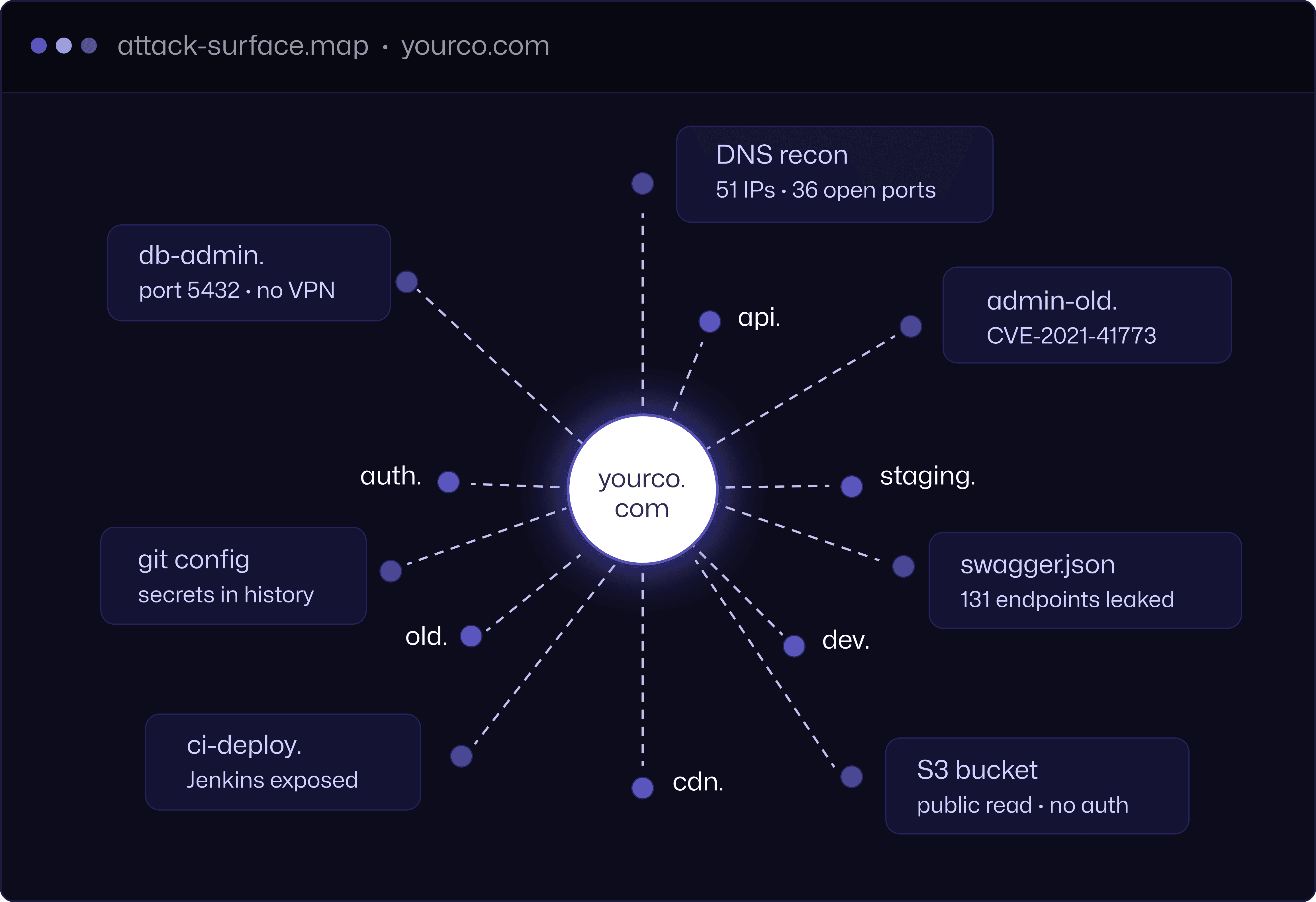
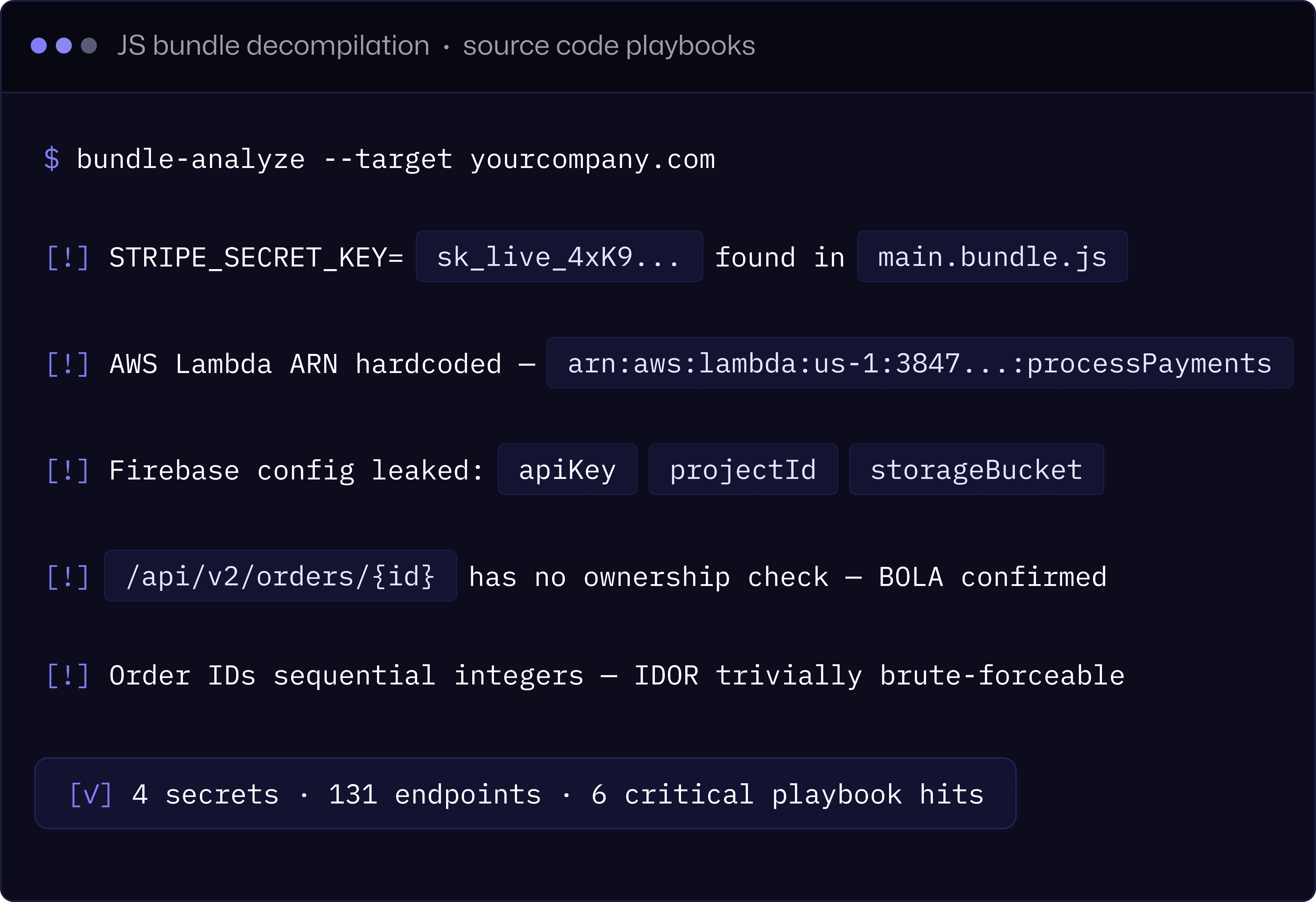
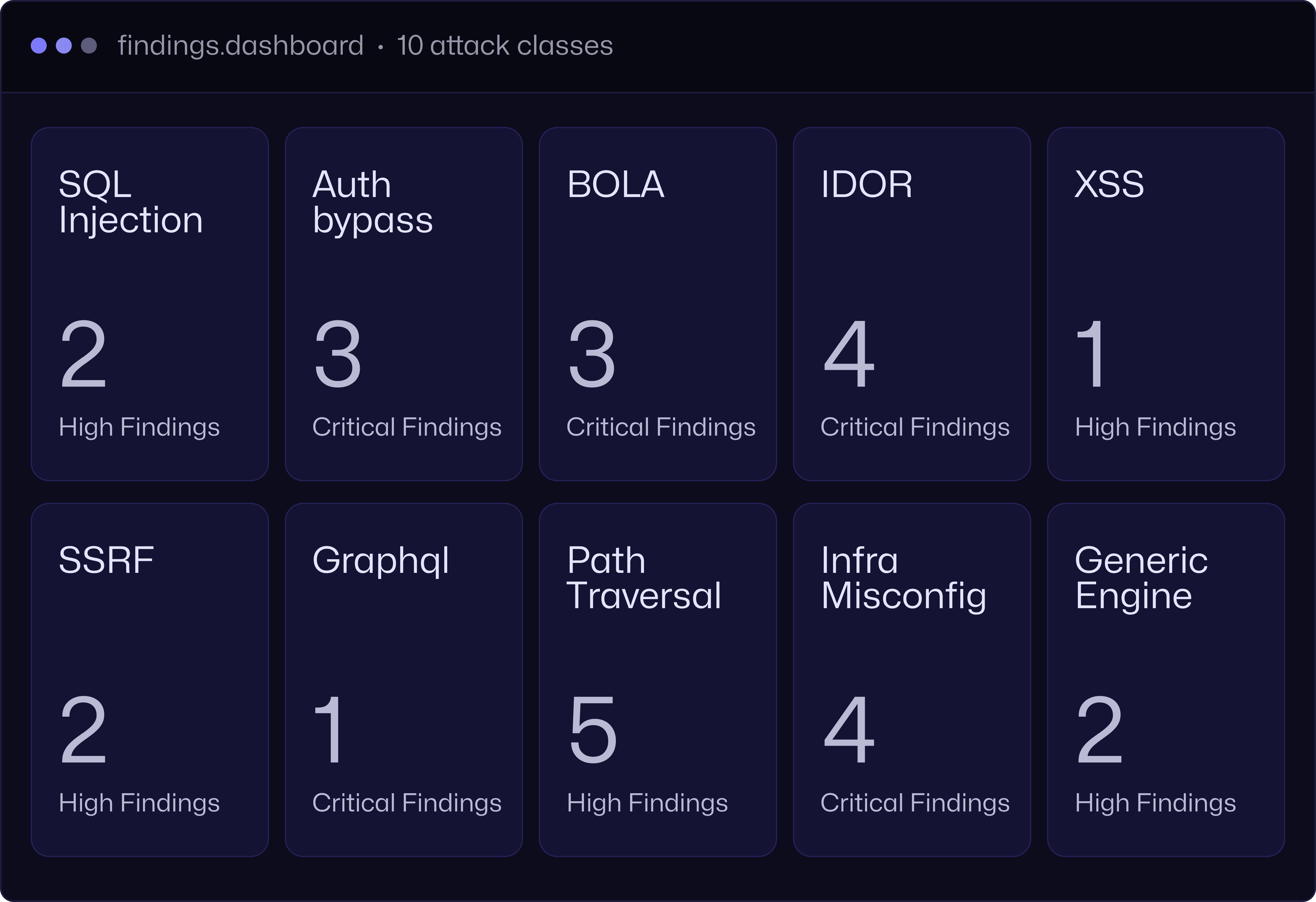
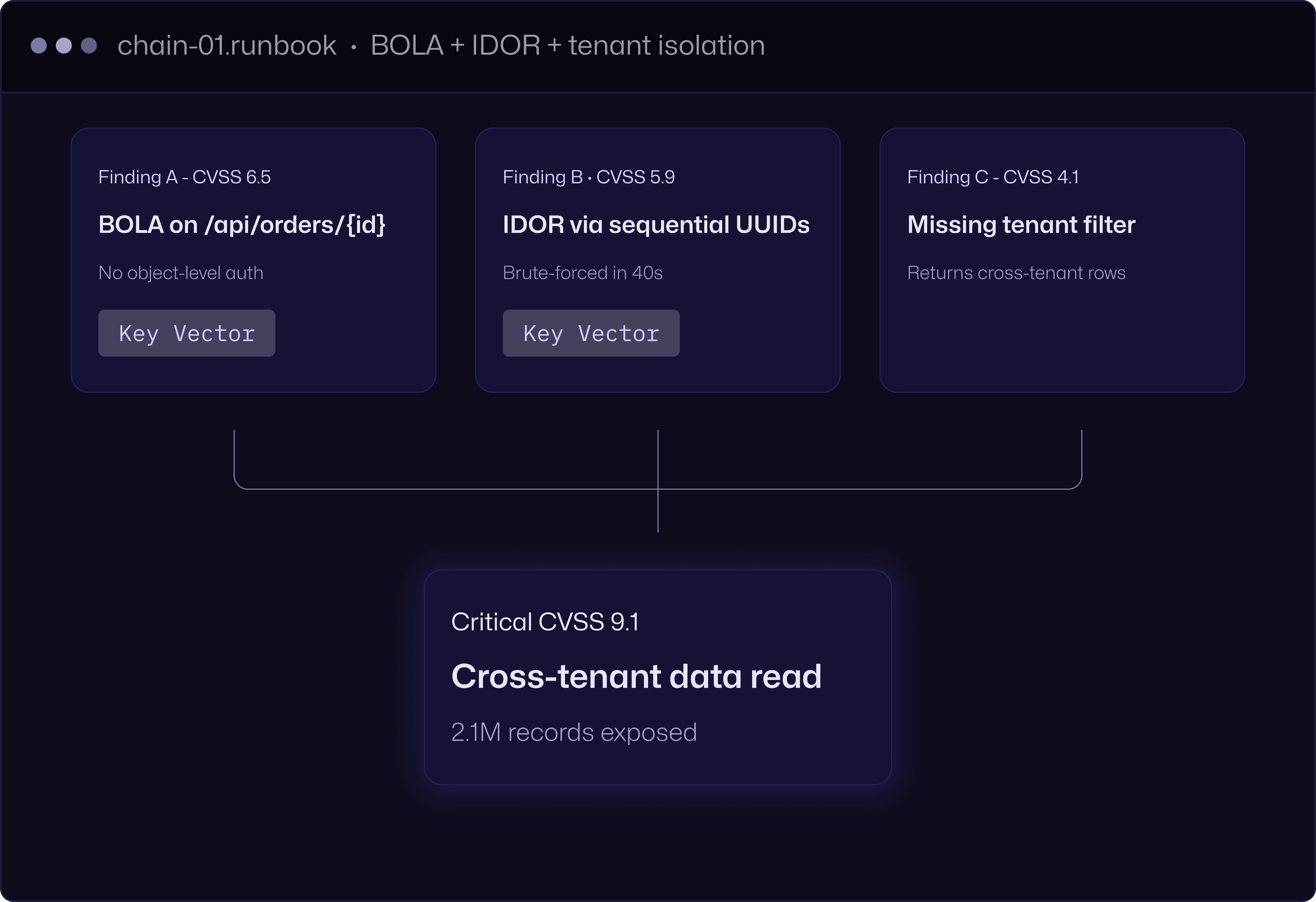
Passive Recon
App Intelligence
500+ Agents
Attack Chains
Evidence
Real impact: In one engagement, CodeAnt identified middleware bypass vulnerabilities affecting 476,000 healthcare records. The platform didn't just find the exposed endpoint, it understood from code analysis why the authorization middleware wasn't being enforced and provided file-and-line remediation guidance.
Vulnerability Type | Requires Code Intelligence | External-Only Detection |
|---|---|---|
BOLA/IDOR | ✅ Must understand authorization logic | ❌ Limited, tests endpoints but can't reason about access control |
JWT validation bypass | ✅ Must trace token verification through middleware | ❌ Sees tokens as opaque strings |
GraphQL field-level auth | ✅ Must analyze resolver-level permissions | ❌ Treats GraphQL as single endpoint |
Business logic flaws | ✅ Must understand intended vs. actual implementation | ❌ Cannot infer business rules |
3. AI-Augmented Attacks Demand AI-Powered Defense
Verizon's 2026 DBIR: 15% of attack techniques are now bolstered by generative AI. Attackers use AI to:
Parse minified JS bundles and extract API endpoints in seconds (CodeAnt found 27,255 CRM contact records exposed in client-side code using automated analysis)
Generate hundreds of payload variants that evade WAF signatures
Reason about multi-step attack chains automatically: "If I bypass JWT validation + chain with BOLA + enumerate user IDs = complete database extraction"
Adapt evasion techniques mid-attack based on defensive telemetry
The validation gap: A vulnerability scanner reporting "this endpoint might be vulnerable to BOLA" isn't the same as proving an attacker can exfiltrate 742 million records through it. Traditional approaches report potential vulnerabilities; exploit validation proves exploitability with working PoC attacks.
AI-powered automated pentesting matches adversary speed through:
Attack-chain reasoning: Multi-step exploitation paths where each step is validated before advancing
Code-aware grey box testing: Inside knowledge of your codebase informs external attacks
Continuous exploit validation: Re-test entire attack surface after every deployment
Check out our guide on "How AI Penetration Testing Works: From Continuous Attack Surface Mapping to Proven Data Leaks"
4. Compliance Requires Evidence, Not Intentions
Auditors want timestamped proof you tested systems, found exploitable issues, fixed them, and can reproduce evidence on demand. Manual pentesting creates evidence gaps:
The manual testing problem:
5-11 week turnaround from engagement start to final evidence
Stale evidence: By final report delivery, your codebase has changed 247 times
No remediation validation: Most organizations skip $5K-$15K retesting, leaving auditors with no proof vulnerabilities were resolved
Inconsistent format: Reports vary wildly in structure, making compliance mapping manual work
What compliance frameworks require:
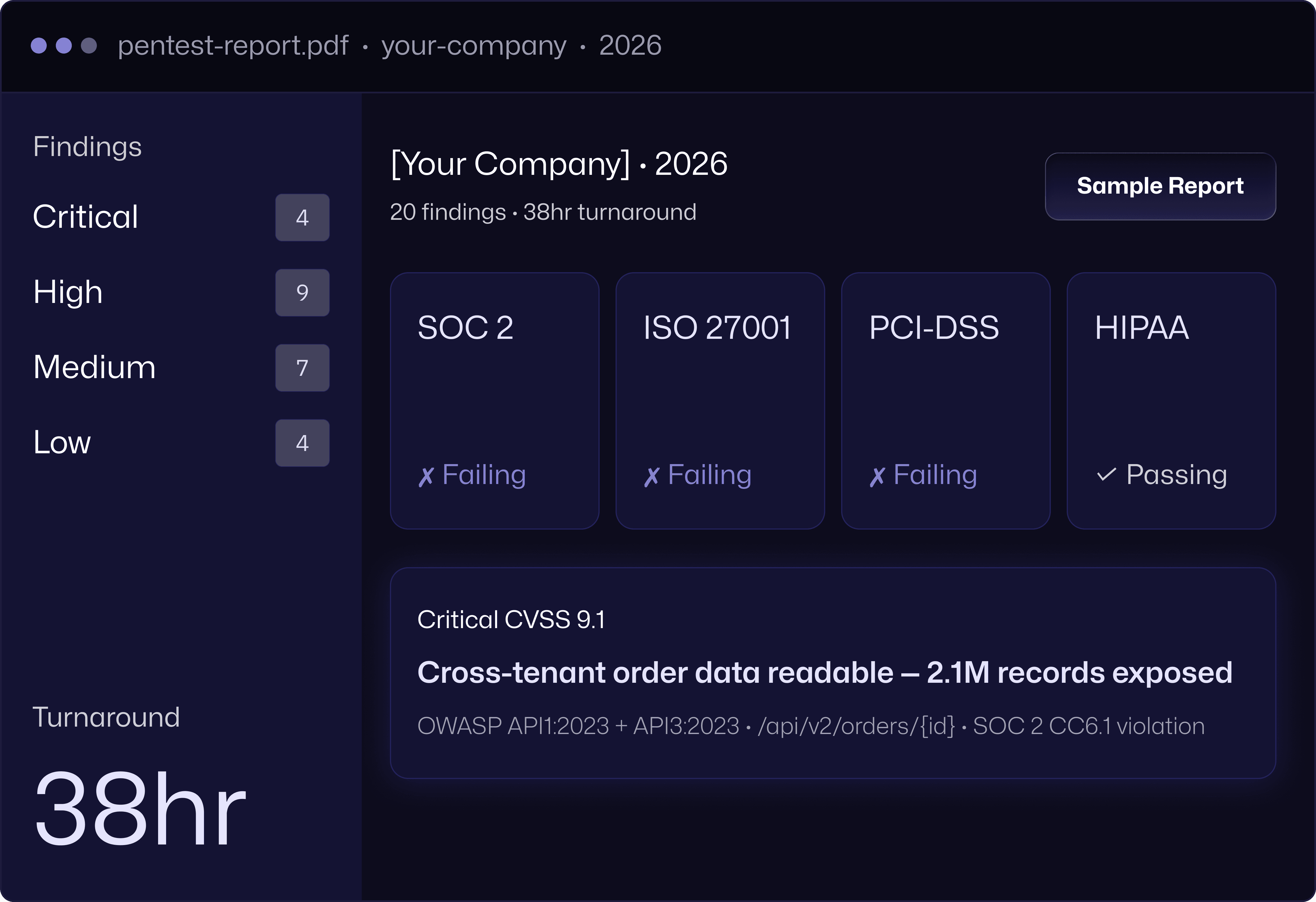
SOC 2 Type II: Testing aligned with releases or quarterly minimum; timestamped remediation tracking; control mapping (CC6.1, CC6.6, CC7.2)
PCI-DSS 4.0: Penetration testing after significant changes and annually; segmentation validation; authenticated testing with exploit validation
ISO 27001: Reproducible testing methodology; CVSS scoring; evidence retention for 3+ years
HIPAA: PHI exposure validation; attack chain documentation; proof of remediation
Automated pentesting delivers:
24-48 hour reports with CVSS 3.1 scoring, control violation mapping, and curl PoC exploits
Reproducible methodology: Same multi-phase process producing consistent, comparable results
Automated remediation validation: Re-scan immediately after fixes at no additional cost, creating complete audit trails
Compliance-aligned reporting: Findings structured for specific frameworks (SOC 2, PCI-DSS, HIPAA)
5. Economics Shifted: Continuous Coverage Beats Point-in-Time Snapshots
The real cost isn't the invoice, it's the triage load from theoretical findings, the exploits discovered between tests, and the average $4.4M breach cost (IBM, 2025) when attackers find what your quarterly testing missed.
Hidden cost of manual testing:
15-20 hours triaging 40-80 findings per engagement, many flagged "informational" without confirmed exploitability
Engineers waste cycles investigating theoretical risks while real exploits sit unvalidated
$5K-$10K per retest discourages validation that fixes actually worked
Automated pentesting with exploit-first validation:
Only findings with working PoC exploits reach your team, no theoretical noise
Reports include curl commands mapped to specific files and lines
Unlimited re-testing validates patches immediately
One customer cut security triage time from 18 hours per manual pentest to 3 hours per automated scan
Where Manual Pentesting Still Wins
Automated pentesting excels at continuous validation and exploit confirmation at scale. But manual pentesters still win at:
Complex business logic vulnerabilities: Automated systems test known patterns (BOLA, IDOR, SQLi). Skilled pentesters identify application-specific flaws like "users can manipulate discount codes to stack promotions infinitely" requiring understanding of business intent, not just technical implementation.
Novel zero-day discovery: Automated platforms execute known exploit techniques efficiently. Manual pentesters discover new attack classes through edge case experimentation and creative abuse of intended functionality.
Social engineering and physical security: Automated pentesting operates entirely in the technical domain. Manual engagements test phishing susceptibility and human-centric attack vectors no automated system replicates.
Advanced evasion and red team operations: Sophisticated attackers use custom tooling, timing-based evasion, and multi-stage persistence. Manual red team exercises simulate advanced persistent threats (APTs) in ways automated platforms, designed for speed and breadth, cannot.
The Hybrid Cadence
Testing Type | Frequency | Purpose |
|---|---|---|
Automated Pentesting | Continuous (post-deployment) | Regression testing, known vulnerability validation, compliance evidence |
Manual Pentesting | Annual or major releases | Novel vulnerability discovery, business logic testing, threat modeling |
Red Team | Bi-annual or as needed | APT simulation, evasion testing, detection/response validation |
The winning strategy: automated platforms for continuous posture validation between targeted manual engagements.
Automated Pentesting Implementation Playbook
1. Define Attack Surface Scope
Prioritize surfaces first:
Internet-facing applications: Public APIs, customer portals, authentication flows
Authenticated user flows: Post-login business logic, RBAC boundaries, data export functions
Critical APIs: Payment processing, PII handling, GraphQL endpoints, internal APIs
Start with 8 services handling authentication, billing, and customer data. These represent 17% of codebase but 80% of business risk.
2. Choose Testing Mode
Mode | What Platform Sees | Best For |
|---|---|---|
Black Box | External behavior only | Initial discovery, compliance baseline |
Grey Box | Authenticated access + repo analysis | Continuous validation, BOLA/IDOR detection |
White Box | Full source code, architecture | Pre-release validation, deep exploit chains |
CodeAnt's grey box mode analyzes your repository to understand routing logic, authentication middleware, and data flows before launching offensive tests, enabling deeper, faster testing than external-only tools.
3. Set SLAs for Findings
Severity | Criteria | Response SLA | Remediation SLA |
|---|---|---|---|
Critical | Working PoC + PII/financial exposure | 4 hours | 24 hours |
High | Authenticated exploit chain + logic bypass | 24 hours | 72 hours |
Medium | Theoretical vulnerability + limited scope | 1 week | 2 weeks |
CodeAnt's "no working exploit, no payment" model ensures findings are actionable, not speculative.
4. Build Retest Loop
After remediation:
Developer fixes vulnerability, commits with finding ID
CI/CD triggers targeted retest
Platform re-runs exploit chain against fixed endpoint
Finding auto-closes if exploit fails (with timestamp and commit hash)
Finding reopens if exploit succeeds (with evidence fix was incomplete)
5. Measure Outcomes
Track:
Mean Time to Remediation (MTTR): Average time from discovery to confirmed fix. Target: <72 hours for critical findings.
Exploit-confirmed vulnerabilities: Findings with working PoCs vs. theoretical issues. Higher ratio = less noise.
Regression rate: Fixed findings that reappear later. Target: <5%.
Coverage expansion: Endpoints, APIs, authenticated flows under continuous testing.
Conclusion: Automated Pentesting Matches Modern Release Velocity
Automated pentesting is growing because quarterly security testing no longer matches how modern teams ship software. A manual pentest may validate one snapshot, but every new pull request, dependency update, API change, and infrastructure change can create fresh attack surface.
That does not make manual pentesting obsolete. Skilled human testers still matter for complex business logic, novel attack paths, red team exercises, and deep investigative work. But automated penetration testing gives teams something manual testing cannot deliver on its own: continuous exploit validation, faster retesting, and audit-ready evidence tied to the current state of the application.
For SaaS, fintech, healthcare, and DevSecOps teams, the best path is usually hybrid. Use automated pentesting for continuous validation across releases, then use manual pentesting for periodic expert-led depth.
If your team ships faster than your security testing cadence, start with one high-risk application, require working PoC evidence, measure remediation time, and expand only when automated pentesting proves it can reduce the gap between code change and confirmed security validation.

