

Choosing a penetration testing tool for a SaaS product differs from choosing one for a single web app. A SaaS platform is multi-tenant, API-driven, and shipping constantly, so the tool has to prove tenant isolation holds and keep up with a release cadence a once-a-year test cannot match.
This guide reviews eight tools on the criteria that matter for SaaS, explains what each one does and where it fits, and maps them to the compliance frameworks that gate enterprise deals. It closes on how to run a fair pilot.
What CodeAnt AI solves here: CodeAnt AI runs continuous, code-aware penetration testing across a SaaS platform's APIs, authorization logic, and multi-tenant boundaries. It proves isolation holds, ships a working proof of exploit mapped to SOC 2 controls, and prices on outcomes.
I reviewed the current product pages, pricing, and documentation for the vendors named here on July 27, 2026. This is a documented capability comparison, not a claim that I ran an assessment against any of them.
What Makes SaaS Penetration Testing Different
A SaaS pentest layers four concerns on top of a generic web-app test, and a tool that ignores them is testing the wrong thing.
Multi-tenant isolation. Proving tenant A cannot read tenant B's data is the core of a SaaS test, and the failure that most often exposes customer records.
API and integration security. The API is the product, and broken authorization on it is the highest-impact SaaS flaw.
Business logic and subscription abuse. Pricing manipulation, feature-gate bypass, and subscription-tier escalation are SaaS-specific attack paths.
Compliance mapping. Reports that map to SOC 2 Trust Services Criteria, ISO 27001, and PCI DSS turn a test into audit and procurement evidence.
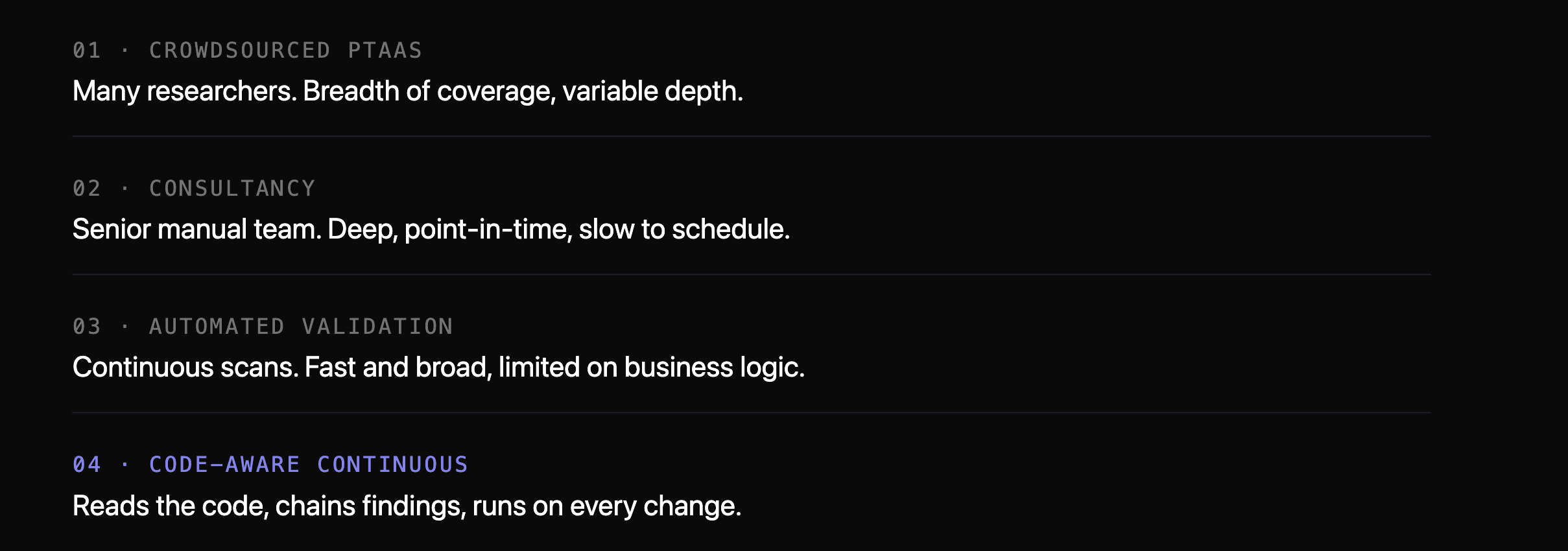
How to read this list: Each tool below is broken down the same way, so you can compare like for like: what it does for SaaS, who it fits best, its pricing shape, and the honest trade-off. The tools span four categories, code-aware platforms, SaaS-focused consultancies, crowdsourced PTaaS, and automated or CI/CD-native testing.
8 Best Penetration Testing Tools for SaaS Companies
The list runs from code-aware platforms through consultancies and PTaaS to automated validation, with the tools that best fit a fast-shipping SaaS product first.
1. CodeAnt AI, code-aware continuous testing
CodeAnt is a defensive and offensive security platform whose pentesting agents read your source code alongside the live product, which is what lets them reach the authorization and tenant-isolation logic that decides whether SaaS customer data stays contained.
What it does for SaaS: It runs black, white, and gray box testing from a URL, repository, and test identities, and traces authorization across roles and tenants at the code level. The offensive agents sit beside AI code review, SAST, SCA, secrets, and IaC scanning, so the same platform catches a class of flaw in the pull request and again at the pentest.
Best for: SaaS and martech teams shipping frequently that need multi-tenant and API depth plus SOC 2 evidence on every release.
Pricing: Outcome-based, a zero engagement fee with payment only when a working high or critical exploit ships. A 48-hour report, a proof of exploit on every high or critical, and free unlimited re-scans. AI code review is published at 24 dollars per user per month.
The trade-off: It is built for the code and application layer, so broad internal-network and Active Directory testing is not its core catalog.
2. Xbow, purpose-built for SaaS

Xbow is a penetration testing firm built specifically for SaaS and software-driven businesses, and it positions its service directly around SOC 2 alignment.
What it does for SaaS: Its methodology covers multi-tenant authorization, API security, and business-logic abuse, and its reports map findings directly to SOC 2 Trust Services Criteria controls, which cuts the effort of turning a pentest into audit evidence. It is a listed partner in the Vanta ecosystem.
Best for: Growth-stage SaaS navigating a first or second SOC 2 cycle that wants SaaS-specific manual testing with auditor-ready reporting.
Pricing: Premium relative to on-demand platforms, quoted per engagement and scope.
The trade-off: Longer lead times than a PTaaS-first platform, and the engagement model can feel heavyweight for a team that only needs a single annual point-in-time test.
3. Cobalt, crowdsourced PTaaS
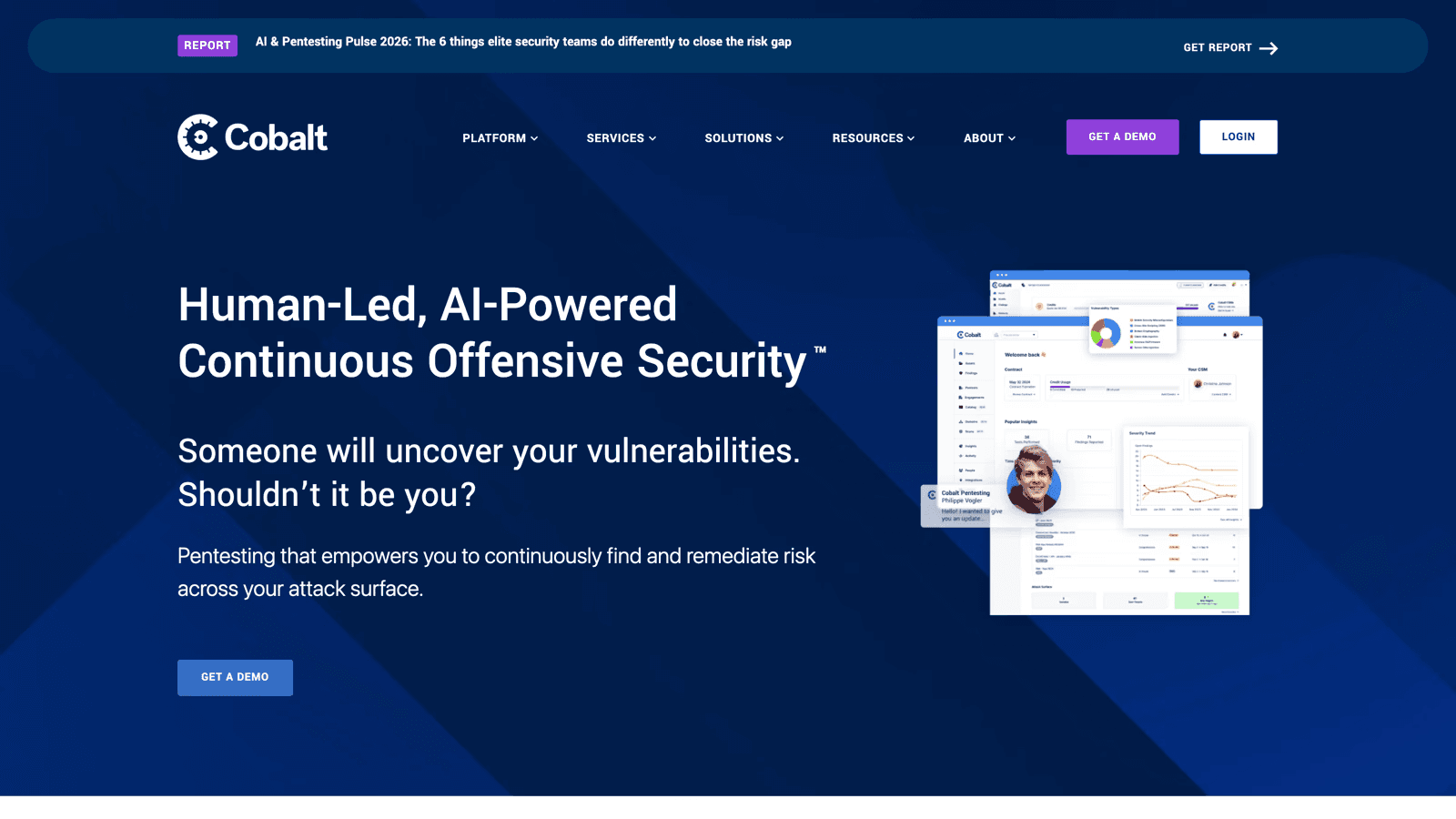
Cobalt built the pentest-as-a-service category around a vetted community of researchers available on demand through a cloud portal.
What it does for SaaS: Teams scope a test, launch it quickly, and receive findings through a dashboard, with integrations into Jira and CI/CD pipelines. The researcher community averages years of experience, and tests can start within days rather than a multi-week procurement cycle.
Best for: SaaS teams that want broad coverage and fast scheduling without committing to a consultancy engagement.
Pricing: Credit-based, with standard SaaS web app engagements commonly in the 8,000 to 25,000 dollar range as of 2026.
The trade-off: Depth on a specific claims or billing API depends on which researchers pick up the engagement, and some teams find the credit model hard to forecast. The alternatives guide covers where teams move when they outgrow it.
4. Bishop Fox, manual-first offensive depth
Bishop Fox is a pure-play offensive security firm known for research-driven, manual-first engagements, with a tester bench that includes conference speakers and published exploit developers.
What it does for SaaS: It brings adversarial creativity to complex authorization models and multi-tenant architectures, finding logic-layer vulnerabilities that standard playbooks miss, and it adds red team and adversary-emulation exercises plus a growing AI and LLM testing line for AI-enabled SaaS. Its Cosmos platform provides continuous attack-surface monitoring between engagements.
Best for: SaaS with elevated risk profiles or mature security programs that want deep, senior human testing.
Pricing: Enterprise-tier, quoted per engagement.
The trade-off: The depth and price suit larger programs, and the manual-first cadence is not built to re-test every release automatically.
5. NetSPI, enterprise PTaaS
NetSPI delivers manual-first testing through its Resolve platform, combining senior human testers with real-time reporting and SLA tracking.
What it does for SaaS: Coverage spans web, API, cloud, containers, and red team, with attack-surface management integrated into testing programs and unlimited retests. Findings map to SOC 2, PCI DSS, HIPAA, and NIST, with audit-friendly evidence.
Best for: Larger SaaS with enterprise compliance programs that want breadth and a high-touch, consultative relationship.
Pricing: Enterprise-oriented, scoped per program.
The trade-off: The enterprise orientation can exceed what an early or mid-stage SaaS actually needs.
6. BreachLock, hybrid PTaaS
BreachLock blends automated scanning with manual testing on a continuous platform, assigning a dedicated project manager to each engagement.
What it does for SaaS: The hybrid model gives broad, frequent coverage with human validation layered on top, transparent pricing, and compliance-mapped reporting for SOC 2, PCI, and HIPAA. Free validation retests are available for a window after testing.
Best for: Compliance-driven SaaS that wants recurring coverage at a price point below the large consultancies.
Pricing: Plan-based and published more transparently than most consultancies.
The trade-off: The automated layer is broad rather than source-aware, so the deepest authorization-logic findings still depend on the manual portion.
7. Pentera, automated security validation
Automated validation platforms continuously test controls by safely emulating attacks, and two lead the category. Pentera runs agentless validation across the internal and external network, and
What it does for SaaS: The platform prove exploitable exposure across infrastructure and identity far more often than a manual engagement, with production-safe exploits and proof of attack paths.
Best for: SaaS with significant internal infrastructure that wants frequent, broad validation of the network and identity layer.
Pricing: Subscription, scoped by environment size.
The trade-off: Does not reads application source, so the multi-tenant and business-logic flaws that expose SaaS customer data sit largely outside their scope, which is where pairing it with code-aware testing pays off.
8. NodeZero, AI-augmented security tool
NodeZero runs autonomous testing of network, cloud, Kubernetes, and Active Directory from an assumed-breach position.
What it does for SaaS: Horizon3 also pushes harder on federal and MSSP channels, holding FedRAMP High authorization where Pentera holds none. Read the automated penetration testing primer if you are comparing this class of tool for the first time.
Best for: Engineering-led SaaS teams that want testing embedded in the deployment pipeline.
Pricing: Quote only. Four cumulative tiers (Flex, Core, Pro, Elite) with no published figures, though a self-serve 30-day free trial exists.
The trade-off: Choose when internal network and Active Directory exploitation is the whole job, you want uncapped test frequency, or you carry a FedRAMP High requirement.
How SaaS Penetration Testing Tools Map To SOC 2, ISO 27001, And PCI DSS
Compliance is what turns a test into deal-clearing evidence. The table sorts the categories against what SaaS frameworks ask for.
Category | Example tools | Multi-tenant depth | Continuous cadence | Compliance evidence |
|---|---|---|---|---|
Code-aware continuous | CodeAnt AI | High, reads the code | Yes, on every change | Mapped, proof of exploit and retest |
SaaS consultancy | Software Secured, Bishop Fox | High, senior manual | Periodic | SOC 2 TSC-mapped |
Crowdsourced PTaaS | Cobalt, BreachLock | Variable by researcher | Platform-managed | Available, mapped |
Automated validation | Pentera, NodeZero | Low on app logic | Yes, frequent | Network and identity proof |
The pattern for SaaS is that multi-tenant and API depth decide what actually gets caught, and code-aware testing is what reaches that layer while keeping the cadence a daily-shipping team needs.
Why Multi-Tenant Isolation Is The Most Important SaaS Pentest
If a SaaS pentest only proves one thing, it should be that tenants stay isolated. Cross-tenant exposure is among the most common causes of SaaS customer-data leaks, and it hinges on authorization logic that looks fine from outside.
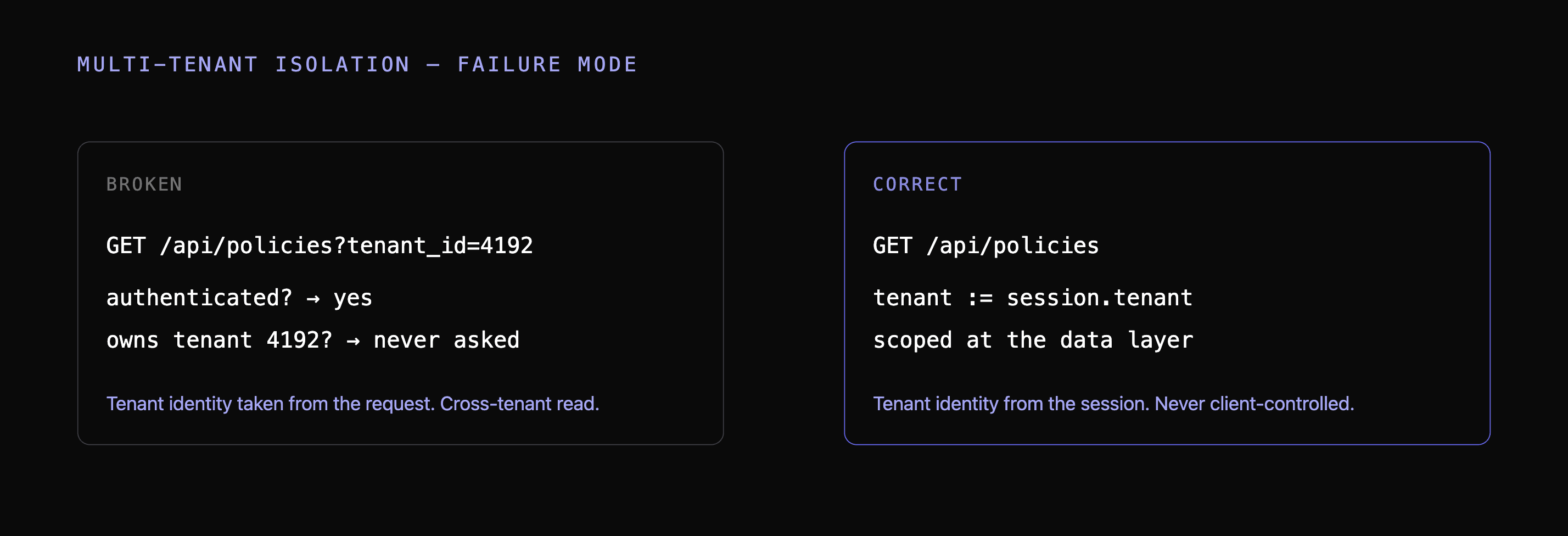
The failure is broken object level authorization, where an endpoint returns a record based on a client-supplied identifier without confirming the caller owns it. A scanner sees a normal 200 response, and only a test that seeds multiple tenants and reads the handler can tell that tenant A just read tenant B's data.
That is why source-level testing is essential for a multi-tenant product, and why it anchors the criteria this list is ranked on.
How To Run A Fair SaaS Penetration Testing Tool Pilot
A short pilot beats a shortlist. It shows what a tool actually catches on your stack before you commit.
Seed multiple tenants and roles. The pilot has to test cross-tenant access, so set up the accounts first.
Write the answer key. Document known authorization boundaries, tenant-ownership rules, and any seeded bugs.
Count verified findings. Rank by reproducible high and critical issues and the time to validate each, not alert volume.
Test a real release. Run the tool against an actual deployment to see the CI/CD fit.
Read the evidence as an auditor would. Check SOC 2 control mapping, exploit proof, and retest results.
The provider evaluation framework and PTaaS SLA guide give you a scorecard before the first scan.
Conclusion: Choose SaaS Pentesting Tools Based On Tenant Depth, Evidence, And Cadence
The best penetration testing tool for a SaaS company is the one that matches how the product is built and shipped. Multi-tenant isolation and API depth decide what actually gets caught, compliance mapping decides whether the test clears a deal, and cadence decides whether the evidence stays current between audits.
For SaaS teams selling to enterprise, evidence matters as much as detection. A useful pentest report should support SOC 2, ISO 27001, PCI DSS, and buyer security reviews with clear scope, working proof of exploit, remediation guidance, and retest results. Multi-tenant isolation should be the centre of the test because cross-tenant exposure is one of the fastest ways to turn a SaaS bug into a customer-data breach.
Cadence is the final filter. A SaaS product that ships daily cannot rely only on one annual test. Continuous, code-aware penetration testing keeps evidence current by testing APIs, roles, integrations, and tenant boundaries as they change. That makes it a stronger fit for SaaS teams that need both security depth and deal-clearing compliance evidence.
That is where CodeAnt fits, code-aware and continuous, priced on what it proves rather than the hours it takes.
Launch a free black box scan for one URL to see what it surfaces on your platform, then book a walkthrough to see testing mapped to the SOC 2 criteria your buyers check. For why that evidence matters in a deal, start with our guide to SOC 2 for martech and enterprise procurement.

