Code Security
Best DeepCode AI and Snyk Code Alternatives For SAST In 2026

Sonali Sood

Founding GTM, CodeAnt AI
DeepCode AI was acquired by Snyk in 2020 and rebranded as Snyk Code. But many teams who adopted it for vulnerability detection now face a critical problem: alert fatigue. When your security tooling flags hundreds of findings per sprint and 5-10% turn out to be false positives, developers stop trusting the signal. That's wasted review cycles, slower PR velocity, and real vulnerabilities buried in noise.
Modern SAST alternatives now combine AI-driven triage, multi-repo architectural understanding, and reachability analysis to cut false-positive rates below 5%, and in some cases, below 2%. For teams managing microservices, legacy monoliths, or 100K+ file codebases, that difference determines whether developers trust and act on security findings or ignore them entirely.
This guide evaluates the top 7 DeepCode AI alternatives based on what matters to engineering teams: accuracy metrics, multi-repo context capabilities, enterprise compliance (ISO 42001, SOC 2), and total cost of ownership. You'll see evidence-based comparisons and clear guidance on which tool fits your architecture.
What Defines "Low-Noise" SAST
Not all SAST tools deliver equal signal quality. Here's what separates low-noise platforms from legacy tools that generate triage overhead:
False-Positive Rate as Primary Filter
Industry-average SAST tools generate 5-10% false-positive rates, translating to hundreds of wasted engineering hours per quarter for teams managing high PR volumes. Research shows 80% of security findings in legacy tools require manual triage, time that could be spent shipping features.
Low-noise SAST consistently delivers:
<5% false-positive rates through context-aware analysis
Reachability analysis proving vulnerabilities are actually exploitable
AI-powered triage ranking findings by actual risk, not theoretical severity
Actionable remediation guidance developers can apply immediately
Context Depth: Single-File vs Multi-Repo
Context Level | What It Understands | False-Positive Impact |
|---|---|---|
Single-file | Syntax, local variables, imports | High (misses cross-file dependencies) |
Project-level | Module structure, internal APIs | Medium (limited to one repo) |
Multi-repo | Microservices, shared libraries, cross-service flows | Low (understands architectural context) |
For teams managing microservices with 10+ services, multi-repo semantic analysis is the difference between actionable findings and noise. Tools analyzing individual files or single repositories will flag patterns that are safe in your broader architecture.
Enterprise Readiness
Beyond accuracy, enterprise SAST must deliver:
Security certifications: SOC 2 Type 2, ISO 27001, and increasingly ISO 42001 (AI management systems)
Deployment flexibility: Cloud, self-hosted, air-gapped options
Scale capabilities: Handle 100K+ file codebases without performance degradation
Workflow integration: Native Git platform support
Over 60% of enterprises will require ISO 42001 certification for AI-powered tools by 2026.
The DeepCode AI (Snyk Code) Baseline
Before diving into alternatives, understand what you're comparing against. Snyk Code delivers genuine strengths:
Industry-leading vulnerability detection with 25M+ data flow cases
Strong OWASP Top 10 coverage
Mature developer adoption (7M+ users)
Excellent GitHub ecosystem integration
Where teams hit limitations:
Project-level context only: No multi-repo semantic analysis for microservices
5-7% false-positive rate: Requires tuning for large-scale deployments
No autonomous workflow automation: Manual remediation required
Platform lock-in: Full feature set requires separate Snyk subscriptions
Teams evaluating alternatives typically need multi-repo context for complex architectures or lower false-positive rates to reduce alert fatigue.
Quick Comparison Table
Tool | False-Positive Rate | Multi-Repo Context (100K+ files) | ISO 42001 Certified | Autonomous Workflows | Starting Price | Best For |
|---|---|---|---|---|---|---|
CodeAnt AI | <2% | ✓ (400K+ files) | ✓ | ✓ (Intent feature) | $20/month | Multi-repo enterprises, ISO 42001 compliance |
Semgrep | 3-5% | ✗ (project-level) | ✗ | ✗ | Free; $30/user | Custom rules, SCA accuracy |
SonarQube | 8-10% | ✗ (requires tuning) | ✗ | ✗ | Free; $32/month | Mature quality gates, self-hosted |
Snyk Code | 5-7% | ✗ (project-level) | ✗ | ✗ | Free; $25/user | GitHub-native single-repo |
GitHub Copilot | N/A (not SAST) | Limited | ✗ | ✗ | $10-19/month | Developer productivity |
Tabnine Enterprise | 4-6% | ✓ (300K-400K files) | ✗ | ✗ | $20/user | Air-gapped environments |
Sourcegraph Cody | 5-7% | ✓ (500K+ indexed) | ✗ | ✗ | Free; $19/user | Cross-repo search |
1) CodeAnt AI: Lowest Noise for Multi-Repo Enterprises
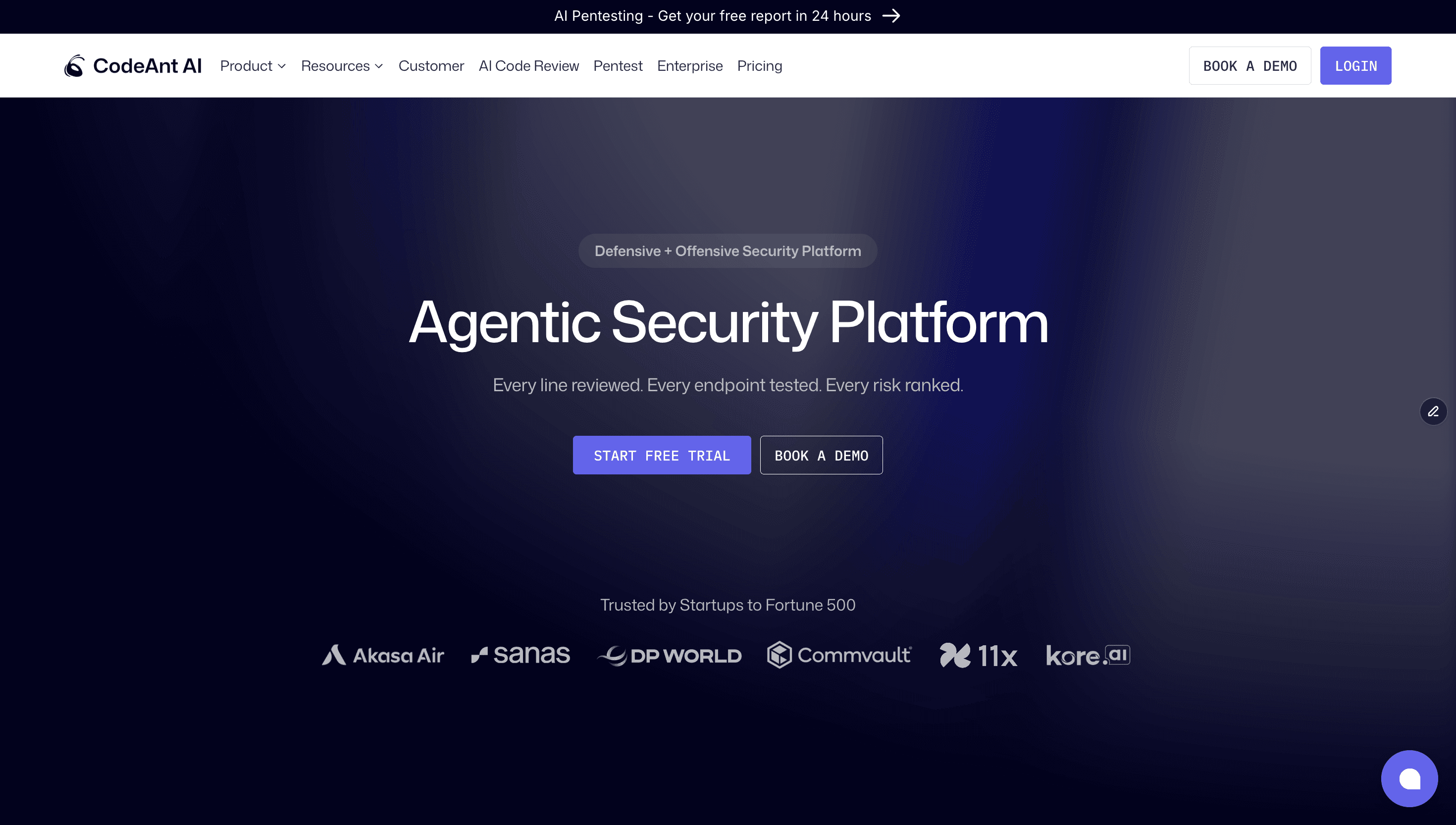
CodeAnt AI leads this comparison by solving the core problem driving teams away from legacy SAST: false-positive fatigue at enterprise scale. With <2% false-positive rate, 70.6% SWE-bench score, and 400K+ file semantic dependency analysis, it delivers the signal quality large engineering organizations need.
Why CodeAnt's Approach Is Different
Most SAST tools operate purely on defense, detecting insecure patterns before code ships, but rarely prove whether vulnerabilities are exploitable. CodeAnt unifies defensive and offensive security: the same platform that reviews code in PRs also validates which risks are reachable and exploitable, creating a shorter path from detection to remediation.
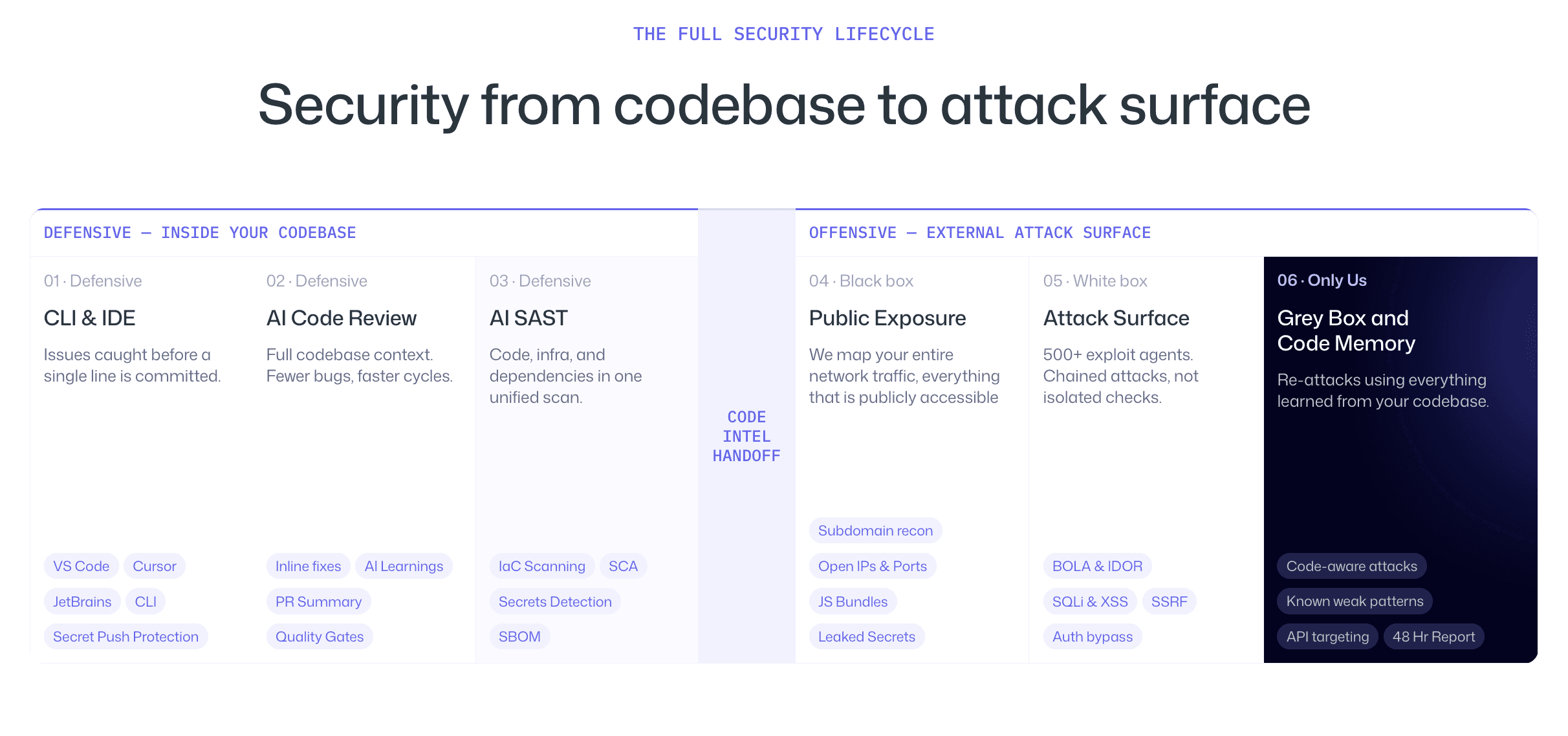
Defensive capabilities:
PR/CI/IDE detection of insecure patterns and data flow risks
Secrets scanning with context-aware false-positive reduction
SCA with dependency risk analysis and SBOM generation
IaC and cloud misconfiguration checks
Offensive capabilities:
Proof-oriented validation without DAST operational overhead
Reachability and exposure context for externally accessible risks
EPSS-based risk scoring for actively exploited vulnerabilities
Cross-service attack path analysis in microservices architectures
Where It Wins
400K+ file semantic dependency analysis enables CodeAnt's low false-positive rate. Unlike project-level analysis or keyword search, the Context Engine processes cross-repo dependencies, shared libraries, and architectural patterns to understand how code behaves in production.
This matters for:
Microservices with shared authentication, authorization, and data layers
Legacy monolith migrations requiring cross-module dependency understanding
Cross-service refactoring needing impact analysis across repos
Autonomous workflow automation through the Intent feature lets teams define spec-driven workflows that automatically generate security fixes, enforce coding standards, and produce compliance reports.
ISO 42001 certification is CodeAnt's unique compliance differentiator—the only tool in this comparison with formal AI governance certification, critical for enterprises in regulated industries.
Real-World Performance
Metric | CodeAnt AI | Industry Average |
|---|---|---|
False-positive rate | <2% | 5-10% |
SWE-bench score | 70.6% | 45-55% |
Multi-repo context | 400K+ files | Project-level only |
PR scan time | <60 seconds | 2-5 minutes |
Honest Limitations
Initial indexing time: First-time indexing of 500K+ file repos takes 30-60 minutes (incremental updates are <60 seconds)
Learning curve for agent workflows: Intent feature requires 2-4 weeks for teams to adapt to spec-driven automation
Premium pricing: At $20/month for Indie plan and custom enterprise pricing, costs more than basic tools but delivers ROI through reduced false positives
When to Choose CodeAnt
Enterprises managing 100K+ lines across multiple repos
Teams requiring ISO 42001 or SOC 2 Type 2 compliance
Organizations wanting to consolidate SAST, SCA, secrets, IaC, and quality tools
Teams frustrated with 5-10% false-positive rates from legacy SAST
Pricing: $20/month Indie plan; custom enterprise pricing. 14-day free trial available
2) Semgrep: Best for Custom Rules and SCA Accuracy
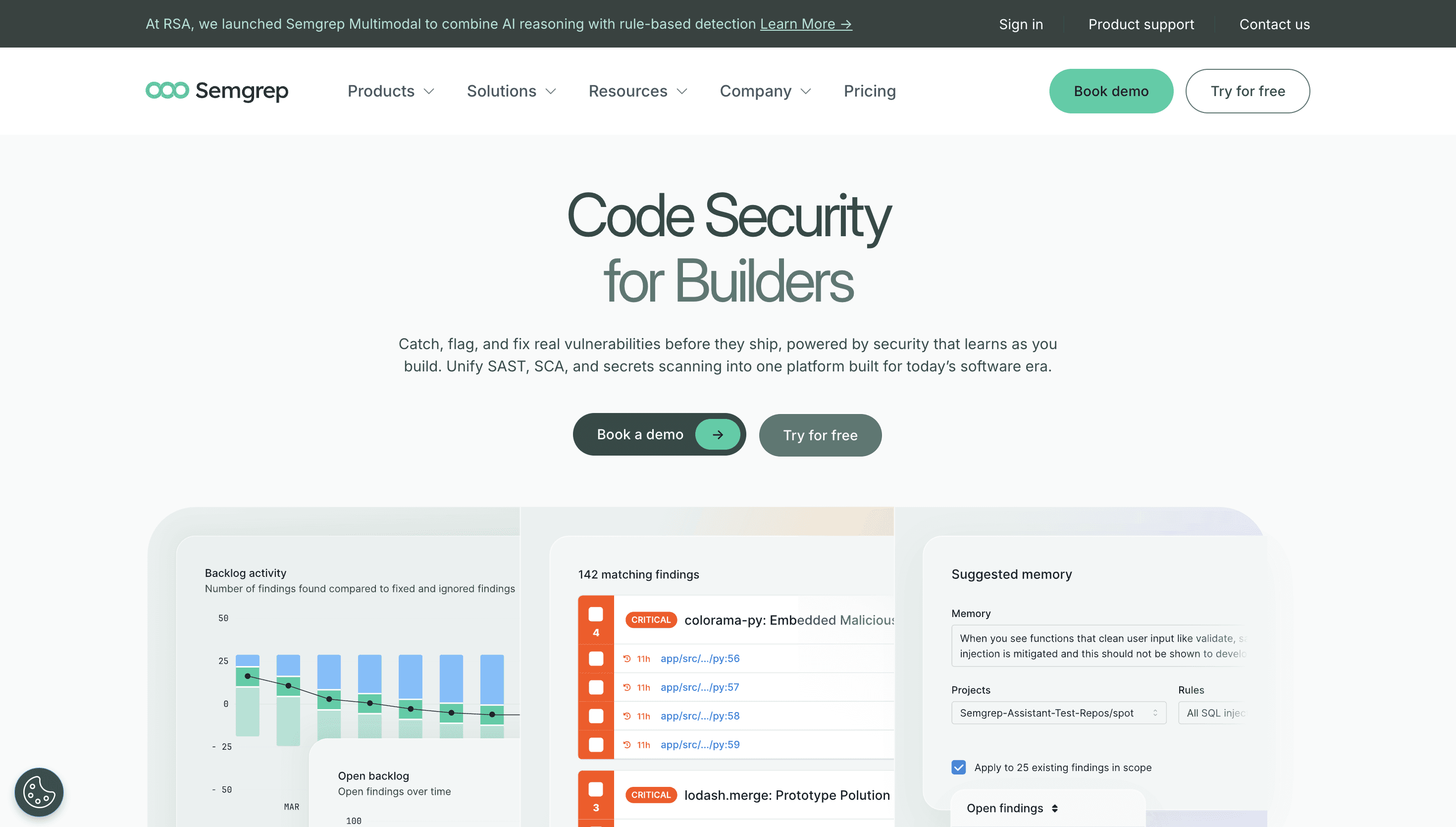
Semgrep reduces noise through custom rule authoring and reachability analysis that cuts high/critical SCA findings by ~98% by proving which vulnerabilities actually matter.
Why Semgrep Reduces Noise
Custom Rule Engine: Lightweight YAML-based rule syntax lets security engineers write organization-specific detections in minutes. Teams can detect internal anti-patterns alongside standard security issues.
Reachability Analysis for SCA: Semgrep's biggest differentiator traces data flow from application code into dependencies to prove exploitability. If your app uses lodash but never calls the vulnerable function, Semgrep won't alert.
Fast Scans: Typically under 30 seconds for most PRs because the engine analyzes syntax patterns rather than building full semantic models.
Trade-Offs
Rule authoring overhead: Requires AppSec engineering capacity to write and maintain custom rules
Limited governance features: No built-in quality gate orchestration or compliance reporting
Narrower vulnerability database: Relies on community contributions and CVE feeds vs. Snyk's proprietary research
Best Fit: Security-forward teams with 1-2 dedicated AppSec engineers who can invest in custom rule development, or teams prioritizing SCA accuracy.
Pricing: Free tier with community rules; Team plans from $30/user/month
Check out this: CodeAnt AI vs Semgrep: Best SAST Tool comparison
3) SonarQube: Mature Quality Gates with Tuning Requirements
SonarQube remains the incumbent for teams needing standardized CI/CD quality gates and comprehensive compliance reporting, but its rule-based architecture produces 8-10% false-positive rates requiring operational investment.
Why Teams Choose SonarQube
Deep CI/CD integration tested across thousands of enterprises
Self-hosted deployment for air-gapped environments
30+ language support with extensive plugins
Quality gate model providing clear governance checkpoints
The Noise Problem
SonarQube's false-positive rate lands at 8-10% without tuning. Its rule-based detection applies generic patterns across all codebases without understanding framework conventions, internal libraries, or architectural patterns.
Operational Overhead:
Quality profile management: Weeks creating custom profiles and adjusting severity
Exclusion patterns: Maintaining exclusion rules across projects
Baseline management: Manual triage of thousands of existing findings
When SonarQube Makes Sense
Need self-hosted deployment for strict data residency
Have dedicated DevOps resources for tuning and maintenance
Prioritize code quality over security-first workflows
Already have institutional SonarQube knowledge
Pricing: Free Community Edition; Team plans from $32/month; Enterprise custom pricing
Checkout this SonarQube Alternative.
4) Snyk Code: Strong for GitHub-Native Single-Repo SAST
Snyk Code delivers strong vulnerability detection with mature developer adoption, but project-level context limitations surface in multi-repo architectures.
Genuine Strengths
25M+ data flow cases with strong OWASP Top 10 coverage
Security-first intelligence with contextual fix suggestions
7M+ developer adoption with mature GitHub integration
~5-7% false-positive rate for SAST when configured
Where Limitations Surface
Project-level context only: Misses cross-service dependencies in microservices
No autonomous automation: Flags issues but doesn't orchestrate remediation
Platform dependency: Full coverage requires separate Snyk subscriptions
False-positive tuning required: Teams managing high PR volumes report significant tuning time
When to Choose Snyk Code
Single-repo or small multi-repo setups
Security-first teams prioritizing vulnerability detection
Organizations already using Snyk for SCA or container scanning
GitHub-native workflows
Pricing: Free tier; Team plan from $25/developer/month
Check out this CodeAnt AI vs Snyk Code: SAST Tool Comparison 2026
5) GitHub Copilot: Developer Throughput, Not SAST Replacement
GitHub Copilot excels at autocomplete and code generation but isn't designed to replace systematic security analysis.
What Copilot Does for Security
Suggests safer code patterns during development
Recommends parameterized queries and input validation
Operates at single-file, single-function level
What It Doesn't Provide
Systematic vulnerability detection across codebases
Reachability analysis for exploitability
Data flow tracking across files or services
CI/CD gating or compliance reporting
The Right Usage Pattern
Use Copilot for development velocity, pair with dedicated SAST for security assurance. Copilot handles throughput; your SAST platform handles risk validation.
Pricing: Free tier; Individual $10/month; Business from $19/month (requires GitHub subscription)
Also, check out this Top 17 GitHub Copilot Alternatives for VS Code in 2026
6) Tabnine Enterprise: Best for Air-Gapped Environments
Tabnine Enterprise offers fully air-gapped deployment with zero external data transmission, critical for finance, healthcare, and defense environments.
Key Capabilities
Air-gapped deployment with no outbound connections
Team-specific learning across 300K-400K files
Privacy-first architecture with configurable controls
SOC 2, GDPR, and HIPAA compliance
The Security Coverage Gap
Tabnine is primarily a code completion tool, not a comprehensive SAST platform. It provides context-aware suggestions but lacks systematic vulnerability scanning, compliance reporting, reachability analysis, or security-specific rule engines.
When to Choose Tabnine
Strict data isolation requirements
Air-gapped deployment needs
Compliance-first architecture (SOC 2, HIPAA, GDPR)
Pair with dedicated SAST for comprehensive coverage
Pricing: $20/user/month for cloud; additional fees for on-premises and air-gapped deployments
7) Sourcegraph Cody: Cross-Repo Context with Limited Security Depth
Sourcegraph Cody brings powerful cross-repo code intelligence, making it valuable for understanding how code connects across repositories, but it's not a SAST-first platform.
What Cody Does Well
Indexes and searches across 500K+ files
Cross-repo dependency tracing
Fast onboarding with natural language queries
Context-aware chat for understanding code patterns
Where It Falls Short for Security
Not a dedicated security scanner
Lacks comprehensive OWASP Top 10 coverage
Requires separate Sourcegraph subscription for full indexing
False-positive rate around 5-7%
Best Used As: Complementary tool for understanding code context, paired with dedicated SAST for comprehensive security coverage.
Pricing: Free tier; Starter from $19/user/month
How to Choose the Right Tool
Match your specific constraints to tool strengths:
If you need ISO 42001 + multi-repo context + autonomous workflows:
→ Choose CodeAnt AI. Only alternative with ISO 42001 certification, 400K+ file semantic analysis, and autonomous workflow automation. <2% false-positive rate minimizes triage overhead.
If you need custom rules + reachability-based SCA:
→ Choose Semgrep. Unmatched custom rule engine and reachability analysis reducing high/critical SCA findings by 98%. Requires engineering resources for rule maintenance.
If you need mature quality gates + self-hosted deployment:
→ Choose SonarQube. Most mature option for quality-focused teams with deep CI/CD integration. Requires dedicated tuning for 8-10% false-positive rate.
If you're GitHub-native + single-repo + security-first:
→ Choose Snyk Code. 25M+ data flow cases with strong OWASP Top 10 coverage for single-repo workflows.
If you need air-gapped deployment + data isolation:
→ Choose Tabnine Enterprise. Air-gapped deployment with SOC 2/GDPR compliance. Pair with dedicated SAST for security coverage.
Evaluating False-Positive Rates in Your Environment
Before committing, run a one-week evaluation on your actual codebase:
Day 1-2: Repository Selection
Choose 3-5 representative repos (legacy service, active microservice, shared library)
Run each tool with default configurations
Measure out-of-the-box signal quality
Day 3-4: Define False-Positive Rubric
True Positive: Actionable finding requiring developer attention
Context-Dependent: Technically correct but requires business context
False Positive: Incorrect finding due to insufficient context
Sample 100 findings per tool across severity levels.
Day 5: Measure Metrics
Actionable Finding Rate = (TP + CD) / Total Findings
Time-to-Triage = Average minutes to classify each finding
Target thresholds:
Actionable rate: >90% (less than 10% false positives)
Time-to-triage: <2 minutes per finding
Document results:
Tool | Actionable Rate | Avg. Time-to-Triage | Tuning Required |
|---|---|---|---|
CodeAnt AI | 98% (2% FP) | 1.2 min | Minimal |
Semgrep | 95% (5% FP) | 1.8 min | Moderate |
SonarQube | 90% (10% FP) | 3.2 min | Heavy |
Run this protocol before vendor calls. You'll enter negotiations with evidence-based requirements.
Conclusion: Your Path Forward to Choose the Best DeepCode AI Alternative
The shift to low-noise SAST directly translates to fewer wasted engineering cycles and higher trust in security tooling. When false-positive rates drop from 8% to <2%, developers stop ignoring alerts and start treating them as actionable signals.
The biggest levers for achieving low noise are multi-repo semantic understanding and reachability context. Tools analyzing code at the project level miss cross-service dependencies and architectural patterns spanning repos. Tools flagging every theoretical vulnerability without proving reachability create alert fatigue.
Your Next Steps:
Shortlist 2-3 best DeepCode AI alternatives based on scale, compliance requirements, and workflow integration
Run a 7-day bake-off measuring triage time per finding and actionable issue rate
Pilot PR gating strategically with severity thresholds to avoid blocking on legacy debt
Expand coverage repo-by-repo once trust is established
For teams managing 100+ repos, multiple microservices, and compliance requirements, where proof-oriented prioritization matters more than raw coverage, start a 14-day trial with CodeAnt AI to measure the difference in triage time, false-positive rate, and developer adoption within the first week.
FAQs
Why Do Teams Look For DeepCode AI Alternatives?
What Are The Best DeepCode AI Alternatives For Low-Noise SAST?
Is CodeAnt AI a Good DeepCode AI Alternative?
What Should I Look For In a DeepCode AI Alternative?
Which DeepCode AI Alternative Is Best For Developer Teams?