Code Security

Pentest Authorization Letter Template + Legal Requirements Explained

Amartya | CodeAnt AI Code Review Platform
Sonali Sood

Founding GTM, CodeAnt AI

In 2018, a penetration testing firm was hired by a regional bank to conduct a physical and network security assessment. The engagement was legitimate. The scope was approved.

On day two, the testers were detained by law enforcement after being reported as suspicious actors attempting to access a restricted area. What resolved the situation wasn’t intent. It was documentation. A signed authorization letter that clearly listed:

  • the individuals conducting the test

  • the facilities and systems in scope

  • the approved testing activities

  • the executive who authorized the engagement

Within an hour, the testers were released. Without that letter, they would have faced the same legal consequences as attackers. This is not an edge case. Every penetration test, whether it involves:

  • applications

  • networks

  • physical access

  • or social engineering

operates in a legal gray area. That gray area is resolved by one thing: explicit, written authorization.

Laws like the Computer Fraud and Abuse Act (US), the Computer Misuse Act (UK), and similar regulations globally all depend on a single condition: Was the access authorized? The authorization letter is what proves that it was. Beyond legal protection, this document defines how the engagement actually runs.

It answers critical operational questions:

  • What systems can be tested

  • Which techniques are permitted

  • Who must be notified if something breaks

  • What happens if a real breach is discovered

These are not administrative details. They determine whether your pentest produces actionable security findings, or turns into an incident. This guide covers everything required to create a proper authorization letter:

  • legal requirements

  • scope definition

  • cloud provider rules

  • third-party considerations

  • emergency procedures

  • and complete template language

By the end, you’ll know exactly how to create an authorization letter that protects your organization, your testers, and the engagement itself.

Related:

Part 1: The Legal Foundation: Why Authorization Letters Exist

The Computer Fraud and Abuse Act (18 U.S.C. § 1030) is the primary US federal statute governing unauthorized computer access. Section (a)(2) prohibits accessing a computer without authorization or exceeding authorized access to obtain information. Section (a)(5) prohibits knowingly causing damage to a protected computer. Both provisions apply to penetration testers who act without explicit written authorization.

The key legal principle: good intent is not a defense under CFAA. A penetration tester who genuinely believes they are authorized, based on a verbal agreement or email exchange, but lacks formal written authorization, faces the same criminal exposure as a malicious attacker. Multiple court cases have turned on exactly this point, the absence of documented authorization transformed what the defendant believed was a legitimate security engagement into a criminal act.

Action

Without Authorization

With Proper Authorization

Port scanning target systems

Potential CFAA §1030(a)(2) violation

Explicitly permitted

Attempting login with test credentials

Potential CFAA §1030(a)(2) violation

Within defined scope

Exploiting a vulnerability

CFAA §1030(a)(5)+ exposure

Within defined scope

Accessing data via exploit

CFAA §1030(a)(2) felony risk

Within defined scope

Intercepting network traffic

Wiretap Act (18 U.S.C. §2511)

Explicitly permitted

Social engineering employees

May trigger state fraud laws

Explicitly permitted

Physical security testing

Trespass / breaking & entering laws

Explicitly permitted

Jurisdiction Considerations

Penetration testing engagements rarely operate in a single legal jurisdiction. Penetration testing laws vary by geography. The same activity may be legal in one jurisdiction and illegal in another unless properly authorized.
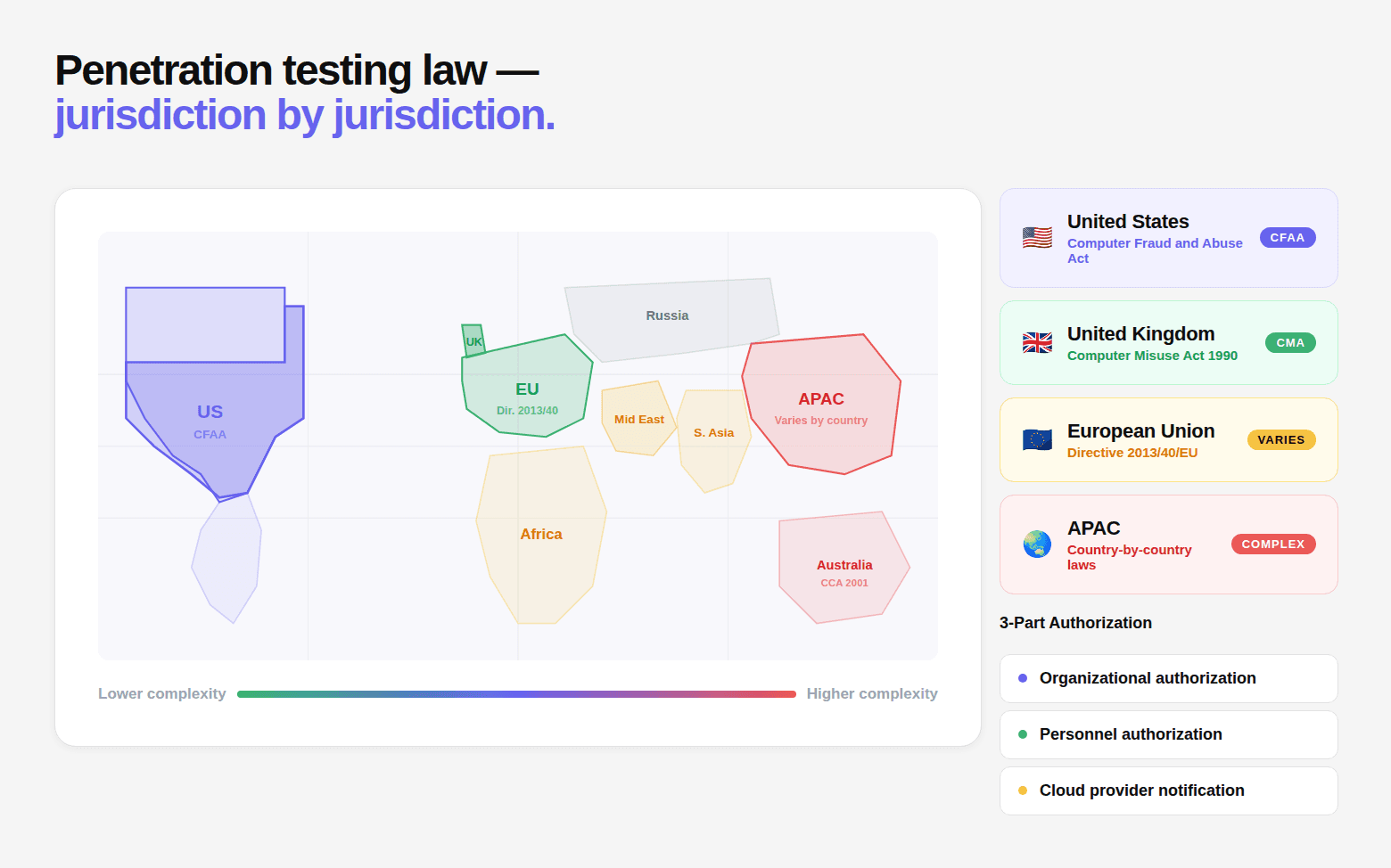
Legal Framework by Region:

Region

Primary Law

Key Legal Risk

Authorization Requirement

United States

CFAA + state laws

Broad scope under CFAA §1030(a)(1)–(7)

Federal law covers all states if properly authorized

United Kingdom

Computer Misuse Act 1990

Unauthorized access (Section 1), modification (Section 3)

Must be authorized by system owner / data controller

European Union

Member state laws + GDPR

Data handling risks under GDPR Article 32

Must include data handling + minimization provisions

What Changes in Each Region

🇺🇸 United States

  • CFAA applies broadly to unauthorized access and system interaction

  • Even benign testing can trigger violations without authorization

  • Federal coverage simplifies multi-state engagements

🇬🇧 United Kingdom

  • Computer Misuse Act focuses on:

    • unauthorized access

    • unauthorized modification

  • Authorization must come from:

    • system owner

    • or legally responsible entity (data controller)

🇪🇺 European Union

  • Legal requirements vary by country

  • GDPR introduces additional obligations:

    • minimize data collection

    • avoid storing personal data discovered during testing

  • Authorization should explicitly define:

    • data handling

    • retention policies

Multi-Jurisdiction Environments

If your systems or teams span regions, complexity increases significantly.

You must:

  • obtain jurisdiction-specific authorization (often via local counsel)

  • define which law governs the engagement (choice of law clause)

  • document where systems are physically hosted

  • evaluate cross-border testing risks

Example:

  • EU-based tester → testing US-hosted system

  • US-based tester → accessing EU data

These scenarios may introduce conflicting legal obligations.

Cloud-Hosted Systems (Critical Detail)

Cloud infrastructure adds another layer of legal ambiguity. Authorization must clearly specify:

  • where systems are physically hosted

  • which jurisdiction applies

Examples:

Cloud Region

Legal Consideration

AWS us-east-1

Primarily US law (CFAA applies)

GCP europe-west1

EU laws + GDPR obligations

Multi-region deployments

Requires explicit legal clarification

Authorization is not just about permission.

It must align with:

  • where systems are hosted

  • where testers operate from

  • which laws apply to both

Without this clarity, a valid pentest in one jurisdiction can become a legal violation in another.

Part 2: The Parties: Who Must Sign and Why

A penetration test authorization letter is only valid if the right parties are involved. It’s not just about permission, it’s about who has the legal authority to grant it. A complete authorization involves three distinct parties.

1. The Authorizing Organization

This is the entity that owns or controls the systems being tested. Important nuance: This is not always the organization paying for the test. If systems are operated by:

  • subsidiaries

  • vendors

  • cloud providers

then each system owner must authorize testing.

Authority Requirements

Requirement

Details

Minimum authority

C-suite executive or written delegation

Recommended

CISO + CTO co-signature

Additional Signatures by System Type

System Type

Additional Signatory

Why

Customer data systems

Legal counsel

Data liability

Payment systems

CFO or legal

Financial risk

Health data systems

Privacy officer

HIPAA compliance

Government systems

Contracting officer

Contractual obligation

What the Signature Represents

A valid signature confirms:

  • authorization for testing activities

  • authority over listed systems

  • acceptance of risk and indemnification

  • agreement to defined scope

What is NOT Valid Authorization

  • IT manager approval alone

  • verbal approval

  • email without formal letter

  • implied approval via purchase order

If the signer does not have authority, the authorization does not hold.

2. The Penetration Testing Firm

The authorization must clearly define who is allowed to test. Not just the company, the individuals.

Required Information

Requirement

Details

Legal entity name

Full company name

Authorized individuals

All testers explicitly listed

Engagement lead

Primary contact

Insurance

Proof of E&O coverage

Data handling

NDA / confidentiality terms

Why Individual Naming Matters

  • law enforcement verification

  • scope accountability

  • cloud provider compliance

  • subcontractor control

Example Format

“The following individuals are authorized to conduct testing:

  1. [Full Name], [Role] — [Employer]

  2. [Full Name], [Role] — [Employer]

Additional individuals require written approval before testing.”

3. Third-Party System Operators (Most Missed)

You cannot authorize testing on systems you don’t control. Modern infrastructure includes:

  • cloud providers

  • SaaS platforms

  • hosting providers

  • CDNs

Each may require separate authorization or notification.

Cloud Providers

Provider

Requirement

AWS

No pre-approval (most cases), but restrictions apply

GCP

No pre-approval, notify if impact risk

Azure

Rules of engagement + possible notification

SaaS Platforms

If testing involves SaaS (e.g., Salesforce, Workday):

Vendor authorization is required

Hosting & Colocation

  • data centers may require notification

  • physical testing requires explicit approval

CDN Providers

Testing through CDNs can trigger protection systems.

  • Cloudflare, Fastly, Akamai may require notification

ISPs

Testing should stop at your infrastructure boundary. Beyond that → separate authorization required.

That said, authorization must align with:

  • system ownership

  • legal authority

  • third-party involvement

Miss any of these, and the authorization breaks.

Even with the right parties involved, authorization is incomplete without clear scope definition. And this is where most engagements fail.

Part 3: The Technical Scope Definition: The Most Consequential Section

Scope ambiguity is the single most common source of disputes between penetration testing firms and their clients. "Test our web application" seems unambiguous until the tester begins testing APIs that serve the mobile application, which the client considers "out of scope." "Test our production environment" seems clear until the tester discovers that production shares a database with the HR system, which the client absolutely did not want tested.

Every ambiguity in scope definition will be resolved at the moment of maximum inconvenience — when a tester has found a vulnerability in a system that may or may not be in scope, or when a client is trying to explain to their board why the penetration testing firm accessed a system they thought was excluded.

Explicit scope definition requires three components:

  1. In-scope enumeration: Everything that IS authorized for testing

  2. Out-of-scope exclusion: Everything that is explicitly NOT authorized, even if adjacent to in-scope systems

  3. Permitted techniques: What testing methods are authorized (and which require special approval)

In-Scope System Enumeration

For each system in scope, specify:

  1. System identifier (IP, hostname, URL, ARN, etc.)

  2. System type (web application, API, infrastructure, database, mobile, etc.)

  3. Ownership confirmation (you own/control this system)

  4. Environment (production, staging, QA, each must be listed if included)

  5. Third-party notification status (cloud provider notified? Y/N)

  6. Special handling (any systems with extra care requirements)

Example in-scope specification:

NETWORK SCOPE:
  Production infrastructure:
    IP Range: 52.14.88.0/24 (AWS us-east-1, owned by Organization)
    IP Range: 52.14.89.0/24 (AWS us-east-1, owned by Organization)
    Specific IPs excluded from range: 52.14.88.155 (third-party monitoring agent — see exclusions)

  Development infrastructure:
    IP Range: 10.0.0.0/16 (internal VPC, accessible via VPN)

APPLICATION SCOPE:
  Primary web application:
    URLs: <https://app.company.com/*>
    <https://api.company.com/*>
    <https://admin.company.com/*>
    Environment: Production
    Authentication: Test account credentials provided in Section 4

  Mobile applications:
    iOS: com.company.app (current App Store version)
    Android: com.company.app (current Play Store version)
    API backend: <https://mobile-api.company.com/v2/*>

  Internal applications (accessible via VPN):
    <https://internal.company.com/*>
    <https://jira.company.internal/*>

NETWORK SCOPE:
  Production infrastructure:
    IP Range: 52.14.88.0/24 (AWS us-east-1, owned by Organization)
    IP Range: 52.14.89.0/24 (AWS us-east-1, owned by Organization)
    Specific IPs excluded from range: 52.14.88.155 (third-party monitoring agent — see exclusions)

  Development infrastructure:
    IP Range: 10.0.0.0/16 (internal VPC, accessible via VPN)

APPLICATION SCOPE:
  Primary web application:
    URLs: <https://app.company.com/*>
    <https://api.company.com/*>
    <https://admin.company.com/*>
    Environment: Production
    Authentication: Test account credentials provided in Section 4

  Mobile applications:
    iOS: com.company.app (current App Store version)
    Android: com.company.app (current Play Store version)
    API backend: <https://mobile-api.company.com/v2/*>

  Internal applications (accessible via VPN):
    <https://internal.company.com/*>
    <https://jira.company.internal/*>

NETWORK SCOPE:
  Production infrastructure:
    IP Range: 52.14.88.0/24 (AWS us-east-1, owned by Organization)
    IP Range: 52.14.89.0/24 (AWS us-east-1, owned by Organization)
    Specific IPs excluded from range: 52.14.88.155 (third-party monitoring agent — see exclusions)

  Development infrastructure:
    IP Range: 10.0.0.0/16 (internal VPC, accessible via VPN)

APPLICATION SCOPE:
  Primary web application:
    URLs: <https://app.company.com/*>
    <https://api.company.com/*>
    <https://admin.company.com/*>
    Environment: Production
    Authentication: Test account credentials provided in Section 4

  Mobile applications:
    iOS: com.company.app (current App Store version)
    Android: com.company.app (current Play Store version)
    API backend: <https://mobile-api.company.com/v2/*>

  Internal applications (accessible via VPN):
    <https://internal.company.com/*>
    <https://jira.company.internal/*>

Out-of-Scope Exclusions

The following systems are explicitly EXCLUDED from testing and must NOT be accessed, probed, or tested in any way, even if discovered during testing:

SYSTEMS EXCLUSIONS:

  1. Third-party production systems:

    • Stripe API (api.stripe.com): Stripe is not a party to this agreement

    • Salesforce (company.salesforce.com): third-party SaaS not authorized

    • Workday HR system (company.myworkday.com): HR data excluded

    • Any system whose IP or hostname is not in the in-scope list

  2. Shared infrastructure:

    • 52.14.88.155: third-party monitoring vendor agent

    • 52.14.88.200: customer-managed server (not owned by Organization)

  3. Specific data categories:

    • Live customer PII: access is limited to test accounts only

    • Financial transaction records: use test account transactions only

    • Employee personal data: HR systems are excluded

  4. Network infrastructure beyond the specified scope:

    • ISP infrastructure upstream of the Organization's border router

    • BGP routing infrastructure

    • DNS resolvers not operated by the Organization

TECHNIQUE EXCLUSIONS (require separate written approval):

  • Denial of Service (DoS) attacks of any kind

  • Social engineering of employees (email phishing, vishing)

  • Physical penetration testing (badge cloning, tailgating)

  • Wireless network attacks

  • Testing that would require modification of production data

  • Testing that involves downloading more than [DEFINED AMOUNT] of customer records

TIMING EXCLUSIONS:

  • No testing between 18:00 UTC Friday and 06:00 UTC Monday (maintenance windows)

  • No testing during the following business-critical periods:
    [List any planned high-traffic events, product launches, fiscal year-end]

WHAT HAPPENS IF TESTER DISCOVERS OUT-OF-SCOPE SYSTEM:

If the tester accidentally accesses or discovers an out-of-scope system:

  1. Immediately cease interaction with the system

  2. Notify the Engagement Contact within 4 hours

  3. Document what was accessed and how

  4. The tester shall not probe, exploit, or analyze the out-of-scope system further

  5. The incident will be documented in the final report

Permitted Testing Techniques Matrix

The table below defines which techniques are allowed, restricted, or prohibited during the engagement.

Category

Technique

Status

Notes

Reconnaissance

Passive OSINT

Permitted

No target interaction


Active port scanning

Permitted

Normal intensity only


Service enumeration

Permitted


Directory / path enumeration

Permitted


Subdomain enumeration

Permitted


Authentication

Login brute force

Limited

Max 10 attempts per account


Password spraying

Limited

Max 3 passwords per account


Credential stuffing

Notify first

Contact engagement lead


MFA bypass testing

Permitted


Session token analysis

Permitted


Exploitation

Exploitation of findings

Permitted

In-scope systems only


Privilege escalation

Permitted

Document all steps


Lateral movement

Notify first

Pre-approval required


Data exfiltration (simulated)

Limited

Test data only

Denial of Service

Any DoS technique

Prohibited

Requires separate agreement


Rate limit testing

Limited

Low intensity only


Resource exhaustion

Prohibited


Social Engineering

Employee phishing

Out of scope

Not included


Phone / vishing

Out of scope

Not included

Injection

SQL injection testing

Permitted

Use test data


Command injection

Permitted

Limited to proof-of-concept


Code injection

Permitted

No persistent modification

Persistence

Backdoor installation

Prohibited

Even temporary


User account creation

Prohibited

Use provided test accounts


Config file modification

Prohibited


Data modification

Prohibited

Read-only exploitation only

Key Interpretation

  • Permitted → No additional approval required

  • Limited → Allowed with strict constraints

  • Notify first → Requires explicit approval before execution

  • Prohibited / Out of scope → Not allowed under any circumstance

Part 4: Cloud Provider Authorization Requirements

AWS Penetration Testing Policy (Current as of 2026)

Amazon Web Services maintains a penetration testing policy that all customers must comply with. The key points:

AWS Penetration Testing Requirements:

WHAT DOES NOT REQUIRE PRIOR APPROVAL:

  • EC2 instances and RDS instances you own

  • API Gateway endpoints

  • Lambda functions

  • ECS/EKS workloads

  • Elastic Beanstalk environments

  • CloudFront distributions

  • Aurora databases

  • S3 buckets (your own)

  • AWS WAF testing

WHAT IS ALWAYS PROHIBITED (regardless of authorization):

  • DNS zone walking (Route53)

  • Denial of service attacks against any AWS infrastructure

  • Port flooding

  • Protocol flooding

  • Request flooding (unless pre-approved)

  • Simulated DDoS attacks

WHAT REQUIRES PRIOR APPROVAL (submit via AWS form):

  • Simulated DDoS testing

  • Load testing that might affect AWS infrastructure

  • Testing AWS-managed services in ways that affect other customers

CURRENT POLICY URL:
  <https://aws.amazon.com/security/penetration-testing/>

CURRENT POLICY URL:
  <https://aws.amazon.com/security/penetration-testing/>

CURRENT POLICY URL:
  <https://aws.amazon.com/security/penetration-testing/>

AUTHORIZATION LETTER LANGUAGE FOR AWS:

  • "Testing is authorized against AWS Account [ID] owned and operated by [Organization Name]. Testing complies with the AWS Penetration Testing

  • Customer Service Policy in effect at the time of testing. Prohibited activities under the AWS policy are excluded from this engagement."

GCP Penetration Testing Policy

CURRENT POLICY POSITION:

Google does not require prior approval for penetration testing of GCP resources
you own. However:

REQUIREMENTS:

  • Testing must be limited to your own GCP resources

  • Testing that could affect other GCP customers is prohibited

  • Notify Google if you discover vulnerabilities in GCP itself (via Google's Vulnerability Reward Program)

  • Do not test Google's underlying infrastructure

PROHIBITED:

  • Testing that impacts shared GCP infrastructure

  • DoS/DDoS testing of any Google services

  • Testing systems you don't own that happen to be on GCP

GCP CURRENT POLICY:
  <https://cloud.google.com/terms/aup>

GCP CURRENT POLICY:
  <https://cloud.google.com/terms/aup>

GCP CURRENT POLICY:
  <https://cloud.google.com/terms/aup>

AUTHORIZATION LETTER LANGUAGE FOR GCP:

"Testing is authorized against GCP Project(s) [Project-ID(s)] under billing account [Account-ID] owned by [Organization Name]. Testing complies with Google Cloud's Acceptable Use Policy and is limited to resources owned by [Organization Name]."

Microsoft Azure Penetration Testing Policy

CURRENT REQUIREMENT:

Microsoft requires customers to notify before conducting penetration tests against Azure resources using the Penetration Testing Rules of Engagement (PTROE) form.

WHERE TO NOTIFY:
  <https://portal.msrc.microsoft.com/en-us/engage/pentest>

WHERE TO NOTIFY:
  <https://portal.msrc.microsoft.com/en-us/engage/pentest>

WHERE TO NOTIFY:
  <https://portal.msrc.microsoft.com/en-us/engage/pentest>

TIMELINE:

  • Submit notification form at least 1-2 business days before testing begins

  • Keep testing within the approved timeline

  • Notify Microsoft if testing extends beyond approved window

WHAT REQUIRES NOTIFICATION:

  • Any penetration testing against Azure-hosted resources

  • Load testing that might impact Azure infrastructure

  • Security assessment of Azure Marketplace solutions you use

WHAT IS PROHIBITED:

  • Testing Azure infrastructure itself (only your resources)

  • DoS or DDoS testing

  • Testing affecting other Azure customers

  • Testing Azure management portals (portal.azure.com etc.)

AUTHORIZATION LETTER LANGUAGE FOR AZURE:"

Testing is authorized against Azure Subscription(s) [Subscription-ID(s)] owned by [Organization Name]. Microsoft has been notified via the Penetration Testing Rules of Engagement form (Notification Reference: [REF-NUMBER], submitted [DATE]). Testing complies with Microsoft's Penetration Testing Rules of Engagement and is limited to resources owned by [Organization Name]."

The Multi-Cloud Authorization Complexity Matrix
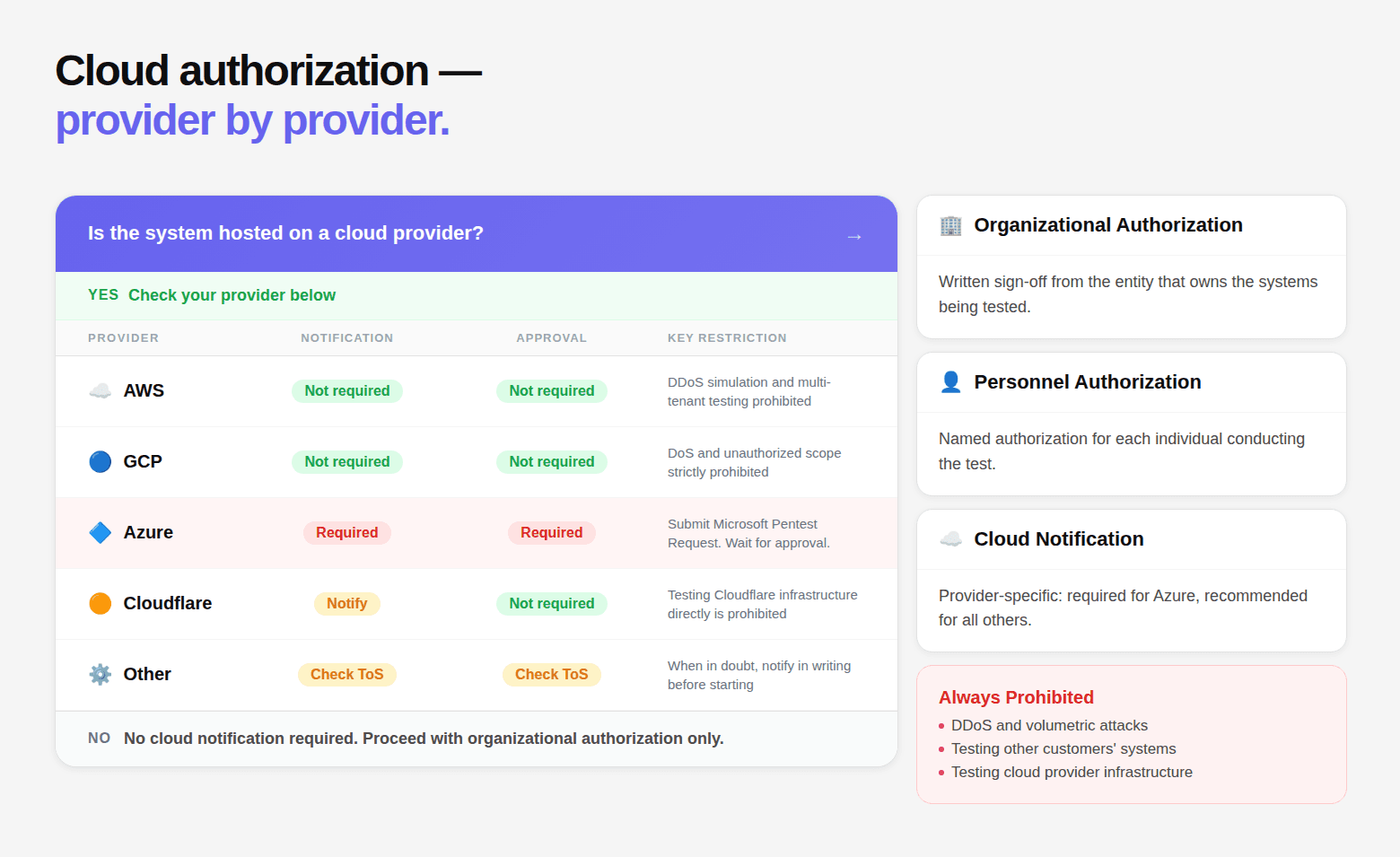
Cloud Provider

Prior Approval Required

Notification Required

Prohibited Activities

Current Policy URL

AWS

No (for most services)

Recommended

DoS, DNS zone walking, Request flooding

aws.amazon.com/security/penetration-testing

GCP

No

Recommended

DoS, cross-customer impact

cloud.google.com/terms/aup

Azure

Via PTROE form

Yes — mandatory

DoS, Azure infrastructure, cross-customer

portal.msrc.microsoft.com

Cloudflare

Contact required

Yes

DDoS simulation, upstream infrastructure

cloudflare.com/responsible-disclosure

Fastly

Contact required

Yes

DDoS, testing Fastly edge infrastructure

N/A contact Fastly directly

Heroku

No (for your apps)

Recommended

Platform infrastructure, other customer apps

devcenter.heroku.com

DigitalOcean

No

Notify if extensive

DoS, cross-customer

digitalocean.com

GitHub

For GitHub.com itself

N/A for repos

GitHub infrastructure

docs.github.com

Part 5: The Emergency Procedures Section: The Most Neglected Provision

Penetration testing involves real exploitation against real systems. Things go wrong:

1. Unintended Service Disruption

What happens: A vulnerability exploit causes unexpected system behavior, service crash, database outage, or resource exhaustion.

Without a procedure:

  • Unclear who to contact

  • Tester may continue unknowingly

  • Client may panic and halt testing

With a procedure:

  • Defined escalation path

  • Tester stops the triggering activity immediately

  • Engagement contact initiates response if required

2. Discovery of an Active Breach

What happens: Tester identifies signs of a real attacker, malware, unauthorized access, or ongoing data exfiltration.

Without a procedure:

  • Tester unsure whether to stop or continue

  • Client remains unaware of active compromise

With a procedure:

  • Immediate escalation

  • Testing halted in affected systems

  • Incident response and forensic preservation begin

3. Access to Out-of-Scope Sensitive Data

What happens: A vulnerability exposes data that should not be accessed, PII, financial records, or internal systems.

Without a procedure:

  • Tester risks violating scope

  • Client unaware sensitive data was exposed

With a procedure:

  • Immediate disengagement

  • Access path documented without further interaction

  • Client notified promptly

4. False Positive Security Alert

What happens: Testing activity triggers SIEM alerts, causing internal incident response activation.

Without a procedure:

  • Confusion between real attack and testing

  • SOC escalation disrupts engagement

With a procedure:

  • Emergency contact confirms testing activity

  • Predefined identifiers (e.g., code words) prevent escalation

5. Physical Security Detention

What happens: Tester is stopped by security or law enforcement during physical testing.

Without a procedure:

  • Legal exposure

  • Escalation into a real incident

With a procedure:

  • Authorization letter presented immediately

  • 24/7 contact validates engagement

6. Third-Party Impact

What happens: Testing affects shared infrastructure or external systems.

Without a procedure:

  • Responsibility unclear

  • Potential legal or contractual issues

With a procedure:

  • Immediate cessation

  • Stakeholders notified

  • Incident documented

Why This Matters

Scenario Type

Risk Without Procedure

Outcome With Procedure

Service disruption

Outage, panic

Controlled response

Active breach

Missed attack

Immediate containment

Data exposure

Scope violation

Safe handling

SIEM alert

False escalation

Controlled validation

Physical detention

Legal risk

Immediate clearance

Third-party impact

Liability

Managed response

The Emergency Procedures Specification

This section defines what happens when something goes wrong during testing.

7.1 Emergency Contact Chain

All parties must be reachable throughout the testing window.

Client Emergency Contacts: (Must respond within defined SLA - e.g., 30/60/120 minutes)

Role

Name

Phone

Mobile

Email

Availability

Primary

[Name]

[Number]

[Mobile]

[Email]

24/7

Secondary

[Name]

[Number]

[Mobile]

[Email]

Backup

Testing Firm Contacts:

Role

Name

Phone

Mobile

Email

Engagement Lead

[Name]

[Number]

[Mobile]

[Email]

Technical Lead

[Name]

[Number]

[Mobile]

7.2 Safe Word Protocol

A safe word system is used to immediately validate the engagement.

  • Safe Word: [UNIQUE WORD] (e.g., BLUEKITE)

  • Used in:

    • SOC communications

    • incident validation

    • law enforcement interactions

Who Knows the Safe Word

[List individuals]

Law Enforcement Script

“This activity is part of an authorized security assessment.
The safe word for this engagement is [SAFE WORD].
Please contact [Name] at [Phone] to confirm authorization.”

7.3 Service Disruption Procedure

If testing causes or may cause disruption:

Immediate Response

  1. Stop the triggering activity immediately

  2. Notify client within [15 minutes]

Client Decision: Client determines next step:

  • continue testing

  • temporarily pause

  • terminate engagement

Follow-Up

  • document cause + technique

  • log client decision

  • trigger incident response if needed

Liability Note

  • in-scope actions → governed by agreement

  • prohibited actions → tester responsibility

7.4 Discovery of Active Third-Party Compromise

If evidence of a real attacker is found:

Immediate Action

  • stop testing in affected area

  • notify client within 4 hours

Testing Team Responsibilities

  • do not modify systems

  • preserve evidence

  • document findings

  • maintain logs

  • provide written summary

Strictly Not Allowed

  • contacting law enforcement

  • notifying third parties

  • public disclosure

  • continuing testing without approval

Key Principle: The client owns incident response decisions.

7.5 Accidental Access to Out-of-Scope Data

If restricted systems or data are accessed:

Immediate Action: stop interaction immediately

Within 4 Hours: Notify Client and provide:

  • what was accessed

  • how it happened

  • what data was seen (description only)

  • confirmation of disengagement

Tester Obligations:

  • do not retain or reuse data

  • delete automatically captured data

  • confirm deletion in writing

  • include incident in final report

Client may:

  • allow alternate testing path

  • terminate test case

7.6 Physical Security Emergencies (If Applicable)

If tester is detained:

  1. Present physical authorization letter

  2. Provide emergency contact

  3. Client confirms engagement

  4. Notify engagement lead within 1 hour

Required Items for Testers:

  • physical authorization letter

  • business card

  • valid photo ID

That said, emergency procedures are not optional.

They define:

  • how quickly incidents are contained

  • how risk is controlled

  • whether testing remains safe and legal

Without them, a controlled test can become a real incident.

Part 6: Data Handling Provisions: The GDPR Dimension

Penetration testing is inherently data-exposing. To confirm vulnerabilities, testers often interact with live systems that contain real customer data, credentials, financial records, and internal business information. This is not incidental. It is part of how modern vulnerabilities are validated.

Because of this, the authorization letter must clearly define how data is handled during testing. Without explicit controls, testing itself can introduce regulatory risk.

6.1 Data Encountered During Penetration Testing

During a standard engagement, testers may encounter multiple categories of sensitive data as a direct result of valid exploitation paths.

Data Type

Typical Source

User credentials

Authentication flaws and weak access controls

Session tokens

Traffic interception and session analysis

Personal data (PII)

IDOR and injection vulnerabilities

Financial data

Business logic and authorization flaws

API keys and service credentials

JavaScript bundles or repository history

Internal business data

Authorization bypass

Encrypted data

Captured traffic that may be decryptable

Log files with user activity

Path traversal or log access vulnerabilities

The presence of this data is evidence of risk. It is not a resource to be collected or retained.

6.2 GDPR and Data Protection Considerations

If testing involves personal data of EU data subjects, it is considered a data processing activity under GDPR. In this context:

  • the client remains the data controller

  • the testing firm operates as a data processor

This introduces specific legal and operational obligations.

Data Processing Agreement (DPA)

A DPA is required when personal data is accessed during testing. It must define:

  • purpose of processing

  • duration of access

  • nature of processing activities

  • categories of data involved

  • security safeguards

Data Minimization

Testing must limit access to the minimum data required to confirm a vulnerability. For example, validating exposure with a single record is sufficient. Extracting full datasets is not.

Purpose Limitation

Data accessed during testing may only be used for vulnerability validation. It must not be used for:

  • internal research

  • training data

  • demonstrations

  • reuse across engagements

Retention Limitation

Client data must not be retained beyond necessity.

  • default expectation is no retention beyond the engagement

  • maximum retention window may be defined as [30 / 60 / 90 days]

  • written confirmation of deletion is required

Data Subject Rights

The client retains responsibility for all data subject rights. The testing firm must ensure that testing activities do not:

  • interfere with these rights

  • bypass existing controls

  • create additional exposure

6.3 Transition to Operational Controls

The principles above must be enforced through explicit, testable rules. The following section defines how data is classified, handled, retained, and protected during the engagement.

Data Handling and Confidentiality

This section translates data protection principles into operational controls that govern the engagement.

Data Classification During Testing

The testing firm shall handle all data encountered during testing according to the following classification model:

Data Category

Handling Requirement

Test account data

May be accessed and analyzed fully

Real user PII

Confirm existence only. Do not copy or reproduce

Payment card data

Confirm existence only. No reproduction

Discovered credentials

Document existence. Rotate upon notification

API keys and secrets

Notify client within 24 hours. Do not retain

Business confidential data

Access only what is necessary. Document usage in report

System credentials

Document access path. Do not store credentials

Source code

May be analyzed. Do not reproduce significant portions

Data Retention and Deletion

The testing firm commits to the following data handling practices.

Testing Artifacts

Includes screenshots, logs, and tool output.

  • retention period: [90 days after report delivery]

  • storage: encrypted systems within testing firm infrastructure

  • access: limited to engagement team members

Final Reports and Supporting Documents

  • retention period: [3 years for compliance purposes]

  • storage: encrypted and access-controlled

Client Data Encountered During Testing

  • retention: none beyond engagement

  • data must be deleted immediately upon discovery

Exception:

  • proof-of-concept evidence required for reporting may be retained temporarily

  • such evidence must be deleted within [30 days of report delivery]

Post-Engagement Requirements

Upon completion of the engagement, the testing firm will:

  • delete all client data from testing systems

  • provide written certification of deletion within [14 days]

  • confirm deletion from backup systems within [30 days]

Reporting and Disclosure

All findings are disclosed exclusively to the client through secure channels.

Approved Communication Methods

  • encrypted email

  • secure client portal

  • encrypted file transfer

  • in-person delivery where required

The Testing Firm Will Not

The testing firm agrees not to:

  • publish or discuss findings publicly without written approval

  • include findings in case studies without explicit consent

  • disclose the client as a customer without approval

  • reuse findings without anonymization

  • share or transfer client data to third parties

Bug Bounty Programs

Findings from this engagement will not be submitted to bug bounty programs by the testing firm. The client retains full discretion to disclose findings independently.

Non-Disclosure Obligations

The testing firm agrees to maintain confidentiality of:

  • the existence of the engagement

  • all findings and vulnerabilities

  • all client data accessed

  • system architecture and configurations

  • business processes observed during testing

Duration

Confidentiality obligations remain in effect for: [2 years] from the engagement completion date

Exceptions

Disclosure is permitted only if required by law or court order. Where legally allowed, the client will be notified in advance.

That said, data handling in penetration testing is not a secondary concern. It is a control layer that determines whether testing remains compliant, secure, and legally defensible. A well-defined data handling section ensures that vulnerabilities are identified without introducing new risk.

Part 7: Complete Authorization Letter Template

This is the complete template ready for adaptation. Every section from Parts 1–6 synthesized into a single coherent document:

PENETRATION TESTING AUTHORIZATION LETTER
AND RULES OF ENGAGEMENT

ENGAGEMENT REFERENCE: [COMPANY-YEAR-NUMBER]
VERSION: 1.0
EFFECTIVE DATE: [START DATE]
EXPIRATION DATE: [END DATE]

═══════════════════════════════════════════════════════════════
SECTION 1: PARTIES
═══════════════════════════════════════════════════════════════

AUTHORIZING ORGANIZATION:
  Legal Name:     [Full legal name of the organization]
  Business Name:  [DBA if applicable]
  Registered Address: [Address]

  Authorized Representative:
    Name:     [Full Name]
    Title:    [C-Suite Title — CISO, CTO, CEO, etc.]
    Email:    [Corporate email]
    Phone:    [Direct phone number]

  Secondary Authorization (Co-Signer if applicable):
    Name:     [Full Name]
    Title:    [Title]

PENETRATION TESTING FIRM:
  Legal Name:     [Full legal name of testing firm]
  Business Address: [Address]

  Engagement Lead:
    Name:     [Full Name]
    Title:    [Engagement Lead / Senior Security Engineer]
    Email:    [Corporate email]
    Phone:    [Direct phone number]

  AUTHORIZED TESTING PERSONNEL:
    The following individuals are exclusively authorized to conduct
    testing activities under this authorization:

    1. [Full Legal Name] — [Role] — [Employer Name]
    2. [Full Legal Name] — [Role] — [Employer Name]
    3. [Full Legal Name] — [Role] — [Employer Name]

    Any individual not listed above who conducts testing activities
    without written amendment to this authorization does so without
    authorization and may face legal consequences.

═══════════════════════════════════════════════════════════════
SECTION 2: ENGAGEMENT PURPOSE AND AUTHORIZATION
═══════════════════════════════════════════════════════════════

2.1 Purpose

The Authorizing Organization engages the Penetration Testing Firm
to conduct a [TYPE: Black Box / Gray Box / White Box / Red Team]
penetration testing engagement for the purpose of identifying
security vulnerabilities in the systems listed in Section 3.

2.2 Authorization

The Authorizing Organization hereby explicitly authorizes the
Penetration Testing Firm and the authorized personnel listed in
Section 1 to:

  a. Probe, scan, and enumerate the systems listed in Section 3
  b. Attempt to identify security vulnerabilities in those systems
  c. Attempt to exploit identified vulnerabilities using the techniques
     permitted in Section 6, to demonstrate confirmed exploitability
  d. Access data in in-scope systems to the minimum extent necessary
     to confirm vulnerability existence and impact
  e. Document all testing activities and findings for delivery to
     the Authorizing Organization

This authorization explicitly DOES NOT permit:
  a. Access to systems not listed in Section 3
  b. Techniques explicitly prohibited in Section 6
  c. Retention or use of client data beyond engagement purposes
  d. Disclosure of findings to third parties without written approval

2.3 Legal Acknowledgment

The Authorizing Organization confirms that it owns, controls, or has
obtained separate authorization for all systems listed in Section 3,
and has the legal authority to authorize security testing of those systems.

The Penetration Testing Firm confirms that all testing activities will
comply with applicable laws, including but not limited to the Computer
Fraud and Abuse Act (18 U.S.C. § 1030), and that this authorization
letter constitutes explicit authorization for all activities within its scope.

═══════════════════════════════════════════════════════════════
SECTION 3: IN-SCOPE SYSTEMS
═══════════════════════════════════════════════════════════════

3.1 Network Scope

[List all in-scope IP ranges, hostnames, and domains]

3.2 Application Scope

[List all in-scope web applications, APIs, mobile applications]

3.3 Cloud Infrastructure Scope

[List cloud accounts, project IDs, subscription IDs, and services]

3.4 Code Repository Scope (White Box only)

[List GitHub/GitLab organizations, repositories]

3.5 Physical Scope (if applicable)

[List physical locations if physical testing is in scope]

═══════════════════════════════════════════════════════════════
SECTION 4: OUT-OF-SCOPE EXCLUSIONS
═══════════════════════════════════════════════════════════════

[List all explicitly excluded systems, data categories, techniques, and timing]

═══════════════════════════════════════════════════════════════
SECTION 5: CLOUD PROVIDER AUTHORIZATION
═══════════════════════════════════════════════════════════════

5.1 AWS Authorization
[Account IDs, compliance with AWS Penetration Testing policy confirmation]

5.2 Azure Authorization
[Subscription IDs, PTROE form reference number and submission date]

5.3 GCP Authorization
[Project IDs, compliance with GCP AUP confirmation]

5.4 Other Cloud/Hosting Providers
[Any additional provider notifications and status]

═══════════════════════════════════════════════════════════════
SECTION 6: PERMITTED TECHNIQUES
═══════════════════════════════════════════════════════════════

[Full techniques matrix from Part 3]

═══════════════════════════════════════════════════════════════
SECTION 7: TESTING WINDOW
═══════════════════════════════════════════════════════════════

7.1 Active Testing Window

  Start Date/Time: [DATE] at [TIME] [TIMEZONE]
  End Date/Time:   [DATE] at [TIME] [TIMEZONE]

  Total Duration: [X] business days / [X] calendar days

7.2 Time Restrictions

  Testing hours (if applicable): [TIMES] [TIMEZONE]
  Blackout periods: [DATES/TIMES when testing must stop]

  After-hours testing: [PERMITTED/NOT PERMITTED/REQUIRES APPROVAL]

7.3 Extension Procedure

Extensions to the testing window require written approval from the
Authorized Representative listed in Section 1. Extensions requested
less than 24 hours before expiration must be approved by phone with
written confirmation.

═══════════════════════════════════════════════════════════════
SECTION 8: EMERGENCY PROCEDURES
═══════════════════════════════════════════════════════════════

[Full emergency procedures from Part 5]

═══════════════════════════════════════════════════════════════
SECTION 9: DATA HANDLING
═══════════════════════════════════════════════════════════════

[Full data handling provisions from Part 6]

═══════════════════════════════════════════════════════════════
SECTION 10: DELIVERABLES
═══════════════════════════════════════════════════════════════

10.1 Report Contents

The Penetration Testing Firm will deliver a final report containing:

  a. Executive summary (1-2 pages, non-technical)
  b. Methodology description
  c. All findings with:
     - Unique finding ID
     - CVSS 4.0 score and vector
     - Severity classification
     - Technical description
     - Proof of concept (with screenshots/evidence)
     - Business impact assessment
     - Root cause analysis
     - Specific remediation guidance
     - Code-level fix where applicable (white box engagements)
  d. Findings prioritized by CVSS score
  e. Exploit chain analysis (where applicable)
  f. Summary of out-of-scope findings if any occurred
  g. Appendices: tool output, raw scan data (optional)

10.2 Report Delivery

  Format:    [PDF / Encrypted PDF / Secure portal]
  Timeline:  Within [5/7/10] business days of testing window close
  Recipient: [Named individuals who receive the report]
  Delivery method: [Encrypted email / Secure upload / In-person]

10.3 Interim Communication

  Critical findings (CVSS 9.0+):
    Notification within: [4 hours / 24 hours] of confirmation
    Method: Phone + encrypted email

  High findings (CVSS 7.0-8.9):
    Notification within: [24 hours / 48 hours] of confirmation
    Method: Encrypted email

═══════════════════════════════════════════════════════════════
SECTION 11: INDEMNIFICATION AND LIABILITY
═══════════════════════════════════════════════════════════════

11.1 Client Indemnification

The Authorizing Organization agrees to indemnify, defend, and hold
harmless the Penetration Testing Firm and its authorized personnel
from any claims, damages, or proceedings arising from:

  a. Testing activities within the authorized scope using permitted techniques
  b. Third-party claims arising from the discovery of vulnerabilities
  c. Law enforcement inquiries related to authorized testing activities

11.2 Tester Responsibility

The Penetration Testing Firm is responsible for:

  a. Testing activities outside the authorized scope
  b. Use of explicitly prohibited techniques
  c. Negligent damage to production systems
  d. Unauthorized disclosure of findings
  e. Data retention beyond permitted periods

11.3 Limitation of Liability

The Penetration Testing Firm's total liability for any claim arising
from this engagement shall not exceed [the engagement fee / $X / the
amount of the firm's applicable professional liability insurance].

Neither party is liable for indirect, consequential, or punitive
damages regardless of the basis of the claim.

═══════════════════════════════════════════════════════════════
SECTION 12: GOVERNING LAW
═══════════════════════════════════════════════════════════════

This authorization letter and any disputes arising from or related
to the engagement described herein shall be governed by the laws of
[STATE/COUNTRY], without regard to conflicts of law provisions.

═══════════════════════════════════════════════════════════════
SECTION 13: SIGNATURES
═══════════════════════════════════════════════════════════════

AUTHORIZING ORGANIZATION:

Signature: _______________________  Date: ___________

Printed Name: _______________________

Title: _______________________

[Co-signer if required:]

PENETRATION TESTING AUTHORIZATION LETTER
AND RULES OF ENGAGEMENT

ENGAGEMENT REFERENCE: [COMPANY-YEAR-NUMBER]
VERSION: 1.0
EFFECTIVE DATE: [START DATE]
EXPIRATION DATE: [END DATE]

═══════════════════════════════════════════════════════════════
SECTION 1: PARTIES
═══════════════════════════════════════════════════════════════

AUTHORIZING ORGANIZATION:
  Legal Name:     [Full legal name of the organization]
  Business Name:  [DBA if applicable]
  Registered Address: [Address]

  Authorized Representative:
    Name:     [Full Name]
    Title:    [C-Suite Title — CISO, CTO, CEO, etc.]
    Email:    [Corporate email]
    Phone:    [Direct phone number]

  Secondary Authorization (Co-Signer if applicable):
    Name:     [Full Name]
    Title:    [Title]

PENETRATION TESTING FIRM:
  Legal Name:     [Full legal name of testing firm]
  Business Address: [Address]

  Engagement Lead:
    Name:     [Full Name]
    Title:    [Engagement Lead / Senior Security Engineer]
    Email:    [Corporate email]
    Phone:    [Direct phone number]

  AUTHORIZED TESTING PERSONNEL:
    The following individuals are exclusively authorized to conduct
    testing activities under this authorization:

    1. [Full Legal Name] — [Role] — [Employer Name]
    2. [Full Legal Name] — [Role] — [Employer Name]
    3. [Full Legal Name] — [Role] — [Employer Name]

    Any individual not listed above who conducts testing activities
    without written amendment to this authorization does so without
    authorization and may face legal consequences.

═══════════════════════════════════════════════════════════════
SECTION 2: ENGAGEMENT PURPOSE AND AUTHORIZATION
═══════════════════════════════════════════════════════════════

2.1 Purpose

The Authorizing Organization engages the Penetration Testing Firm
to conduct a [TYPE: Black Box / Gray Box / White Box / Red Team]
penetration testing engagement for the purpose of identifying
security vulnerabilities in the systems listed in Section 3.

2.2 Authorization

The Authorizing Organization hereby explicitly authorizes the
Penetration Testing Firm and the authorized personnel listed in
Section 1 to:

  a. Probe, scan, and enumerate the systems listed in Section 3
  b. Attempt to identify security vulnerabilities in those systems
  c. Attempt to exploit identified vulnerabilities using the techniques
     permitted in Section 6, to demonstrate confirmed exploitability
  d. Access data in in-scope systems to the minimum extent necessary
     to confirm vulnerability existence and impact
  e. Document all testing activities and findings for delivery to
     the Authorizing Organization

This authorization explicitly DOES NOT permit:
  a. Access to systems not listed in Section 3
  b. Techniques explicitly prohibited in Section 6
  c. Retention or use of client data beyond engagement purposes
  d. Disclosure of findings to third parties without written approval

2.3 Legal Acknowledgment

The Authorizing Organization confirms that it owns, controls, or has
obtained separate authorization for all systems listed in Section 3,
and has the legal authority to authorize security testing of those systems.

The Penetration Testing Firm confirms that all testing activities will
comply with applicable laws, including but not limited to the Computer
Fraud and Abuse Act (18 U.S.C. § 1030), and that this authorization
letter constitutes explicit authorization for all activities within its scope.

═══════════════════════════════════════════════════════════════
SECTION 3: IN-SCOPE SYSTEMS
═══════════════════════════════════════════════════════════════

3.1 Network Scope

[List all in-scope IP ranges, hostnames, and domains]

3.2 Application Scope

[List all in-scope web applications, APIs, mobile applications]

3.3 Cloud Infrastructure Scope

[List cloud accounts, project IDs, subscription IDs, and services]

3.4 Code Repository Scope (White Box only)

[List GitHub/GitLab organizations, repositories]

3.5 Physical Scope (if applicable)

[List physical locations if physical testing is in scope]

═══════════════════════════════════════════════════════════════
SECTION 4: OUT-OF-SCOPE EXCLUSIONS
═══════════════════════════════════════════════════════════════

[List all explicitly excluded systems, data categories, techniques, and timing]

═══════════════════════════════════════════════════════════════
SECTION 5: CLOUD PROVIDER AUTHORIZATION
═══════════════════════════════════════════════════════════════

5.1 AWS Authorization
[Account IDs, compliance with AWS Penetration Testing policy confirmation]

5.2 Azure Authorization
[Subscription IDs, PTROE form reference number and submission date]

5.3 GCP Authorization
[Project IDs, compliance with GCP AUP confirmation]

5.4 Other Cloud/Hosting Providers
[Any additional provider notifications and status]

═══════════════════════════════════════════════════════════════
SECTION 6: PERMITTED TECHNIQUES
═══════════════════════════════════════════════════════════════

[Full techniques matrix from Part 3]

═══════════════════════════════════════════════════════════════
SECTION 7: TESTING WINDOW
═══════════════════════════════════════════════════════════════

7.1 Active Testing Window

  Start Date/Time: [DATE] at [TIME] [TIMEZONE]
  End Date/Time:   [DATE] at [TIME] [TIMEZONE]

  Total Duration: [X] business days / [X] calendar days

7.2 Time Restrictions

  Testing hours (if applicable): [TIMES] [TIMEZONE]
  Blackout periods: [DATES/TIMES when testing must stop]

  After-hours testing: [PERMITTED/NOT PERMITTED/REQUIRES APPROVAL]

7.3 Extension Procedure

Extensions to the testing window require written approval from the
Authorized Representative listed in Section 1. Extensions requested
less than 24 hours before expiration must be approved by phone with
written confirmation.

═══════════════════════════════════════════════════════════════
SECTION 8: EMERGENCY PROCEDURES
═══════════════════════════════════════════════════════════════

[Full emergency procedures from Part 5]

═══════════════════════════════════════════════════════════════
SECTION 9: DATA HANDLING
═══════════════════════════════════════════════════════════════

[Full data handling provisions from Part 6]

═══════════════════════════════════════════════════════════════
SECTION 10: DELIVERABLES
═══════════════════════════════════════════════════════════════

10.1 Report Contents

The Penetration Testing Firm will deliver a final report containing:

  a. Executive summary (1-2 pages, non-technical)
  b. Methodology description
  c. All findings with:
     - Unique finding ID
     - CVSS 4.0 score and vector
     - Severity classification
     - Technical description
     - Proof of concept (with screenshots/evidence)
     - Business impact assessment
     - Root cause analysis
     - Specific remediation guidance
     - Code-level fix where applicable (white box engagements)
  d. Findings prioritized by CVSS score
  e. Exploit chain analysis (where applicable)
  f. Summary of out-of-scope findings if any occurred
  g. Appendices: tool output, raw scan data (optional)

10.2 Report Delivery

  Format:    [PDF / Encrypted PDF / Secure portal]
  Timeline:  Within [5/7/10] business days of testing window close
  Recipient: [Named individuals who receive the report]
  Delivery method: [Encrypted email / Secure upload / In-person]

10.3 Interim Communication

  Critical findings (CVSS 9.0+):
    Notification within: [4 hours / 24 hours] of confirmation
    Method: Phone + encrypted email

  High findings (CVSS 7.0-8.9):
    Notification within: [24 hours / 48 hours] of confirmation
    Method: Encrypted email

═══════════════════════════════════════════════════════════════
SECTION 11: INDEMNIFICATION AND LIABILITY
═══════════════════════════════════════════════════════════════

11.1 Client Indemnification

The Authorizing Organization agrees to indemnify, defend, and hold
harmless the Penetration Testing Firm and its authorized personnel
from any claims, damages, or proceedings arising from:

  a. Testing activities within the authorized scope using permitted techniques
  b. Third-party claims arising from the discovery of vulnerabilities
  c. Law enforcement inquiries related to authorized testing activities

11.2 Tester Responsibility

The Penetration Testing Firm is responsible for:

  a. Testing activities outside the authorized scope
  b. Use of explicitly prohibited techniques
  c. Negligent damage to production systems
  d. Unauthorized disclosure of findings
  e. Data retention beyond permitted periods

11.3 Limitation of Liability

The Penetration Testing Firm's total liability for any claim arising
from this engagement shall not exceed [the engagement fee / $X / the
amount of the firm's applicable professional liability insurance].

Neither party is liable for indirect, consequential, or punitive
damages regardless of the basis of the claim.

═══════════════════════════════════════════════════════════════
SECTION 12: GOVERNING LAW
═══════════════════════════════════════════════════════════════

This authorization letter and any disputes arising from or related
to the engagement described herein shall be governed by the laws of
[STATE/COUNTRY], without regard to conflicts of law provisions.

═══════════════════════════════════════════════════════════════
SECTION 13: SIGNATURES
═══════════════════════════════════════════════════════════════

AUTHORIZING ORGANIZATION:

Signature: _______________________  Date: ___________

Printed Name: _______________________

Title: _______________________

[Co-signer if required:]

PENETRATION TESTING AUTHORIZATION LETTER
AND RULES OF ENGAGEMENT

ENGAGEMENT REFERENCE: [COMPANY-YEAR-NUMBER]
VERSION: 1.0
EFFECTIVE DATE: [START DATE]
EXPIRATION DATE: [END DATE]

═══════════════════════════════════════════════════════════════
SECTION 1: PARTIES
═══════════════════════════════════════════════════════════════

AUTHORIZING ORGANIZATION:
  Legal Name:     [Full legal name of the organization]
  Business Name:  [DBA if applicable]
  Registered Address: [Address]

  Authorized Representative:
    Name:     [Full Name]
    Title:    [C-Suite Title — CISO, CTO, CEO, etc.]
    Email:    [Corporate email]
    Phone:    [Direct phone number]

  Secondary Authorization (Co-Signer if applicable):
    Name:     [Full Name]
    Title:    [Title]

PENETRATION TESTING FIRM:
  Legal Name:     [Full legal name of testing firm]
  Business Address: [Address]

  Engagement Lead:
    Name:     [Full Name]
    Title:    [Engagement Lead / Senior Security Engineer]
    Email:    [Corporate email]
    Phone:    [Direct phone number]

  AUTHORIZED TESTING PERSONNEL:
    The following individuals are exclusively authorized to conduct
    testing activities under this authorization:

    1. [Full Legal Name] — [Role] — [Employer Name]
    2. [Full Legal Name] — [Role] — [Employer Name]
    3. [Full Legal Name] — [Role] — [Employer Name]

    Any individual not listed above who conducts testing activities
    without written amendment to this authorization does so without
    authorization and may face legal consequences.

═══════════════════════════════════════════════════════════════
SECTION 2: ENGAGEMENT PURPOSE AND AUTHORIZATION
═══════════════════════════════════════════════════════════════

2.1 Purpose

The Authorizing Organization engages the Penetration Testing Firm
to conduct a [TYPE: Black Box / Gray Box / White Box / Red Team]
penetration testing engagement for the purpose of identifying
security vulnerabilities in the systems listed in Section 3.

2.2 Authorization

The Authorizing Organization hereby explicitly authorizes the
Penetration Testing Firm and the authorized personnel listed in
Section 1 to:

  a. Probe, scan, and enumerate the systems listed in Section 3
  b. Attempt to identify security vulnerabilities in those systems
  c. Attempt to exploit identified vulnerabilities using the techniques
     permitted in Section 6, to demonstrate confirmed exploitability
  d. Access data in in-scope systems to the minimum extent necessary
     to confirm vulnerability existence and impact
  e. Document all testing activities and findings for delivery to
     the Authorizing Organization

This authorization explicitly DOES NOT permit:
  a. Access to systems not listed in Section 3
  b. Techniques explicitly prohibited in Section 6
  c. Retention or use of client data beyond engagement purposes
  d. Disclosure of findings to third parties without written approval

2.3 Legal Acknowledgment

The Authorizing Organization confirms that it owns, controls, or has
obtained separate authorization for all systems listed in Section 3,
and has the legal authority to authorize security testing of those systems.

The Penetration Testing Firm confirms that all testing activities will
comply with applicable laws, including but not limited to the Computer
Fraud and Abuse Act (18 U.S.C. § 1030), and that this authorization
letter constitutes explicit authorization for all activities within its scope.

═══════════════════════════════════════════════════════════════
SECTION 3: IN-SCOPE SYSTEMS
═══════════════════════════════════════════════════════════════

3.1 Network Scope

[List all in-scope IP ranges, hostnames, and domains]

3.2 Application Scope

[List all in-scope web applications, APIs, mobile applications]

3.3 Cloud Infrastructure Scope

[List cloud accounts, project IDs, subscription IDs, and services]

3.4 Code Repository Scope (White Box only)

[List GitHub/GitLab organizations, repositories]

3.5 Physical Scope (if applicable)

[List physical locations if physical testing is in scope]

═══════════════════════════════════════════════════════════════
SECTION 4: OUT-OF-SCOPE EXCLUSIONS
═══════════════════════════════════════════════════════════════

[List all explicitly excluded systems, data categories, techniques, and timing]

═══════════════════════════════════════════════════════════════
SECTION 5: CLOUD PROVIDER AUTHORIZATION
═══════════════════════════════════════════════════════════════

5.1 AWS Authorization
[Account IDs, compliance with AWS Penetration Testing policy confirmation]

5.2 Azure Authorization
[Subscription IDs, PTROE form reference number and submission date]

5.3 GCP Authorization
[Project IDs, compliance with GCP AUP confirmation]

5.4 Other Cloud/Hosting Providers
[Any additional provider notifications and status]

═══════════════════════════════════════════════════════════════
SECTION 6: PERMITTED TECHNIQUES
═══════════════════════════════════════════════════════════════

[Full techniques matrix from Part 3]

═══════════════════════════════════════════════════════════════
SECTION 7: TESTING WINDOW
═══════════════════════════════════════════════════════════════

7.1 Active Testing Window

  Start Date/Time: [DATE] at [TIME] [TIMEZONE]
  End Date/Time:   [DATE] at [TIME] [TIMEZONE]

  Total Duration: [X] business days / [X] calendar days

7.2 Time Restrictions

  Testing hours (if applicable): [TIMES] [TIMEZONE]
  Blackout periods: [DATES/TIMES when testing must stop]

  After-hours testing: [PERMITTED/NOT PERMITTED/REQUIRES APPROVAL]

7.3 Extension Procedure

Extensions to the testing window require written approval from the
Authorized Representative listed in Section 1. Extensions requested
less than 24 hours before expiration must be approved by phone with
written confirmation.

═══════════════════════════════════════════════════════════════
SECTION 8: EMERGENCY PROCEDURES
═══════════════════════════════════════════════════════════════

[Full emergency procedures from Part 5]

═══════════════════════════════════════════════════════════════
SECTION 9: DATA HANDLING
═══════════════════════════════════════════════════════════════

[Full data handling provisions from Part 6]

═══════════════════════════════════════════════════════════════
SECTION 10: DELIVERABLES
═══════════════════════════════════════════════════════════════

10.1 Report Contents

The Penetration Testing Firm will deliver a final report containing:

  a. Executive summary (1-2 pages, non-technical)
  b. Methodology description
  c. All findings with:
     - Unique finding ID
     - CVSS 4.0 score and vector
     - Severity classification
     - Technical description
     - Proof of concept (with screenshots/evidence)
     - Business impact assessment
     - Root cause analysis
     - Specific remediation guidance
     - Code-level fix where applicable (white box engagements)
  d. Findings prioritized by CVSS score
  e. Exploit chain analysis (where applicable)
  f. Summary of out-of-scope findings if any occurred
  g. Appendices: tool output, raw scan data (optional)

10.2 Report Delivery

  Format:    [PDF / Encrypted PDF / Secure portal]
  Timeline:  Within [5/7/10] business days of testing window close
  Recipient: [Named individuals who receive the report]
  Delivery method: [Encrypted email / Secure upload / In-person]

10.3 Interim Communication

  Critical findings (CVSS 9.0+):
    Notification within: [4 hours / 24 hours] of confirmation
    Method: Phone + encrypted email

  High findings (CVSS 7.0-8.9):
    Notification within: [24 hours / 48 hours] of confirmation
    Method: Encrypted email

═══════════════════════════════════════════════════════════════
SECTION 11: INDEMNIFICATION AND LIABILITY
═══════════════════════════════════════════════════════════════

11.1 Client Indemnification

The Authorizing Organization agrees to indemnify, defend, and hold
harmless the Penetration Testing Firm and its authorized personnel
from any claims, damages, or proceedings arising from:

  a. Testing activities within the authorized scope using permitted techniques
  b. Third-party claims arising from the discovery of vulnerabilities
  c. Law enforcement inquiries related to authorized testing activities

11.2 Tester Responsibility

The Penetration Testing Firm is responsible for:

  a. Testing activities outside the authorized scope
  b. Use of explicitly prohibited techniques
  c. Negligent damage to production systems
  d. Unauthorized disclosure of findings
  e. Data retention beyond permitted periods

11.3 Limitation of Liability

The Penetration Testing Firm's total liability for any claim arising
from this engagement shall not exceed [the engagement fee / $X / the
amount of the firm's applicable professional liability insurance].

Neither party is liable for indirect, consequential, or punitive
damages regardless of the basis of the claim.

═══════════════════════════════════════════════════════════════
SECTION 12: GOVERNING LAW
═══════════════════════════════════════════════════════════════

This authorization letter and any disputes arising from or related
to the engagement described herein shall be governed by the laws of
[STATE/COUNTRY], without regard to conflicts of law provisions.

═══════════════════════════════════════════════════════════════
SECTION 13: SIGNATURES
═══════════════════════════════════════════════════════════════

AUTHORIZING ORGANIZATION:

Signature: _______________________  Date: ___________

Printed Name: _______________________

Title: _______________________

[Co-signer if required:]

Part 8: Special Circumstances: When Standard Letters Aren't Enough

Red Team Engagements

Red team engagements involve a restricted knowledge model — only specific individuals know the test is occurring. This creates complications for the authorization letter:

RED TEAM AUTHORIZATION SPECIAL PROVISIONS:

Standard authorization letters are known to the IT and security team.
Red team engagements require that only specific individuals know:

KNOWLEDGE COMPARTMENTALIZATION:
  Individuals who know the engagement is occurring:
    □ [Executive Sponsor — CEO/Board member][Legal Counsel][CISO — if not part of the "blue team" being tested]

  Individuals who must NOT know (to ensure realistic testing):
    □ SOC analysts
    □ IT security team
    □ System administrators
    □ Help desk

WHAT THIS MEANS FOR THE AUTHORIZATION LETTER:
  1. The letter must be signed by someone with authority who is NOT
     in the group being tested
  2. A "get out of jail free" card is provided to each red team member
     containing contact info for the Executive Sponsor ONLY
  3. The code word system must be known only to Executive Sponsor
     (NOT to IT security team who would be "blue team")
  4. A sealed envelope with full authorization details may be held
     by Legal Counsel, opened only if legal issue arises

HANDLING BLUE TEAM RESPONSE:
  If the blue team detects and responds to red team activity:
  □ Define whether red team should "break character" if caught
  □ Define the escalation path if blue team escalates to law enforcement
  □ Define what happens if the blue team actually prevents red team success

GET OUT OF JAIL FREE CARD (Physical card given to each tester):
  ────────────────────────────────────────────────────────────
  AUTHORIZED SECURITY ASSESSMENT

  The individual presenting this card is conducting an authorized
  penetration test / red team engagement on behalf of [Organization Name].

  For immediate verification, contact:
  [Executive Sponsor Name]: [24/7 Phone Number]

  Code Word: [SAFE WORD]

  Engagement Reference: [ENGAGEMENT-ID]

RED TEAM AUTHORIZATION SPECIAL PROVISIONS:

Standard authorization letters are known to the IT and security team.
Red team engagements require that only specific individuals know:

KNOWLEDGE COMPARTMENTALIZATION:
  Individuals who know the engagement is occurring:
    □ [Executive Sponsor — CEO/Board member][Legal Counsel][CISO — if not part of the "blue team" being tested]

  Individuals who must NOT know (to ensure realistic testing):
    □ SOC analysts
    □ IT security team
    □ System administrators
    □ Help desk

WHAT THIS MEANS FOR THE AUTHORIZATION LETTER:
  1. The letter must be signed by someone with authority who is NOT
     in the group being tested
  2. A "get out of jail free" card is provided to each red team member
     containing contact info for the Executive Sponsor ONLY
  3. The code word system must be known only to Executive Sponsor
     (NOT to IT security team who would be "blue team")
  4. A sealed envelope with full authorization details may be held
     by Legal Counsel, opened only if legal issue arises

HANDLING BLUE TEAM RESPONSE:
  If the blue team detects and responds to red team activity:
  □ Define whether red team should "break character" if caught
  □ Define the escalation path if blue team escalates to law enforcement
  □ Define what happens if the blue team actually prevents red team success

GET OUT OF JAIL FREE CARD (Physical card given to each tester):
  ────────────────────────────────────────────────────────────
  AUTHORIZED SECURITY ASSESSMENT

  The individual presenting this card is conducting an authorized
  penetration test / red team engagement on behalf of [Organization Name].

  For immediate verification, contact:
  [Executive Sponsor Name]: [24/7 Phone Number]

  Code Word: [SAFE WORD]

  Engagement Reference: [ENGAGEMENT-ID]

RED TEAM AUTHORIZATION SPECIAL PROVISIONS:

Standard authorization letters are known to the IT and security team.
Red team engagements require that only specific individuals know:

KNOWLEDGE COMPARTMENTALIZATION:
  Individuals who know the engagement is occurring:
    □ [Executive Sponsor — CEO/Board member][Legal Counsel][CISO — if not part of the "blue team" being tested]

  Individuals who must NOT know (to ensure realistic testing):
    □ SOC analysts
    □ IT security team
    □ System administrators
    □ Help desk

WHAT THIS MEANS FOR THE AUTHORIZATION LETTER:
  1. The letter must be signed by someone with authority who is NOT
     in the group being tested
  2. A "get out of jail free" card is provided to each red team member
     containing contact info for the Executive Sponsor ONLY
  3. The code word system must be known only to Executive Sponsor
     (NOT to IT security team who would be "blue team")
  4. A sealed envelope with full authorization details may be held
     by Legal Counsel, opened only if legal issue arises

HANDLING BLUE TEAM RESPONSE:
  If the blue team detects and responds to red team activity:
  □ Define whether red team should "break character" if caught
  □ Define the escalation path if blue team escalates to law enforcement
  □ Define what happens if the blue team actually prevents red team success

GET OUT OF JAIL FREE CARD (Physical card given to each tester):
  ────────────────────────────────────────────────────────────
  AUTHORIZED SECURITY ASSESSMENT

  The individual presenting this card is conducting an authorized
  penetration test / red team engagement on behalf of [Organization Name].

  For immediate verification, contact:
  [Executive Sponsor Name]: [24/7 Phone Number]

  Code Word: [SAFE WORD]

  Engagement Reference: [ENGAGEMENT-ID]

Supply Chain and Third-Party Testing

When the organization wants to test systems operated by its vendors or supply chain partners:

THIRD-PARTY SYSTEM TESTING AUTHORIZATION:

Scenario: Organization A wants to test the security of its critical vendor,
Vendor B, because Vendor B has access to Organization A's data.

LEGAL REALITY:
  Organization A cannot authorize testing of Vendor B's systems.
  Only Vendor B can authorize testing of Vendor B's systems.
  Organization A can CONTRACT with Vendor B to require testing as
  part of the vendor agreement, but that contract right is not
  the same as the authorization letter.

CORRECT APPROACH:
  Option 1: Organization A contracts Vendor B to engage a testing firm
    - Vendor B signs the authorization letter as the authorizing party
    - Organization A is named as the contracting/funding party
    - Testing firm is authorized by Vendor B for Vendor B's systems

  Option 2: Organization A hires the testing firm, Vendor B provides authorization
    - Testing firm is engaged by Organization A
    - Vendor B signs a separate authorization letter for their systems
    - The letter acknowledges Organization A as the contracting party
    - Both letters travel with the testing team

AUTHORIZATION LETTER LANGUAGE FOR VENDOR TESTING:
  "This authorization is granted by [Vendor Name] ("Vendor") as the owner
  and operator of the systems listed in Section 3. [Organization Name]
  ("Client") has contracted for this assessment as part of its vendor
  security program under [Contract Reference]

THIRD-PARTY SYSTEM TESTING AUTHORIZATION:

Scenario: Organization A wants to test the security of its critical vendor,
Vendor B, because Vendor B has access to Organization A's data.

LEGAL REALITY:
  Organization A cannot authorize testing of Vendor B's systems.
  Only Vendor B can authorize testing of Vendor B's systems.
  Organization A can CONTRACT with Vendor B to require testing as
  part of the vendor agreement, but that contract right is not
  the same as the authorization letter.

CORRECT APPROACH:
  Option 1: Organization A contracts Vendor B to engage a testing firm
    - Vendor B signs the authorization letter as the authorizing party
    - Organization A is named as the contracting/funding party
    - Testing firm is authorized by Vendor B for Vendor B's systems

  Option 2: Organization A hires the testing firm, Vendor B provides authorization
    - Testing firm is engaged by Organization A
    - Vendor B signs a separate authorization letter for their systems
    - The letter acknowledges Organization A as the contracting party
    - Both letters travel with the testing team

AUTHORIZATION LETTER LANGUAGE FOR VENDOR TESTING:
  "This authorization is granted by [Vendor Name] ("Vendor") as the owner
  and operator of the systems listed in Section 3. [Organization Name]
  ("Client") has contracted for this assessment as part of its vendor
  security program under [Contract Reference]

THIRD-PARTY SYSTEM TESTING AUTHORIZATION:

Scenario: Organization A wants to test the security of its critical vendor,
Vendor B, because Vendor B has access to Organization A's data.

LEGAL REALITY:
  Organization A cannot authorize testing of Vendor B's systems.
  Only Vendor B can authorize testing of Vendor B's systems.
  Organization A can CONTRACT with Vendor B to require testing as
  part of the vendor agreement, but that contract right is not
  the same as the authorization letter.

CORRECT APPROACH:
  Option 1: Organization A contracts Vendor B to engage a testing firm
    - Vendor B signs the authorization letter as the authorizing party
    - Organization A is named as the contracting/funding party
    - Testing firm is authorized by Vendor B for Vendor B's systems

  Option 2: Organization A hires the testing firm, Vendor B provides authorization
    - Testing firm is engaged by Organization A
    - Vendor B signs a separate authorization letter for their systems
    - The letter acknowledges Organization A as the contracting party
    - Both letters travel with the testing team

AUTHORIZATION LETTER LANGUAGE FOR VENDOR TESTING:
  "This authorization is granted by [Vendor Name] ("Vendor") as the owner
  and operator of the systems listed in Section 3. [Organization Name]
  ("Client") has contracted for this assessment as part of its vendor
  security program under [Contract Reference]

Government and Regulated Industry Special Requirements


Part 9: Common Authorization Letter Mistakes and How to Avoid Them

The Ten Most Common Mistakes

Mistake

Why It's Dangerous

The Correct Approach

Verbal authorization only

Provides zero legal protection

Always get written authorization before any testing begins

Signing authority too low

IT manager cannot legally authorize

Require C-suite or delegated authority confirmation

No named individuals

Anyone at the firm could claim authorization

List every authorized tester by full legal name

Vague scope ("our systems")

Any system claimed is "ours"

Enumerate specific IPs, hostnames, URLs, account IDs

No out-of-scope list

Adjacent systems get tested

Explicitly exclude everything not in scope

Cloud provider notification omitted

Violates cloud ToS, potential account suspension

Check and document provider requirements before testing

No emergency procedures

Disruptions become crises

Define escalation path for every scenario

No data handling provisions

GDPR/regulatory exposure

Explicit provisions for each data category encountered

Open-ended testing window

Tester can return indefinitely

Hard start and end dates with extension procedure

No copy carried by testers

Law enforcement encounters become crises

Every tester carries a physical copy

The Document Nobody Reads Until They Need It Desperately

The penetration test authorization letter is the document that nobody reads carefully during normal operations and everyone reads desperately when something goes wrong — when law enforcement shows up, when a service goes down during testing, when a tester accidentally accesses a system that shouldn't have been in scope, when a client disputes what was authorized.

At that moment — when the authorization letter is needed most — there are exactly two outcomes: the document is clear, specific, and complete, and the situation resolves quickly in everyone's favor; or the document is vague, incomplete, or absent, and lawyers get involved.

The difference between those two outcomes is the quality of the work done before testing began. Specific scope definitions, named individuals, signed by actual authority, cloud providers notified, emergency procedures defined, data handling addressed. None of this is difficult. None of it is expensive. All of it is the kind of preparation that separates professional security testing engagements from the ones that generate cautionary stories.

CodeAnt AI provides engagement documentation — including a complete authorization letter package — as a standard part of every penetration testing engagement. The letter is reviewed by the client's legal team before signing, cloud provider notifications are handled as part of engagement setup, and emergency contacts are verified as reachable before the first test packet is sent.

The engagement doesn't start until the paperwork is right. That's not bureaucracy — it's the foundation that makes everything else in the engagement meaningful.

Book a 30-minute scoping call. Testing starts within 24 hours. Book your call here.

Continue reading:

FAQs

Can we use email confirmation as authorization instead of a formal letter?

How specific does the scope need to be? Can we just say "all of company.com"?

We use AWS, GCP, and Azure. Do we need separate authorization for each?

What if our testing firm doesn't want to sign the authorization letter?

We're doing a bug bounty program, not a traditional pentest. Do we still need this?

Table of Contents

Start Your 14-Day Free Trial

AI code reviews, security, and quality trusted by modern engineering teams. No credit card required!

Share blog: